
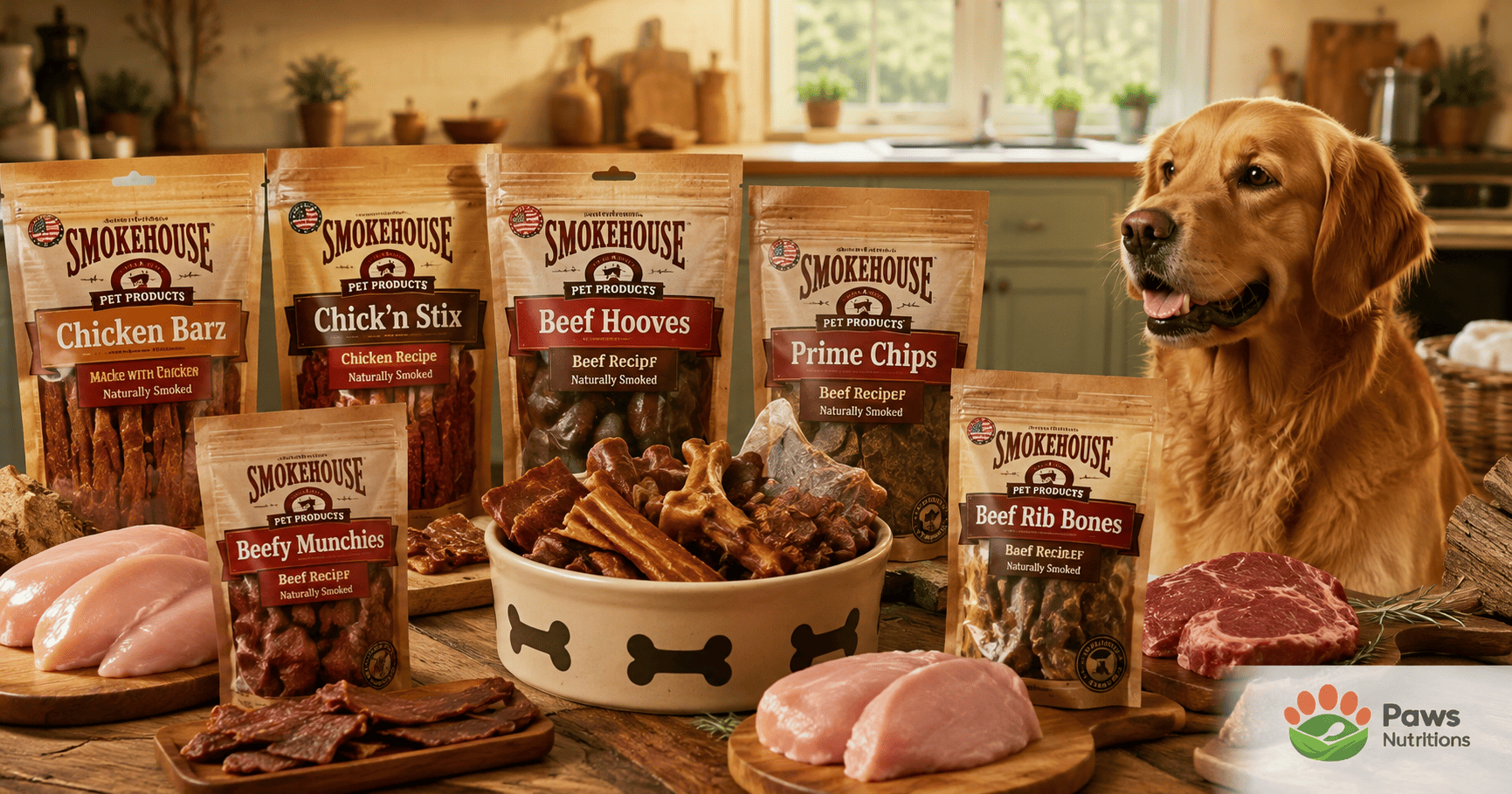
If you’ve ever tossed a bag of Chick’n Stix or a beef pizzle into your cart without a second thought, you’re not alone. Smokehouse Pet Products has been a familiar name on pet store shelves since 1991, but finding a straight answer about what’s actually in the bag, whether the brand has ever been recalled, or which retailer has the best price is surprisingly hard.
That’s exactly what this guide fixes. You’ll get a full breakdown of Smokehouse’s product lines, a dry matter basis nutrition comparison, verified recall history (including one claim on the brand’s own website that doesn’t hold up), a weight-based feeding chart, and real price-per-ounce numbers across five major retailers. No fluff, no guesswork — just what you need to decide if Smokehouse dog treats belong in your pantry.
We also pulled in real questions dog owners actually search for, checked recall databases directly instead of trusting brand copy, and compared Smokehouse against a few of its closest competitors so you can see exactly where it fits in the wider market. By the end, you’ll know which products suit your dog’s size and chewing style, how much to feed, and where to find the best price.
What Is Smokehouse Pet Products? (Brand Overview & History)
Smokehouse Pet Products, Inc. is a California-based pet treat manufacturer headquartered in Sun Valley. The company has been producing dog treats and chews since 1991, building its reputation on slow-smoked, single-ingredient products made from beef, chicken, pork, lamb, and turkey.
Unlike many newer pet treat brands that lead with trendy marketing language, Smokehouse has stuck with a fairly consistent, low-key identity for over 30 years: real meat, minimal ingredients, and an in-house smoking process it controls from start to finish. That consistency is part of the appeal for long-time customers, even if the brand’s public presence hasn’t kept pace with flashier competitors.
Founded in 1991 — Sun Valley, California Origins
Smokehouse started as a small operation focused on one idea: take simple cuts of meat, smoke them slowly, and skip the artificial extras. Over three decades, that approach turned into a catalog of more than 30 SKUs spanning treats, chews, bones, and sausage-style snacks. The company still operates its own smokehouses in Sun Valley, and it says it monitors the cooking process around the clock to keep quality consistent.
You won’t find a flashy origin story or a founder biography splashed across the brand’s website — Smokehouse keeps its public-facing story pretty bare-bones, which is honestly consistent with the no-frills approach it takes to its products. What the company lacks in storytelling, it makes up for with a genuinely long track record. Three decades in a competitive pet treat market isn’t nothing, and it suggests the core product has held up well enough to keep retailers reordering year after year.
Important — Don’t Confuse These Two Brands
Here’s a mix-up that trips up a lot of shoppers doing their own research: Smokehouse Pet Products (the dog treat maker covered in this article) is a completely different company from Smokehouse Products, which makes wood smoking chips, pellets, and BBQ accessories for grilling. The BBQ-focused Smokehouse Products was a division of Luhr Jensen & Sons before Bear Mountain Forest Products acquired it in 2007. If you’re researching either company, double-check you’re looking at the right one — search results and company directories occasionally blend the two together.
The confusion usually shows up when someone searches just “Smokehouse” plus a general term like “reviews” or “recall,” and ends up pulling information about wood pellets instead of dog treats, or vice versa. If you’re trying to verify a recall, a review, or a company address, always add “pet” or “dog treats” to your search to make sure you’re looking at the Sun Valley, California pet food manufacturer and not the barbecue accessories company.
How Smokehouse Treats Are Made
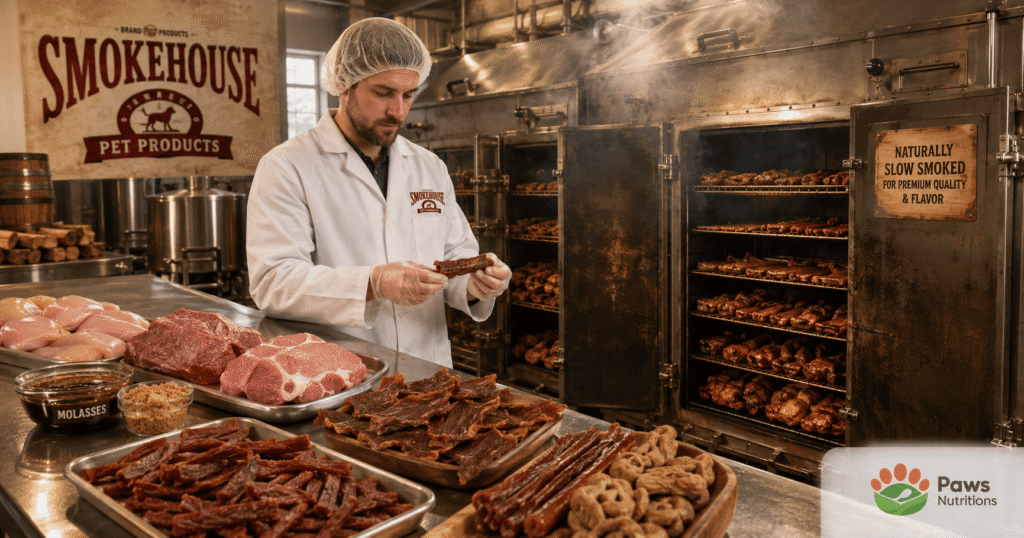
Smokehouse treats fall into two broad categories: USA-made products smoked in-house in California, and an imported line that includes items like duck chips and chicken skewers. Most of the USA-made meat treats are basted in molasses before roasting, which gives them their signature deep color and rich smell. The company markets its treats as free from added colorings, grains, and artificial preservatives, though ingredient lists do vary by SKU, so it’s worth checking the specific product you’re buying.
The molasses-basting step is worth understanding a little better, since it shows up across almost the entire USA-made lineup. Rather than using liquid smoke or artificial flavoring, Smokehouse relies on the actual smoking process plus a molasses coating to build flavor. That’s a fairly old-school approach to pet treat manufacturing, and it’s part of why the treats have such a strong smell straight out of the bag — something plenty of reviewers mention, for better or worse depending on their dog’s reaction.
Full Smokehouse Product Line Breakdown
Smokehouse’s catalog is bigger than most shoppers realize. Knowing which category a product falls into helps you match the right chew to your dog’s size, chewing style, and dietary needs. Rather than a handful of flagship products, Smokehouse spreads its lineup across five distinct categories, and each one serves a genuinely different purpose in your dog’s routine.
Use the breakdown below as a quick reference before you shop, then cross-check it against the feeding guide and pricing sections further down in this article for the full picture on any specific product you’re considering.
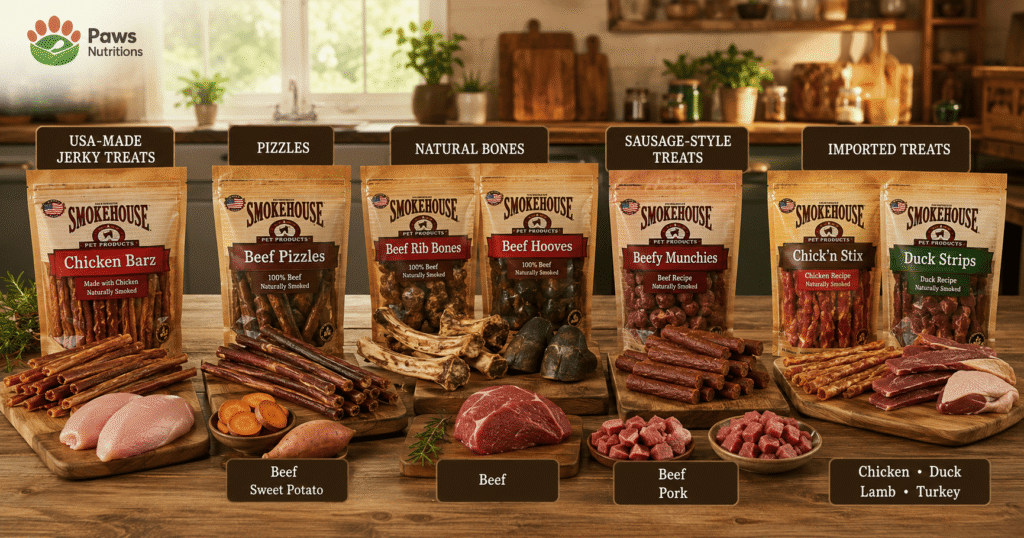
USA-Made Treats & Chews
This is the core lineup: Chicken Breast Strips, Chicken Barz, Prime Chips, Beef Hooves, Prime Slice, Toobles, Beefy Munchies, Lammy Munchies, Bacon Skin, Pig Ears, Pork Skin, and Turkey Breast. These are single-protein, jerky-style treats designed as rewards or light snacks rather than meal replacements.
Most of these come in resealable bags ranging from 4 to 16 ounces, and they’re meant to be broken or cut into smaller pieces for everyday training and reward use. Because they’re single-ingredient, they’re also one of the easier places to start if you’re doing an elimination trial to figure out which protein your dog tolerates best.
Pizzles (Steer & Pork)
Steer pizzles and pork pizzles are long-lasting chews popular with dogs who need something to work on for a while. They’re a single ingredient, which makes them a reasonable option for dogs with food sensitivities — as long as your dog tolerates beef or pork protein.
These tend to have a stronger odor than the jerky-style treats, which some owners love and others find genuinely unpleasant indoors. If smell is a dealbreaker for you, this is a category worth trying in small quantities before committing to a larger multipack.
Bones
The bone lineup includes Beef Rib Bones, Knee Bones, Knuckle Bones, Mammoth Bones, Round Bones, Shorty Mammoth, Lamb Bonz, Shank Bones, and Porky Bones. These are dense, long-lasting chews best suited to moderate chewers under supervision — more on safety considerations later in this guide.
Bone size varies dramatically across this category, from smaller knee bones suited to medium dogs up to the large mammoth bones aimed at bigger, more determined chewers. Match the bone size to your dog’s jaw strength rather than just their overall body weight, since some smaller dogs chew far more aggressively than their size would suggest.
Sausage-Style Treats
Chicken Dogs, Chick’n Stix, Beef Recipe Rolls, Beefy Dogs, and Pepperoni Stix are soft, sausage-shaped treats. They’re easy to break into smaller training-sized pieces, which makes them popular for reward-based training sessions.
This category tends to be softer and moister than the jerky-style treats, which makes it a good fit for puppies, senior dogs, or any dog that struggles with harder textures. It’s also the category most frequently mentioned in customer reviews as a training-session favorite.
Imported Line
Smokehouse’s imported products include Imported Chicken Breast Strips, Imported Chicken Barz, Duck Chips, Chicken Kabobs, Poppers, Chicken Chips, Chicken Skewers, Chix Mix, Duck Breast Tenders, Duck & Sweet Potato, Chicken & Sweet Potato Combo, and Bully Sticks. If country of origin matters to you, this is the line to check ingredient sourcing on before buying.
The imported line also introduces protein variety beyond the standard beef, chicken, pork, lamb, and turkey options — duck being the most notable addition. If your dog needs a novel protein for an elimination diet or has grown tired of the usual options, this line is worth a look, though always confirm current country-of-origin labeling directly on the package since sourcing can shift over time.
Table 1: Smokehouse Product Line Matrix
| Category | Example Products | Origin | Best Use Case |
| Jerky-style treats | Chicken Barz, Prime Chips, Turkey Breast | USA-made | Everyday reward treat |
| Pizzles | Steer Pizzle Stix, Pork Pizzle Twist | USA-made | Long-lasting chew |
| Bones | Knee Bone, Knuckle Bone, Mammoth Bone | USA-made | Supervised heavy chewers |
| Sausage-style | Chick’n Stix, Beefy Dogs, Pepperoni Stix | USA-made | Training treats |
| Imported line | Duck Chips, Bully Sticks, Chix Mix | Imported | Variety / novelty protein |
Dry Matter Basis Nutrition Breakdown
Comparing treats by the numbers on the bag alone can be misleading, since moisture content varies a lot between a soft sausage-style treat and a hard-smoked jerky strip. Converting to dry matter basis (DMB) strips out water content so you’re comparing protein and fat on equal footing.
This kind of comparison rarely shows up in typical product listings or brand marketing, which usually just repeats the guaranteed analysis printed on the bag without adjusting for moisture. If you’re trying to genuinely compare two Smokehouse products — or compare Smokehouse against a competing brand — doing the DMB math yourself (or using the estimates below) gives you a much fairer picture.
Why DMB Matters for Jerky-Style and Single-Ingredient Treats
A treat that looks lower in protein on the label might actually be higher once you remove moisture from the equation. This matters most when you’re comparing a moist sausage-style treat like Chick’n Stix against a drier product like Chicken Barz, since the raw label numbers alone won’t tell you which one delivers more protein per bite.
Protein, Fat, and Moisture Comparison Across Top SKUs
Smokehouse doesn’t publish a full DMB breakdown for its whole catalog, so the estimates below are calculated from the guaranteed analysis and typical moisture ranges for each treat category. Always check the guaranteed analysis panel on your specific bag, since formulations can shift between production runs.
As a general pattern, the driest products (bully sticks, harder jerky strips) will show the highest protein percentage once you convert to dry matter basis, while the softer, sausage-style treats look lower simply because they hold more water weight. That doesn’t make one category “better” than another — it just means you shouldn’t compare a soft treat and a dry treat using the numbers straight off the label.
Table 2: Estimated Dry Matter Basis Nutrition
| Product | As-Fed Protein | As-Fed Moisture | Estimated DMB Protein |
| Chick’n Stix | ~18% | ~25% | ~24% |
| Chicken Barz | ~35% | ~12% | ~40% |
| Prime Chips | ~32% | ~14% | ~37% |
| Bully Sticks | ~65% | ~10% | ~72% |
AAFCO & WSAVA Compliance — What Smokehouse Discloses (and Doesn’t)
Treats occupy a different regulatory lane than complete-and-balanced dog food, and it’s worth understanding that distinction before you judge Smokehouse against AAFCO nutrient profiles. A lot of the confusion pet owners run into online comes from applying complete-diet standards to a product category that was never designed to meet them.
Treats vs. Complete-and-Balanced Claims
AAFCO (Association of American Feed Control Officials) sets nutrient profiles for complete diets, not for treats. Smokehouse products are marketed and labeled as treats, not meal replacements, so they aren’t required to meet full life-stage nutrient standards. That’s normal for the category — the concern only arises if treats make up too large a share of your dog’s daily calories.
WSAVA Guidelines and the 10% Rule
The World Small Animal Veterinary Association (WSAVA) and most veterinary nutritionists recommend keeping treats under 10% of a dog’s total daily caloric intake, with the rest coming from a complete, balanced diet. Because several Smokehouse products are calorie-dense (bully sticks especially), it’s easy to go over that threshold if you’re not tracking portions.
This matters more than most pet owners realize, because treats that seem harmless in isolation can quietly throw off an otherwise well-balanced diet if you’re feeding several different types across the day. If your dog gets a jerky strip in the morning, a bully stick in the afternoon, and a sausage-style treat in the evening, those calories add up fast — worth keeping in mind if your dog is managing weight.
| Quick tip: Treats should stay under 10% of your dog’s daily calories. For a 30-lb dog eating roughly 700 calories a day, that’s about 70 calories from treats — often just one or two pieces depending on the product. |
Is Smokehouse Safe? DCM & Grain-Free Considerations
Single-ingredient meat treats like Smokehouse’s lineup generally sit outside the center of the DCM conversation, but it’s worth understanding the context if you’re feeding a grain-free diet alongside these treats. This is one of the most commonly searched safety questions for any grain-free-adjacent pet product, so it deserves a clear, direct answer rather than a vague reassurance.
Grain-Free Single-Ingredient Treats and the DCM Investigation
The FDA’s ongoing look into diet-associated dilated cardiomyopathy (DCM) has focused primarily on grain-free complete diets high in legumes like peas and lentils — not single-ingredient meat treats. Since most Smokehouse products are just meat (with molasses basting on some lines), they don’t carry the same legume-heavy profile that’s been central to the DCM discussion. Still, if your dog eats a grain-free complete diet, treats are one more thing worth mentioning to your vet during routine visits.
What Smokehouse’s Ingredient Lists Actually Show
Most Smokehouse treats list one or two ingredients: the named protein, and often molasses for basting. That simplicity is a plus for dogs with food sensitivities, but it also means there’s no added glucosamine, joint support, or functional benefit beyond the protein itself — you’re paying for a straightforward treat, not a supplement.
If you’re comparing labels across the catalog, you’ll notice the bone and pizzle products tend to be the simplest, often just a single named protein with no additional ingredients at all. The sausage-style treats and jerky strips are the ones most likely to include molasses, salt, or minor preservatives, so they’re worth a closer label check if your dog has specific dietary restrictions.
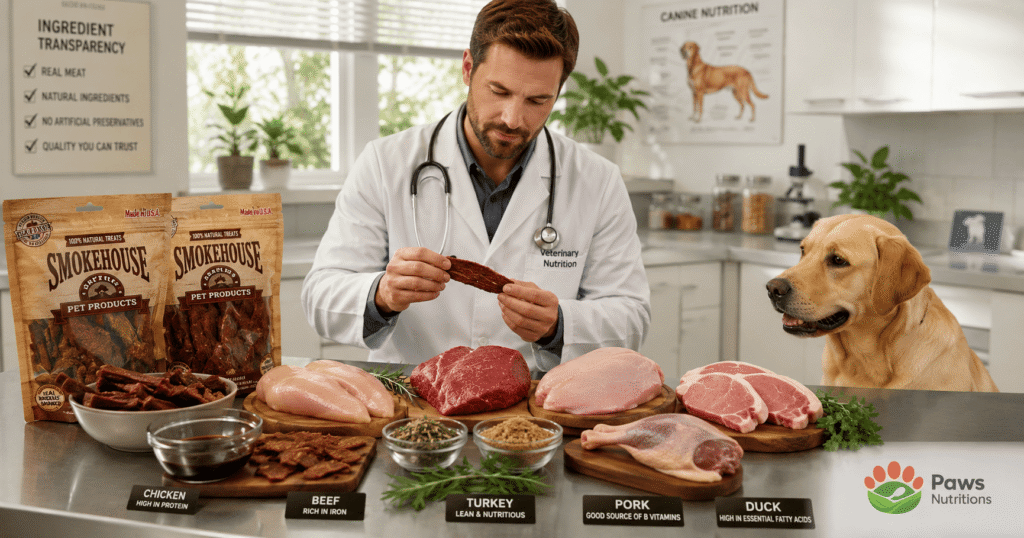
Ingredients and Additives to Watch For
Molasses-basted treats add sugar content that pure jerky products don’t have, so if your dog is managing weight or has diabetes, check the ingredient panel before choosing a basted product over a plain one. Sodium content can also run higher in cured or smoked treats, which is worth knowing if your dog has kidney or heart-related dietary restrictions.
None of this makes Smokehouse products unusual compared to other smoked meat treats on the market — the same basting and curing tradeoffs apply across most brands using similar methods. The point isn’t to avoid these treats altogether; it’s to read past the front-of-bag marketing and check the actual guaranteed analysis and ingredient panel if your dog has a specific health condition that makes sugar or sodium content relevant.
Ingredient Sourcing Transparency
Smokehouse doesn’t publish detailed sourcing certifications like “grass-fed” or “free-range” for its proteins, which puts it a step behind some of the more premium single-ingredient competitors on the transparency front. If sourcing detail is a priority for you, it’s worth reaching out to the company’s customer service line directly, since that level of detail isn’t consistently available on the packaging or the website.
Food Sensitivities and Allergy Considerations
Because most Smokehouse products are single-protein, they’re genuinely useful for dogs with suspected food allergies, as long as you already know which protein is safe for your dog. Beef and chicken are two of the more common canine allergens, so if your dog has a confirmed sensitivity to either, look toward the lamb, turkey, pork, or duck options in the imported line instead.
Verified Recall History — What Actually Happened
This is the section most competitor content skips entirely, and it’s exactly where independent verification matters most. Recall history is one of the few objective, checkable facts about any pet food brand, and it deserves more than a passing mention buried at the bottom of a product page.
The 2018 Beefy Munchies Salmonella Recall
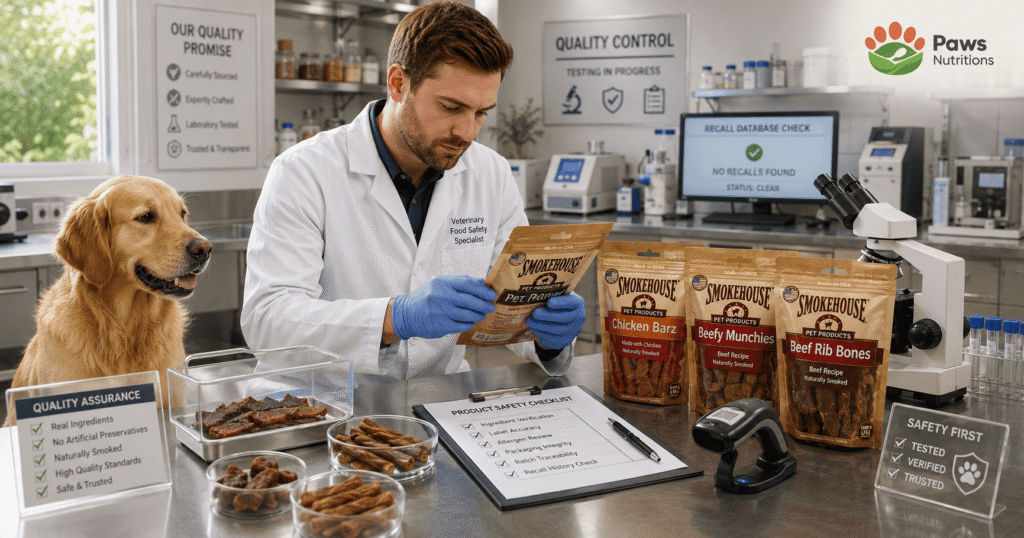
In February 2018, Smokehouse Pet Products recalled its Beefy Munchies treats after routine testing by the Colorado Department of Agriculture found Salmonella in two 4-ounce packages. The initial recall covered 4-ounce bags only, but Smokehouse voluntarily requested the FDA expand it to cover all sizes and package types — including individual bags, resealable bags, and plastic tubs sold under the name Beefy Bites. The product had been distributed nationwide. No illnesses were reported in connection with the issue, and the FDA has since marked the recall as completed and terminated.
What stands out about this recall is how the company handled the expansion. Rather than waiting for regulators to force a broader action, Smokehouse specifically requested that the FDA widen the scope beyond the original 4-ounce bags, citing an abundance of caution. That’s a meaningfully different response than simply complying with the minimum required recall, and it’s worth factoring into how you weigh the company’s overall track record on safety.
Brand-Claim Inconsistency Alert
Smokehouse’s own website states on its Health page that the company has “never had any product recalled” in the 20+ years it’s been selling treats. Based on the verified 2018 FDA recall above, that claim doesn’t hold up. It’s likely leftover copy that was never updated after the recall occurred — but it’s the kind of detail worth knowing before you take brand messaging at face value.
Is Smokehouse Currently Under Any Active Recall?
As of this article’s publication, there is no active FDA recall against Smokehouse Pet Products. The 2018 Beefy Munchies recall was resolved and closed. As always, it’s smart to check the FDA’s pet food recall page directly before purchasing if you want the most current status.
How to Check for Future Recalls Yourself
Don’t rely on brand websites alone to disclose recall history, since this article found a clear case of outdated information doing exactly the opposite. Instead, search the FDA’s pet food recall database directly, or sign up for a recall alert service that emails you when a new notice is issued. It takes less than a minute and gives you a far more reliable source than marketing copy.
Table 3: Recall Timeline
| Date | Product | Reason | Scope | Status |
| Feb 9, 2018 | Beefy Munchies (4 oz) | Possible Salmonella | Regional (WA, MI, NC, CO) | Completed |
| Feb 16-20, 2018 | Beefy Munchies / Beefy Bites (all sizes) | Possible Salmonella | Nationwide | Completed |
| Present | None | N/A | N/A | No active recall |
Weight-Based Feeding Guide
Smokehouse publishes a basic feeding chart on its own site, but it’s easy to miss and doesn’t cover every product category. Here’s an expanded version organized by dog weight and treat type.
How Many Treats Per Day by Dog Weight
Portion sizes should scale with your dog’s weight, not a flat number of pieces. Smaller dogs need far fewer pieces of dense, calorie-rich treats like bully sticks compared to lighter jerky-style snacks.
Feeding Guidance for Puppies vs. Adult Dogs
Puppies have smaller stomachs and higher sensitivity to new proteins, so introduce any Smokehouse product gradually and watch for loose stool or vomiting in the first 24 hours. Adult dogs generally tolerate the brand’s single-protein treats well, but portion control still matters, especially with calorie-dense chews.
Senior dogs are worth a special mention here too. Older dogs often have less robust digestion and may have dental issues that make harder chews like bones or thick pizzles uncomfortable or even risky. If you’re feeding an older dog, the softer sausage-style treats are usually the safer starting point, with harder chews reserved for dogs that still have strong, healthy teeth.
Table 4: Feeding Chart by Product Type & Weight
| Dog Weight | Jerky-Style Treats | Sausage-Style Treats | Bully Sticks / Pizzles |
| Under 7 lbs | 1/2 piece/day | 1-2 pieces/day | 1/4 stick, supervised |
| 7-12 lbs | 1/2-1 piece/day | 2-4 pieces/day | 1/2 stick, supervised |
| 13-20 lbs | 1 piece/day | 4-8 pieces/day | 1 stick, supervised |
| 21-50 lbs | 1-2 pieces/day | 8-15 pieces/day | 1-2 sticks, supervised |
| 51+ lbs | 2-4 pieces/day | 15-30 pieces/day | 2+ sticks, supervised |
Price-Per-Ounce Breakdown Across Retailers
Smokehouse pricing varies more than you’d expect between retailers, partly because so many third-party sellers list the same SKUs at different markups. Here’s what we found when comparing listings directly across the five retailers you’re most likely to check before buying.
Amazon Pricing
Amazon listings for Smokehouse products are fragmented across multiple third-party sellers, and prices for the same item (like 8 oz Prime Chips) ranged from roughly $19 to $33 depending on the seller. Flag this for manual verification before buying — Amazon pricing shifts frequently and isn’t centralized under one official brand storefront.
Walmart Pricing
Walmart carries a solid chunk of the Smokehouse catalog with more consistent pricing. Chicken Chips (4 oz) run around $12.99, the 8 oz version is closer to $21.64, and Knee Bones (5-pack) were listed around $23.81 on sale.
Target Pricing
Target’s Smokehouse selection is limited to just two SKUs in most stores: Chick’n Stix at $18.99 and a 5-pack of Knee Bones at $31.89.
Chewy & Pet Food Express Pricing
Pet Food Express lists Beef Pizzle Stix and Pork Pizzle Twist at $2.99 each, among the lowest per-unit prices we found for any Smokehouse product. Chewy carries additional SKUs like the 12-inch Rib Bone, though exact pricing fluctuates with promotions.
Keep in mind that Pet Food Express and similar regional retailers show inventory based on your local store or delivery zip code, so the specific SKUs available to you may differ from what showed up in our search. If you’re shopping locally, it’s worth calling ahead or checking the store locator before making a special trip for a specific Smokehouse product.
Why Prices Vary So Much Between Retailers
The biggest driver of price variation is the number of third-party sellers listing the same product, especially on Amazon, where multiple sellers can list identical Smokehouse SKUs at completely different markups. Big-box retailers like Walmart and Target tend to hold steadier, more predictable pricing since they buy and stock directly rather than hosting a marketplace of independent sellers.
Regional pet retailers like Pet Food Express often show the lowest per-unit prices on select items, likely because they’re competing directly against nearby physical pet stores rather than the broader national marketplace. If you have one nearby, it’s worth checking their listings before defaulting to Amazon or a big-box chain.
Table 5: Price-Per-Ounce Comparison
| Product | Amazon | Walmart | Target | Pet Food Express |
| Chicken Chips (4 oz) | Varies by seller | $12.99 | Not listed | Not listed |
| Chicken Chips (8 oz) | $19-$33 | $21.64 | Not listed | Not listed |
| Chick’n Stix | Varies by seller | Not listed | $18.99 | Not listed |
| Knee Bones (5-pack) | Not listed | $23.81 | $31.89 | Not listed |
| Pizzle Stix | Varies by seller | Not listed | Not listed | $2.99 |
Smokehouse Pet Products vs. Competing Brands
Smokehouse isn’t the only single-ingredient treat brand on the shelf. Here’s how it stacks up against a few common alternatives shoppers consider, so you can decide whether it’s genuinely the right fit or just the most familiar name in the aisle.
Smokehouse vs. Redbarn
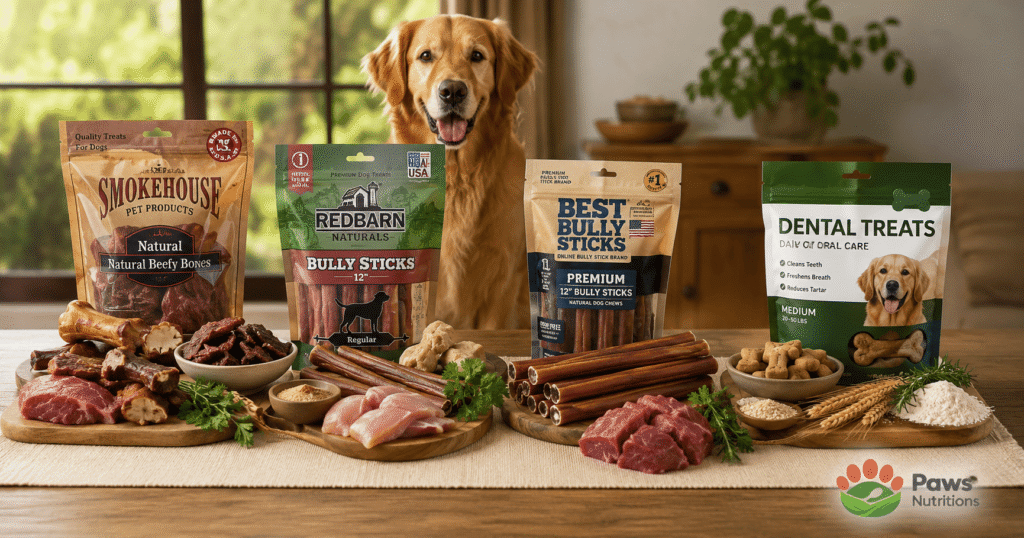
Redbarn offers a broader range of functional treats (dental chews, joint-support formulas) alongside its single-ingredient line, while Smokehouse stays focused on straightforward smoked meat products without added supplements.
Smokehouse vs. Best Bully Sticks
Best Bully Sticks specializes almost entirely in bully sticks and offers more sourcing transparency (grass-fed, free-range claims) than Smokehouse’s general bully stick line, though Smokehouse tends to price lower per stick.
Smokehouse vs. Mainstream Chews (Milk-Bone, Greenies)
Milk-Bone and Greenies lean into dental-health formulations and biscuit-style textures, which is a different category entirely from Smokehouse’s meat-based chews. If dental cleaning is your main goal, those brands are more directly formulated for it; if you want a simple, high-protein reward, Smokehouse fits that niche better.
It’s worth thinking about these brands as solving different problems rather than competing head-to-head. A lot of pet owners actually rotate between categories — a dental biscuit brand for daily oral care, and a Smokehouse-style protein chew for weekend enrichment or a longer-lasting reward. Treating this as an either-or choice misses how most multi-treat households actually shop.
Table 6: Competitor Comparison
| Brand | Focus | Ingredient Simplicity | Price Positioning |
| Smokehouse Pet Products | Single-ingredient smoked treats | High | Mid-range |
| Redbarn | Functional + single-ingredient | Medium | Mid-range |
| Best Bully Sticks | Bully sticks specialist | High | Premium |
| Milk-Bone / Greenies | Dental health biscuits | Low | Budget-mid |
Real Customer Reviews — What Owners Actually Say
Reviews for Smokehouse products are scattered across Amazon, Walmart, Yelp, and independent review platforms rather than centralized in one place, so we pulled together the recurring themes rather than relying on any single source’s star rating, which can be skewed by a small number of reviews on any individual SKU.
Positive Themes
Owners consistently mention that dogs respond enthusiastically to the smell and taste of Smokehouse treats, and several reviewers highlight the USA-made sourcing and simple ingredient lists as reasons they keep buying. The soft, sausage-style treats also get praise for being easy to break into small training-sized pieces.
Durability comes up often too, particularly for the bone and pizzle categories — several long-time customers describe these as reliable options that keep a dog occupied far longer than cheaper alternatives, which they see as good value even at a slightly higher per-unit price.
Common Complaints
The most frequent complaint centers on product consistency — some reviewers reported treats that arrived unusually greasy or with a strong odor that their dogs actually avoided, which is the opposite of the typical praise. This kind of variability suggests checking reviews for the specific SKU and seller you’re buying from, especially on marketplaces with multiple third-party listings.
A smaller number of reviews also mention packaging issues, like bags arriving without a proper seal or treats that felt stale on arrival. These complaints tend to cluster around specific third-party Amazon sellers rather than the product itself, which reinforces the earlier point about verifying the seller before you buy, not just the brand.
Safety-Related Owner Concerns
A recurring theme among dog owners discussing chew treats generally (not unique to Smokehouse) is concern about overconsumption and choking risk with bone-style products. Several forum and Q&A threads raise questions about how many pieces are safe per sitting and whether bones can splinter — both good reasons to stick to the weight-based feeding guide above and to supervise your dog with any bone or pizzle product.
It’s also worth noting a pattern in Amazon and Walmart Q&A sections: shoppers frequently ask about packaging (whether treats are individually wrapped, how they’re sealed for freshness) more than they ask about ingredients. That tells you something about where buyer uncertainty actually sits — it’s less about “is this a good treat” and more about basic practical questions the product listings themselves don’t always answer clearly.
Reader-Reported Concern About Smokehouse Chicken Skewers
A reader recently contacted us with a serious concern about Smokehouse Chicken Skewers after experiencing the loss of two unrelated dogs. According to the reader, both dogs had been fed these treats and later developed a cancer involving an unidentified toxin. The dogs reportedly passed away only three weeks apart, and their veterinarian questioned whether a dietary exposure could have played a role.
The reader also reported that their veterinarian, who has approximately 55 years of experience, specifically asked whether the dogs had eaten products from China. The owner was surprised to learn that the Chicken Skewers were identified as a product of China. Because this report involves two unrelated dogs and a veterinarian’s concern about a possible common exposure, we believe it deserves attention.
However, this is an individual reader report, not a confirmed finding that Smokehouse Chicken Skewers caused cancer or toxin-related illness. A report that an illness occurred after consuming a particular treat doesn’t, by itself, prove that the treat caused the illness. Other exposures, underlying conditions, environmental factors, or unrelated causes could also be involved.
For that reason, we don’t want to make a claim that the available information cannot support. Instead, we’re documenting the concern and encouraging further investigation. If you have experienced a suspected adverse reaction to Smokehouse dog treats, keeping the original packaging can be extremely helpful.
If you still have the product, save the lot or batch number, UPC, expiration date, country-of-origin information, purchase receipt, and any remaining treats. Veterinary records, pathology reports, and toxicology results may also provide useful information. These details can help identify whether multiple reports involve the same product or manufacturing lot.
Pet owners who believe their dog has experienced a serious reaction should also consider reporting the event to the appropriate regulatory authorities and contacting the manufacturer. When making a report, provide as much specific information as possible, including the exact product, lot number, feeding history, symptoms, diagnosis, and relevant veterinary documentation.
Update: We are currently treating this as a reader-reported safety concern rather than a confirmed product-related finding. If additional verifiable information becomes available, including product lot details or veterinary documentation, this section can be updated accordingly.
Are Smokehouse Treats Safe for Puppies and Small Breeds?
Size matters as much as ingredients when picking the right Smokehouse product for a puppy or small-breed dog.
Size-Appropriate Product Picks
Smaller, softer options like Chick’n Stix or thin jerky strips are generally easier for puppies and toy breeds to manage than dense bones or thick pizzles, which are better suited to medium and large dogs with stronger jaws.
Supervision Guidance for Bones and Pizzles
Always supervise any dog — but especially puppies — with bone-style or pizzle chews. Remove and discard any piece that’s been chewed down small enough to swallow whole, and never leave a dog unattended with a hard chew for extended periods.
A good rule of thumb: if you wouldn’t feel comfortable leaving the room for ten minutes while your dog has the chew, don’t. Puppies especially can go from calmly gnawing to aggressively tearing off chunks in a matter of seconds once teething discomfort kicks in, so keep an eye on the pace of chewing, not just the size of the piece.
Where to Buy Smokehouse Pet Products (Best Value Guide)
Based on the pricing comparison above, your best move depends on what you’re prioritizing.
Best Retailer by Price
For pizzle-style chews, Pet Food Express offered the lowest per-unit price we found at $2.99. For jerky-style treats like Chicken Chips, Walmart consistently beat Amazon’s third-party seller pricing.
Target’s selection is limited enough that it’s rarely your cheapest option overall, but it can be convenient if you’re already shopping there for other supplies and just need one or two specific SKUs like Chick’n Stix or Knee Bones.
Best Retailer by Availability & Shipping
Amazon and Chewy offer the broadest SKU availability and fastest shipping options if you can’t find a specific product locally, though you should always double-check per-seller pricing on Amazon before checking out.
If you’re buying in bulk or restocking regularly, it’s worth comparing the per-ounce price rather than the sticker price on the front of the listing. A smaller bag at a lower upfront cost can easily work out more expensive per ounce than a larger bag from a different retailer — the comparison table above is a good starting reference, but pricing shifts often enough that it’s worth a quick recheck before every large order.
Final Verdict — Is Smokehouse Pet Products Worth Buying?
Smokehouse earns its long shelf life in pet stores honestly: simple ingredient lists, USA-made options, and a catalog wide enough to fit almost any dog’s chewing style. The 2018 recall was handled transparently and has stayed resolved since, though the outdated “never recalled” claim on the brand’s own site is worth noting if accuracy matters to you.
Weighed against the competitors covered in this guide, Smokehouse holds its own on price and ingredient simplicity, even if it lags behind on sourcing transparency and functional add-ons like joint or dental support. For most owners looking for a reliable, no-frills protein treat, that tradeoff is a reasonable one.
Who It’s Best For
Dog owners who want straightforward, single-protein treats without added fillers, and who are comfortable portioning treats themselves rather than relying on packaging guidance alone.
Smokehouse also makes sense if you’re feeding a multi-dog household with a range of sizes, since the catalog spans everything from small training-sized sausage treats up to large mammoth bones for bigger, more determined chewers — you can generally find a size-appropriate option across the whole lineup without switching brands.
Who Should Look Elsewhere
If you want dental-specific formulations, added joint supplements, or fully transparent sourcing certifications (grass-fed, free-range), brands like Redbarn or Best Bully Sticks may be a better fit for those specific needs.
Owners who prioritize odor-free treats for indoor use may also want to sample a small bag before committing, since the smoking and molasses-basting process does produce a noticeably strong smell on several products in the lineup.
Frequently Asked Questions
Has Smokehouse Pet Products ever been recalled?
Yes. In February 2018, Smokehouse recalled all sizes of its Beefy Munchies treats over possible Salmonella contamination. The recall is fully resolved.
Is Smokehouse Pet Products the same company as Smokehouse Products (BBQ smoking chips)?
No. Smokehouse Pet Products makes dog treats in Sun Valley, CA. Smokehouse Products makes wood smoking chips for grilling and is a separate company.
How many Smokehouse treats can I give my dog per day?
It depends on your dog’s weight and the treat type — check the feeding chart above, and keep treats under 10% of daily calories.
Are Smokehouse dog treats made in the USA?
Most of the core lineup is USA-made in Sun Valley, California, though Smokehouse also sells a separate imported product line.
Are Smokehouse Chick’n Stix individually wrapped?
No. Chick’n Stix and similar bulk treats typically come loose in a resealable bag, not individually wrapped.
Are Smokehouse bully sticks and bones safe for aggressive chewers?
They can be, but always supervise your dog and remove any piece small enough to swallow whole to avoid choking risk.
Key Takeaways
- Smokehouse Pet Products has made single-ingredient dog treats since 1991 in Sun Valley, California.
- It’s a completely different company from Smokehouse Products, the BBQ smoking chip brand.
- The brand had one verified nationwide recall in 2018 (Beefy Munchies, Salmonella) — now fully resolved.
- Smokehouse’s own website inaccurately claims it has never been recalled.
- Pricing varies significantly by retailer — compare before buying, especially on Amazon.
- Keep treats under 10% of your dog’s daily calories and always supervise bone-style chews.
Disclaimer:This article is not sponsored, not affiliated, and not a paid advertisement. It is written for educational and informational purposes only. Any brand names, product links, or retailer mentions are included solely for reader reference and comparison — we have no partnership, financial relationship, or affiliation with Smokehouse Pet Products or any retailer mentioned.

A dedicated writer and digital enthusiast committed to creating high-quality, informative, and reader-focused content. Through thoughtful research and clear communication, he aims to deliver valuable insights that help readers navigate the ever-changing digital landscape.
My 2 dogs recently passed away 3 weeks apart. We were feeding the Smokehouse Skewers with chicken. Although the bags are visually appealing and state made with chicken roasted to perfection, my dogs developed a cancer with an unknown toxin. After thousands of dollars spent for the care, our vet asked if we fed them anything from China. to our surprised these treats are a product of China USDA inspected. My vet said he never saw this type of cancer toxin in his 55 years as a vet with 2 dogs that are not related by birth. I hope you can research this and save some other pet owner from this horrible heartbreak.
I’m so sorry for your loss. Losing two dogs only three weeks apart is heartbreaking, and I can understand why you would want other pet owners to know about what happened.
Thank you for taking the time to share this here, especially because the specific product you mentioned—Smokehouse Chicken Skewers—is part of the brand’s imported product line. That is something I believe deserves careful attention and further investigation.
I want to be very careful about drawing a direct connection between the treats and the cancer/toxin you described without veterinary, pathology, or laboratory evidence establishing that link. At the same time, I don’t think a report like yours should simply be dismissed. Two unrelated dogs developing a serious condition, combined with your veterinarian specifically asking about dietary exposure, is important information to document.
My article already discusses Smokehouse’s recall history and safety concerns, but your experience highlights an additional question that deserves investigation: whether there are any documented problems associated with this specific product, its manufacturing lot, or its ingredients/sourcing.
If you still have the packaging, I would strongly recommend keeping it. The **lot/batch number, UPC, expiration date, and country-of-origin information** could be particularly valuable. Your dogs’ veterinary records, pathology reports, and any toxicology results may also help determine whether there is a common exposure worth investigating.
I would also encourage you to report the suspected adverse event to the FDA and to contact Smokehouse directly with the product and lot information. If you are comfortable sharing the exact lot number and the veterinary diagnosis here, I would be very interested in looking into the issue further.
Again, I’m truly sorry you had to go through this. Your warning may help other pet owners ask better questions about the treats they give their dogs, and I appreciate you bringing the experience to my attention.