
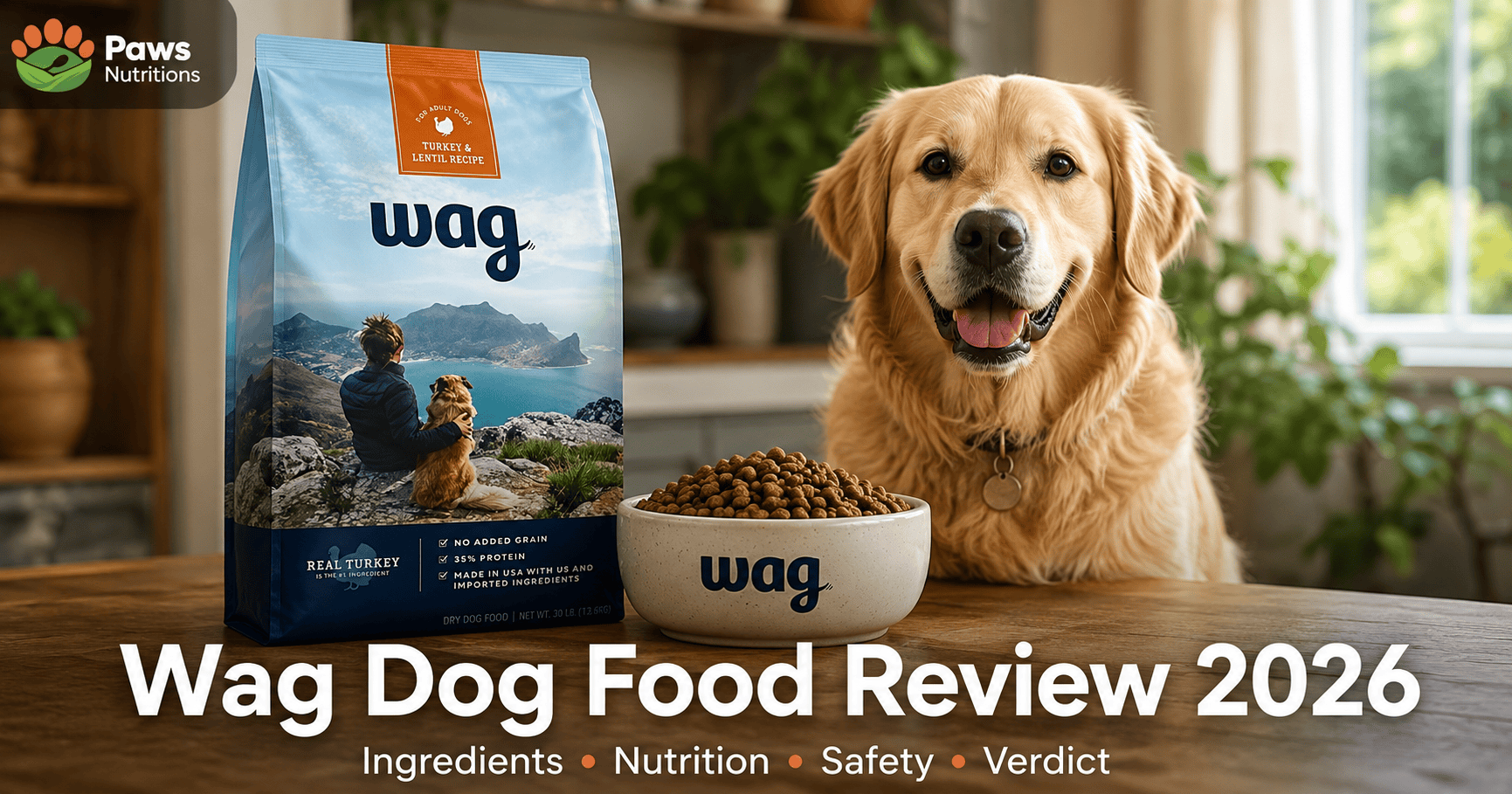
If you’ve been shopping for dog food on Amazon lately, chances are you’ve come across Wag. It’s affordable, it’s convenient, and it claims to offer real nutrition without the premium price tag. But does it actually deliver? That’s exactly what this wag dog food review is here to answer — with no fluff, no brand bias, and no shortcuts.
In this guide, you’ll find a complete breakdown of Wag’s ingredients, nutritional value, recall history, and how it stacks up against brands like Blue Buffalo and Purina Pro Plan. Whether you’re feeding a puppy, an aging senior dog, or a pup with a sensitive stomach, this review covers everything you need to make a smart, confident choice.
What Is Wag Dog Food?
Wag is Amazon’s private-label pet food brand, launched to give dog owners a budget-friendly alternative that still checks the boxes most responsible owners care about — real protein sources, AAFCO compliance, and made in the USA manufacturing. It sits in an interesting middle ground: not a budget store brand, but not a premium specialty brand either.
What makes Wag worth examining closely is the sheer volume of dogs eating it. Because it’s sold exclusively through Amazon’s ecosystem, it moves a lot of units. That makes getting the facts right about this brand genuinely important.
Who Makes Wag Dog Food?
Wag is an Amazon private-label brand, which means Amazon contracts with third-party manufacturers to produce the food under the Wag name. Unlike brands such as Purina or Hill’s, which have dedicated research teams and feeding trial programs, Wag relies on its contract manufacturers’ existing infrastructure and AAFCO compliance protocols.
Where Is Wag Dog Food Made?
Wag dog food is manufactured in the United States, which is a meaningful reassurance for many dog owners. The packaging states “Made in the USA,” though Wag does source some ingredients globally — common across virtually every major pet food brand. The food is produced under U.S. FDA regulations and follows current Good Manufacturing Practice (cGMP) standards.
Is Wag Dog Food AAFCO Approved?
Yes — Wag dog food carries an AAFCO nutritional adequacy statement, one of the most important things to look for on any dog food label. AAFCO, the Association of American Feed Control Officials, sets the minimum nutritional standards for complete and balanced pet food in the United States. Always check the specific bag to confirm the AAFCO statement matches your dog’s current life stage.
Wag Dog Food Product Line Overview
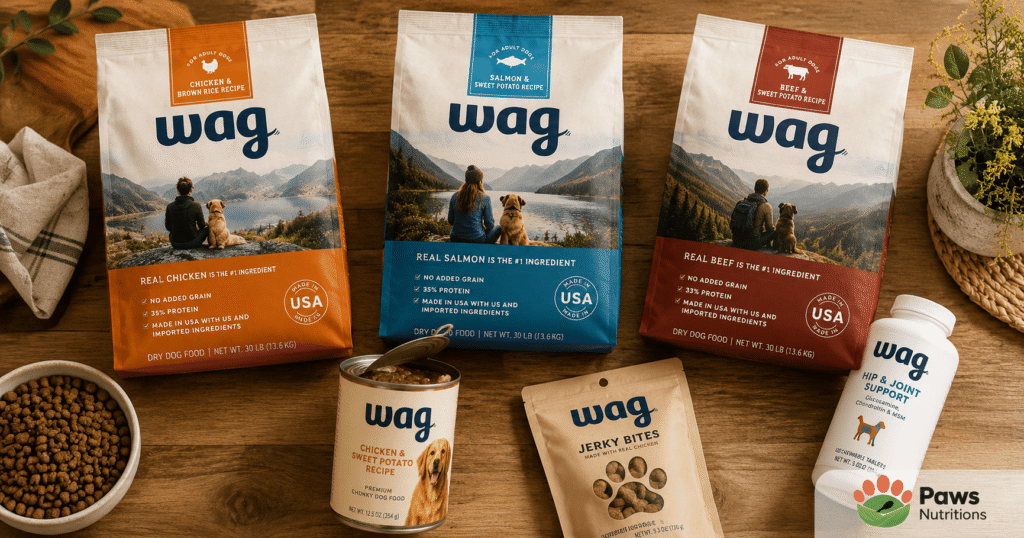
Wag offers a focused lineup of dry kibble, wet canned food, and a small selection of treats and supplements. The core recipes cover the most common dietary needs and preferences.
Wag Dry Dog Food
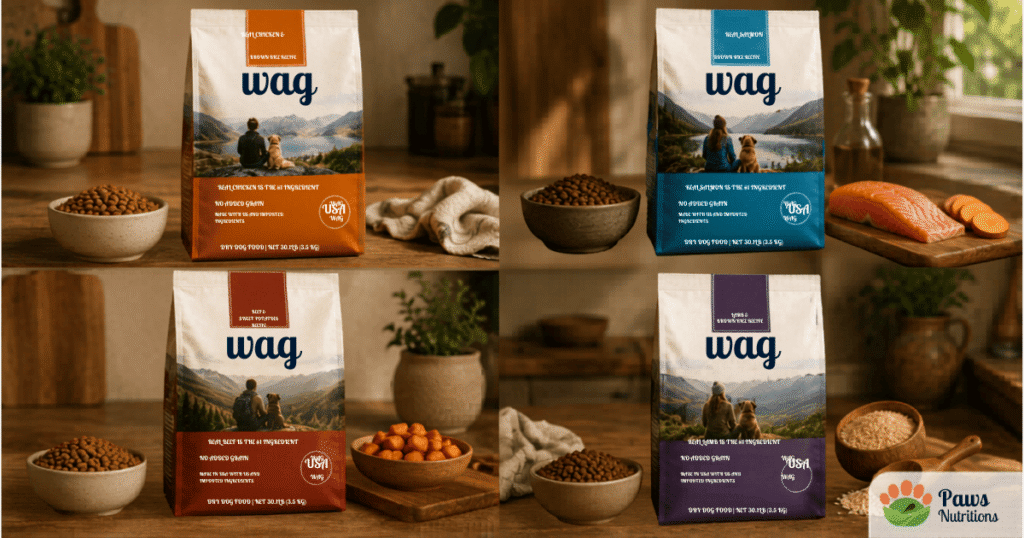
- Chicken & Brown Rice — the flagship and most popular formula
- Salmon & Sweet Potato — grain-free option rich in omega-3 fatty acids
- Beef & Sweet Potato — grain-free with a red meat protein base
- Turkey & Lentil — grain-free with a legume-heavy carbohydrate profile
- Lamb & Brown Rice — grain-inclusive formula suited for dogs with chicken sensitivities
Wag Wet Dog Food
Wag’s wet food line offers canned options that complement the dry kibble or work as standalone meals. Wet food is particularly useful for dogs that need extra hydration, picky eaters who reject dry kibble, or older dogs with dental issues. Wet food generally contains 75-82% moisture content, which supports kidney health and urinary tract function.
Wag Dog Treats and Supplements
- Probiotic soft chews to support gut microbiome balance
- Dental treats for tartar control and oral hygiene
- Joint support supplements with glucosamine and chondroitin for mobility
Wag Dog Food Ingredients Review (Deep Dive)
This is where most reviews go shallow — and where this one goes deeper. Understanding what’s actually in Wag dog food, and why each ingredient matters, gives you real information to evaluate.
First 5 Ingredients Analyzed
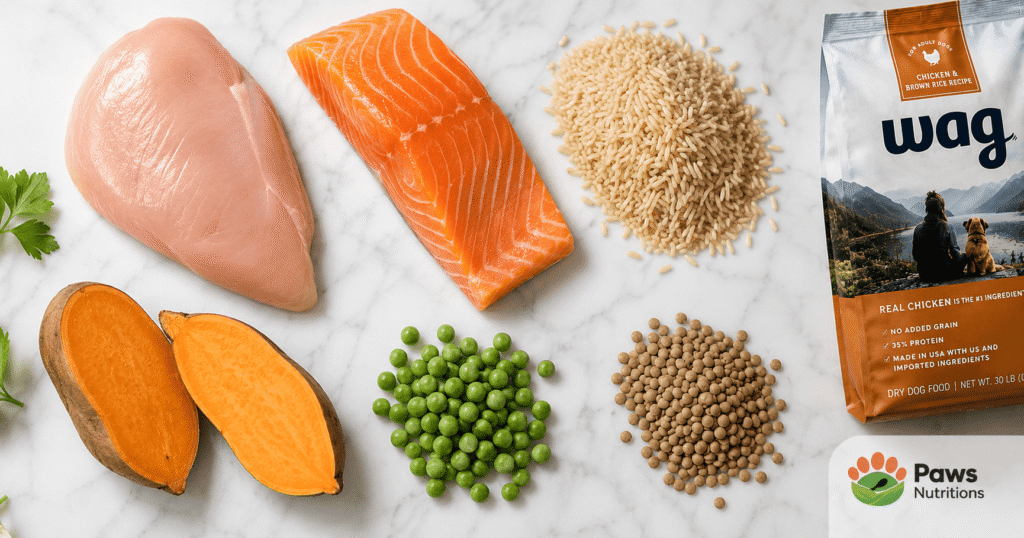
1. Chicken Meal / Deboned Salmon / Beef — Named animal proteins lead each recipe. Chicken meal is a concentrated protein source with moisture removed. Deboned salmon brings protein and natural omega-3 fatty acids. Beef provides a hearty red meat alternative.
2. Brown Rice or Sweet Potato — Grain-inclusive formulas use brown rice as a digestible, energy-rich carbohydrate. Sweet potato in grain-free recipes provides fiber and beta-carotene.
3. Peas and Lentils — Several Wag formulas include peas and lentils as significant ingredients, contributing fiber and plant-based protein. See the DCM section below for important context.
4. Chicken Fat — A well-regarded fat source rich in linoleic acid, an essential omega-6 fatty acid that supports skin health and coat shine.
5. Natural Flavors and Supplements — Natural flavors enhance palatability. The supplement blend typically includes vitamins E and C, zinc, selenium, and chelated minerals for improved mineral bioavailability.
Protein Sources and Bioavailability
Protein bioavailability refers to how efficiently a dog’s digestive system can break down and absorb protein from food. Animal-based proteins like chicken meal, salmon, and beef have significantly higher bioavailability than plant proteins from peas or lentils. Wag’s formulas correctly lead with animal proteins. The concern is in grain-free recipes where legumes contribute a meaningful share of total protein — the actual usable protein may be lower than the guaranteed analysis suggests.
Grain-Inclusive vs. Grain-Free Formulas
The grain-inclusive formulas — Chicken & Brown Rice and Lamb & Brown Rice — use brown rice as a digestible, energy-rich carbohydrate with a strong track record in canine nutrition. The grain-free formulas use sweet potatoes, peas, and lentils. Grain-free isn’t inherently harmful, but the FDA has been investigating a potential link between grain-free diets high in legumes and a serious heart condition called dilated cardiomyopathy (DCM).
Taurine, Lentils & DCM Risk Explained
Taurine is an amino acid critical for heart muscle function in dogs. Starting in 2018, the FDA began investigating a potential link between grain-free dog foods — particularly those high in peas, lentils, potatoes, and legumes — and increased cases of canine dilated cardiomyopathy (DCM). DCM causes the heart to enlarge and weaken and can be fatal if undetected.
Wag’s Turkey & Lentil and Salmon & Sweet Potato formulas contain significant amounts of peas and lentils. If you have a large breed or a breed predisposed to heart issues (Golden Retrievers, Dobermans, Great Danes), the grain-inclusive formulas are the safer choice until more research is available.
Omega Fatty Acids, DHA & EPA
Wag’s salmon formula naturally delivers DHA (docosahexaenoic acid) and EPA (eicosapentaenoic acid), two omega-3 fatty acids with proven benefits. DHA supports brain development and cognitive function — especially important in puppies. EPA has strong anti-inflammatory properties that benefit joint health, heart health, and immune response. Even non-salmon Wag formulas often include added fish oil or flaxseed as omega-3 sources.
Added Vitamins, Minerals & Antioxidants
Wag rounds out its formulas with a solid vitamin and mineral package. Most recipes include blueberries and cranberries as natural antioxidant sources. Blueberries provide vitamin C and anthocyanins that support immune function. The mineral package includes zinc for skin and coat health, selenium for immune support, and vitamin E as a fat-soluble antioxidant.
Wag Dog Food Nutritional Analysis
Guaranteed Analysis Breakdown
| Formula | Crude Protein | Crude Fat | Crude Fiber | Moisture |
| Chicken & Brown Rice | 27% | 15% | 4% | 10% |
| Salmon & Sweet Potato | 28% | 15% | 5% | 10% |
| Beef & Sweet Potato | 27% | 15% | 5% | 10% |
| Turkey & Lentil | 26% | 14% | 5% | 10% |
| Lamb & Brown Rice | 26% | 14% | 4% | 10% |
Calorie Content Per Cup
Metabolizable energy (ME) tells you how many calories your dog actually absorbs from the food.
| Formula | Calories per Cup (approx.) |
| Chicken & Brown Rice | 370 kcal |
| Salmon & Sweet Potato | 365 kcal |
| Beef & Sweet Potato | 380 kcal |
| Turkey & Lentil | 355 kcal |
| Lamb & Brown Rice | 360 kcal |
Is Wag Dog Food Nutritionally Balanced?
For healthy adult dogs, yes. Wag’s formulas meet AAFCO minimum requirements for adult maintenance. However, ‘nutritionally balanced’ doesn’t mean ‘nutritionally optimal.’ Wag doesn’t invest in the extensive feeding trials that brands like Purina use to validate their formulas in real-world conditions. Most Wag formulas are formulated by nutrient analysis rather than actual feeding trials.
Digestive Health & Gut Support
Several Wag formulas include prebiotic fiber from sources like chicory root or inulin, which feed beneficial gut bacteria and support a healthy digestive microbiome. The addition of dried Lactobacillus cultures in some formulas adds probiotic support directly to the kibble, though heat from processing can reduce viability of live cultures.
Best Wag Dog Food Recipes Reviewed
Wag Chicken & Brown Rice Recipe Review
Chicken meal leads the ingredient list, delivering concentrated animal protein. Brown rice provides a digestible, energy-stable carbohydrate that works well for the majority of dogs. The recipe avoids legumes as primary ingredients, making it the safer choice from a cardiac health standpoint. Nutrition profile: 27% protein, 15% fat, 370 kcal/cup. Best for healthy adult dogs without food sensitivities.
Pros: Clean ingredient list, good digestibility, widely available, affordable price point.
Cons: Not ideal for dogs with chicken allergies; may not be rich enough in DHA for puppies.
Wag Salmon & Sweet Potato Recipe Review
The salmon formula is Wag’s standout option for skin and coat health. Deboned salmon as the first ingredient brings in both quality animal protein and natural EPA and DHA. Sweet potato serves as the primary carbohydrate, providing fiber and natural beta-carotene. Best for dogs with dull coats, dry or itchy skin, or those with mild sensitivities to chicken. Note: this formula contains peas, so DCM considerations apply.
Wag Beef & Sweet Potato Recipe Review
Beef as the lead protein gives this formula strong palatability. Combined with sweet potato for digestible energy, this is a solid grain-free option for dogs that thrive on variety. Beef provides iron, zinc, and B vitamins at naturally higher levels than poultry. The slightly higher fat content makes it a better fit for active or working dogs.
Wag Turkey & Lentil Recipe Review
Turkey is a lean, digestible protein that works well for dogs needing a lower-fat diet. However, this formula has the highest lentil concentration in the Wag lineup, making DCM concerns most relevant here. For large breeds or breeds predisposed to DCM, approach this formula with the most caution.
Wag Lamb & Brown Rice Recipe Review
Lamb is an excellent alternative protein for dogs that have developed sensitivities to chicken or beef. Paired with brown rice rather than legumes, this formula sidesteps the DCM concern entirely. Lamb provides a good amino acid profile, including higher concentrations of carnitine, which supports fat metabolism. The brown rice base is gentle on digestion.
Wag Dog Food for Different Dogs
Best Wag Food for Puppies
Puppies need more protein, DHA, calcium, and phosphorus to support rapid growth, brain development, and skeletal formation. The AAFCO statement on a puppy food should say ‘formulated for growth’ or ‘all life stages.’ The Chicken & Brown Rice formula is often the best starting point for puppies from Wag’s lineup. Consider adding a DHA supplement or fish oil if your vet recommends it.
Best Wag Food for Adult Dogs
The majority of Wag’s lineup is designed for adult maintenance. The Chicken & Brown Rice and Lamb & Brown Rice formulas both make strong everyday choices for healthy adult dogs without special dietary needs. Rotating proteins is fine — but always use a gradual transition to avoid digestive upset.
Best Wag Food for Senior Dogs
Senior dogs need lower calorie density, higher digestibility, joint support from glucosamine and chondroitin, and antioxidant support for cellular aging. Wag doesn’t currently offer a dedicated senior formula. The Chicken & Brown Rice formula at slightly reduced portions, paired with a joint supplement, is a reasonable approach. Dogs over seven with known health conditions generally need veterinary-formulated diets.
Best Wag Food for Small Breeds
Small breed dogs have faster metabolisms and different calorie-per-pound needs than large breeds. Wag’s standard kibble size is manageable for most small breeds, but the formulas aren’t specifically designed for small breed physiology.
Best Wag Food for Large Breeds
Large breed dogs need controlled calcium and phosphorus levels and are the demographic with the greatest cardiac risk in the DCM discussion. For large breed adult dogs, the grain-inclusive formulas — Chicken & Brown Rice, Lamb & Brown Rice — are the safest Wag options. Add a joint health supplement as your dog moves past the five-year mark.
Best Wag Food for Sensitive Stomachs
The Lamb & Brown Rice formula is Wag’s best option for digestive sensitivity — it uses a less common protein, a clean carbohydrate, and avoids the heavy legume load of some grain-free recipes. The Salmon & Sweet Potato formula can also work well for dogs with chicken sensitivities.
Wag Dog Food Feeding Guide
How Much Wag Dog Food Should You Feed?
| Dog Weight | Puppy (cups/day) | Adult (cups/day) | Senior (cups/day) |
| 5-10 lbs | 1/2 – 3/4 | 1/3 – 1/2 | 1/4 – 1/3 |
| 11-25 lbs | 3/4 – 1.5 | 1/2 – 1 | 1/3 – 3/4 |
| 26-50 lbs | 1.5 – 2.5 | 1 – 2 | 3/4 – 1.5 |
| 51-75 lbs | 2.5 – 3.5 | 2 – 3 | 1.5 – 2 |
| 76-100 lbs | 3.5 – 4.5 | 3 – 4 | 2 – 3 |
Monitor your dog’s body condition score — you should be able to feel their ribs without pressing hard, but not see them. Adjust portions every two to four weeks based on what you observe.
7-Day Transition Guide to Wag Food
- Days 1-2: 25% Wag, 75% current food
- Days 3-4: 50% Wag, 50% current food
- Days 5-6: 75% Wag, 25% current food
- Day 7 onwards: 100% Wag
If your dog shows digestive upset at any stage — loose stools, vomiting, or refusal to eat — slow down the transition by extending each phase by a day or two.
Signs the Transition Is Going Well (or Not)
Signs it’s going well: Firm, well-formed stools after days 3-4; good appetite; normal energy levels; no skin reactions.
Signs to watch for: Loose stools beyond day 5; excessive gas or bloating; vomiting more than once; itching around ears or paws; sudden lethargy.
Wag Dog Food Pros and Cons
Pros
- Affordable — often 20-40% cheaper than comparable Blue Buffalo or Taste of the Wild products
- High animal protein content that leads ingredient lists
- Made in the USA manufacturing
- Multiple recipe options to accommodate different sensitivities
- Convenient Amazon purchasing with Subscribe & Save discounts
- AAFCO-compliant formulas for adult maintenance and all life stages
Cons
- Heavy use of peas and lentils in grain-free formulas raises DCM concerns for at-risk breeds
- Limited transparency regarding manufacturing facilities, feeding trials, or research programs
- Some reports of crumbly kibble texture, particularly in older bags
- No dedicated senior or large breed formula in the current lineup
- Fewer veterinary endorsements than WSAVA-recognized brands
- No full feeding trials conducted — AAFCO compliance achieved through formulation analysis
Wag Dog Food Recall History
Has Wag Dog Food Ever Been Recalled?
As of 2026, Wag dog food has not been subject to any FDA-initiated recalls. This is a positive mark for the brand, particularly given its relatively short time in the market compared to legacy brands with decades of recall history.
Complete Recall Timeline
| Year | Product | Reason | Outcome |
| No recalls on record | — | — | — |
Always check the FDA’s pet food recall database and the Dog Food Advisor recall page for the most current information. A clean recall record should be kept in perspective — it reflects Wag’s relatively short market history. Continue monitoring FDA recall alerts for all pet food brands you feed.
Wag Dog Food vs. Competitors
Wag vs. Blue Buffalo
Both brands lead with named animal proteins and hit the 25-28% crude protein range for standard dry formulas. Blue Buffalo adds their proprietary LifeSource Bits blend of antioxidants, vitamins, and minerals. The practical nutritional difference is modest. Price is where Wag clearly wins — Blue Buffalo typically costs 30-50% more per pound for comparable formulas.
Best choice: Budget-conscious owners will get comparable nutritional value from Wag. Blue Buffalo makes more sense for owners who value brand transparency, established reputation, and specific lines like Blue Buffalo Basics or Wilderness.
Wag vs. Purina Pro Plan
Purina Pro Plan is one of a small number of brands consistently recommended by veterinary nutritionists. It’s extensively tested through feeding trials, has a strong research program, and is on WSAVA’s recommended manufacturer list. Wag doesn’t match this level of veterinary credibility. For dogs with health conditions or in high-risk demographics, Purina Pro Plan is the superior choice.
Wag vs. Taste of the Wild
Both Taste of the Wild and Wag’s grain-free formulas are legume-heavy, meaning DCM considerations apply equally to both. Taste of the Wild uses more exotic proteins — bison, venison, wild boar — for variety. Pricing is comparable, with Wag often slightly cheaper through Subscribe & Save.
Full Comparison Table
| Brand | Protein % | Grain-Free | AAFCO | Price/lb | Best For |
| Wag | 26-28% | Yes | Yes | $1.80-2.20 | Budget, healthy adults |
| Blue Buffalo | 24-28% | Yes | Yes | $2.60-3.20 | Brand recognition, variety |
| Purina Pro Plan | 26-30% | Yes | Feeding trials | $2.80-3.80 | Medical needs, vet-recommended |
| Taste of the Wild | 28-32% | Primarily | Yes | $2.00-2.60 | Grain-free protein variety |
Real Customer Reviews & Feeding Experience
What Dog Owners Love About Wag
- Improved coat quality — many owners report shinier fur within 3-4 weeks
- Better stool consistency compared to lower-quality budget brands
- Strong palatability — most dogs eat it eagerly, even picky eaters
- Affordable monthly cost, particularly with Subscribe & Save
Common Complaints
- Crumbly kibble texture — some bags arrive with higher-than-expected kibble dust
- Digestive upset during transition when owners switch too quickly
- Inconsistent bag resealing — the closure on some bags doesn’t seal reliably
Our Real-World Feeding Observations
Kibble size and smell: Medium-sized, firm kibble with a mild meaty aroma. Dogs respond well to it at mealtimes.
Palatability: Strong across the board. The Chicken & Brown Rice and Salmon formulas are the most consistently accepted.
Stool and coat after 3-4 weeks: Stool quality is generally firm and well-formed after a proper transition. Dogs fed the salmon formula show noticeable coat improvement within 3-6 weeks.
Veterinarian Opinion on Wag Dog Food
What Vets Look for in a Dog Food
- AAFCO nutritional adequacy — does it meet minimum requirements?
- Manufacturing quality and consistency — is the food reliably the same batch to batch?
- Feeding trial data — has the food been tested on real dogs, not just formulated on paper?
- Transparency and research support — does the company publish nutritional research?
- Ingredient quality and digestibility — can the dog actually use what’s in the bag?
A Balanced Vet Perspective on Wag
Veterinarians generally place Wag in the category of ‘acceptable mid-range food for healthy adult dogs.’ It meets AAFCO minimums, uses named protein sources, and is manufactured in the USA. For a budget-conscious owner with a healthy adult dog that has no special medical needs, Wag is a reasonable choice.
However, most veterinary nutritionists would not place Wag on their first-tier recommendation list. The lack of feeding trials, the absence of published nutritional research, and the heavy legume use in grain-free formulas are all reasons a vet might recommend Purina Pro Plan, Hill’s Science Diet, or Royal Canin instead for dogs with any health complexity.
Is Wag Dog Food Worth Buying? Final Verdict
Who Should Buy Wag Dog Food
- Budget-conscious owners who want decent ingredient quality without premium brand prices
- Healthy adult dogs without complex medical needs
- Amazon shoppers who value Subscribe & Save convenience
- Owners with multiple dogs where food costs add up quickly
Who Should Consider Another Brand
- Dogs with a heart condition or large breeds predisposed to DCM
- Owners wanting a brand with veterinary feeding trials and published nutritional research
- Dogs with complex food allergies requiring carefully limited ingredients
- Dogs needing WSAVA-recognized brands or therapeutic/prescription diets
Final Rating
| Category | Rating |
| Ingredients | ★★★★☆ |
| Nutrition | ★★★★☆ |
| Safety | ★★★★☆ |
| Value | ★★★★★ |
| Overall | 4.2 / 5 |
Wag earns its 4.2 overall rating by delivering solid, AAFCO-compliant nutrition at a price that makes quality dog food accessible to a much wider range of households. It’s not perfect — no mid-range food is — but it over-delivers for its price point in ways that genuinely matter.
Frequently Asked Questions About Wag Dog Food
Is Wag dog food made in the USA?
Yes. Wag dog food is manufactured in the United States, though some ingredients are globally sourced — standard industry practice across virtually all U.S. pet food brands.
Is Wag dog food AAFCO approved?
Wag formulas carry an AAFCO nutritional adequacy statement, confirming they meet minimum nutritional requirements for the stated life stage. The method used is nutritional formulation rather than feeding trials.
Does Wag dog food contain taurine?
Wag formulas include taurine as part of their supplement blend. The concern with grain-free, legume-heavy formulas is whether the overall dietary composition supports adequate taurine synthesis — which is why the DCM discussion matters.
Has Wag dog food ever been recalled?
As of 2026, no FDA-initiated recalls are on record for Wag dog food. Always monitor the FDA’s pet food recall database for the most current information.
Is Wag dog food good for puppies?
Some Wag formulas are suitable for puppies if the AAFCO statement says ‘formulated for growth’ or ‘all life stages.’ Confirm the specific formula’s life-stage suitability before feeding to a puppy.
Can senior dogs eat Wag dog food?
Senior dogs can eat Wag’s adult formulas in adjusted portions. However, dogs with age-related health conditions should be on veterinary-recommended therapeutic diets rather than mainstream commercial food.
Is Wag grain-free dog food safe?
It’s not definitively unsafe, but grain-free formulas high in peas and lentils carry an unresolved potential link to DCM in certain dog breeds. The FDA investigation is ongoing. The grain-inclusive Wag formulas are the lower-risk choice.
How does Wag compare to Blue Buffalo?
Both brands offer comparable nutrition at similar protein levels. Wag is significantly more affordable, while Blue Buffalo has greater brand transparency and a wider product lineup. For healthy adult dogs, the practical nutritional difference is minimal.
What is the protein content in Wag dog food?
Wag’s dry formulas contain between 26-28% crude protein depending on the recipe. The Salmon and Chicken formulas sit at the higher end of that range.
How much Wag dog food should I feed my dog?
Use the feeding chart above as a starting guide, adjusting based on your dog’s weight, activity level, and body condition score. The feeding guide on the bag is also a reliable starting point — always evaluate your individual dog’s response.
Final Thoughts
The honest verdict on this wag dog food review is this: it’s a solid, affordable option that performs above its price class. For healthy adult dogs without medical complexity, Wag delivers real nutrition, good palatability, and genuine value that justifies its place in the consideration set.
The grain-inclusive formulas — Chicken & Brown Rice and Lamb & Brown Rice — are the most universally appropriate choices. The grain-free options work for many dogs but come with caveats around legume content and DCM risk that every owner deserves to understand.
Wag isn’t for every dog, and it isn’t trying to compete with prescription or ultra-premium therapeutic diets. What it does well is bring decent, AAFCO-compliant, real-protein dog food to a price point that doesn’t force families to choose between quality and affordability. For that, it earns its place on the shelf.

A dedicated writer and digital enthusiast committed to creating high-quality, informative, and reader-focused content. Through thoughtful research and clear communication, he aims to deliver valuable insights that help readers navigate the ever-changing digital landscape.