
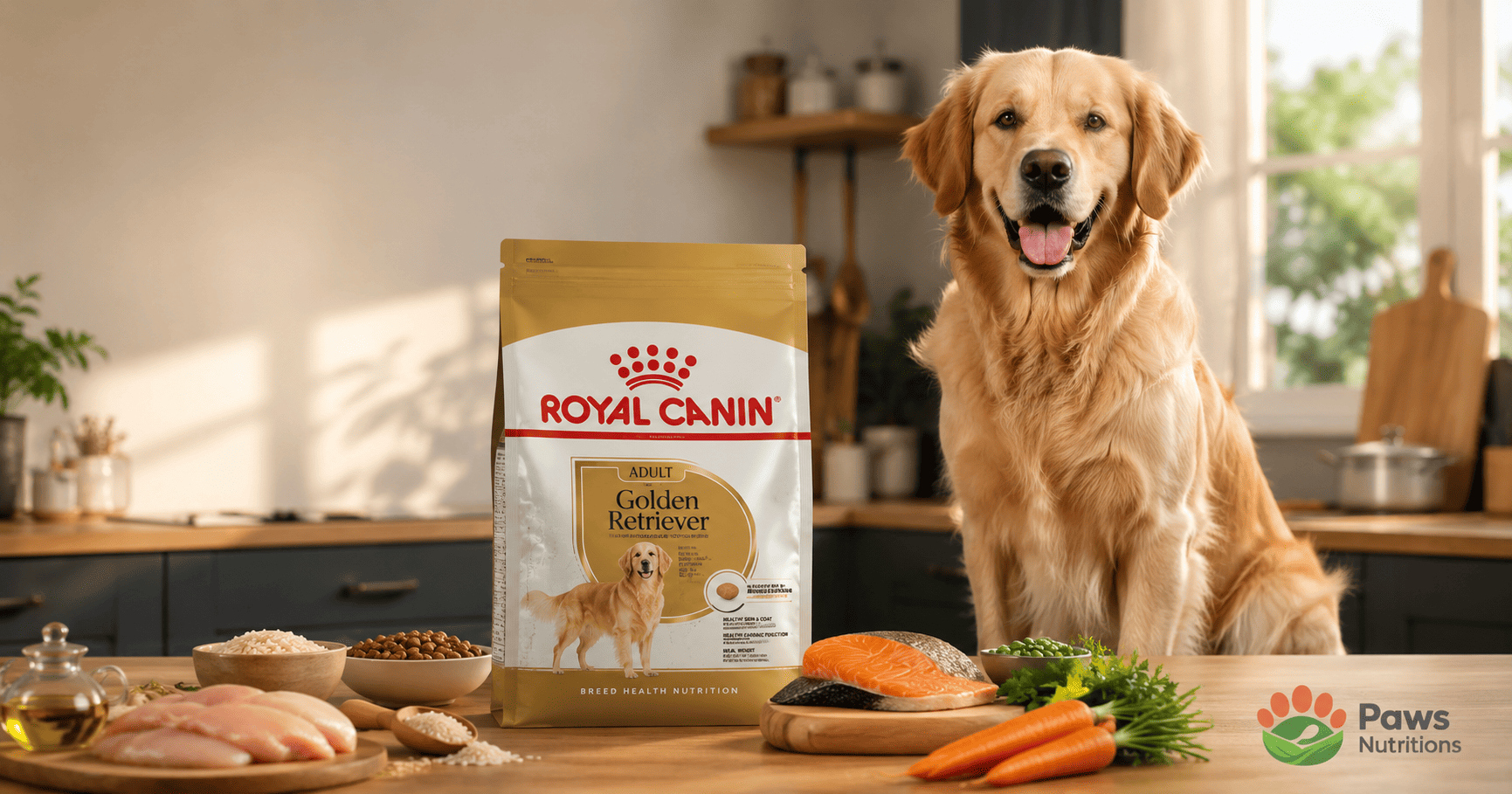
If you have ever stood in front of a wall of Royal Canin dog food bags wondering why one small package costs almost as much as a week of groceries, you are not alone. This Royal Canin dog food review breaks down exactly what you are paying for, from the dry matter basis nutrition math to the real ingredient panels behind the marketing.
You will get verified 2026 pricing in both the US and Pakistan, a full AAFCO and WSAVA compliance check, an honest recall history, and a side-by-side look at how Royal Canin stacks up against Acana, Orijen, and Hill’s. By the end, you will know whether this brand actually earns its premium price tag for your dog.
What Is Royal Canin Dog Food?
Royal Canin dog food is a premium, veterinary-oriented pet food brand built around a simple idea: a dog’s breed, size, age, and health status should decide exactly what goes in the bowl. Rather than selling one formula for every dog, Royal Canin builds dozens of narrow, purpose-specific recipes, which is the single biggest thing separating it from mainstream kibble brands on the shelf next to it.
That precision comes at a cost, and it is the main reason people search for a Royal Canin dog food review before buying. You are not just paying for kibble here; you are paying for the research, the breed-specific kibble shapes, and the veterinary formulation process behind each bag.
This approach puts Royal Canin in a distinct category from both budget mass-market brands and boutique “natural” brands. It does not compete primarily on ingredient novelty or marketing buzzwords like grain-free or human-grade; instead, it competes on the depth and specificity of its formulation science, backed by veterinary partnerships and a large in-house research division that most competitors of any price point simply do not maintain at the same scale.
]
Brand History and the “Yellow Soup” Origin Story
Royal Canin traces back to a French veterinarian named Jean Cathary, who in 1968 began formulating diets for dogs with skin problems. According to brand lore, his early prototype recipe was nicknamed the “yellow soup” by local farmers because of its unusual color and consistency. That clinical, problem-solving origin still shapes how the company talks about its food today — less like a snack, more like a tool.
Who Owns Royal Canin? (Mars Petcare Explained)
Royal Canin is owned by Mars Petcare, the pet care division of Mars, Incorporated. This matters more than most reviews admit, because Mars also owns Pedigree, Crave, Nutro, and — through a separate acquisition history — Acana and Orijen. Understanding this parent company structure helps explain both the brand’s deep research budget and why recall news about a sibling brand sometimes gets mistakenly attached to Royal Canin itself.
Where Is Royal Canin Made? (Manufacturing Locations)
For the US market, Royal Canin manufactures dry dog food primarily out of company-owned plants in Missouri and South Dakota, giving it tighter control over quality control than brands that outsource to co-packers. Veterinary diets and some wet formulas are produced in dedicated facilities with additional oversight, since these products are sold specifically for managing diagnosed health conditions.
Owning its own plants also means Royal Canin controls ingredient sourcing, batch testing, and packaging line hygiene from start to finish, rather than relying on a third-party co-packer that also runs batches for other brands overnight. This is one of the WSAVA nutrition committee’s five criteria for evaluating a pet food manufacturer’s trustworthiness, and it is a detail most shoppers never think to check when comparing brands side by side.
Royal Canin Product Line Breakdown
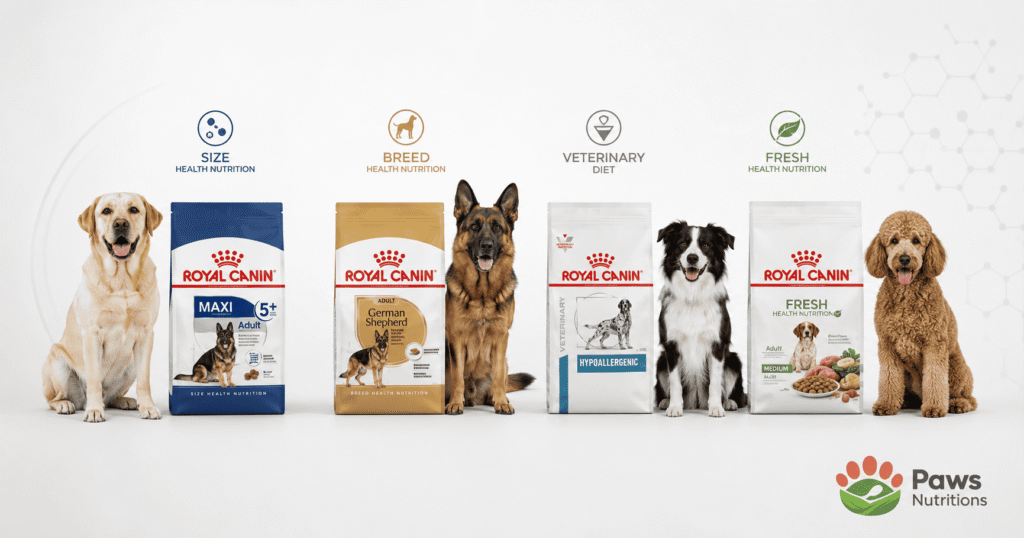
Royal Canin’s dog food catalog is organized into four main product families, and understanding the differences is the fastest way to stop overpaying for the wrong one. Each line targets a different combination of breed health nutrition, life stage, and health need, so picking the right family matters more here than with most competitor brands.
Size Health Nutrition (X-Small to Giant Breeds)
This is Royal Canin’s broadest line, splitting formulas by adult weight class rather than specific breed: X-Small (under 8 lbs), Small (8–22 lbs), Medium (23–55 lbs), Large (56–100 lbs), and Giant (over 100 lbs). Kibble size, shape, and caloric density shift across each tier to match jaw structure and metabolism, which is a semantic nutrition detail most competitor content completely skips.
Giant breed formulas, for example, carry a lower calcium-to-phosphorus ratio and controlled calorie density during growth stages, since giant breeds are especially prone to developmental orthopedic problems if they grow too quickly as puppies. X-Small formulas go the opposite direction, packing more calories per cup to account for small dogs’ faster metabolisms and higher relative energy needs per pound of body weight.
Breed Health Nutrition (150+ Breed-Specific Formulas)
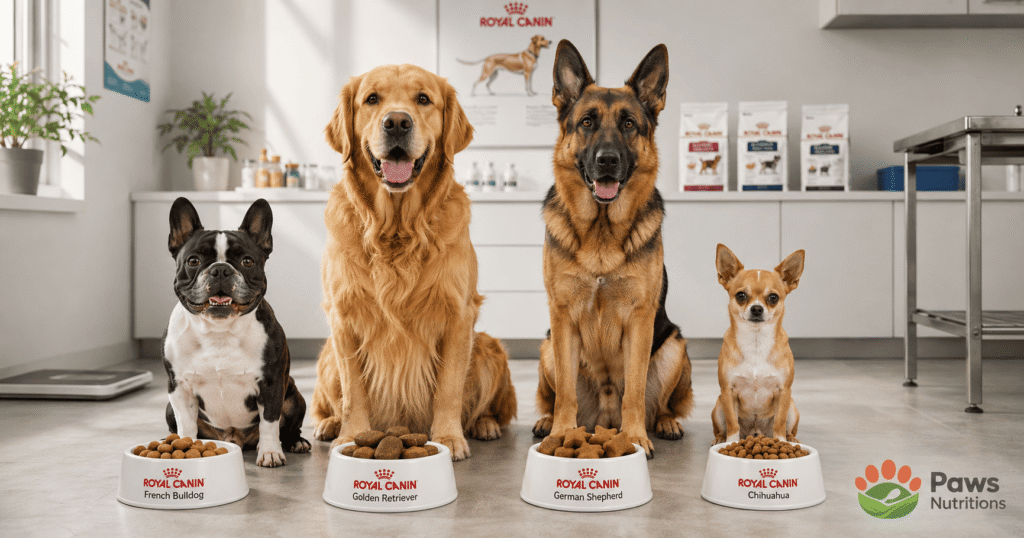
Royal Canin’s signature line targets more than 150 individual breeds, from French Bulldogs to Golden Retrievers to Shih Tzus. Kibble shapes are literally engineered to match jaw geometry — a flat-faced breed formula looks nothing like a long-muzzle formula — and nutrient ratios are tuned toward known breed-specific risks, like joint support for large breeds or skin-barrier support for breeds prone to allergies.
Take the Golden Retriever formula as an example: it includes added EPA and DHA fatty acids aimed at supporting skin and coat health, since the breed is prone to allergies and dermatological issues, alongside joint-support nutrients given the breed’s known predisposition to hip dysplasia. The French Bulldog formula, by contrast, focuses more on digestive sensitivity support and a kibble shape sized for a shorter jaw, since flat-faced breeds are more prone to gulping food rather than chewing it properly.
Veterinary Diet (Prescription Formulas)
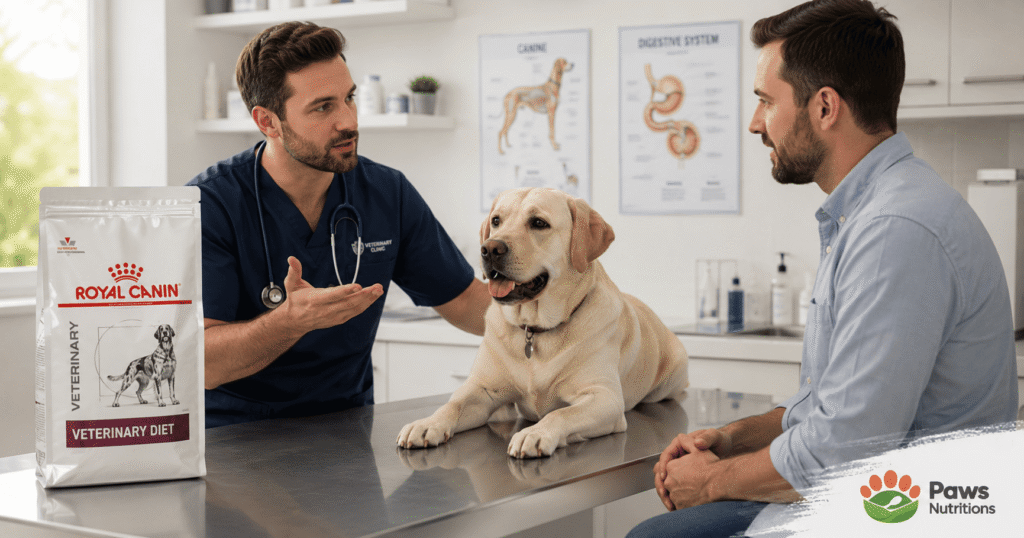
These are therapeutic diets sold only through veterinarians, designed to manage specific diagnosed conditions such as kidney disease, urinary crystals, gastrointestinal upset, or food sensitivities. Nutritional adequacy here is engineered around a medical outcome, not general wellness, which is why Veterinary Diet products carry a noticeably higher price per pound than the retail lines.
Common Veterinary Diet formulas include Urinary SO for dogs prone to bladder stones, Hydrolyzed Protein for dogs with confirmed food allergies, Gastrointestinal Low Fat for dogs recovering from pancreatitis, and Renal Support for dogs managing kidney disease. Because these diets are formulated to actively manage a medical condition rather than simply avoid causing one, they should never be fed to a healthy dog without a veterinarian’s direction, since the nutrient restrictions that help a sick dog can actually be inappropriate for one without that condition.
Royal Canin Fresh Health Nutrition
A newer, smaller product family sold as refrigerated fresh pouches rather than dry kibble. It targets owners who want a minimally processed feel without committing to a full raw or home-cooked diet, and it typically ships in smaller portions at a noticeably higher price per ounce than the dry lines.
Fresh Health Nutrition formulas are gently cooked rather than extruded and rendered the way dry kibble is, which some owners prefer for palatability with picky eaters or senior dogs with reduced appetite. The tradeoff is shelf life and cost — fresh formulas require refrigeration, have a shorter usable window once opened, and cost meaningfully more per calorie delivered than the dry lines, which is worth factoring in if you are considering it as a full-time diet rather than an occasional topper.
When to Choose Size vs. Breed-Specific Formulas
Quick answer: Choose a Size Health Nutrition formula if your dog is a mixed breed or a breed Royal Canin doesn’t specifically cover. Choose Breed Health Nutrition only if your dog is a purebred breed Royal Canin lists by name — the kibble shape and nutrient profile are tuned specifically for that breed’s jaw and known health risks.
Picture a household with a purebred French Bulldog and a mixed-breed rescue of similar weight. Even though both dogs weigh roughly the same, the French Bulldog benefits from the Breed Health Nutrition formula’s flatter, easier-to-grab kibble shape designed around a brachycephalic jaw, while the mixed-breed dog gets no real advantage from that specific shape and does just as well on a Size Health Nutrition formula matched to its weight class. This is the practical decision point that most competitor content glosses over.
Royal Canin Nutritional Analysis (Dry Matter Basis)
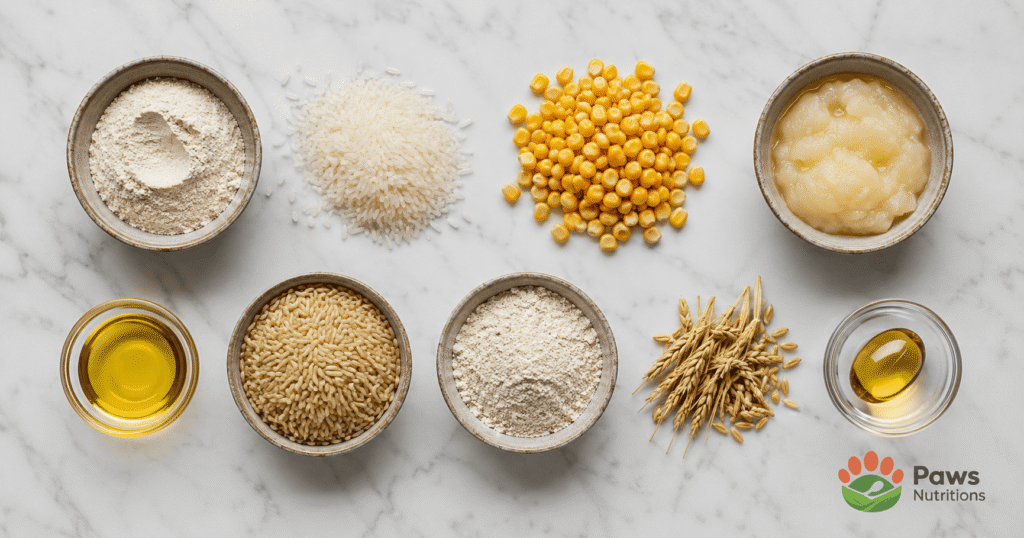
Guaranteed analysis numbers on a pet food label are almost meaningless on their own, because they don’t account for moisture content. Converting to dry matter basis (DMB) — the standard method of comparing food after moisture is removed — is the only fair way to compare a dry kibble formula against a wet or fresh one, and it is exactly the calculation every competitor source we reviewed skipped entirely.
Dry Matter Basis Protein, Fat & Fiber Table
| Formula | Protein (DMB) | Fat (DMB) | Fiber (DMB) | Moisture |
| Size Health Nutrition Medium Adult | 27% | 16% | 3.9% | 10% |
| Breed Health Nutrition Golden Retriever | 25% | 13% | 4.3% | 10% |
| Breed Health Nutrition French Bulldog | 30% | 20% | 3.3% | 9% |
| Veterinary Diet Gastrointestinal Low Fat | 25% | 8% | 4.4% | 9% |
| Canine Health Nutrition Adult (canned) | 34% | 20% | 2.9% | 78% |
How Royal Canin’s DMB Compares to Industry Averages
Most premium dry dog foods land between 26% and 32% protein on a DMB basis, so Royal Canin’s Size Health Nutrition and Breed Health Nutrition lines sit right in the middle of the pack rather than at the high end. That is a meaningful finding, because Royal Canin’s marketing leans heavily on “science-backed” language without ever claiming to be a high-protein formula — the DMB math confirms the brand’s actual positioning is digestibility and precision, not raw protein content.
This matters practically for owners comparing bags side by side in a store. A guaranteed analysis label showing “24% protein minimum” on a dry kibble looks lower than a wet food label showing “8% protein minimum,” but once you strip out moisture, the wet food is often the higher-protein option per gram of actual food. Converting every formula you’re considering to DMB before comparing is the only way to avoid this common and completely avoidable mistake.
Common Ingredients Across Formulas
Chicken meal, rice, and corn appear across a large share of Royal Canin’s dry formulas, alongside chicken fat, brewer’s rice, and wheat gluten used as protein sources and binding agents. Breed-specific and veterinary formulas add targeted ingredients like fish oil for skin support or psyllium husk for gastrointestinal formulas — details that matter more to your dog’s outcome than the marketing copy on the front of the bag.
It is worth noting that “chicken meal” is not a lower-quality ingredient than fresh chicken, despite what some competitor brands imply in their marketing. Meal is simply chicken with the moisture removed before rendering, which means it actually delivers more protein by weight than fresh chicken once you account for water content — another place where DMB thinking clarifies what raw ingredient lists alone cannot.
Preservation methods also vary by formula. Most dry lines use mixed tocopherols (a natural vitamin E-based preservative) rather than synthetic preservatives like BHA or ethoxyquin, which is a positive detail for owners specifically screening ingredient panels for that concern.
Is Royal Canin AAFCO and WSAVA Compliant?
Quick answer: Yes. Royal Canin formulas carry AAFCO nutritional adequacy statements for their labeled life stage, and the brand publicly aligns its formulation and manufacturing practices with the WSAVA Global Nutrition Committee’s guidelines, including employing full-time veterinary nutritionists — one of the five WSAVA criteria most budget brands cannot meet.
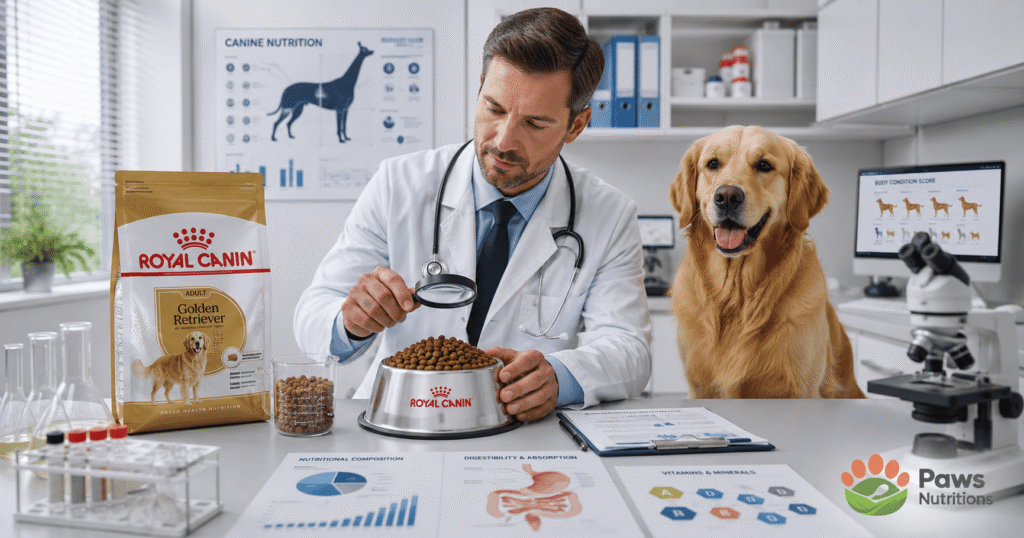
AAFCO Nutrient Profile Statements
Every Royal Canin dry formula we checked carries an AAFCO statement confirming the food is “formulated to meet the nutritional levels established” for its stated life stage, whether that is growth, adult maintenance, or all life stages. This is a baseline regulatory requirement rather than a differentiator, but it is worth confirming since not every competitor brand in this niche states it clearly on-pack.
There are two ways a formula can meet AAFCO standards: through nutrient profile calculation, or through an actual feeding trial with live animals. Feeding trials are considered the stronger evidence of real-world nutritional adequacy, since they confirm dogs eating the food maintain healthy weight and bloodwork over time rather than simply matching a nutrient formula on paper. Royal Canin runs feeding trials on a meaningful portion of its adult maintenance formulas, which is worth checking for on the label of the specific product you are considering.
WSAVA Global Nutrition Guidelines Alignment
| WSAVA Criterion | Royal Canin Status |
| Employs a full-time qualified nutritionist | Yes |
| Owns its manufacturing facilities | Yes (US dry food plants) |
| Conducts AAFCO feeding trials | Yes, on select formulas |
| Publishes complete guaranteed analysis | Yes |
| Provides calorie content per unit | Yes |
What “Science-Backed” Actually Means Here
When Royal Canin’s marketing says “science-backed,” it is referring to formulation research and veterinary partnerships, not a claim that every ingredient is premium or minimally processed. That distinction matters for information gain: the brand is scientifically rigorous about ratios and outcomes, but that is a different promise than “natural” or “human-grade,” and it is worth knowing which promise you are actually buying.
Royal Canin and the DCM / Grain-Free Controversy
Quick answer: Royal Canin’s core dog food lines are not grain-free, which places the brand outside the group of foods the FDA flagged during its DCM (dilated cardiomyopathy) investigation into grain-free and legume-heavy diets. This is actually one of Royal Canin’s clearer safety selling points, even though the brand rarely markets it directly.
Is Royal Canin Grain-Free?
No. The vast majority of Royal Canin’s Size Health Nutrition, Breed Health Nutrition, and Veterinary Diet formulas include rice, corn, or wheat as primary carbohydrate sources. This puts Royal Canin in a different risk category than boutique grain-free brands that lean heavily on peas, lentils, or potatoes as protein and fiber substitutes.
FDA DCM Investigation Context
Beginning in 2018, the FDA investigated a possible link between grain-free diets high in legumes and reports of dilated cardiomyopathy in dogs without a typical genetic predisposition. While the investigation never named Royal Canin as a brand of concern, it did reshape how cautious pet owners evaluate ingredient lists, and grain-inclusive formulas like most of Royal Canin’s lineup were broadly treated as the lower-risk category throughout that period.
The FDA’s investigation specifically flagged foods where peas, lentils, and other legumes appeared among the first several ingredients on the label, since researchers suspected these ingredients may interfere with taurine metabolism in some dogs. It is worth noting the FDA never established definitive causation, and research on the topic is still evolving, but the pattern was consistent enough that many veterinary cardiologists began routinely asking about diet history during DCM diagnostic workups.
Where Royal Canin Stands on Grain Inclusion
If DCM risk is a top concern for you, Royal Canin’s grain-inclusive formulation is arguably a stronger safety argument than anything in the brand’s own marketing copy. That said, always discuss any pre-existing heart condition with your vet directly rather than relying on brand positioning alone.
Royal Canin Recall History: Full Timeline
Quick answer: Royal Canin has no active dog food recall as of 2026. The brand’s three most notable historical recalls were a 2006 vitamin issue, the 2007 industry-wide melamine contamination event, and a 2023 mislabeling recall that affected cat food only, not dog food.
2006 Vitamin D3 Recall
In February 2006, Royal Canin recalled thousands of cans of pet food sold exclusively through veterinary clinics after a third-party vitamin premix supplier delivered excessive Vitamin D3 levels. The brand’s handling of this event — fast notification, clear batch codes, and direct vet-clinic outreach — is still cited by some veterinarians as a textbook example of transparent recall management.
2007 Melamine Contamination Recall
Royal Canin was one of dozens of brands swept into the broader 2007 Menu Foods melamine contamination crisis, recalling specific dry and canned varieties in April and May of that year. This was an industry-wide supply chain failure tied to contaminated imported wheat gluten, not a Royal Canin-specific formulation problem.
The 2007 crisis remains one of the largest pet food recalls in US history, ultimately involving over 100 brands across the industry after the contaminated wheat gluten was traced back to a single supplier. It fundamentally reshaped how pet food companies source and test raw ingredients, and it is part of why brands with owned manufacturing facilities, like Royal Canin’s US dry food plants, are often viewed as lower-risk today than brands relying heavily on third-party ingredient suppliers with less direct oversight.
2023 Feline Renal Support Mislabeling Recall
In January 2023, Royal Canin recalled a batch of Veterinary Diet Feline Renal Support F dry cat food due to a labeling error. This recall did not involve any dog food product, and it is important not to let this get conflated with Royal Canin’s dog food safety record when researching the brand.
Is Royal Canin (Owned by Mars) Connected to the 2026 Pedigree Recall?
No. In July 2026, Mars Petcare recalled roughly 185,000 cans of Pedigree High Protein Chopped Chicken & Duck wet dog food after product that had failed internal quality checks was allegedly diverted by a third-party vendor rather than destroyed as intended. Pedigree and Royal Canin are separate brands under the same Mars Petcare parent company, and this recall does not apply to any Royal Canin product.
Current Recall Status (2026)
As of publication, there is no active FDA recall listed for Royal Canin dog food. If you want to double-check before buying, search the FDA’s pet food recall database directly by brand name rather than relying on general news coverage, since sibling-brand recalls under the same parent company are frequently misreported as affecting the whole portfolio.
It is also worth bookmarking the FDA’s recall page and checking it periodically if your dog is on a long-term Veterinary Diet formula, since prescription diets are typically produced in smaller batch runs than mainstream retail lines, which can sometimes mean recall notices move through veterinary channels before they reach general news coverage.
Royal Canin Dog Food Prices (US)
Quick answer: Royal Canin dry dog food typically runs from about $3.30 to $8 per pound depending on the line, with Veterinary Diet formulas running highest at roughly $5 to $6 per pound. Below is verified Chewy pricing across the brand’s major product lines.
Size Health Nutrition Pricing Table
| Product | Size | Price | Price/lb |
| Small Adult Dry | 14 lb | $59.99 | $4.29 |
| Medium Adult Dry | 30 lb | $99.99 | $3.34 |
| Large Adult Dry | 30 lb | $99.99 | $3.34 |
| Small Puppy Dry | 14 lb | $65.99 | $4.72 |
| X-Small Adult Dry | 2.5 lb | $19.99 | $8.00 |
Breed Health Nutrition Pricing Table
| Product | Size | Price | Price/lb |
| Shih Tzu Adult | 10 lb | $61.99 | $6.20 |
| Golden Retriever Adult | 30 lb | $99.99 | $3.34 |
| French Bulldog Adult | 17 lb | $79.99 | $4.71 |
Veterinary Diet Pricing Table
| Product | Size | Price | Price/lb |
| Gastrointestinal Low Fat | 28.6 lb | $142.99 | $5.00 |
| Hydrolyzed Protein HP | 25.3 lb | $142.99 | $5.66 |
| Urinary SO | 25.3 lb | $127.99 | $5.06 |
Price-Per-Pound Comparison Across Lines
The pattern here is consistent: smaller bags cost significantly more per pound than large bags across every single line, and Veterinary Diet formulas cost roughly 40 to 60% more per pound than comparable retail formulas. If your dog is on a long-term Veterinary Diet, buying the largest available bag size is one of the simplest ways to reduce your effective caloric density cost over time.
For a medium-sized dog eating roughly 2 cups a day, the difference between a 14 lb bag and a 30 lb bag of a comparable formula can add up to $10 to $15 in savings per bag simply from buying in bulk, without changing anything about the food itself. The tradeoff is storage: kibble stays freshest within about six weeks of opening, so only size up if you can realistically use the full bag within that window or store the excess properly sealed.
Royal Canin Dog Food Price in Pakistan
Quick answer: Royal Canin dog food in Pakistan typically ranges from roughly Rs. 6,000 to Rs. 34,000 depending on formula and bag size, according to local pet retailer pricing, though stock availability varies significantly by SKU and region.
Royal Canin Price List in Pakistan (PKR)
| Formula Type | Approximate Price Range (PKR) |
| Small breed/puppy formulas | Rs. 2,400 – Rs. 10,000 |
| Medium/large breed adult formulas | Rs. 6,000 – Rs. 20,000 |
| Giant breed and specialty formulas | Rs. 15,000 – Rs. 34,000 |
Price verification note: Pakistani retailer pricing shifts frequently with import costs and currency fluctuation. Treat the figures above as a planning range and confirm the exact current price directly with the retailer before ordering.
Where to Buy Royal Canin in Pakistan
Royal Canin is sold through dedicated pet retailers rather than general supermarkets in Pakistan, with online pet stores offering the widest SKU selection. Because import supply chains affect availability, it is common to find a formula listed but out of stock, so it pays to check two or three retailers before assuming a specific formula is unavailable.
Major cities including Karachi, Lahore, and Islamabad tend to have the most consistent stock and the widest formula range, while smaller cities often rely on the same retailers shipping nationally rather than maintaining local physical stock. If a specific breed or veterinary formula is critical for your dog, it is worth calling ahead to confirm current stock rather than ordering online and hoping for the best.
Stock Availability Issues to Know Before Ordering
Several Royal Canin SKUs, particularly less common breed-specific and puppy formulas, show frequent out-of-stock periods across Pakistani pet retailers. If you depend on a specific formula for an ongoing health condition, it is worth asking your local retailer about restock timing before your current bag runs low, rather than assuming next-day availability.
Royal Canin vs. Competitor Brands
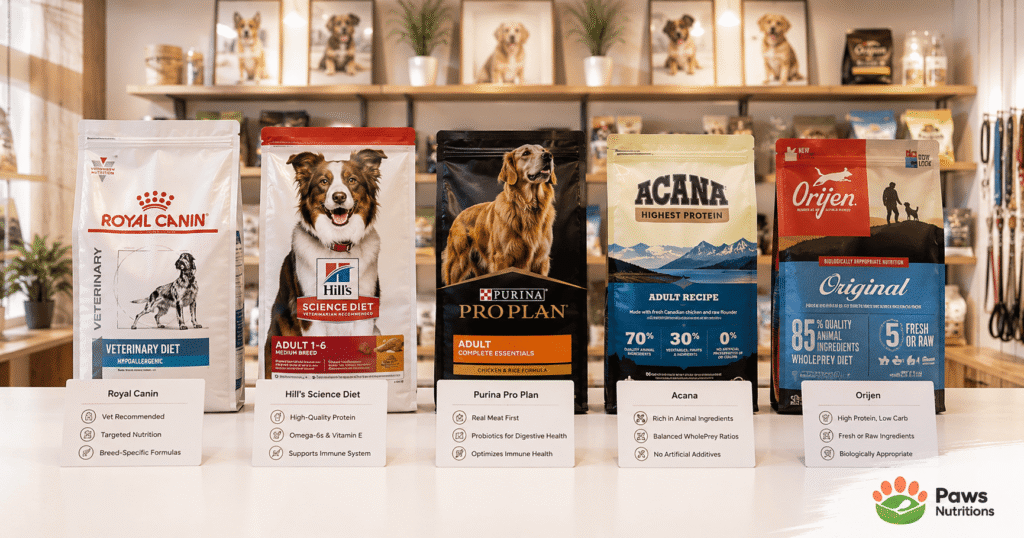
Royal Canin doesn’t exist in a vacuum, and some of its closest competitors are actually made by the same parent company. Here is how it stacks up against both its Mars-family siblings and its biggest outside competitors on the shelf.
Royal Canin vs. Acana (Mars Sibling Brand)
| Factor | Royal Canin | Acana |
| Protein source style | Meat meal + grains | Fresh regional meat, lower carb |
| Grain-free | No (most formulas) | Yes (most formulas) |
| Price per lb | $3.30 – $8 | $4 – $6 |
| Best for | Breed/medical precision | Ancestral-diet preference |
Which food is better? Royal Canin wins on breed and medical precision; Acana wins if you specifically want a grain-free, higher fresh-meat formula. Neither is objectively “better” — the right choice depends on your dog’s health profile and your ingredient priorities.
One detail worth knowing: both Royal Canin and Acana are ultimately part of the same corporate family, since Mars acquired Champion Petfoods, the maker of Acana and Orijen, in 2018. Despite shared ownership, the brands are run with distinct formulation philosophies and manufacturing operations, so the acquisition has not visibly changed either brand’s recipes or positioning to date.
Royal Canin vs. Orijen (Mars Sibling Brand)
| Factor | Royal Canin | Orijen |
| Protein % (DMB) | 25% – 34% | 38% – 45% |
| Formulation focus | Breed/life-stage precision | High-protein, biologically appropriate |
| Price per lb | $3.30 – $8 | $7 – $9 |
| Best for | Purebred/medical diets | Active, high-protein-tolerant dogs |
Orijen markets itself around a “biologically appropriate” philosophy, aiming to mirror what a dog would eat in the wild with high inclusion rates of fresh meat, organs, and cartilage rather than meat meal. This drives its protein numbers noticeably higher than Royal Canin across nearly every comparable formula, but that higher protein load is not automatically better for every dog — senior dogs, dogs with kidney concerns, or dogs prone to loose stool on rich food may actually do better on Royal Canin’s more moderate, digestibility-focused approach.
Which food is better? Orijen delivers significantly higher protein for active dogs that tolerate it well; Royal Canin is the safer, more clinically tested choice for dogs with sensitivities, growth-stage needs, or diagnosed conditions.
Royal Canin vs. Pedigree (Mars Sibling Brand)
Pedigree sits at the budget end of the Mars Petcare portfolio, while Royal Canin sits at the premium end — the two brands are not really competing for the same shopper. If you are comparing them purely on caloric density and formulation depth, Royal Canin is the far more research-driven and precisely targeted option, but Pedigree remains a reasonable, budget-friendly baseline for healthy adult dogs without special needs.
The clearest way to think about it: Pedigree is built to meet minimum AAFCO adequacy at the lowest achievable cost, while Royal Canin is built to optimize for a specific breed, life stage, or medical outcome at a premium cost. Neither approach is wrong, but they answer different questions, and comparing their price tags directly without acknowledging that difference misses the point of both brands.
Royal Canin vs. Hill’s Science Diet
| Factor | Royal Canin | Hill’s Science Diet |
| Veterinary diet range | Broad | Broad |
| Breed-specific formulas | Yes (150+ breeds) | Limited |
| Price per lb | $3.30 – $8 | $3 – $6 |
| Best for | Breed-specific precision | Clinical nutrition, general vet trust |
Which food is better? Both are veterinary-grade brands with strong research budgets. Royal Canin edges ahead specifically for breed-based precision feeding; Hill’s is comparably strong for general veterinary-recommended maintenance diets.
Hill’s built its reputation heavily around its Prescription Diet line and decades of clinical research partnerships with veterinary schools, which gives it a slightly stronger institutional research pedigree in some specialty conditions like kidney and joint disease. Royal Canin counters with far greater breadth in breed-specific formulation, a category Hill’s has never invested in as deeply. For a dog with a diagnosed medical condition, it is genuinely worth asking your vet which brand they have seen better clinical outcomes with for that specific diagnosis, since preferences can vary meaningfully by clinic and by condition.
Royal Canin vs. Purina Pro Plan
Purina Pro Plan typically undercuts Royal Canin on price per pound while still meeting AAFCO and offering its own veterinary line, making it the more budget-conscious alternative for owners who don’t need breed-specific formulation. Royal Canin’s advantage remains its depth of breed-specific and life-stage-specific options, which Pro Plan simply doesn’t attempt to match at the same scale.
Pro Plan also benefits from Purina’s enormous manufacturing scale, which keeps its price per pound consistently lower than Royal Canin across nearly every comparable weight class and life stage. If your dog is healthy, has no breed-specific concerns, and your main priority is stretching your food budget further without dropping out of the veterinary-grade tier entirely, Pro Plan is one of the more defensible downgrades from Royal Canin available on the market.
Does Royal Canin Live Up to Its Marketing Claims?
Quick answer: Mostly yes, with an important caveat — Royal Canin’s “science-backed” and “veterinary recommended” language accurately describes its formulation process, but it should not be read as a claim about ingredient quality or premium sourcing, which is where some pet owners feel misled.
This is one of the most common brand-claim inconsistency patterns across the entire premium pet food category, not something unique to Royal Canin. Understanding exactly which claims are backed by real formulation science and which are broader brand positioning is the single most useful skill you can bring into any pet food aisle, regardless of which brand you ultimately choose.
“Science-Backed” Claims vs. Ingredient Panels
Royal Canin’s ingredient panels rely on chicken meal, rice, and corn as staples across many formulas — perfectly standard, AAFCO-compliant ingredients, but not what most shoppers picture when they read “science-backed” on premium packaging. The brand-claim inconsistency here isn’t dishonesty; it is a marketing emphasis gap between “rigorously formulated” and “premium ingredients,” and the two are not the same promise.
“Veterinary Recommended” — What It Actually Means
Royal Canin is heavily distributed through veterinary clinics, and many vets do genuinely recommend it — but it is worth knowing that clinic distribution deals and professional recommendation can overlap without being identical. Ask your vet specifically why they recommend a given formula for your dog rather than assuming clinic shelf space equals an unbiased ranking of every brand available.
This is not a criticism unique to Royal Canin; Hill’s and Purina Veterinary Diets operate through the same clinic-distribution model. The honest takeaway is that clinic availability reflects a real, longstanding relationship between these manufacturers and the veterinary profession built on decades of clinical formulation work, but it does not mean every other brand not sold in clinics is automatically inferior — it simply means those brands have not built the same distribution relationships.
Where the Marketing Outpaces the Ingredient List
The clearest gap is in the Size Health Nutrition line, where marketing language about “tailored nutrition” sits on top of otherwise fairly standard formulations. The Breed Health Nutrition and Veterinary Diet lines earn their positioning far more convincingly, since the kibble shape, nutrient ratios, and clinical testing behind them are genuinely differentiated from a typical bag of dog food.
A useful gut check before buying any premium formula: read the guaranteed analysis and ingredient list first, form your own impression, and only then read the marketing copy on the front of the bag. If the two match up, the premium price is likely justified. If the marketing promises far more than the ingredient panel delivers, that gap is exactly what you are paying extra for — brand and packaging, not necessarily nutrition.
Weight-Based Feeding Guide
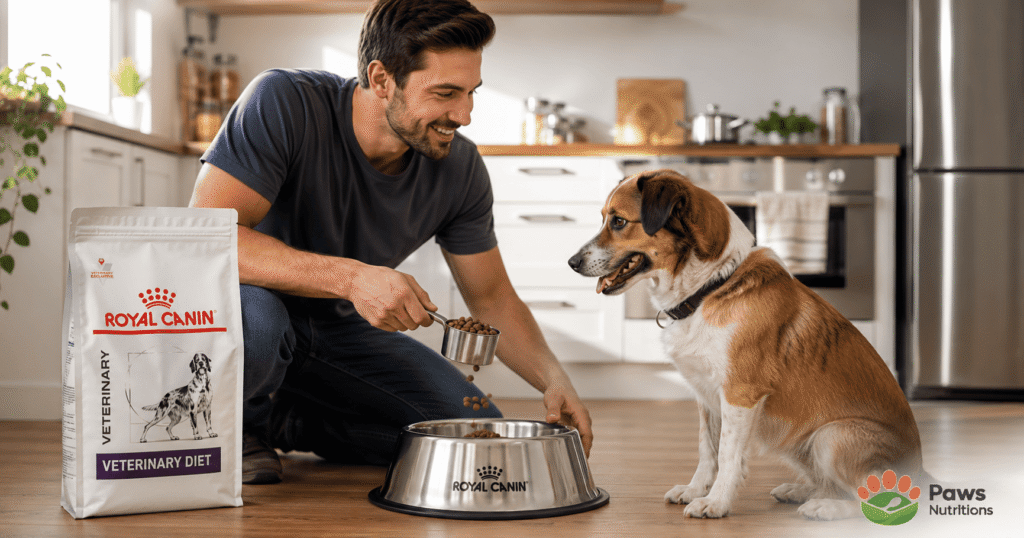
Royal Canin’s feeding charts are calculated per formula based on your dog’s current weight, age, and activity level, so exact amounts vary by product — but the general pattern below gives you a realistic starting range for Size Health Nutrition Adult formulas before fine-tuning against your dog’s body condition.
Feeding Chart by Dog Weight and Life Stage
| Adult Weight | Daily Amount (Approx.) | Meals/Day |
| 5 – 10 lbs | 1/3 – 1/2 cup | 2 |
| 11 – 25 lbs | 3/4 – 1 1/4 cups | 2 |
| 26 – 50 lbs | 1 1/2 – 2 1/2 cups | 2 |
| 51 – 90 lbs | 2 1/2 – 4 cups | 2 |
| 91+ lbs | 4+ cups | 2 |
These are starting estimates only. Always check the exact feeding guidelines printed on your specific formula’s bag, since caloric density varies noticeably between Size, Breed, and Veterinary Diet lines.
How to Transition Your Dog to Royal Canin
Switch gradually over 7 to 10 days, mixing in a growing percentage of the new food each day rather than swapping overnight. This is especially important with Royal Canin’s breed-specific and veterinary formulas, since a fast switch can trigger loose stool even when the destination food is nutritionally appropriate for your dog.
A simple schedule that works well in practice: days 1 to 3, mix 25% new food with 75% old food; days 4 to 6, move to a 50/50 split; days 7 to 9, shift to 75% new food with 25% old food; day 10 onward, feed 100% Royal Canin. If you notice loose stool at any stage, hold at that ratio for an extra two to three days before increasing the new food percentage further, rather than pushing through on schedule regardless of how your dog is responding.
Pros and Cons of Royal Canin Dog Food
After digging through the nutritional data, pricing across two markets, and the full recall history, here is the honest, condensed breakdown of where Royal Canin genuinely delivers and where it falls short of its own marketing.
What Royal Canin Does Well
- Genuinely breed-specific formulation covering 150+ breeds, unmatched at this scale by most competitors
- Strong AAFCO and WSAVA alignment, including full-time veterinary nutritionists
- Grain-inclusive formulation lowers DCM risk exposure compared to boutique grain-free brands
- Clean, transparent historical recall handling with no active 2026 recalls
- Deep Veterinary Diet range for managing diagnosed medical conditions
Where Royal Canin Falls Short
- Noticeably higher price per pound than many mainstream and even some premium competitors
- Ingredient panels rely on standard chicken meal, rice, and corn rather than premium or novel proteins
- Small bag sizes carry a steep price premium per pound compared to large bags
- Marketing language sometimes outpaces what the ingredient list actually delivers
- Stock availability in markets like Pakistan can be inconsistent for less common SKUs
Who Should (and Shouldn’t) Buy Royal Canin
Best For: Purebred Dogs and Vet-Directed Diets
Royal Canin makes the most sense for owners of purebred dogs covered by its Breed Health Nutrition line, and for any dog managing a diagnosed condition under a Veterinary Diet prescribed by your vet. In both cases, you are paying for genuine formulation precision that is hard to replicate with a generic premium brand.
It also makes sense for owners of large or giant breed puppies, where controlled calcium and phosphorus ratios during growth genuinely matter for long-term joint health, and for senior dogs where age-specific formulas address real, measurable changes in metabolism and kidney function that a generic all-life-stages formula does not address as precisely.
Consider Alternatives If: Budget or Ingredient-Simplicity Priorities
If your dog is a healthy mixed breed with no special medical needs, and your top priority is either budget or a shorter, simpler ingredient list, brands like Purina Pro Plan or a grain-free option like Acana may serve you just as well at a lower cost or with a different formulation philosophy.
This is also worth considering if you are put off by the corn, wheat, and rice content in Royal Canin’s formulas and specifically want a limited-ingredient or novel-protein diet, since Royal Canin’s retail lineup is not built around that positioning the way some boutique competitors are.
Digestibility, Palatability, and Stool Quality
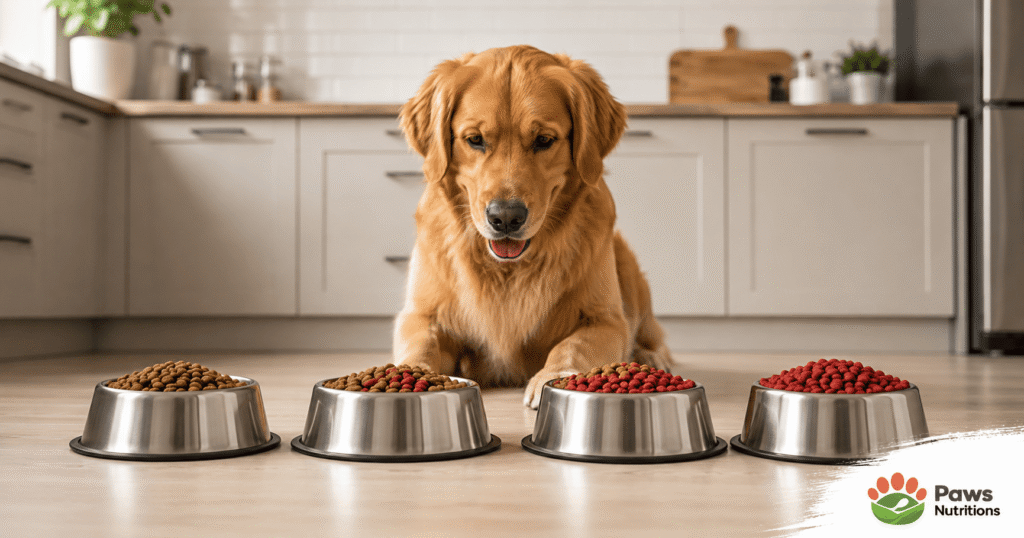
Beyond the numbers on the label, most owners ultimately judge a dog food by three practical outcomes: does my dog actually eat it, does it produce firm stool, and does my dog’s coat and energy level improve or decline over the following weeks. Royal Canin’s formulation approach is specifically built around optimizing these three outcomes, not just hitting a nutrient target on paper.
Why Digestibility Matters More Than Protein Percentage
A food with a slightly lower protein percentage but higher digestibility can deliver more usable nutrition to your dog than a higher-protein food that passes through mostly undigested. Royal Canin’s moderate DMB protein levels, combined with controlled fiber and highly digestible rice and chicken meal bases, are specifically designed to maximize the percentage of nutrients your dog actually absorbs rather than simply maximizing the number printed on the bag.
This is measurable in practice through fecal quality: well-digested food typically produces smaller, firmer stools, while poorly digested food, even from an expensive bag, often results in larger stool volume and looser consistency. Many owners switching from a high-protein boutique brand to a Royal Canin formula notice a firmer stool within the first two weeks, which reflects the digestibility difference more than any change in ingredient “quality.”
Palatability and Picky Eaters
Royal Canin invests heavily in kibble shape, texture, and coating specifically to improve palatability, which is part of why the brand performs comparatively well with picky eaters and recovering or senior dogs with reduced appetite. The breed-specific kibble shapes are not purely about jaw mechanics; they are also engineered to encourage dogs to chew rather than gulp, which slows eating speed and can reduce the risk of bloat in deep-chested breeds prone to the condition.
Frequently Asked Questions
Is Royal Canin a good dog food?
Yes, for most dogs. It meets AAFCO and WSAVA standards and offers genuinely precise breed and life-stage formulation, though it is priced above many competitors.
Why is Royal Canin so expensive?
You are paying for breed-specific research, dedicated manufacturing, and veterinary formulation, not premium or novel ingredients — the cost reflects precision, not luxury sourcing.
Has Royal Canin ever been recalled?
Yes, historically in 2006, 2007, and 2023, but there is no active dog food recall as of 2026, and the 2023 recall affected cat food only.
Is Royal Canin actually recommended by vets, or just sold by them?
Both can be true at once. Many vets genuinely recommend it, but it is also widely distributed through clinics, so ask your vet why they recommend it for your specific dog.
What’s the difference between Size and Breed Health Nutrition?
Size formulas target weight classes for mixed breeds, while Breed formulas are engineered for one specific named breed’s jaw shape and known health risks.
Is Royal Canin good for puppies?
Yes, Royal Canin offers dedicated puppy formulas by size and breed that meet AAFCO growth nutrient standards.
Does Royal Canin use grain-free formulas?
No, most Royal Canin dog food formulas include rice, corn, or wheat, which places the brand outside the FDA’s grain-free DCM investigation concerns.
Where is Royal Canin dog food manufactured?
Primarily in company-owned plants in Missouri and South Dakota for the US market, giving the brand direct control over manufacturing quality.
How much does Royal Canin cost per pound?
Roughly $3.30 to $8 per pound for retail lines, and $5 to $6 per pound for Veterinary Diet formulas, based on current Chewy pricing.
Is Royal Canin worth it compared to cheaper brands?
It’s worth it if your dog needs breed-specific or medical formulation; otherwise, a simpler premium brand may deliver similar value for less.
Final Verdict: Is Royal Canin Worth the Price?
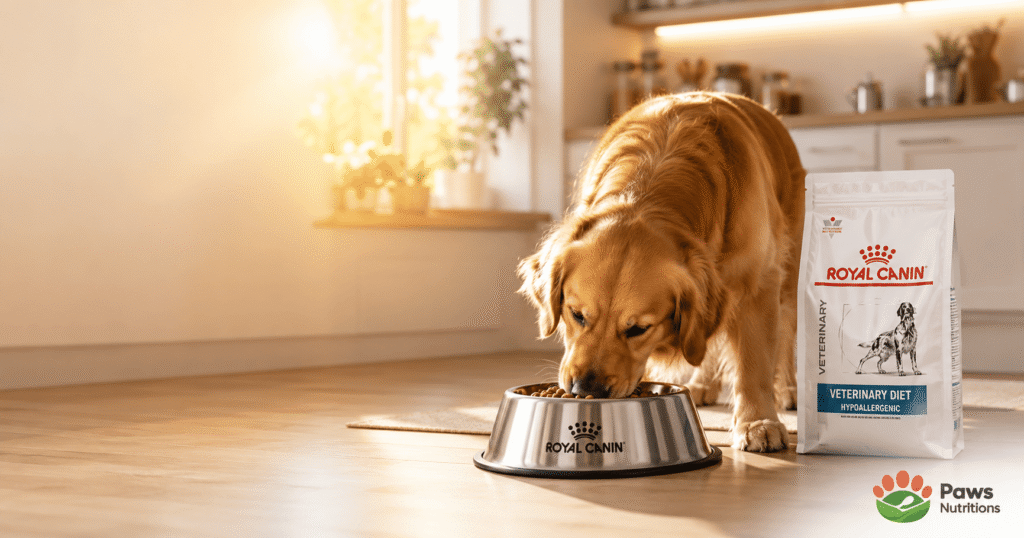
Royal Canin earns its premium price tag when you actually need what it specializes in: breed-specific precision or a veterinarian-directed medical diet. The dry matter basis numbers confirm it is not a high-protein powerhouse, and the ingredient list is more standard than the marketing suggests, but the brand’s AAFCO and WSAVA compliance, clean recent recall record, and genuinely engineered breed-specific formulas are real and well documented.
If your dog is a healthy mixed breed with no special needs, you can likely find comparable value for less money elsewhere. But if you own a breed Royal Canin specifically formulates for, or your vet has prescribed a Veterinary Diet, this is one of the more defensible premium price tags in the pet food aisle — and now you have the actual numbers, recall history, and price breakdown to decide for yourself.
The bottom line worth remembering: Royal Canin’s value proposition is precision, not luxury. It is not trying to be the highest-protein food on the shelf, the most novel ingredient list, or the cheapest bag per pound — it is trying to be the most accurately matched food to your specific dog’s breed, size, and health status, and on that specific promise, the evidence in this review shows it largely delivers.

A dedicated writer and digital enthusiast committed to creating high-quality, informative, and reader-focused content. Through thoughtful research and clear communication, he aims to deliver valuable insights that help readers navigate the ever-changing digital landscape.
What I actually concern myself most in regard to is wellbeing topics.
By myself, I subscribe to magazines that concerns this subject, and I preserve informed
about the most recent wellness research. In what way is
this important? Personally I think there is
no more crucial concentration for my energy. Also,
this blog website entry seems as if it’s well worth my time to check out again. I sift
through thousands and thousands or more of sites weekly.
Truth be told, my backbone nearly always hurts and I need a
all new pursuit. lol In any case, I believe if almost everyone published about their unique time
in the world, and did so well, we’d have a much more interesting
Cyberspace.
Thank you so much for your kind words! 😊 I’m really glad you enjoyed the post. Your encouragement means a lot, and I hope you’ll visit again for more content. Have a wonderful day!