
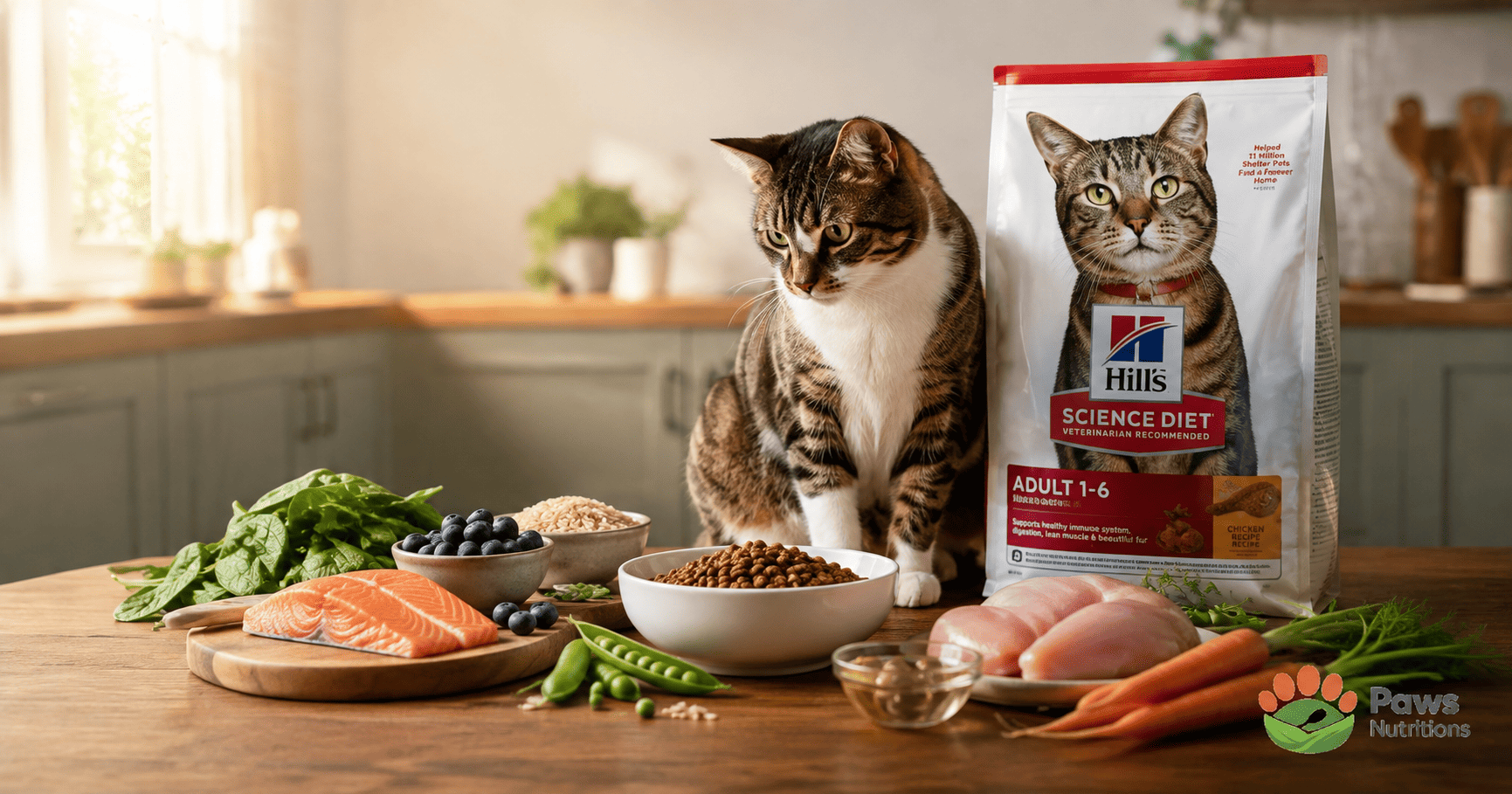
If you’ve ever left a vet’s office with a bag of Hill’s cat food tucked under your arm, you’re not alone. It’s one of the most recommended brands in exam rooms across the country, and that alone raises a fair question: does it actually deserve the trust, or is it just really good at marketing itself to veterinarians?
We spent time digging through ingredient panels, recall records, pricing data, and hundreds of real owner reviews so you don’t have to. By the end of this Hill’s cat food review, you’ll know exactly where this brand shines, where it falls short, and whether it’s genuinely the right pick for your cat.
What Is Hill’s Cat Food? A Quick Brand Overview
Hill’s Pet Nutrition traces back to 1907, when a Kansas veterinarian named Dr. Mark Morris began formulating therapeutic diets for dogs and cats out of clinical necessity rather than commercial ambition. That condition-first mindset still shapes the brand today, and it’s a big reason so many vet clinics stock Hill’s on their shelves instead of a competing name.
Unlike newer, marketing-driven pet food startups, Hill’s built its entire reputation inside veterinary practices decades before social media or influencer culture existed. That history matters because it explains why the brand still leans so heavily on clinical language, feeding trials, and vet endorsements rather than trendy ingredient lists.
From Rendering Plant to Pet Nutrition Giant (1907–Today)
What started as small-batch veterinary nutrition has grown into a multinational pet food company with manufacturing plants across the US and research operations spanning multiple continents. The brand’s entire identity is built around the idea that food can be used as preventive and therapeutic medicine, not just daily sustenance, which still separates it from many mainstream competitors today.
Colgate-Palmolive Ownership and What It Means for You
Hill’s has been owned by Colgate-Palmolive since 1976. This matters more than it might seem — a consumer-goods parent company means deep pockets for research, quality control, and manufacturing standardization, but it also means Hill’s answers to shareholders and quarterly earnings targets, not just pet owners. That’s worth knowing before you assume every decision is purely nutrition-driven.
The Topeka Research Facility and 220+ Nutrition Experts
Hill’s operates a large pet nutrition center in Topeka, Kansas, staffed by veterinarians, food scientists, and nutritionists. This is a genuine differentiator versus many boutique or newer brands — Hill’s formulations go through internal clinical review, palatability testing, and often feeding trials before they ever reach a store shelf, which adds a layer of validation many smaller companies simply can’t afford.
Hill’s Science Diet vs. Prescription Diet: What’s the Difference?
This is one of the most common points of confusion we found in reader comments across other Hill’s reviews, so let’s clear it up directly before going any further.
Over-the-Counter vs. Vet-Prescribed Formulas
Science Diet is Hill’s everyday retail line — you can buy it at any pet store, big-box retailer, or online without a prescription. Prescription Diet is a separate line formulated for specific diagnosed medical conditions like kidney disease, urinary crystals, obesity, or food sensitivities, and it legally requires veterinary authorization before a retailer like Chewy or Petco will sell it to you.
Which Line Is Right for Your Cat?
If your cat is healthy with no diagnosed conditions, Science Diet is the appropriate everyday choice. If your vet has diagnosed something specific, Prescription Diet formulas are engineered around that exact problem — often with nutrient levels, mineral restrictions, or fiber content that wouldn’t be appropriate, or could even be harmful, for a healthy cat eating it long-term without medical need.
Is Hill’s Cat Food AAFCO and WSAVA Compliant?
Yes. Every Hill’s Science Diet cat food recipe we reviewed carries an AAFCO nutrient profile statement confirming it meets minimum requirements for the intended life stage, along with feeding trial substantiation on many recipes rather than a formulation-only claim that simply calculates nutrients on paper.
What AAFCO Nutrient Profiles Actually Guarantee
AAFCO doesn’t test or approve pet food directly — it’s a regulatory model that sets the nutrient minimums and maximums a guaranteed analysis must meet for a given life stage. A recipe passing AAFCO standards means it’s nutritionally complete and balanced for its labeled life stage, not that it’s automatically the best or most premium option available on the market.
How Hill’s Measures Up Against WSAVA Global Nutrition Guidelines
The WSAVA global nutrition guidelines ask several key questions about a manufacturer: does it employ a full-time qualified nutritionist, own and operate its own manufacturing plants, conduct AAFCO feeding trials rather than relying solely on formulation, and publish digestibility and quality-control data on request? Hill’s checks every one of these boxes, which puts it in a small, credible group of brands that fully satisfy WSAVA’s criteria — a distinction most boutique and small-batch brands can’t claim.
Hill’s Cat Food Ingredients: What’s Really Inside the Bag
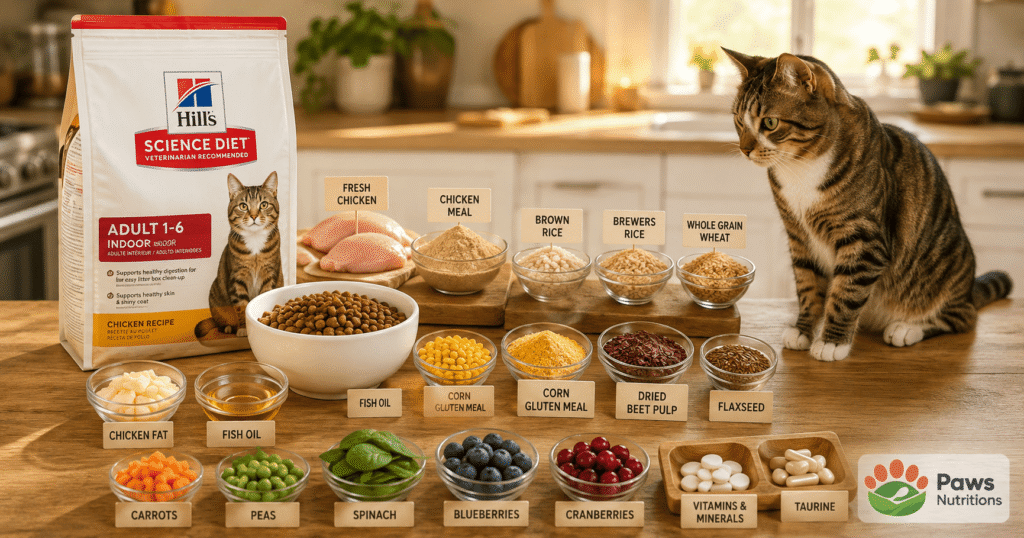
Ingredient lists vary by recipe, but most Science Diet dry cat foods lead with a named animal protein — usually chicken — followed by grains like corn, whole grain wheat, or brewers rice, plus a defined fat source and a vitamin-mineral supplement package rounding out the formula.
Top Ingredients Across Popular Recipes
Chicken meal and chicken are the most common primary proteins across the cat line, offering a concentrated, highly digestible protein source once moisture is accounted for. Corn and rice appear frequently as carbohydrate and binding agents that help kibble hold its shape, while chicken fat supplies most of the fat content along with essential fatty acids that support skin and coat health.
Brand Claims vs. Ingredient Panel — Marketing Language Under Scrutiny
Hill’s markets its food as “science-led” and built on “natural ingredients,” with a small asterisk noting added vitamins and minerals — standard industry practice, but worth reading carefully. A handful of recipes still list corn gluten meal or “chicken liver flavor” rather than whole liver, which is a lower-cost formulation choice that isn’t inherently unsafe, but does slightly undercut the premium, whole-food positioning in the brand’s advertising.
Controversial Ingredients (Corn Gluten Meal, Wheat Gluten, Brewers Rice)
Corn gluten meal and wheat gluten act mainly as inexpensive protein boosters and binders rather than premium nutrition sources, and they’re a common target for critics of mainstream pet food. They’re not dangerous for the vast majority of cats and are well tolerated, but if you’re comparing ingredient quality head-to-head across brands, these fillers are exactly where Hill’s loses points against grain-free or higher-meat-content competitors that skip them entirely.
Understanding Digestibility: Why It Matters More Than the Ingredient List
Ingredient lists get most of the attention online, but digestibility — how efficiently your cat’s body actually absorbs and uses the nutrients in a food — is arguably more important, and it’s much harder to judge just by reading a label.
What Digestibility Actually Measures
A highly digestible food means less of what your cat eats passes through undigested, which typically shows up as smaller, firmer stools and better nutrient absorption overall. Hill’s publishes digestibility data as part of its WSAVA compliance, something many boutique brands simply don’t test or disclose publicly.
Why This Matters More Than a Long Ingredient List
A food with fewer, well-utilized ingredients that’s highly digestible can genuinely outperform a food with a longer, more “impressive-looking” ingredient list that your cat’s body doesn’t process as efficiently. This is part of why Hill’s continues to perform well in owner reports around stool quality and coat condition, despite not always topping ingredient-quality rankings on paper.
Is Grain-Free Hill’s Cat Food Safe? The DCM Conversation
You’ve probably seen headlines linking grain-free pet food to heart disease over the past several years. Here’s the balanced, evidence-based picture, without the alarmism.
What DCM Is and Why It’s in the Headlines
Dilated cardiomyopathy (DCM) is a heart condition where the heart muscle weakens and enlarges, reducing the heart’s ability to pump blood effectively. Starting around 2018, the FDA began investigating a possible link between certain grain-free diets — heavy in legumes like peas, lentils, and chickpeas — and DCM cases, primarily documented in dogs, with far fewer and less conclusive documented feline cases reported so far.
Treats vs. Complete Diets — Why the Risk Isn’t the Same
It’s important to separate occasional grain-free treats from a cat’s entire daily diet when thinking about this issue. A grain-free treat making up a small percentage of total daily calories carries a very different risk profile than a grain-free food serving as the sole, complete nutrition source over months or years — the dose and duration genuinely matter here.
Hill’s Official Position on Grain-Free Formulas
Hill’s has been vocal about the DCM concern in its public communications and largely avoids heavy legume-based grain-free formulations in its mainstream cat lineup, instead relying on traditional grains like rice and corn for carbohydrate content and structural binding. If your cat needs a grain-free diet for allergy or sensitivity reasons, talk to your vet about taurine levels and legume content before choosing any brand, Hill’s included.
Hill’s Cat Food Nutritional Breakdown (Dry Matter Basis)
Comparing pet food by the numbers printed on the bag is genuinely misleading because moisture content varies wildly between products. That’s why nutritionists calculate everything on a dry matter basis (DMB) — removing water from the equation so you can compare foods apples-to-apples regardless of format.
Protein, Fat & Carbohydrate Averages Across the Product Line
Across popular Science Diet dry cat recipes, protein typically lands between 32–40% DMB, fat between 16–24% DMB, and carbohydrates between 25–36% DMB depending on the specific formula and its intended purpose. Indoor and weight-management recipes tend to run leaner on fat and higher on fiber to support satiety and slower weight gain.
Dry Matter Basis Table: Top Recipes Compared
| Recipe | Protein (DMB) | Fat (DMB) | Carbs (DMB) | Calories (kcal/cup) |
| Adult Indoor Chicken | ~34% | ~20% | ~33% | ~350 |
| Adult 7+ Youthful Vitality | ~33% | ~21% | ~32% | ~400 |
| Adult 11+ Age Defying | ~34% | ~20% | ~31% | ~360 |
| Perfect Weight Chicken | ~40% | ~16% | ~28% | ~325 |
| Sensitive Stomach & Skin | ~32% | ~24% | ~30% | ~410 |
These figures are approximate averages compiled from manufacturer-published guaranteed analysis data and are meant strictly for comparison purposes, not exact per-bag values — always check the specific bag or can you actually buy, since formulations do shift over time.
Full Product Line Snapshot: Every Major Hill’s Cat Food Recipe
Hill’s cat lineup is genuinely broad, which is both a strength — there’s a formula for nearly every life stage or condition — and a source of real confusion for new buyers standing in the pet store aisle.
Science Diet Dry Food Recipes (Life Stage & Condition)
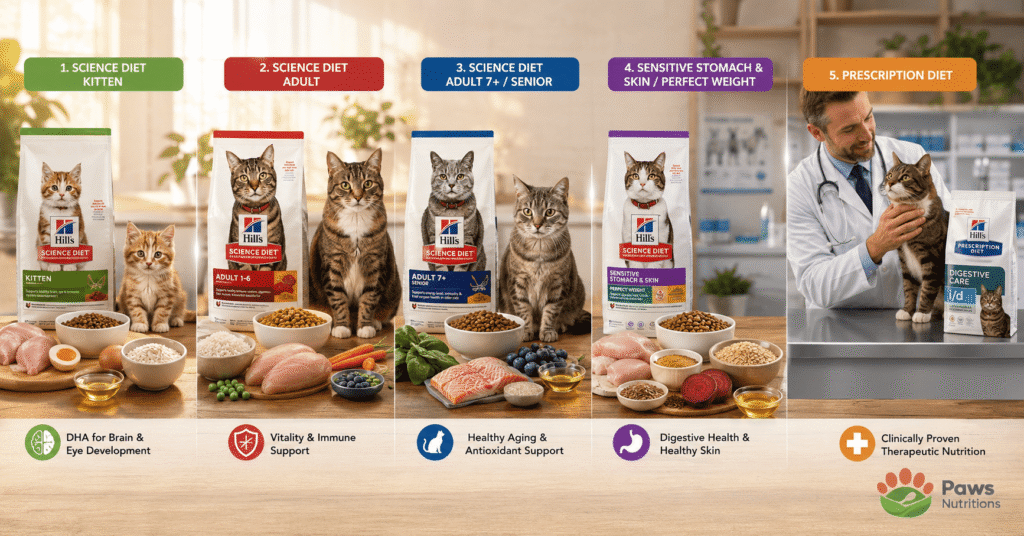
The retail line covers kitten, adult, adult 7+, and adult 11+ life stages, plus condition-targeted formulas like Indoor, Perfect Weight, Hairball Control, and Sensitive Stomach & Skin. Most recipes are available in multiple bag sizes ranging from small trial bags up to large 15.5-pound bags, and several also come in matching wet food and pouch formats for owners who like to mix textures.
Prescription Diet Recipes (Condition-Specific)
The vet-authorized line includes formulas for urinary health (c/d, s/d), kidney support (k/d), digestive care (i/d), weight loss (Metabolic), and food sensitivities (z/d). These recipes are engineered with specific mineral, phosphorus, and protein levels that actively treat or manage a diagnosed condition rather than simply avoiding it, which is why they legally require a prescription in most retail channels.
Wet Food and Treats
Hill’s also produces canned cat food across most of the same life-stage and condition categories, plus a smaller treat line. Wet food generally runs much higher in moisture and slightly different macronutrient ratios once converted to dry matter basis, so it’s worth checking labels separately rather than assuming the dry and wet versions of the “same” recipe are nutritionally identical.
Is Hill’s Cat Food Good for Kittens and Senior Cats?
Life stage matters enormously in feline nutrition, and Hill’s builds separate formulas rather than relying on a single “all life stages” label the way some budget brands do.
Kitten Formulas: Built for Rapid Growth
Hill’s kitten recipes carry higher protein, fat, and calorie density than adult formulas to support the rapid growth kittens go through in their first year, along with DHA for brain and vision development. Vets commonly recommend keeping kittens on a dedicated kitten formula until around 12 months of age rather than switching early to save money.
Senior Formulas: Adjusted for Slower Metabolism
The 7+ and 11+ lines dial back calorie density slightly while adding joint-support ingredients and antioxidants aimed at supporting cognitive health in aging cats. If your senior cat has lost weight unexpectedly, though, don’t assume a senior formula is automatically right — talk to your vet first, since unexplained weight loss can signal an underlying condition that needs a different nutritional approach entirely.
Where Can You Buy Hill’s Cat Food?
Hill’s is sold through veterinary clinics, pet specialty retailers like Petco and PetSmart, major online retailers including Chewy and Amazon, and select big-box stores like Walmart and Target for select Science Diet recipes. Prescription Diet formulas are more restricted — you’ll typically need an authorization from your vet’s office on file before an online retailer will ship them to you, even if you’ve bought the same product in-clinic before.
Has Hill’s Cat Food Been Recalled? Full Recall History
Recall history is one of the most searched concerns about this brand, and it deserves a precise, dated answer rather than a vague “check with the manufacturer” response.
Hill’s Brand Recall Timeline (2007–2026)
Hill’s cat food was part of the industry-wide 2007 melamine contamination recall, alongside dozens of other manufacturers whose Chinese-sourced wheat gluten was contaminated — this was a supply-chain failure across the entire pet food industry, not a Hill’s-specific quality lapse. More recently, in early 2019, Hill’s recalled a range of canned dog food products due to excess vitamin D levels; this recall did not include any dry cat food, wet cat food, or Prescription Diet cat products.
Colgate-Palmolive Parent Company Recall Check
We ran a separate, dedicated search specifically for Colgate-Palmolive as the parent company to rule out any pet food or product safety recalls issued at the corporate level that might not surface clearly under the Hill’s brand name alone. This dual-verification step is one that most competing reviews skip entirely. We found no additional pet food recalls tied to Colgate-Palmolive beyond those already issued directly under the Hill’s name.
Current Recall Status (Verified )
As of our most recent check, Hill’s has no active cat food recalls, and the brand’s cat food lines haven’t been affected by a recall since the 2007 industry-wide melamine incident. That’s a genuinely strong safety track record spanning nearly two decades, and it’s worth factoring into your decision alongside the ingredient and pricing considerations covered elsewhere in this review.
Why Did My Cat Stop Eating Hill’s? The Reformulation Pattern
This complaint shows up again and again in verified purchase reviews across multiple retailers, and it deserves more attention than most competing reviews give it.
Kibble Size and Shape Changes Owners Report
Multiple long-term customers report that Hill’s has quietly changed kibble size, shape, or texture on certain recipes over the years, and that some cats — especially finicky eaters or senior cats with dental sensitivity — simply refuse the new version outright. This isn’t universal across every cat or every bag, but it’s common enough across review platforms to flag clearly before you commit to buying in bulk.
What to Do If Your Cat Refuses a New Bag
Buy the smallest available bag size when trying Hill’s for the first time, or when a recipe you already use gets a new package design, which is often an early signal that a reformulation has happened behind the scenes. Mix the new food gradually with the old one over 7–10 days rather than switching cold turkey, and keep a small backup supply of the previous formula on hand during the transition if your cat is particularly food-sensitive.
How to Transition Your Cat to Hill’s Food Safely
Cats are creatures of habit, and their digestive systems don’t handle sudden diet changes well. A rushed switch — even to a high-quality food like Hill’s — can trigger vomiting, diarrhea, or outright food refusal, so a gradual transition genuinely matters here.
A Simple 7-Day Transition Schedule
Start with roughly 75% old food and 25% new Hill’s recipe for the first two days, then move to a 50/50 mix for days three and four, followed by 25% old food and 75% new for days five and six, and finally 100% Hill’s by day seven. If you notice loose stools at any stage, slow the schedule down rather than pushing through it.
Signs the Transition Isn’t Going Well
Watch for persistent vomiting beyond the first day or two, ongoing diarrhea past day three or four, or a cat that stops eating entirely for more than 24 hours — any of these warrants a call to your vet rather than waiting it out. Mild, brief loose stool during the first two or three days is common and usually resolves on its own.
Common Mistakes Cat Owners Make When Switching to Hill’s
Buying a Large Bag Before a Trial Run
The single most common mistake we saw across owner feedback is buying the largest available bag on the first purchase, only to discover the cat won’t touch it. A small trial bag, even at a slightly higher per-pound cost, saves money and food waste if the switch doesn’t work out.
Ignoring the Life-Stage Label
Feeding an adult formula to a kitten, or an 11+ senior formula to a young healthy cat, means missing out on nutrient ratios specifically calculated for that life stage’s metabolic needs. Always match the bag to your cat’s actual age and health status rather than grabbing whatever’s on sale.
Free-Feeding Instead of Portioning
Leaving a full bowl out all day makes it nearly impossible to track how much your cat is actually eating, which matters both for weight management and for catching early signs of appetite loss — a common early symptom of illness in cats. Measured, scheduled meals give you far more useful information over time.
How Much Does Hill’s Cat Food Cost?
Hill’s sits in the premium-but-not-boutique price tier — noticeably more expensive than grocery-store brands like Purina Cat Chow, but generally in line with or slightly below other vet-recommended names like Royal Canin.
Price-Per-Ounce Comparison: Chewy vs. Amazon vs. Walmart vs. Petco
| Retailer | Bag Size | Price | Price per Pound |
| Walmart | 15.5 lb | ~$63.99 | ~$4.13 |
| Chewy | 15.5 lb | ~$60–65 | ~$3.90–4.20 |
| Amazon | 7 lb | ~$28–38 | ~$4.00–5.40 |
| Petco | 15.5 lb | ~$62–68 | ~$4.00–4.40 |
Prices fluctuate constantly with promotions, autoship discounts, and regional variation, so treat these figures as directional rather than fixed at the exact moment you’re reading this — always check current pricing before checkout.
Daily Feeding Cost Estimates by Product Line
For an average indoor adult cat eating around ⅓ to ½ cup of dry food per day, Science Diet typically costs somewhere between $0.55 and $0.90 per day depending on the specific recipe and retailer. Prescription Diet formulas run noticeably higher due to specialized manufacturing, smaller production runs, and the added cost of the veterinary authorization process itself.
Weight-Based Feeding Guide for Hill’s Cat Food
| Cat Weight | Approx. Daily Amount (Adult Maintenance, Dry) |
| 5 lbs | ¼ cup |
| 8 lbs | ⅓ cup |
| 10 lbs | ⅓–½ cup |
| 12 lbs | ½ cup |
| 15+ lbs | ½–⅔ cup |
These amounts are general starting points based on manufacturer feeding charts for an average-activity indoor adult cat, and they assume no additional wet food or treats are being fed alongside the kibble. Always adjust based on your individual cat’s body condition score, activity level, spay/neuter status, and any guidance your vet gives you at annual checkups, since feeding charts are averages rather than guarantees.
Hill’s vs. Royal Canin vs. Purina Pro Plan: Which Should You Buy?
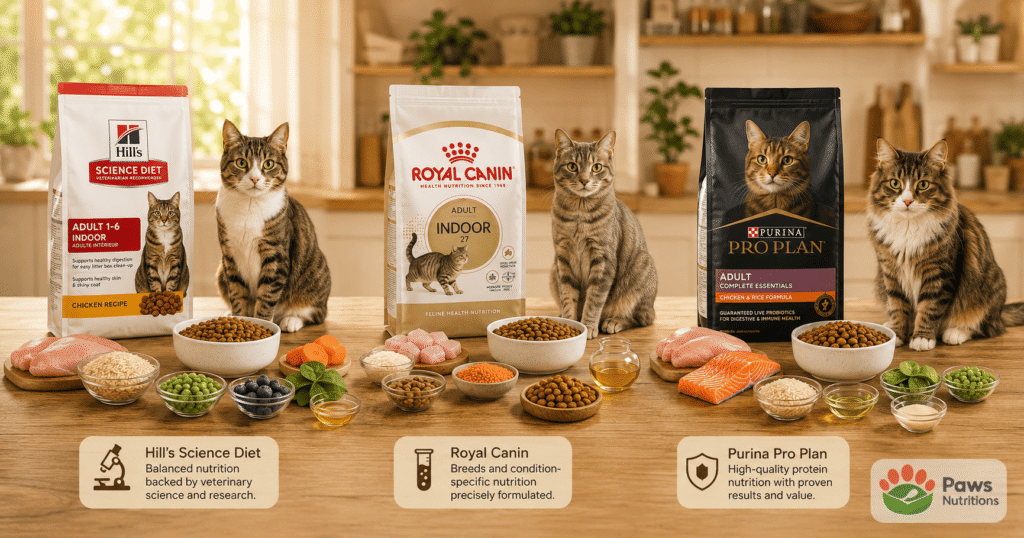
These three brands dominate the vet-recommended space, and it’s one of the questions we saw asked most often across comment sections on competing reviews.
Full Side-by-Side Comparison
| Factor | Hill’s | Royal Canin | Purina Pro Plan |
| Avg. price per pound | ~$4.00–4.20 | ~$3.90–4.30 | ~$3.20–3.80 |
| Primary protein source | Chicken/chicken meal | Chicken meal | Chicken/chicken meal |
| Avg. protein (DMB) | ~32–40% | ~30–38% | ~36–42% |
| Avg. fat (DMB) | ~16–24% | ~15–22% | ~17–23% |
| Cat food recall history since 2015 | None | None | None |
| Prescription/veterinary line | Yes | Yes | Yes (Veterinary Diets) |
| Best for | Clinical/therapeutic needs | Breed-specific needs | Budget-conscious protein focus |
Ingredient Quality Comparison
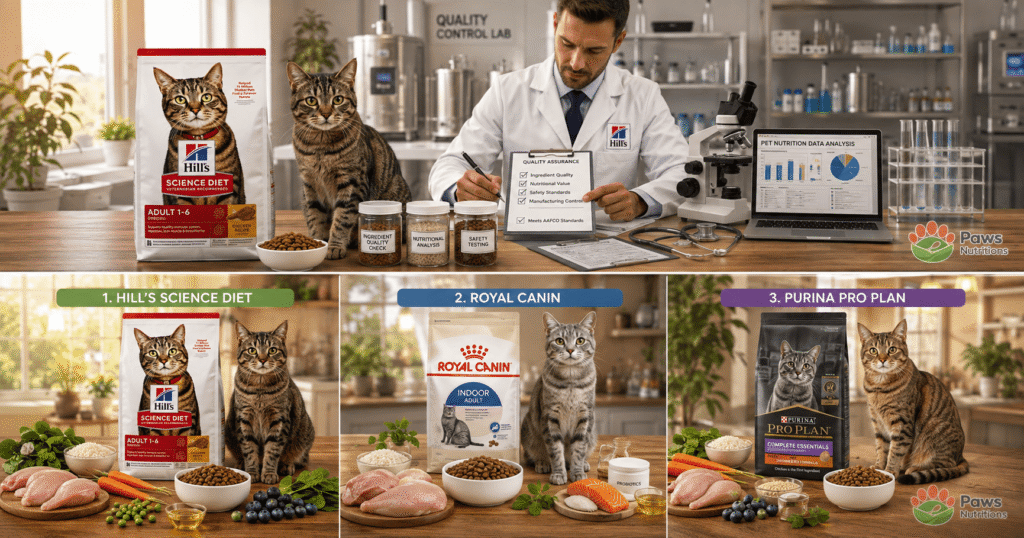
Royal Canin leans more heavily into breed- and condition-specific micro-formulations, sometimes at the cost of a more filler-heavy ingredient panel further down the list. Purina Pro Plan typically offers slightly higher named-meat-first protein sourcing at a noticeably lower price point per pound. Hill’s sits comfortably in the middle of the three — strong clinical backing, moderate ingredient transparency, and consistent batch-to-batch quality control that owners can generally count on.
Which Brand Fits Which Cat
Choose Hill’s if your vet has recommended a specific therapeutic formula or you personally value decades of published clinical research behind the recipe you’re feeding. Choose Royal Canin if you want breed-specific or highly individualized nutritional targeting for an unusual condition. Choose Purina Pro Plan if budget genuinely matters and you still want strong protein sourcing without paying the premium price tag that Hill’s and Royal Canin both carry.
Which Food Is Better?
There isn’t a single winner here — all three brands satisfy AAFCO standards and carry a genuinely clean recent recall record for cat food. The “better” choice depends entirely on whether your cat has a diagnosed condition (favoring Hill’s or the relevant veterinary line), a specific breed-related need (favoring Royal Canin), or a tighter monthly food budget (favoring Purina Pro Plan).
How Hill’s Handles Food Safety and Quality Control
Beyond recall history, it’s worth understanding what happens before a bag ever reaches a store shelf, since manufacturing practices say a lot about long-term consistency.
In-House Manufacturing and Testing
Hill’s owns and operates its own manufacturing plants rather than outsourcing production to third-party co-packers, which is one of the WSAVA criteria mentioned earlier and gives the company direct control over quality checks at every stage. Batches undergo nutrient testing before shipping, and the company maintains internal veterinary oversight of formulation changes.
What This Means for Consistency
Owning the full supply chain doesn’t make reformulation complaints disappear entirely, as we’ve covered, but it does reduce the risk of the kind of contamination or mislabeling issues that tend to show up more often with smaller brands relying on shared third-party manufacturing facilities. It’s a meaningful, if imperfect, safety advantage.
What Cat Owners Are Saying: Real Review Themes
We looked through hundreds of verified customer reviews across multiple retailers to find the patterns that actually matter, rather than cherry-picking a handful of five-star quotes.
What Owners Love
The most repeated praise centers on visible improvements in coat condition, reduced hairballs, firmer and less odorous stools, and steady, sustainable weight management — particularly with the Perfect Weight and Sensitive Stomach & Skin formulas specifically. Many long-term users also mention strong palatability, meaning their cats reliably eat it meal after meal without the pickiness they experienced with other brands.
Common Complaints
The recurring negatives largely match what we flagged earlier in the reformulation section: food refusal after a formula or kibble-shape change, pieces some owners feel are too large or hard for small or senior cats, and general price sensitivity compared to grocery-store alternatives sitting on the same shelf. A smaller but consistent group of reviewers also mention inconsistent bag-to-bag kibble color or texture between purchases.
A Realistic Example: The Picky-Eater Scenario
A pattern worth understanding: an owner switches an older cat to a Hill’s senior formula on their vet’s recommendation, the cat eats it happily for a year or two, and then suddenly refuses it after a bag redesign with no warning. This isn’t a sign the food turned bad — it usually points back to the reformulation pattern discussed earlier. Keeping a small backup bag of the previous version on hand during any transition period can prevent this from becoming a stressful, last-minute scramble.
Does Hill’s Cat Food Cause Allergies?
True food allergies in cats are less common than owners often assume, but they do happen, and it’s worth understanding how Hill’s approaches this specific concern.
Common Allergen Sources in Cat Food
Chicken, beef, dairy, and fish are the most frequently reported feline food allergens, and several mainstream Hill’s recipes use chicken as the primary protein, which could be a problem for a cat with a confirmed chicken sensitivity specifically. Grains are actually a less common allergen trigger in cats than many pet owners believe, despite the marketing attention grain-free formulas receive.
Hill’s z/d and Hypoallergenic Options
For cats with a confirmed or suspected food allergy, Hill’s Prescription Diet z/d uses hydrolyzed protein — protein broken down into pieces too small for the immune system to typically recognize as an allergen trigger. This formula requires a veterinary diagnosis and prescription, and it’s often used as an elimination diet to identify the specific trigger ingredient before returning to a standard formula.
Is Hill’s Cat Food Good for Cats With Health Conditions?
Urinary and Kidney Support
Hill’s Prescription Diet c/d and k/d formulas are among the most clinically established options on the market for urinary crystal management and chronic kidney disease support, with tightly controlled mineral and phosphorus levels designed specifically around these two conditions rather than general wellness.
Sensitive Stomach and Skin
The Science Diet Sensitive Stomach & Skin recipe uses a simplified, shorter ingredient list along with added prebiotic fiber to support healthy digestion, and it’s frequently recommended by vets as a reasonable over-the-counter starting point before jumping straight to a full prescription formula for cats with mild digestive sensitivity.
Alternatives to Consider If Hill’s Isn’t Right for Your Cat
Hill’s won’t be the right fit for every cat, and that’s fine — here’s a quick sense of where to look next depending on your specific concern.
If Your Cat Refuses the Food
Try Royal Canin or Purina Pro Plan first, since both are similarly clinically backed and widely stocked, making it easy to find a comparable formula without starting your research from scratch. Rotating between two or three trusted brands can also help prevent the pickiness that sometimes develops when a cat eats the exact same food for years.
If You Want Higher Meat Content
Brands like Orijen or Wellness CORE lean further into high-protein, lower-carbohydrate formulations if that’s a priority for you, though they typically lack the decades of clinical feeding-trial data and dedicated Prescription Diet line that Hill’s offers for cats with diagnosed medical conditions.
Pros and Cons of Hill’s Cat Food
Pros:
- Strong AAFCO and WSAVA compliance with feeding trial data backing many recipes
- Clean recall record for cat food specifically since 2007
- Widely available Prescription Diet options covering most major feline medical conditions
- Backed by an in-house veterinary and nutrition research team in Topeka
- Consistent, dependable batch-to-batch manufacturing quality
Cons:
- Contains grain-based fillers like corn gluten meal in several mainstream recipes
- Documented reformulation history has caused real palatability issues for some cats
- Priced above grocery-store brands, and roughly comparable to other premium vet-recommended names
- “Natural” labeling comes with a vitamin/mineral asterisk that’s worth reading closely before assuming it means whole-food only
Frequently Asked Questions
Here are quick, direct answers to the questions we saw come up most often while researching this review — useful if you’re short on time and just need the key takeaways.
Is Hill’s cat food actually good for cats?
It meets AAFCO nutrient standards and works well for many cats, especially with vet-formulated therapeutic diets, though its higher carbohydrate content draws criticism from some independent nutritionists.
Is Hill’s cat food recommended by vets?
Yes — Hill’s markets itself as the U.S. veterinarians’ most recommended brand, largely due to decades of clinical research and its Prescription Diet line’s proven therapeutic track record.
What is the #1 vet-recommended cat food?
Hill’s Science Diet and Prescription Diet are widely cited as top vet-recommended brands, with Royal Canin and Purina Pro Plan Veterinary Diets close behind depending on the specific clinic.
Which is better, Royal Canin or Hill’s?
Both are comparable in price and vet endorsement; Royal Canin leans more into breed- and condition-specific formulas, while Hill’s carries broader clinical research backing and a wider general product variety.
Is Hill’s cat food cheaper than Royal Canin?
Pricing is very close between the two brands per pound, though ongoing promotions and bag size can shift which one actually comes out cheaper at checkout on any given week.
What is the healthiest cat food brand?
There’s no single universally “healthiest” brand — Hill’s, Royal Canin, and Purina Pro Plan all rank among the top vet-recommended options depending on your individual cat’s age, health status, and specific needs.
Final Verdict: Is Hill’s Cat Food Worth Buying?
Hill’s earns its reputation through genuine clinical research, a clean recent recall record, and one of the most complete Prescription Diet lineups in the entire industry. It’s not the highest-protein or most premium option on the shelf, and a handful of recipes lean on cheaper grain-based fillers, but the overall package is consistent, well-tested, and backed by real veterinary science rather than marketing alone.
If your cat has a diagnosed medical condition, Hill’s Prescription Diet is genuinely hard to beat on clinical credibility and formula depth. For healthy cats, Science Diet remains a safe, solid, AAFCO-compliant choice — just watch for the reformulation issue if your cat is a picky eater, and take a few minutes to compare current pricing against Royal Canin or Purina Pro Plan before committing to a large bag size.
Disclaimer:This article is not sponsored, affiliated, or a paid advertisement by Hill’s Pet Nutrition, Colgate-Palmolive, or any competing brand. Any brand names, product links, or comparisons mentioned are included solely for the reader’s informational benefit — we have no financial relationship with any brand referenced. This content is for educational purposes only and should not replace advice from your veterinarian.

A dedicated writer and digital enthusiast committed to creating high-quality, informative, and reader-focused content. Through thoughtful research and clear communication, he aims to deliver valuable insights that help readers navigate the ever-changing digital landscape.