
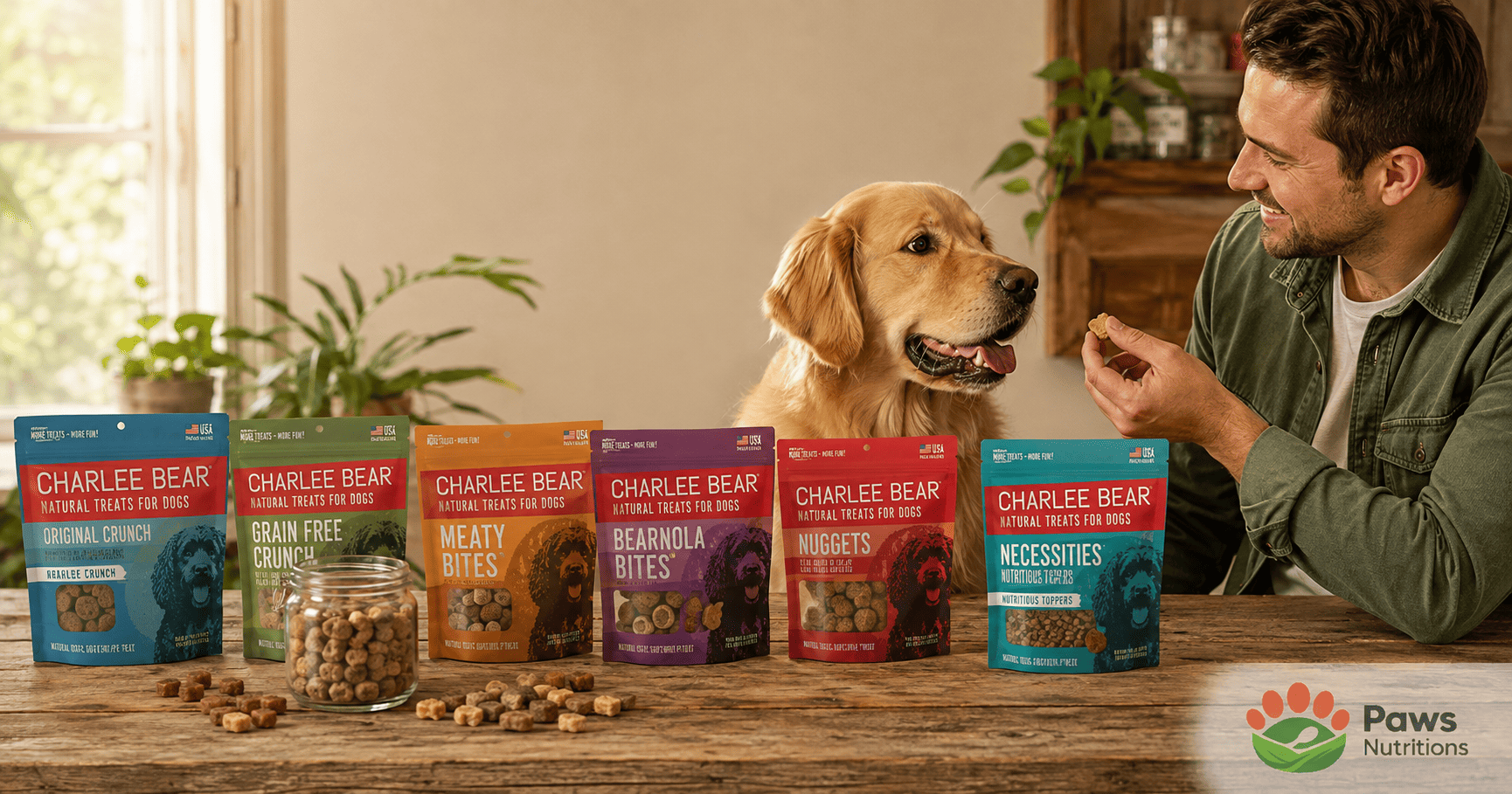
If you’ve ever reached into your pocket during a training session only to find your treats turned to crumbs, you already know why so many owners reach for Charlee Bear dog treats. These bite-sized, three-calorie biscuits have built a loyal following since the 1990s. But with a “grain free” tagline splashed across the homepage, plenty of owners wonder what’s actually inside the bag.
That’s exactly what this guide answers. We checked ingredient panels SKU by SKU, verified the brand’s full recall history, and compared prices across Chewy, Walmart, Target, and Amazon. You’ll also get a weight-based feeding guide and a straight answer on whether Charlee Bear dog treats deserve a spot in your dog’s treat jar.
How We Researched This Review
Before writing a word of this guide, we pulled live pricing directly from Chewy, Walmart, Target, and Amazon, cross-checked ingredient panels against multiple retailer listings and the brand’s own product pages, and ran a dual recall search covering both the Charlee Bear name and its parent company, Gott Pet Products. We also reviewed long-running pet owner discussion threads to surface real, recurring questions that owners have been asking about this brand for years. The goal was to move past copy-pasted marketing language and verify what’s actually true, SKU by SKU.
What Is Charlee Bear? Brand Story & Ownership
Charlee Bear started as a family recipe back in 1992, formally launching as a brand in 1997. The name comes from a real rescue dog named Charlee, whose round face and gentle nature reportedly reminded his family of a teddy bear. That backstory still shows up in the brand’s packaging and marketing today, and it’s part of why the brand has such a strong emotional connection with long-time customers.
The Real “Charlee” Behind the Name
According to the brand’s own account, Charlee was a small rescue dog who became the inspiration for the very first recipe. The founding family wanted a treat that was gentle enough for frequent feeding but tasty enough that dogs would respond consistently during training — a combination that wasn’t common in the pet treat aisle of the early 1990s.
Who Owns Charlee Bear?
Today, Charlee Bear is owned by Gott Pet Products, LLC, a family-owned company based in Wisconsin. Gott Pet Products also owns Hound & Gatos, a grain-free canned cat and dog food brand it acquired in June 2018. Knowing the parent company matters here, because it lets you check the whole corporate family’s safety track record, not just one brand name in isolation.
Steve Brown and the Original Formula
The original recipe is credited to Steve Brown, a well-known author on raw feeding and canine nutrition, and someone who has contributed nutrition insights to major pet food advisory sites. His background lends a degree of formulation credibility that’s worth noting, since many training-treat brands never disclose who actually developed their recipes or what nutritional philosophy shaped them.
Sister Brand: The Hound & Gatos Connection
Hound & Gatos is worth mentioning here because it shares ownership, manufacturing philosophy, and quality-control standards with Charlee Bear. Since its founding in 2010, Hound & Gatos has never had a product recall — a track record that reflects positively on how the parent company approaches food safety across its portfolio.
Table 1: Brand Snapshot
| Detail | Information |
| Founded | 1992 (recipe), 1997 (brand launch) |
| Headquarters | Wisconsin, USA |
| Parent company | Gott Pet Products, LLC |
| Sister brand | Hound & Gatos (canned cat/dog food) |
| Manufacturing | USA-made, contract-manufactured |
| Formula credit | Steve Brown, canine nutrition author |
Charlee Bear Product Line Explained
Charlee Bear isn’t a single product anymore — it’s grown into six distinct lines, and that matters because each one has a different ingredient profile. Lumping them together, the way a lot of retail listings do, is where a lot of the confusion around this brand starts. Understanding which line you’re actually buying is the single most useful thing you can do before adding a bag to your cart.
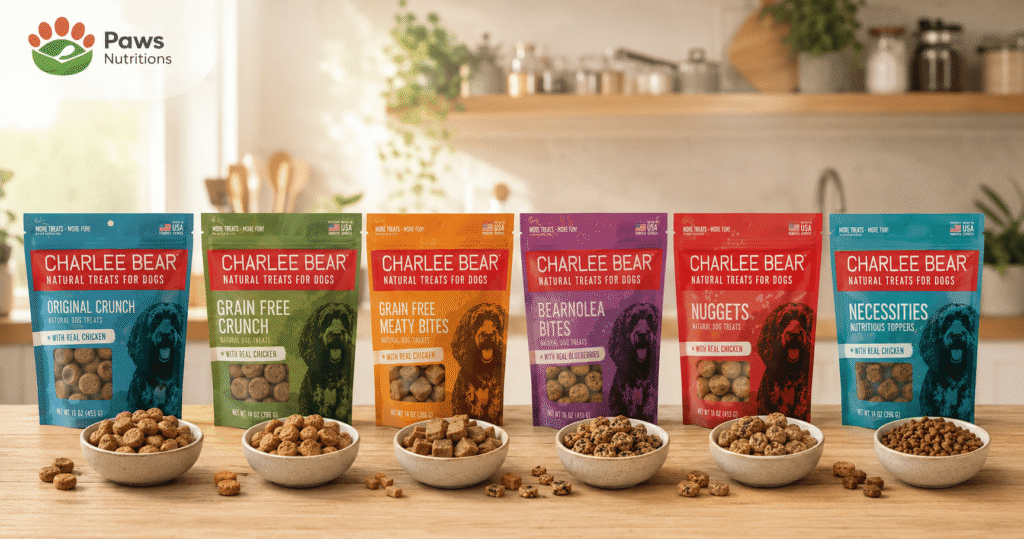
Original Crunch
Original Crunch is the baked biscuit that started it all, sold in flavors like Cheese & Egg, Chicken Liver, Turkey Liver & Cranberries, and Chicken Soup & Garden Veggie. These are wheat-based biscuits, baked for a light, crumb-free crunch, and they remain the brand’s best-selling and most widely available line.
Grain Free Crunch
Grain Free Crunch is a separate line entirely, formulated without wheat, corn, or soy. Flavors include Bacon & Blueberry, Peanut Butter & Banana, Chicken/Pumpkin/Apple, Turkey/Sweet Potato/Cranberry, and Beef & Cheese. This is the line to reach for if you specifically need a genuinely grain-free training treat.
Grain Free Meaty Bites
Grain Free Meaty Bites are freeze-dried rather than baked, which means they pack a noticeably higher protein density per treat. Flavors include Beef Liver & Sweet Potatoes, Chicken & Blueberries, Beef Liver & Apples, and Beef & Cheese. These cost more per ounce, but many owners consider them worth it for high-value rewards.
Bearnola Bites
Bearnola Bites lean into a granola-inspired recipe built around oats, cranberries, peanut butter, and honey. Flavors include Peanut Butter & Honey, Blueberry Pie, Cranberry Cobbler, and Pumpkin Spice. This line isn’t grain-free, since oats are the base ingredient.
Nuggets
Nuggets, launched most recently, are filled-center crunchy treats — crunchy on the outside with a soft, flavorful center. Flavors include PB & Beary Parfait, Sunny Side Up, Strawbeary Swirl, Shepherds Pie, and Bearcuterie Bites. As one of the newer additions to the lineup, Nuggets haven’t received much independent review coverage yet.
Necessities Toppers
Necessities Toppers are freeze-dried meal toppers built around specific health goals rather than being a standalone treat. Varieties include Salmon & Whitefish (hip and joint support), Chicken (digestive health support), Beef (immune health support), and Pork (skin and coat support). These are meant to be sprinkled over regular meals, not handed out as training rewards.
Table 2: Product Line Comparison
| Product Line | Format | Example Flavors | Grain-Free? |
| Original Crunch | Baked biscuit | Cheese & Egg, Chicken Liver | No |
| Grain Free Crunch | Baked biscuit | Bacon & Blueberry, Chicken/Pumpkin/Apple | Yes |
| Grain Free Meaty Bites | Freeze-dried | Beef Liver & Apples, Chicken & Blueberries | Yes |
| Bearnola Bites | Baked, granola-style | Peanut Butter & Honey, Pumpkin Spice | No |
| Nuggets | Filled-center crunchy | PB & Beary Parfait, Shepherds Pie | No |
| Necessities Toppers | Freeze-dried topper | Salmon & Whitefish, Chicken | Yes |
Charlee Bear Ingredients: What’s Really Inside
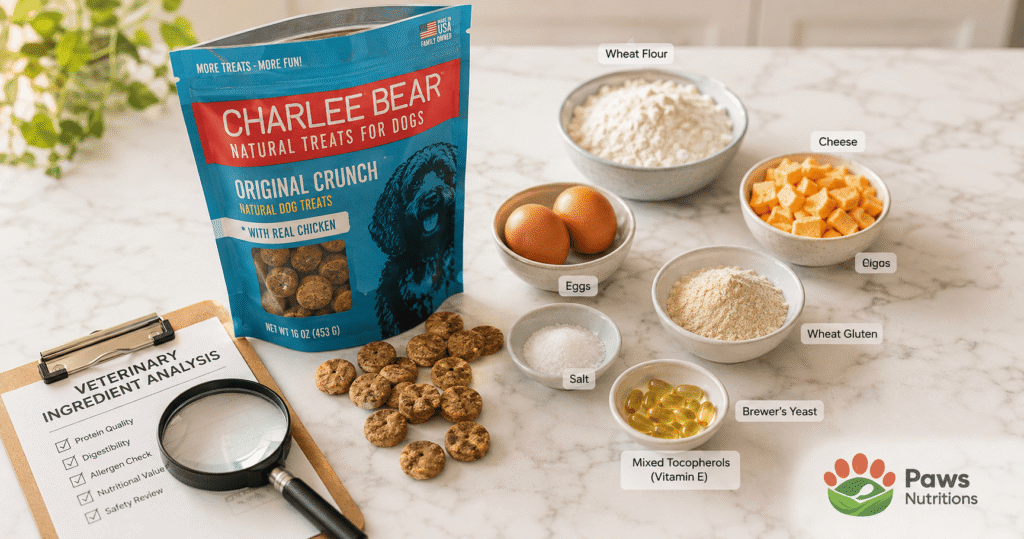
This is the section most competitor articles skip, and it’s the one that matters most if your dog has food sensitivities. We pulled the actual ingredient panel for one of the brand’s best-selling SKUs, Original Crunch Cheese & Egg: Wheat Flour, Cheese, Wheat Gluten, Dried Egg Product, Salt, Brewer’s Yeast, and Mixed Tocopherols (a natural preservative used to protect fat freshness).
Notice that wheat flour is the very first ingredient, meaning it makes up the largest portion of the treat by weight. That’s not a criticism on its own — wheat isn’t inherently bad for most dogs, and it’s a normal, digestible carbohydrate source in pet food — but it directly contradicts the idea that “Charlee Bear” as a whole brand is grain-free. Only the Grain Free Crunch, Grain Free Meaty Bites, and Necessities Toppers lines actually skip wheat, corn, and soy entirely. Original Crunch, Bearnola Bites, and Nuggets do not.
Original Crunch Ingredient Panel
Beyond Cheese & Egg, other Original Crunch flavors follow a similar structure: a wheat-based flour, a named protein or flavor source (cheese, liver, chicken), salt, brewer’s yeast, and a natural preservative. Some flavors, like Liver, also include garlic powder for flavoring.
Grain Free Crunch Ingredient Panel
The Grain Free Crunch line replaces wheat flour with alternative carbohydrate sources like pea flour, tapioca, or potato starch, paired with named proteins such as chicken, beef, or turkey and real fruit or vegetable inclusions like blueberries, bananas, or sweet potatoes.
Is Charlee Bear Actually Grain-Free?
No, not across the board. Only three of the six product lines are formulated without grains. If your dog needs a genuinely grain-free treat, stick specifically to Grain Free Crunch, Grain Free Meaty Bites, or Necessities Toppers, and always double-check the ingredient panel on the specific bag before buying, since packaging redesigns happen periodically.
Garlic Powder in Dog Treats: Is It Safe?
Garlic powder shows up in some Charlee Bear flavors, and it’s a fair question to raise since garlic in large amounts is genuinely toxic to dogs, capable of damaging red blood cells. In the tiny concentrations used purely for flavoring treats, it’s generally considered safe by veterinary toxicology standards, but dogs with known garlic sensitivities, or breeds like Japanese Akitas and Shiba Inus that show heightened sensitivity to allium compounds, should avoid these specific flavors altogether.
Are Charlee Bear Treats Suitable for Dogs with Allergies?
Dogs with confirmed food allergies need named, single-source proteins and predictable ingredient lists, and most Charlee Bear flavors do use named proteins like chicken, beef, or turkey rather than vague “meat by-products.” That said, several flavors combine multiple proteins or add dairy (cheese) and egg, which are two of the more common canine allergens. If your dog has a diagnosed allergy, cross-reference the specific flavor’s ingredient panel against your vet’s elimination-diet list rather than assuming any “natural” treat is automatically safe.
Dry Matter Basis Nutrition Breakdown
Guaranteed analysis numbers on a bag only tell part of the story, since treats are sold “as fed” with moisture still included in the percentages. Converting to a dry matter basis (DMB) removes the water content from the equation and gives you a cleaner, more accurate comparison between products with different moisture levels. Based on the label for Original Crunch Cheese & Egg, crude protein sits at a minimum of 18%, crude fat at a minimum of 8%, crude fiber at a maximum of 5%, and moisture capped at 10%.
Calorie-wise, Charlee Bear treats run about 2.9 kcal per treat, or roughly 3,160 kcal/kg on a metabolizable energy basis. That’s genuinely low compared to most training treats on the market, many of which run anywhere from 8 to 20 calories per piece, and it’s the brand’s core selling point.
Table 3: DMB Nutrition Snapshot (Original Crunch Cheese & Egg)
| Nutrient | Guaranteed Analysis (As Fed) | Notes |
| Crude Protein | 18% min | Reasonable for a training treat |
| Crude Fat | 8% min | Moderate |
| Crude Fiber | 5% max | Standard |
| Moisture | 10% max | Low moisture, shelf-stable |
| Calories | ~2.9 kcal/treat | Ideal for frequent rewards |
Understanding Guaranteed Analysis Labels
Every bag of dog treats carries a “guaranteed analysis” panel listing minimum or maximum percentages for protein, fat, fiber, and moisture. These numbers are legally required, but they’re often misread. A “minimum” protein figure means the treat contains at least that percentage, not exactly that percentage, and manufacturers can legally exceed it without updating the label right away. Reading past the marketing claims and into this panel directly is the single best habit any pet owner can build when comparing treats side by side.
AAFCO and WSAVA Compliance: Are These Treats Nutritionally Sound?
It’s important to set expectations here: Charlee Bear treats, like nearly all dog treats on the market, are not formulated to meet AAFCO’s nutritional adequacy standards for a complete and balanced diet. That’s not a red flag specific to this brand — it applies to virtually every treat sold, from jerky strips to dental chews. Treats are meant to supplement, not replace, a dog’s regular food, and no responsible manufacturer markets them as a meal substitute.
What AAFCO Approval Means for Treats vs. Complete Diets
AAFCO’s “complete and balanced” designation only applies to foods tested or formulated to meet a dog’s full daily nutrient requirements. Since treats make up a small fraction of daily intake, they’re exempt from this standard, though reputable brands still test for guaranteed analysis accuracy and safety.
WSAVA Guidelines and Where Treats Fit In
WSAVA guidelines, which many veterinary nutritionists reference when counseling clients, generally recommend that treats make up no more than 10% of a dog’s total daily calories, with the remaining 90% coming from a complete and balanced main diet. Because Charlee Bear treats run so low in calories per piece, they actually make it easier to stay under that 10% threshold than higher-calorie jerky-style or biscuit-style treats from other brands.
Grain-Free Treats and the DCM Conversation
Any discussion of grain-free pet products in 2026 has to address the FDA’s ongoing investigation into a possible link between grain-free diets and dilated cardiomyopathy (DCM) in dogs. The investigation, which began in 2018, has never established a confirmed causal link between grain-free formulas and DCM specifically, and the picture remains genuinely unresolved among veterinary researchers, with some suspecting legume-heavy formulations rather than the absence of grain itself.
Why Treats Carry Different Risk Than Complete Diets
Here’s the distinction that matters most: the DCM concern applies almost entirely to complete and balanced grain-free diets fed as a dog’s primary food source over months or years, not to treats given occasionally in small quantities. Since Charlee Bear’s grain-free lines are treats, not meals, the total exposure and caloric contribution is dramatically lower than a dog’s daily kibble or wet food.
Where Charlee Bear’s Grain-Free Line Fits This Discussion
If your dog already eats a grain-free complete diet as their main food, it’s worth discussing your dog’s full nutritional picture — treats included — with your veterinarian, simply so the conversation accounts for total legume and grain-free exposure across everything your dog eats in a day, not just the main meal.
How Charlee Bear Treats Fit Different Life Stages
Not every flavor or format suits every age of dog, and it’s worth thinking through your dog’s specific life stage before settling on a line.
Puppies
Puppies old enough to safely chew and swallow regular kibble can generally handle Charlee Bear’s crunchy biscuits without issue, since the treats are small and don’t pose a significant choking risk for most breeds. That said, very young or toy-breed puppies should start with a half-treat at a time to gauge digestive tolerance before working up to a full piece.
Adult Dogs
Adult dogs are the primary audience for this brand, and the low-calorie format works well for both everyday training and casual rewarding without meaningfully affecting a healthy adult’s weight management plan, provided the 10% daily calorie guideline is respected.
Senior Dogs
Senior dogs, especially those with dental sensitivity, often do well with Charlee Bear’s light, crumbly crunch compared to harder, denser biscuits from other brands. However, seniors managing kidney or liver conditions should have their vet review the sodium and protein content of any treat, Charlee Bear included, before adding it to a restricted diet.
Common Mistakes Owners Make When Using Training Treats
Even a well-formulated treat can cause problems if it’s used incorrectly, so it’s worth flagging a few patterns we consistently see among dog owners.
Treating Every Reward the Same Way
Not every behavior deserves the same reward. Using a premium, high-value flavor like liver for something as simple as sitting on command trains your dog to expect the best treat for minimal effort, which weakens the reward’s impact for harder tasks later.
Ignoring the 10% Rule During Long Training Sessions
It’s easy to lose count during an extended backyard training session, especially with a treat this small and low-calorie. Pre-portioning a day’s worth of treats into a small container before you start training helps you stick to the recommended daily amount without having to count individual pieces mid-session.
Assuming All Flavors Are Interchangeable
As covered earlier, Original Crunch and Grain Free Crunch aren’t nutritionally identical. Swapping between them without checking the ingredient panel can catch owners off guard if their dog has a wheat sensitivity they didn’t realize was relevant to a “treat” rather than a full meal.
Charlee Bear Recall History: Full Transparency Timeline
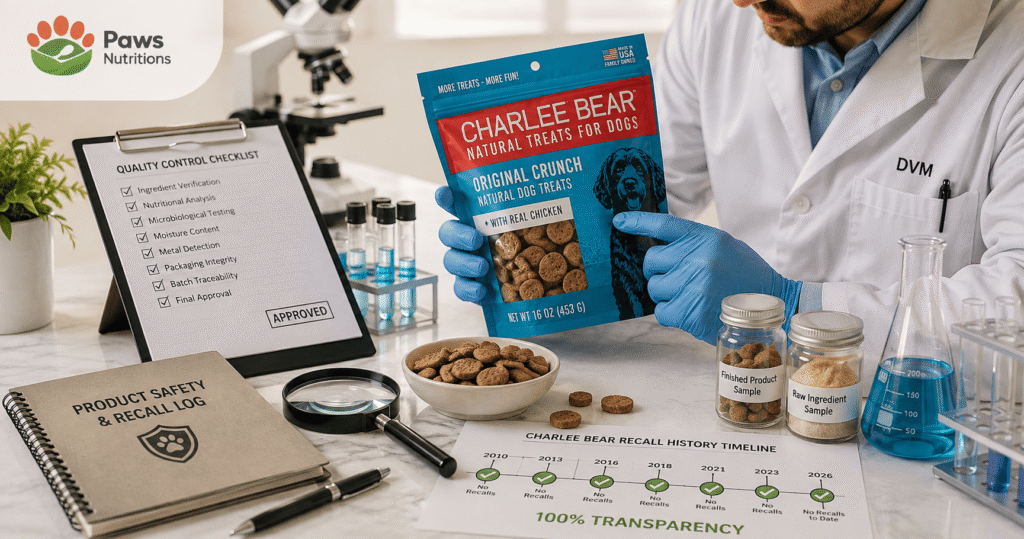
Recall history is one of the clearest ways to judge a pet food company’s manufacturing standards, so we ran a dual search covering both the Charlee Bear brand name and its parent company, Gott Pet Products, rather than relying on brand-name search results alone. Voluntary recalls, like the one described below, are actually a positive signal in one specific sense: they show a company caught a potential issue through its own testing and acted before problems reached consumers at scale, rather than waiting for outside pressure or a wave of complaints to force action.
The 2012 Protein Crunch Bar Salmonella Recall
Charlee Bear itself has one confirmed recall. On November 1, 2012, the company voluntarily recalled specific lots of its Protein Crunch Bar treats (Chicken Recipe with Carrots and Chicken Recipe with Sweet Potatoes) due to potential Salmonella contamination discovered during routine finished-product testing. The affected treats were distributed nationally in September and October 2012, sold in 5.5 oz packages under two specific UPC codes and lot numbers. According to the company’s own statement and FDA records, there were no confirmed human or animal illnesses tied to the recall. Notably, the Protein Crunch Bar line no longer exists in the current product lineup, having been discontinued sometime after the incident.
Parent Company Gott Pet Products and Hound & Gatos Recall Check
We also checked the parent company and sister brand specifically, since a brand-name-only search can miss issues tied to shared manufacturing or ownership. Gott Pet Products and Hound & Gatos have zero recalls on record since Hound & Gatos launched in 2010, according to multiple independent pet food safety trackers, including sources that specifically monitor FDA recall databases.
Current Recall Status
That works out to more than 13 years without a repeat incident across the Charlee Bear brand, and zero incidents whatsoever for its sister brand. That’s a genuinely strong track record in an industry where recalls, unfortunately, remain fairly common across many well-known brands.
Table 4: Recall Timeline
| Date | Product | Reason | Outcome |
| November 1, 2012 | Protein Crunch Bars (Chicken/Carrots, Chicken/Sweet Potato) | Potential Salmonella contamination | Voluntary recall; no confirmed illnesses; product line discontinued |
| Since 2013 | All current Charlee Bear lines | — | No further recalls reported |
| Since 2010 | Gott Pet Products / Hound & Gatos | — | Zero recalls on record |
Brand Claims vs. Ingredient Panel: What We Found
The “Never Includes Wheat” Claim vs. the Actual Label
One retailer’s product description for Original Crunch Cheese & Egg states the treats “never include corn, wheat, soy, artificial colors, or flavors.” The actual ingredient panel lists Wheat Flour as the first ingredient and Wheat Gluten as the third. That’s a direct contradiction, and it’s exactly the kind of gap between marketing copy and the actual label that’s worth checking before you buy, especially if your dog has a diagnosed wheat sensitivity or allergy.
“No Preservatives” vs. Mixed Tocopherols
Separately, some product pages describe the treats as made “without preservatives,” while the label lists Mixed Tocopherols, a natural, vitamin-E-based preservative used to prevent fat rancidity. This is a fairly minor point since natural tocopherols are widely considered safe and are actually preferred over synthetic preservatives like BHA or BHT, but it’s still technically a preservative, not a genuine absence of one.
Why This Matters for Sensitive Dogs
If your dog has a confirmed wheat or gluten sensitivity, relying on retailer copy alone could lead you to buy the wrong line entirely. Always cross-check the actual ingredient panel on the bag itself, not just the marketing description on a retailer’s website, before feeding any treat to a dog with known sensitivities.
Charlee Bear Price Comparison Across Retailers
We checked live pricing across four major retailers to see where Charlee Bear dog treats offer the best value per ounce, since sticker price alone can be misleading when bag sizes vary.
Chewy Pricing
Chewy consistently came out as the cheapest option across nearly every SKU we checked. Original Crunch 16 oz bags run roughly $0.57–$0.63 per ounce, and Grain Free Crunch 8 oz bags run about $1.13 per ounce. Chewy also offers bundle discounts and autoship savings that push the effective price even lower for repeat buyers.
Walmart Multi-Pack Pricing
Walmart multi-packs land close to Chewy on a per-ounce basis, though the total ticket price is naturally higher since you’re buying two bags at once rather than a single bag. This makes Walmart a reasonable choice if you’re stocking up for a longer training program.
Target Pricing
Target consistently priced higher per ounce, sometimes 40–80% above Chewy’s rate, even with “sale” badges displayed on the product listing. This is worth double-checking before assuming a discount tag automatically means a genuinely good deal compared to other retailers.
Amazon Bulk Pack Pricing
Amazon bulk multi-packs (4-packs and up) can undercut everyone else on a per-ounce basis, sometimes dropping below $0.50 per ounce for larger bundles. That said, third-party seller pricing on Amazon fluctuates, so it should always be manually verified before checkout rather than assumed based on search results.
Table 5: Price-Per-Ounce Comparison
| Product | Chewy | Walmart | Target |
| Original Crunch Cheese & Egg, 16 oz | $0.57/oz | ~$0.55/oz (2-pack) | — |
| Original Crunch Chicken Liver, 16 oz | $0.58/oz | ~$0.62/oz (2-pack) | ~$0.76/oz |
| Grain Free Bacon & Blueberry, 8 oz | $1.13/oz | — | ~$1.61/oz |
| Chicken Soup & Garden Veggie, 16 oz | $0.63/oz | ~$0.87/oz | — |
| Meaty Bites (Freeze-Dried), 2.25 oz | $5.78/oz | ~$5.77/oz (2-pack) | — |
How to Use Charlee Bear Treats for Training
Why Low-Calorie Treats Work Better for Frequent Rewards
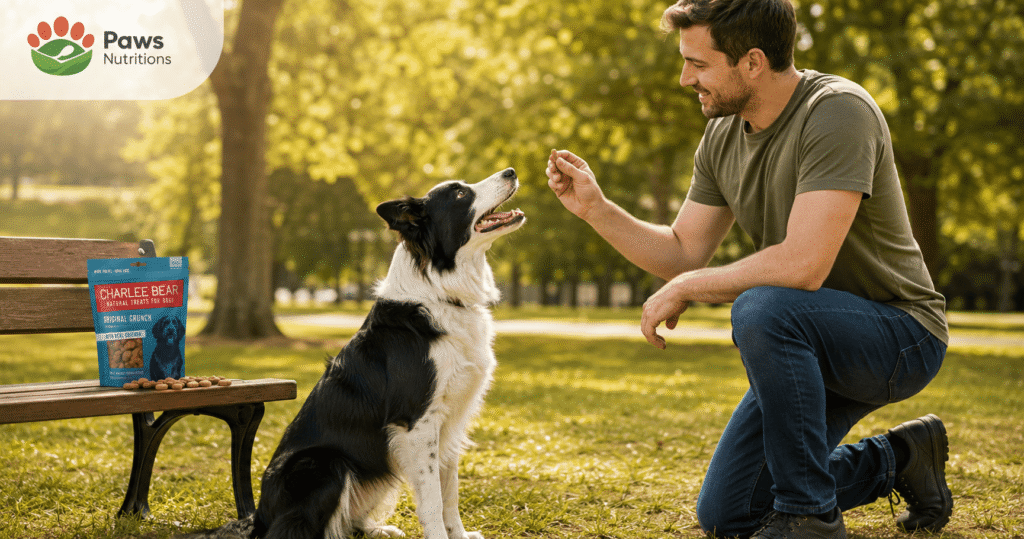
Low-calorie treats matter more than most new dog owners realize. When a treat only costs your dog 2.9 calories, you can reward far more frequently during a training session without pushing your dog toward weight gain over time. That’s the exact reasoning behind Charlee Bear’s “pocket perfect” design and deliberately low calorie count.
Best Flavors for High-Value Training Rewards
For high-value rewards during tougher training tasks — recall practice around distractions, for example, or teaching a brand-new command — flavors with real liver or cheese tend to get the strongest response, since dogs generally rate meaty, savory flavors above fruit-forward ones like blueberry or banana. Save the fruit-forward flavors for easier, lower-stakes reinforcement.
Pocket Perfect Design: A Practical Training Benefit
Because the biscuits don’t leave grease or crumbs behind, you can genuinely keep a handful loose in a jacket pocket without ruining the fabric — a small but real practical advantage over soft, moist training treats that tend to melt, stick together, or leave stains during a long walk or an outdoor training session.
Weight-Based Feeding Guide
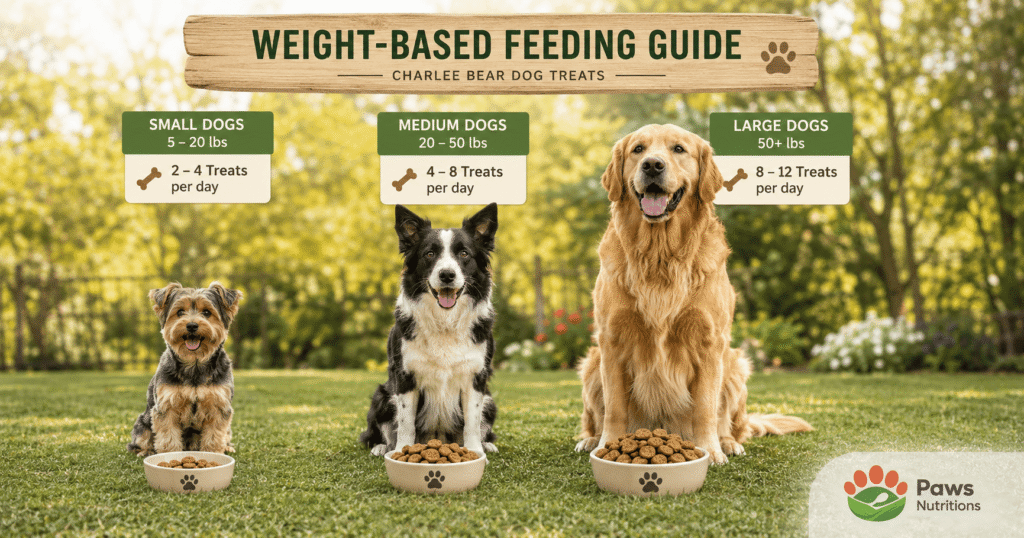
Since treats should stay under roughly 10% of daily calories, portion sizes need to scale with your dog’s size and activity level rather than following a single fixed number for every dog.
Small Breeds (Under 20 lbs)
Small dogs generally do well with 5 to 8 treats per day, split across multiple short training sessions rather than given all at once. Their smaller daily calorie budget means even low-calorie treats can add up faster proportionally.
Medium Breeds (20–50 lbs)
Medium-sized, moderately active dogs can typically handle 10 to 15 treats per day without exceeding the 10% guideline, which comfortably supports a full daily training routine plus the occasional bonus reward.
Large Breeds (50+ lbs)
Larger, more active dogs can generally handle 15 to 20 treats per day and still stay well under the 10% ceiling, given their higher total daily calorie needs.
Table 6: Feeding Guide by Weight
| Dog Weight | Suggested Treats Per Day | Notes |
| Under 20 lbs | 5–8 treats | Split across training sessions |
| 20–50 lbs | 10–15 treats | Fine for active training days |
| 50+ lbs | 15–20 treats | Still stays well under 10% of daily calories |
These figures assume a moderately active adult dog eating a complete, balanced main diet. Puppies, seniors, and dogs with health conditions like diabetes, pancreatitis, or obesity should follow their veterinarian’s specific guidance instead of a general rule of thumb.
Charlee Bear vs. Competitor Training Treats
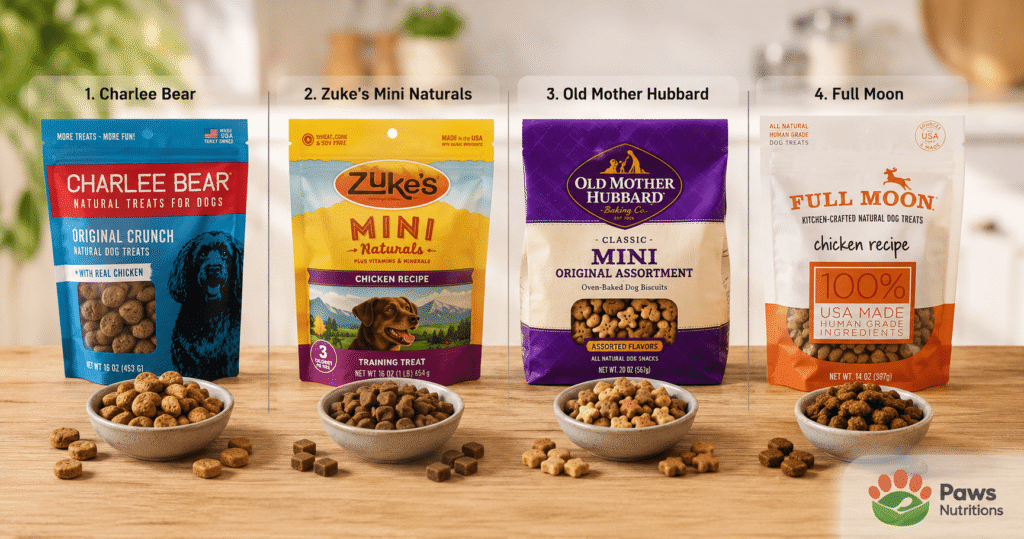
Charlee Bear isn’t the only low-calorie training treat on the market, so here’s how it stacks up against a few common alternatives owners consider when comparison-shopping.
Table 7: Competitor Comparison
| Brand | Calories/Treat | Price/oz (approx.) | Grain-Free Option | Recall History |
| Charlee Bear (Original Crunch) | ~2.9 | $0.57–$0.63 | Separate line only | 1 recall (2012) |
| Zuke’s Mini Naturals | ~2 | $0.90–$1.10 | Yes, most flavors | Multiple historical recalls |
| Old Mother Hubbard/Wellness | ~15–20 (larger biscuit) | $0.30–$0.45 | No | Limited history |
| Full Moon | ~10–15 | $1.20–$1.80 | Varies by line | Limited history |
Why Price Per Ounce Matters More Than Sticker Price
A larger bag with a higher sticker price can still be the better deal, and a smaller “on sale” bag can still be the worse one, which is exactly why we calculated per-ounce pricing throughout this review instead of comparing raw bag prices. Old Mother Hubbard’s lower per-ounce cost comes with a tradeoff, too — its biscuits run far higher in calories per treat, so the savings per ounce don’t necessarily translate into savings per training session once you account for portion size.
Which Treat Is Better?
Charlee Bear’s main edge is its genuinely low calorie count combined with a competitive per-ounce price on Chewy specifically, plus a longer, more consistent brand history than some newer competitors. Zuke’s edges it out slightly on calories per treat, but generally costs more per ounce. Its main weakness compared to competitors is the labeling confusion around which lines are actually grain-free, which puts more research burden on the buyer than a brand with a single, consistent formula.
Charlee Bear for Multi-Dog Households
Households with more than one dog burn through training treats noticeably faster, which is where Charlee Bear’s per-ounce pricing on Chewy becomes a genuine practical advantage over pricier freeze-dried competitors. The 16 oz Original Crunch bags, in particular, offer enough volume to cover simultaneous training sessions for two or three dogs without needing to restock every few days, and the low calorie count keeps total daily intake manageable even when multiple dogs are being rewarded at once during group training or obedience classes.
What Long-Time Owners Say
Long-running pet owner discussion threads consistently mention Charlee Bear as a go-to low-calorie training treat, particularly among owners of smaller breeds who need to watch calorie intake closely. Several experienced owners have flagged, over the years, that the Original Crunch line isn’t grain-free despite the brand’s overall grain-free reputation — the exact same gap we independently verified through the ingredient panel in this review. That kind of consistency between long-term community feedback and our own direct research is a strong signal that the confusion around this brand’s labeling is real, recurring, and worth addressing clearly rather than glossing over.
Is Charlee Bear Better Than Homemade Treats?
Homemade treats give you complete ingredient control, which is genuinely valuable for dogs with severe, diagnosed allergies. But they lack the guaranteed analysis testing, consistent calorie counts, and shelf stability that a commercially manufactured treat like Charlee Bear provides out of the box. For most owners without a diagnosed medical need for a fully custom recipe, a well-vetted commercial option that’s been verified for ingredients and recall history offers a better balance of convenience, consistency, and safety than homemade alternatives made without lab-tested nutrient ratios.
Pros and Cons of Charlee Bear Dog Treats
Weighing the full picture from this review, here’s where Charlee Bear genuinely earns its reputation and where it falls short of the marketing claims on the label.
What Charlee Bear Does Well
The extremely low calorie count makes frequent training rewards realistic without overfeeding, pricing on Chewy specifically is genuinely competitive against similar training treats, the recall history is clean apart from one isolated 2012 incident with no confirmed illnesses, the brand offers real product variety across six distinct lines to suit different dietary needs and budgets, and USA-based manufacturing adds a layer of regulatory oversight that imported treats don’t always carry.
Where Charlee Bear Falls Short
The “grain free” branding featured on the homepage doesn’t apply to the whole lineup, which creates genuine confusion for shoppers who assume every bag is grain-free by default. Some retailer product descriptions directly contradict the actual ingredient panel, Target pricing runs noticeably higher than other retailers despite prominent sale tags, and the brand doesn’t publish detailed ingredient sourcing information beyond a general “Made in USA” claim.
Where to Buy Charlee Bear Dog Treats
Best Value Retailer
Chewy remains the best overall value across nearly every SKU we compared, and it also offers autoship discounts for owners who go through treats regularly.
In-Store Options
Petco was historically the brand’s primary brick-and-mortar retail home, and it’s still a reliable place to find the full range in person. Walmart and Target both carry select flavors, though availability and pricing vary noticeably by location and by online listing.
Table 8: Where to Buy
| Retailer | Best For | Notes |
| Chewy | Best overall value | Consistently lowest per-ounce pricing |
| Walmart | Multi-pack convenience | Competitive per-ounce, higher total cost |
| Target | In-store pickup | Higher per-ounce pricing |
| Amazon | Bulk multi-packs | Verify seller and price manually |
| Petco | In-store browsing | Historically the brand’s original retail home |
Storage and Shelf Life
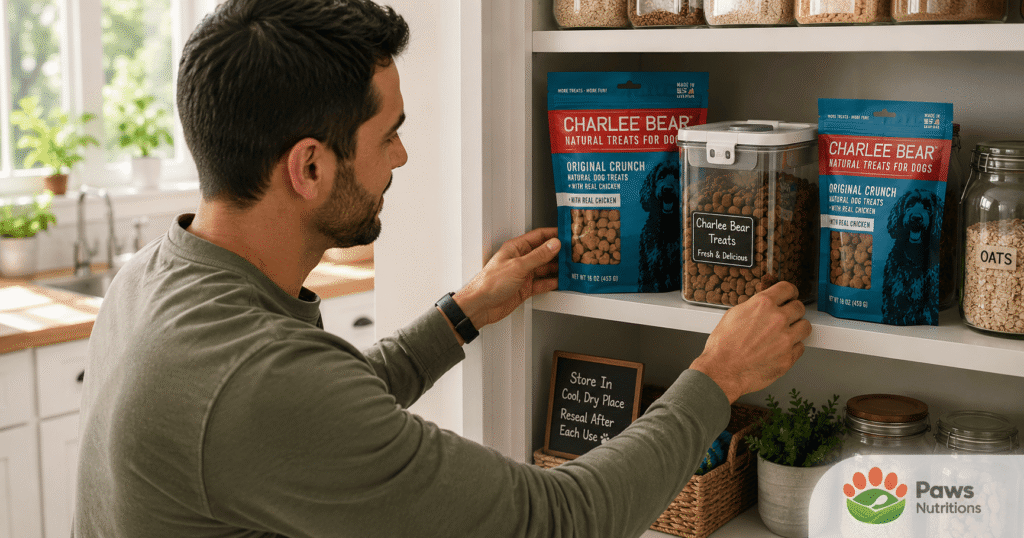
Charlee Bear treats are baked or freeze-dried to a low moisture content, which naturally extends shelf life compared to soft, moist treats. Once opened, resealing the bag tightly and storing it in a cool, dry pantry helps preserve crunch and prevents the natural tocopherol preservative from breaking down prematurely. Freeze-dried lines, like Meaty Bites and Necessities Toppers, are more sensitive to humidity than baked biscuits, so they benefit from an airtight container if you live somewhere humid.
Key Takeaways
- Only three of Charlee Bear’s six product lines are genuinely grain-free: Grain Free Crunch, Grain Free Meaty Bites, and Necessities Toppers.
- The brand has one confirmed recall (November 2012, Salmonella, Protein Crunch Bars) and has stayed recall-free for over 13 years since.
- Chewy consistently offers the lowest price per ounce across nearly every SKU we compared.
- At roughly 2.9 calories per treat, portion sizes can comfortably stay within the WSAVA-recommended 10% daily treat guideline.
- Some retailer product descriptions contradict the actual ingredient panel — always check the bag itself, not just the listing.
Glossary: Key Terms in This Review
A few technical terms come up repeatedly throughout this guide, so here’s a quick reference if you need it.
AAFCO stands for the Association of American Feed Control Officials, the body that sets nutritional standards for pet food in the United States. Dry matter basis (DMB) is a way of comparing nutrient percentages after removing moisture content, giving a fairer comparison between products. Guaranteed analysis refers to the legally required label listing minimum or maximum nutrient percentages. WSAVA is the World Small Animal Veterinary Association, whose global nutrition guidelines are widely referenced by veterinary nutritionists. DCM, or dilated cardiomyopathy, is a heart condition that the FDA has investigated for a possible link to certain grain-free diet formulations. Metabolizable energy (ME) describes the usable calorie content of a food after accounting for digestion and absorption.
How Charlee Bear Compares on Ingredient Sourcing
Charlee Bear markets its treats as made in the USA, and the ingredient panels we reviewed are consistent with domestically sourced named proteins and grains rather than vague, non-specific sourcing language. This is a meaningful point of differentiation from budget training treats that rely on imported ingredients without disclosing country of origin, since USA-based sourcing generally comes with tighter regulatory oversight during manufacturing. That said, the brand doesn’t publish a detailed sourcing map the way some premium boutique brands do, so owners wanting ingredient-level traceability beyond “Made in USA” won’t find that level of detail on the packaging.
Frequently Asked Questions
Are Charlee Bear treats good for dogs?
Yes, for most healthy dogs. They’re low in calories and made with recognizable ingredients, though dogs with wheat sensitivities should stick to the grain-free lines specifically.
Were Charlee Bear dog treats recalled?
Yes, once. In November 2012, the company recalled specific lots of Protein Crunch Bars over potential Salmonella contamination; that product line no longer exists today.
Where are Charlee Bear dog treats made?
Charlee Bear treats are made in the USA, manufactured through contract manufacturers on behalf of parent company Gott Pet Products, LLC.
How much fat is in a Charlee Bear dog treat?
Original Crunch treats guarantee a minimum of 8% crude fat on an as-fed basis, which is a moderate fat level typical for a baked training biscuit.
Are Charlee Bear dog treats with beef liver available?
Yes. Beef liver appears in the Grain Free Meaty Bites line, including Beef Liver & Sweet Potatoes and Beef Liver & Apples freeze-dried flavors.
How many treats per day should I give my dog?
It depends on your dog’s weight, but a general rule is keeping treats under 10% of daily calories — roughly 5 to 20 Charlee Bear treats per day depending on size.
Final Verdict: Is Charlee Bear Worth Buying?
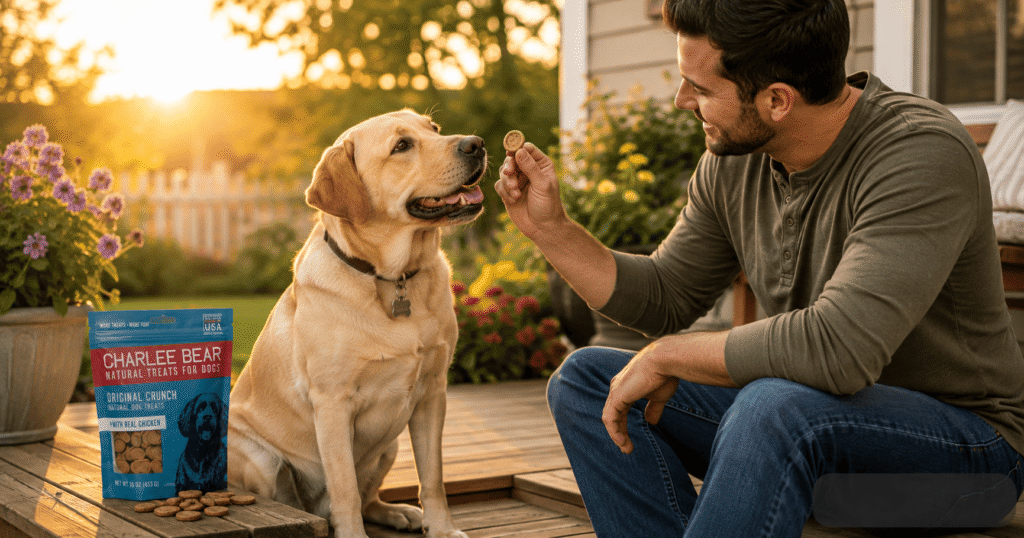
Charlee Bear dog treats earn their reputation as a genuinely low-calorie, budget-friendly training option, and the ingredient panels hold up to scrutiny once you know which product line you’re actually looking at. The brand’s recall history is clean apart from one isolated, well-handled incident back in 2012, and pricing on Chewy specifically is hard to beat for the format and calorie count offered.
The one thing worth remembering before you buy: don’t assume the whole brand is grain-free just because the homepage tagline says so. Check the specific bag, especially if your dog has a wheat sensitivity, and you’ll get exactly what you’re expecting from Charlee Bear dog treats every single time you reach for the jar.
Disclaimer:This article is not sponsored, not affiliated with, and not a paid advertisement for Charlee Bear, Gott Pet Products, or any retailer mentioned above. Any brand names, product links, or retailer references included here are provided purely for the reader’s convenience and educational purposes. We have no financial relationship with these companies.

A dedicated writer and digital enthusiast committed to creating high-quality, informative, and reader-focused content. Through thoughtful research and clear communication, he aims to deliver valuable insights that help readers navigate the ever-changing digital landscape.