
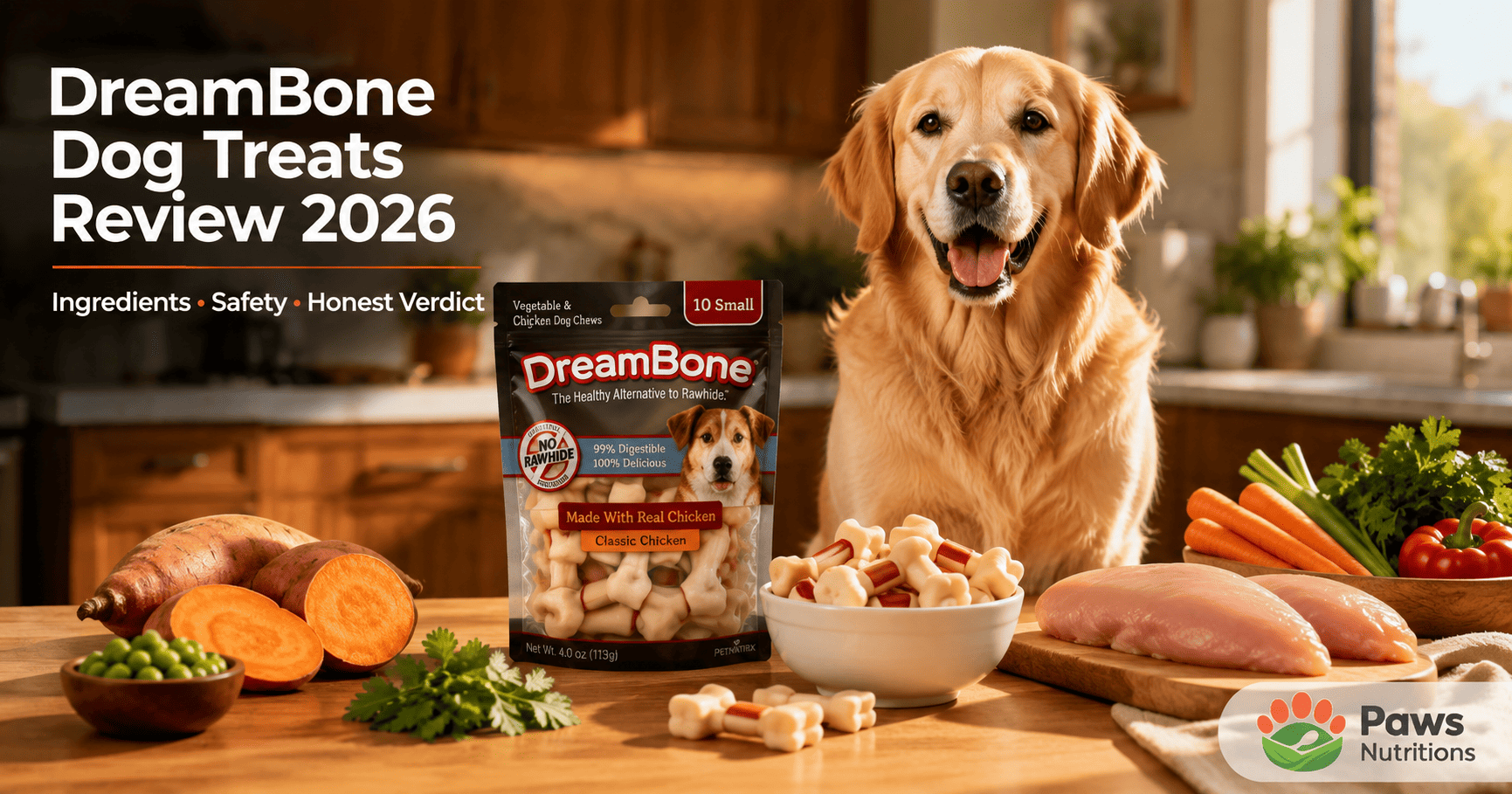
If you’ve ever stood in the pet aisle staring at a bag of DreamBone dog treats wondering whether that “rawhide-free” label actually means safer, you’re not alone. Thousands of dog owners search for answers every month, and most of what they find is either a sales page or a scattered forum thread with more questions than answers.
This DreamBone dog treats review pulls it all together in one place. You’ll get a full ingredient breakdown, a dry matter basis nutrition table, verified pricing across major retailers, a real look at the brand’s safety history, and a weight-based feeding guide — so you can decide with confidence, not guesswork.
What Is DreamBone? Brand Overview and Ownership
DreamBone is a rawhide-free dog chew brand built around the idea that dogs can get the same chewing satisfaction as rawhide without the digestion risks that come with it. The brand markets its chews as combining real meat flavoring with vegetable-based ingredients, wrapped or molded into bone, stick, and twist shapes that mimic traditional rawhide chews.
Who Makes DreamBone? PetMatrix and the Spectrum Brands Acquisition
DreamBone was originally developed by PetMatrix LLC, a New Jersey-based pet products company. In 2017, Spectrum Brands Holdings — a large consumer products conglomerate that also owns brands like Nature’s Miracle and IAMS’ former pet accessories lines — acquired PetMatrix for roughly $255 million, folding DreamBone into its Global Pet Care division. This ownership history matters because it explains why DreamBone shares manufacturing infrastructure and quality-control systems with several other pet product brands under the same parent company.
DreamBone’s Core Product Philosophy — Rawhide-Free Chews Explained
The entire brand identity rests on being rawhide-free. Instead of using tanned animal hide, DreamBone chews are made primarily from vegetable starches like potato and corn, combined with real meat or poultry flavoring on the outer layer. The company states its formulas go through internal digestibility testing, though this is not the same as a formal AAFCO feeding trial, a distinction we’ll cover in detail later.
Where DreamBone Products Are Sold
You’ll find DreamBone chews at most major retailers, including Target, Walmart, Amazon, Chewy, and Petco, along with the brand’s own website. Availability is broad, which is part of why so many owners encounter the product without doing deep research first — it’s simply sitting on the shelf next to rawhide alternatives at an approachable price.
That broad distribution is actually part of the story here. When a treat brand sits on nearly every major retail shelf, it tends to accumulate a much larger volume of customer reviews and complaints than a niche boutique brand — simply because far more dogs are eating it. Keep that in mind as you read through the safety section later in this review: a large raw number of complaints doesn’t automatically mean a higher *rate* of problems, but it does mean there’s a genuinely large sample size of real-world feedback to draw from, which is one reason this brand gets discussed so often in dog owner communities.
It also means you’re likely to encounter DreamBone even if you weren’t specifically looking for it. Many owners pick it up as an impulse buy while restocking food or litter, which is exactly why an informed, ingredient-level understanding matters more here than it might for a chew you sought out deliberately.
DreamBone Product Lineup Explained
DreamBone isn’t a single product — it’s a family of chew lines, each with a slightly different formula, texture, and purpose. Knowing which line you’re looking at matters, because ingredients and nutritional value shift noticeably between them.
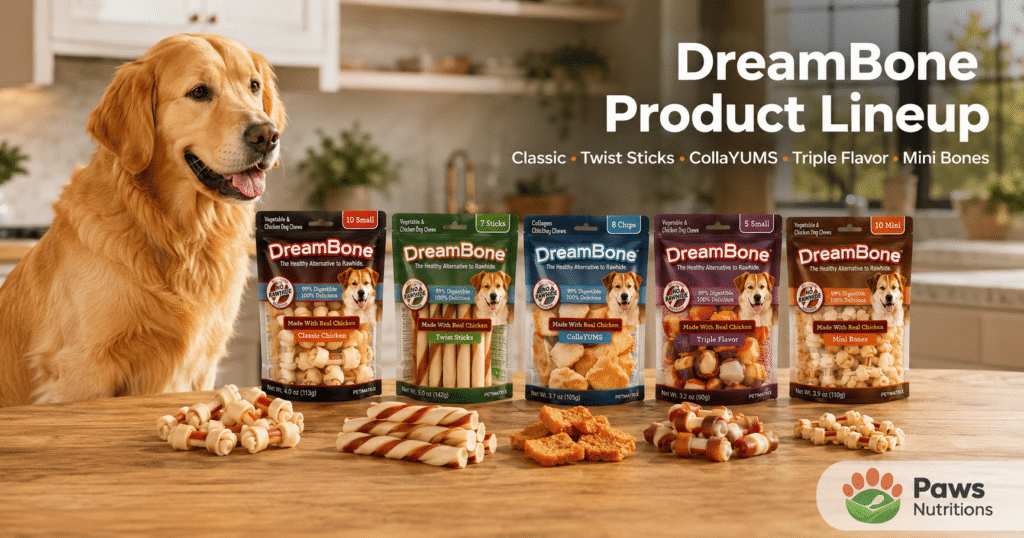
Classic Bone Chews
The original DreamBone shape, styled to look like a traditional rawhide bone. These use a vegetable-starch core wrapped in a real chicken layer, and they’re the most widely stocked item in the lineup.
Twist Sticks and Twisties
Smaller, stick-shaped chews designed for shorter chewing sessions. They come in chicken, chicken and peanut butter, and mixed-protein varieties, and tend to be priced lower per bag than the Classic bones.
CollaYUMS (Collagen-Enriched Chews)
A newer line that swaps some of the corn-heavy filler for chicken cartilage and dried cultured whey, marketed as a collagen-support chew. This is the closest DreamBone gets to a “premium” formulation, and it shows in the ingredient deck.
Triple Flavor and Spirals
These combine chicken, beef, and pork flavoring in a single chew or a twisted spiral shape. They’re marketed toward dogs who get bored of single-flavor treats.
Mini Bones and Puffy Chips
Sized for smaller dogs and puppies, Mini Bones scale down the Classic formula, while Puffy Chips are a lighter, crunchier snack-style treat rather than a long-chew item.
Choosing the right line for your dog isn’t just about flavor preference — it changes the nutritional and safety math discussed later in this article. A toy breed working through a full-sized Classic Bone Chew is getting a very different sorbitol dose relative to body weight than a large breed dog would from the same chew. If you own multiple dogs of different sizes, it’s worth buying the size-appropriate version for each rather than splitting one bag across the household.
DreamBone Ingredients — What’s Really Inside
This is the section most competitor pages skip entirely, and it’s the one you actually need before buying. Ingredient decks differ meaningfully across DreamBone’s product lines, so a blanket “DreamBone is safe” or “DreamBone is bad” statement misses the point — it depends on which bag you’re holding.
Classic Formula Ingredient Breakdown
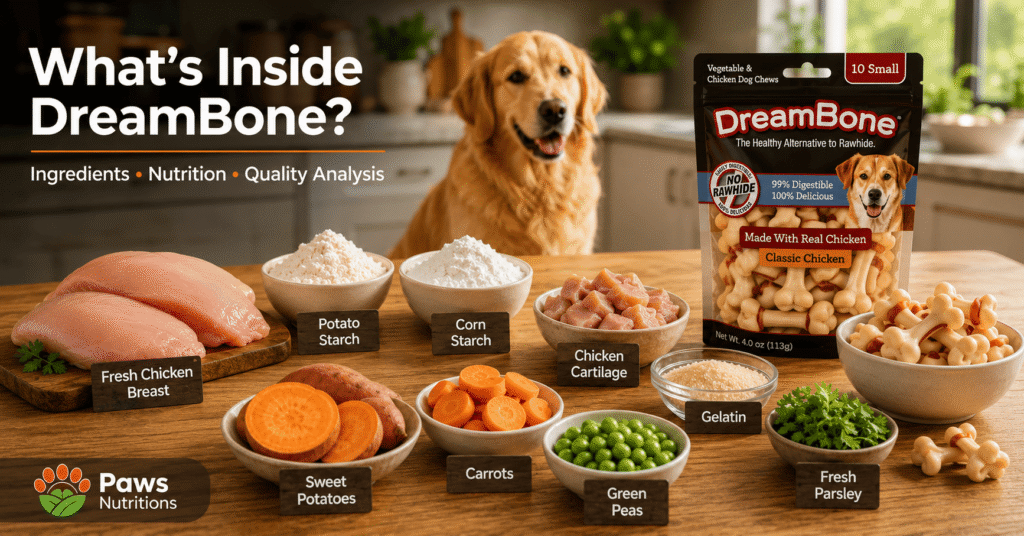
The Classic Chicken Bone Chew lists corn starch, glycerin, gelatin, sorbitol, natural chicken flavor, and titanium dioxide, with FD&C Red 40 used as a coloring agent in some SKUs. Corn starch and glycerin form the chewable base, gelatin helps bind the shape, and the artificial coloring exists purely for visual appeal — it adds no nutritional value.
CollaYUMS Ingredient Breakdown
CollaYUMS swaps in potato starch, chicken cartilage, and dried cultured whey as primary ingredients, moving away from corn as the base filler. This formula reads closer to what you’d expect from a mid-tier “natural” treat brand, though it’s still a highly processed chew rather than a single-ingredient product.
The Sorbitol Question — Should You Be Concerned?
Sorbitol is a sugar alcohol used as a humectant to keep the chew pliable. In small amounts it’s generally considered safe for dogs, but it does have a mild laxative effect, and dog owners in online forums have repeatedly connected it to loose stool in dogs who chew through a bone quickly or eat more than the recommended daily amount. The practical takeaway: portion control matters more with DreamBone than with a single-ingredient chew, because a fast chewer can ingest enough sorbitol in one sitting to upset their stomach.
In practice, this plays out differently depending on your dog’s chewing style. A dog who nibbles a Classic Bone Chew over the course of an hour is metabolizing the sorbitol gradually, which most digestive systems handle without issue. A dog who devours the same chew in five minutes is getting a concentrated dose all at once — and that’s the scenario most closely tied to the diarrhea reports you’ll see repeated across owner forums. If your dog is a fast chewer, splitting a chew into a smaller portion or supervising more closely during the first few uses is a reasonable precaution rather than an overreaction.
Artificial Colors and Preservatives Across Product Lines
Classic and Twist Stick lines use artificial dyes like Red 40 for visual appeal; CollaYUMS and some newer SKUs have moved away from synthetic coloring. If dye sensitivity is a concern for your dog, check the ingredient panel on the specific bag — don’t assume all DreamBone products use the same recipe.
Table 1: Side-by-Side Ingredient Comparison
| Ingredient Category | Classic Bone Chews | CollaYUMS | Triple Flavor |
| Primary base | Corn starch | Potato starch | Corn starch |
| Protein source | Chicken flavor (surface) | Chicken cartilage, whey | Chicken, beef, pork flavor |
| Sweetener/humectant | Sorbitol, glycerin | Glycerin | Sorbitol, glycerin |
| Artificial coloring | Yes (Red 40, some SKUs) | No (most SKUs) | Yes (some SKUs) |
| Titanium dioxide | Yes | No | Yes |
| Preservative type | Mixed tocopherols | Mixed tocopherols | Mixed tocopherols |
DreamBone Nutrition Facts on a Dry Matter Basis
Guaranteed analysis panels on treat bags list nutrients “as fed,” which includes moisture weight — and that makes protein and fat levels look artificially low. Converting to dry matter basis (DMB) strips out moisture so you can compare treats fairly, the same way you’d compare dog foods.
Why Dry Matter Basis Matters for Treat Comparison
A treat with 8% protein “as fed” and 10% moisture isn’t actually 8% protein once you remove the water weight — it’s higher. DMB conversion is the only accurate way to know how much real nutritional density a chew is providing versus how much is just moisture and filler.
Guaranteed Analysis by Product Line
DreamBone’s own guaranteed analysis figures are modest compared to actual meat-based chews, since these are starch-based products with a flavor coating rather than protein-dense chews.
Table 2: DMB Nutrition Table by Product Line
| Product Line | Crude Protein (Min) | Crude Fat (Min) | Crude Fiber (Max) | Moisture (Max) | Protein DMB (Est.) |
| Classic Bone Chews | 8.0% | 1.0% | 3.0% | 12.0% | ~9.1% |
| Twist Sticks | 7.0% | 1.5% | 4.0% | 13.0% | ~8.0% |
| CollaYUMS | 12.0% | 2.0% | 2.5% | 11.0% | ~13.5% |
| Triple Flavor | 8.0% | 1.5% | 3.5% | 12.0% | ~9.1% |
Figures reflect standard guaranteed analysis ranges published by the brand; always confirm against the specific bag you purchase, since formulas are updated periodically.
Is DreamBone AAFCO Compliant?
This is one of the most misunderstood parts of the DreamBone conversation, and it deserves a direct, honest answer.
What DreamBone Claims About AAFCO Protocols
DreamBone states that its formulas are developed using AAFCO nutrient profile guidance and that the company conducts internal digestibility studies. That’s a legitimate claim, but it’s narrower than what many shoppers assume it means.
AAFCO Feeding Trials vs. Formulation Protocols — the Important Distinction
There’s a real difference between a product that’s undergone a full AAFCO feeding trial (live animal testing over a set period, used to certify a food as “complete and balanced”) and one that’s simply formulated with AAFCO nutrient guidance in mind. DreamBone chews are treats, not a complete diet, so they aren’t required to pass a feeding trial — but you shouldn’t read “AAFCO-informed formulation” as equivalent to “AAFCO feeding-trial certified.” They’re not the same claim.
WSAVA Guidelines and Where DreamBone Falls Short of Full Compliance Language
The World Small Animal Veterinary Association (WSAVA) publishes global standards for pet food manufacturers, including recommendations around ingredient sourcing transparency, quality control testing, and employing a qualified nutritionist. DreamBone’s public materials don’t reference WSAVA guidelines directly, which is a transparency gap compared to some premium treat brands that explicitly publish WSAVA-aligned manufacturing statements.
Why should this matter to you as a shopper rather than a regulator? Because guaranteed analysis and nutritional adequacy claims are only as trustworthy as the testing behind them. A brand that publishes its feeding trial data, names its formulating nutritionist, and discloses its manufacturing facilities gives you something concrete to verify. A brand that leans on general marketing language about following AAFCO guidance gives you less to work with — not necessarily because the product is unsafe, but because you’re taking more on faith. That distinction is worth remembering the next time you compare DreamBone against a smaller boutique brand that publishes fuller documentation.
Is DreamBone Safe for Dogs? Full Safety Analysis
This is the question most people searching for a DreamBone review actually want answered, so here’s the direct version: there is no formal FDA recall on record specifically for DreamBone products, but there is a documented pattern of consumer complaints spanning over a decade, and you should weigh that pattern seriously before buying.

Has DreamBone Ever Been Officially Recalled?
No agency-issued recall currently exists for DreamBone chews specifically. It’s worth noting that in 2017, several rawhide chew brands under Spectrum Brands’ broader pet care portfolio — including Digest-eeze and Healthy-Hide — were pulled from some retailers following contamination concerns. DreamBone itself was not part of that action, since DreamBone is rawhide-free by design, but the shared parent company is a detail worth knowing if you’re evaluating brand-wide trust.
Consumer Complaint Patterns (SafelyHQ, Lawsuits, Forums)
Across pet safety complaint databases and long-running forum threads, a consistent set of concerns shows up: dogs experiencing vomiting, diarrhea, and in some reported cases more serious gastrointestinal distress after chewing DreamBone products. Some threads span a decade of user reports, with recurring mentions of the treats softening into a gummy texture that some dogs swallow in large pieces rather than chewing down slowly.
What makes this pattern worth taking seriously isn’t any single dramatic report — it’s the consistency of the pattern over such a long timeframe. When the same category of complaint (GI upset tied to fast consumption or oversized portions) shows up repeatedly across more than ten years of independent reports from unrelated owners, that’s a meaningfully different signal than a handful of isolated complaints you’d expect with any mass-market product. It doesn’t mean every dog will react this way — most reviews are neutral to positive — but it does mean the risk is real enough to plan around rather than dismiss.
Reported Symptoms — Diarrhea, Bloody Stool, and Obstruction Risk
The most commonly reported symptom is loose stool, which lines up with the sorbitol content discussed earlier. Less common but more serious reports include bloody stool and suspected gastrointestinal obstruction, typically in cases where a dog swallowed a large, softened chunk rather than chewing it down fully. As with any chew treat, supervision during chewing sessions is essential, and you should remove any piece that’s become small enough to swallow whole.
What DreamBone and Spectrum Brands Have Said Publicly
Neither DreamBone nor Spectrum Brands has issued a public statement addressing the recurring safety complaints in detail. The brand’s official materials focus on product marketing rather than responding directly to the safety concerns raised in consumer forums — a transparency gap worth factoring into your decision.
Table 3: Recall & Complaint Timeline
| Year | Event Type | Brand Involved | Outcome |
| 2014–2024 | Ongoing consumer complaints (GI upset, softening texture) | DreamBone | No formal recall; pattern documented across forums |
| 2017 | Rawhide chew recall action | Sister brands under Spectrum Brands (not DreamBone) | Product pulled from some retailers |
| 2017 | Corporate acquisition | PetMatrix acquired by Spectrum Brands | Ownership and manufacturing consolidated |
| Ongoing | Individual consumer complaints (SafelyHQ, lawsuits) | DreamBone | No agency recall issued to date |
Manufacturing Location — China, Vietnam, or USA?
Manufacturing location is one of the most frequently asked, and most frequently confused, details about this brand.
Why Manufacturing Country Has Changed Over Time
Older DreamBone stock was largely manufactured in China. In recent years, some product lines have shifted production to Vietnam, and select newer SKUs under the “Dream Naturals” sub-branding reference New Jersey manufacturing or finishing. This isn’t unusual for large consumer goods companies balancing cost and supply chain, but it does mean two bags bought a year apart may not come from the same facility.
How to Check Your Bag’s Country of Origin
The country of origin is printed on the bottom or back panel of every DreamBone bag, usually near the ingredient list. If manufacturing transparency matters to you, check this every time you buy, rather than assuming it matches your last purchase.
DreamBone vs. Rawhide — Real Safety Comparison
The entire premise of DreamBone is being a safer alternative to rawhide, so it’s worth testing that claim directly.
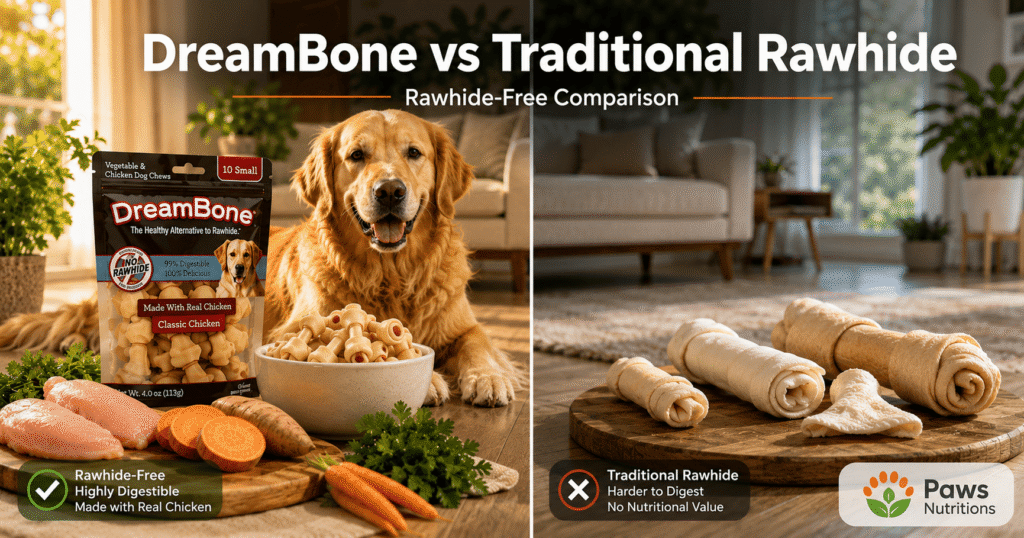
Choking and Obstruction Risk Compared
Traditional rawhide can break into large, dense chunks that are genuinely dangerous if swallowed whole. DreamBone chews soften faster, which reduces the risk of a hard chunk breaking free — but that softening creates a different risk: a gummy piece a dog can gulp down without much chewing at all. Neither risk profile is zero.
Digestibility Compared
Rawhide is notoriously slow to digest and can sit in the stomach for extended periods. DreamBone’s starch-based formula is generally easier to break down, which is the brand’s core safety argument — but “easier to digest” doesn’t mean “risk-free,” especially in smaller dogs.
Table 4: DreamBone vs. Traditional Rawhide Safety Comparison
| Factor | DreamBone | Traditional Rawhide |
| Digestibility | Faster, starch-based | Slow, can sit in stomach for days |
| Choking risk pattern | Softens into gummy pieces | Hard chunks can break free |
| GI upset reports | Documented (sorbitol-related) | Documented (blockage-related) |
| Best supervision level | Full supervision recommended | Full supervision required |
| Made without animal hide | Yes | No |
Which Chew Is Better? For dogs prone to swallowing large hard chunks, DreamBone’s faster-softening formula is the safer direction. For dogs who tend to gulp rather than chew thoroughly, traditional rawhide’s slower breakdown may actually pose less immediate risk than a chew that softens into an easily swallowed piece. Your dog’s individual chewing style matters more here than either product’s marketing claims.
DreamBone vs. SmartBones — What’s the Difference?
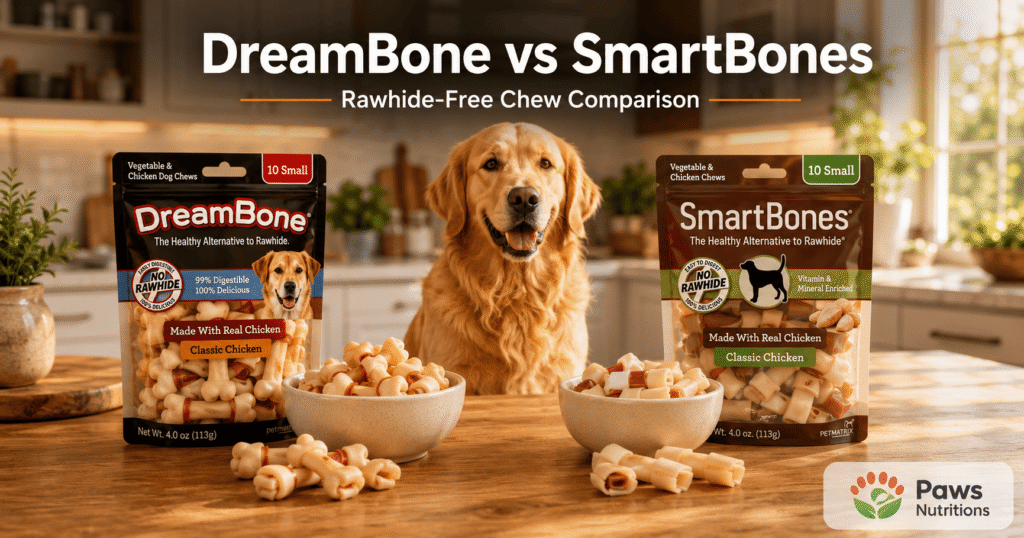
SmartBones is another rawhide-free chew brand frequently mentioned alongside DreamBone, and the two get confused often enough to deserve a direct comparison.
Shared Ownership, Different Formulas
Both brands are owned by Spectrum Brands, but they aren’t identical products with different labels — SmartBones tends to lean more heavily into vegetable and chicken-based recipes with fewer artificial dyes across its core lineup, while DreamBone’s Classic line still uses synthetic coloring in some SKUs.
Which Brand Fits Which Dog
If your dog has a known dye sensitivity, SmartBones’ dye-free core lineup may be the safer starting point. If you’re prioritizing price and wide retail availability, DreamBone’s broader product range and consistent stocking at Target and Walmart make it the easier day-to-day option.
Table 5: DreamBone vs. SmartBones Feature Comparison
| Feature | DreamBone | SmartBones |
| Parent company | Spectrum Brands | Spectrum Brands |
| Artificial dyes | Some SKUs (Red 40) | Mostly dye-free core line |
| Price range | $8–$20 per bag | $9–$22 per bag |
| Retail availability | Very wide (Target, Walmart, Amazon) | Wide, slightly narrower |
| Rawhide-free | Yes | Yes |
Which Chew Is Better? Neither brand wins outright — they’re closer siblings than true competitors, sharing a parent company and a similar rawhide-free approach. If dye-free ingredients matter most to you, lean toward SmartBones’ core lineup. If price consistency and shelf availability matter more, DreamBone’s broader retail footprint makes it the easier default choice for most households.
DreamBone Brand-Name Confusion — Dream Bones vs. Busy Bones
This mix-up shows up constantly in online reviews, and it’s worth clearing up before you buy the wrong product entirely.
Why Shoppers Mix Up These Two Products
“Dream Bones” (DreamBone’s branded product) and “Busy Bone” (a Purina-owned dog treat) sound similar enough that reviews and complaints sometimes get cross-posted between the two products by mistake. They are made by completely different companies, with different formulas and different safety track records.
Key Differences at a Glance
DreamBone is rawhide-free and starch-based; Busy Bone is a more traditional biscuit-style dental chew made by Purina. If you’re researching complaints or recall history, double-check which brand a specific report is actually about — misattributed reviews are common in this space.
DreamBone Price Guide — Full Cost Breakdown
Here’s where the numbers get concrete. Pricing below reflects a snapshot of current retail listings and can shift with promotions, so treat this as a strong reference point rather than a guaranteed price.
Target Pricing by Product (Verified)
Target carries the widest in-store DreamBone selection among major retailers, with Twist Sticks and Mini Bones as the most consistently stocked items.
Table 6: Price-Per-Ounce Comparison Across Retailers
| Product | Target Price | Size | Price Per Oz |
| Twist Sticks with Chicken | $11.19 | ~8.8 oz | ~$1.27/oz |
| Chicken & Vegetable Twist Sticks (50ct) | $14.69 | 12.3 oz | $1.19/oz |
| Dream Kabobz (18ct) | $13.99 | 10.0 oz | $1.40/oz |
| Twisties (25ct) | $9.99 | 7.05 oz | $1.42/oz |
| Twist Stick Sirloin Wrap (15ct) | $7.99 | 3.7 oz | $2.16/oz |
| Chicken Wrapped Twists (30ct) | $9.99 | 7.4 oz | $1.35/oz |
| Chicken & Vegetable Spiral Variety (32ct) | $15.99 | 12.3 oz | $1.30/oz |
| Peanut Butter Puffy Chips | $10.99 | 8.8 oz | $1.25/oz |
Walmart Pricing by Product
Walmart’s DreamBone listings largely mirror Target’s pricing within a dollar or two per bag, though in-stock availability varies more by location and shifts frequently with online marketplace listings.
Amazon Pricing (Flagged for Manual Verification)
Amazon pricing for DreamBone products typically ranges from $10 to $35+ depending on bag size and multipack bundling. Amazon prices are cart-gated and fluctuate with promotions, so always verify the current price at checkout rather than relying on a cached figure.
Best Value Picks by Price-Per-Ounce
Based on verified Target pricing, the Chicken & Vegetable Twist Sticks 50-count bag and the Peanut Butter Puffy Chips offer the strongest price-per-ounce value in the current lineup, while single small bags like the Sirloin Wrap Twist Sticks carry the highest per-ounce cost.
Weight-Based Feeding Guide for DreamBone Chews
Portion control isn’t optional with this brand — given the sorbitol and starch content discussed earlier, sticking to the recommended amount genuinely reduces the odds of stomach upset.
Recommended Chews Per Day by Dog Size
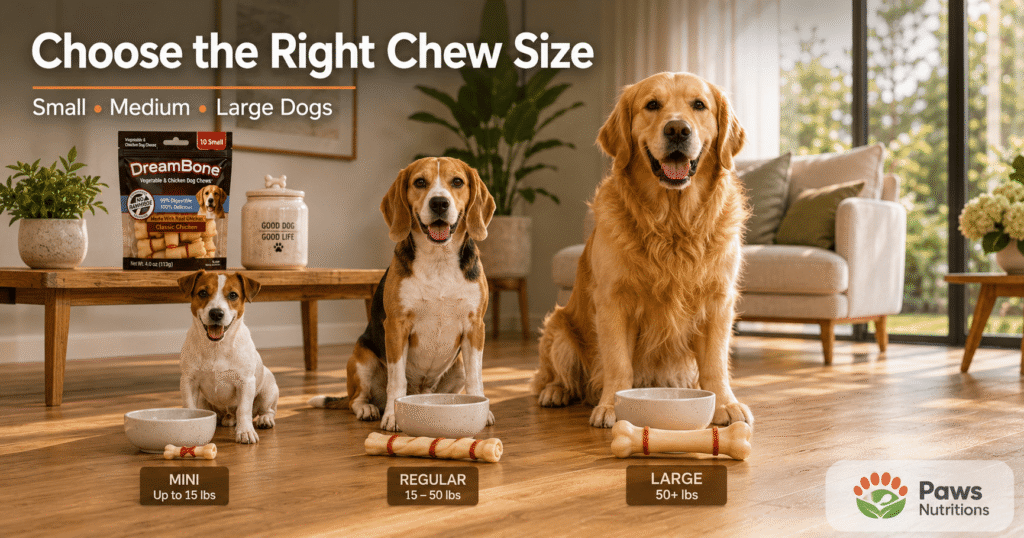
DreamBone’s own guidance caps most products at 1 to 2 chews per day, scaled to the size of the chew relative to your dog’s weight.
Table 7: Feeding Guide by Dog Weight
| Dog Weight | Recommended Chew Size | Max Per Day |
| Under 15 lbs | Mini Bones or small Twist Sticks | 1 chew |
| 15–35 lbs | Regular Twist Sticks or small Classic Bone | 1–2 chews |
| 35–60 lbs | Classic Bone Chew (regular size) | 1–2 chews |
| Over 60 lbs | Classic Bone Chew (large size) | 1–2 chews, supervised |
Puppy Feeding Guidelines (8 Weeks and Older)
DreamBone lists most products as suitable from 8 weeks of age, but younger puppies chew more aggressively relative to their size and swallow smaller pieces faster. Start with the smallest size available and supervise the entire chewing session.
Senior Dog Considerations
Senior dogs with sensitive digestion may react more noticeably to the sorbitol content. If your senior dog has a history of loose stool, consider starting with half a chew rather than a full one to gauge tolerance.
A Practical First-Time Feeding Routine
If you’re introducing DreamBone chews to your dog for the first time, a cautious rollout beats jumping straight to the full recommended amount. Start with half the suggested portion on day one, and watch stool consistency over the following 24 hours before offering a second chew. This isn’t unique to DreamBone — it’s good practice with any new treat — but it’s especially relevant here given how consistently sorbitol-related loose stool shows up in owner reports. If your dog handles the smaller portion well, you can move to the full recommended amount on your normal schedule.
Pros and Cons of DreamBone Dog Treats
What DreamBone Does Well
- Genuinely rawhide-free, reducing one specific category of choking risk
- Wide retail availability at accessible price points
- Multiple flavor and format options to suit different chewing styles
- CollaYUMS line offers a meaningfully improved ingredient profile over Classic
Where DreamBone Falls Short
- Sorbitol and artificial dye content in Classic and Twist Stick lines
- Long-running pattern of consumer GI-upset complaints without a public brand response
- No clear WSAVA-aligned transparency statement
- Manufacturing location has shifted over time, requiring per-bag verification
What Real Dog Owners Are Saying
Positive Experiences and Common Praise
Many owners report their dogs enjoy the taste and find the chews satisfying for shorter chewing sessions, with particular praise for the Twist Sticks as an easy, mess-free daily treat.
Negative Experiences and Recurring Complaints
The most consistent negative feedback centers on loose stool after normal-sized portions, along with occasional reports of dogs swallowing softened pieces too quickly. Reports of more serious reactions exist but appear to represent a smaller share of the overall feedback pattern.
A smaller but recurring complaint category involves texture and quality consistency between bags — some owners report a chew softening unusually fast in one bag compared to a previous purchase. This kind of batch-to-batch variation is common with mass-produced starch-based treats, but it’s a good reason to always supervise a new bag the first few times, even if your dog has had DreamBone before without issue.
How to Store DreamBone Chews Properly
Storage affects both texture and safety, and it’s a detail most competing reviews skip entirely.
Keeping Chews Fresh and Firm
Store unopened bags in a cool, dry place away from direct sunlight. Once opened, reseal the bag tightly or transfer chews to an airtight container — humidity is the main factor that causes DreamBone chews to soften prematurely, which in turn increases the swallowing risk discussed earlier in this review.
Signs a Chew Has Gone Bad
Discard any chew that feels unusually sticky, shows visible mold, or has an off smell compared to a fresh piece from the same bag. Starch-based chews are more prone to moisture absorption than dried meat treats, so this check is worth doing every time, not just occasionally.
Safer Alternatives to Consider
If the ingredient profile or complaint pattern above gives you pause, there are other rawhide-free options worth comparing.
Natural Single-Ingredient Chews
Options like single-ingredient bully sticks, yak milk chews, or dehydrated sweet potato chews avoid sorbitol and artificial coloring entirely, though they typically cost more per ounce.
Vet-Recommended Rawhide-Free Options
Brands built around limited-ingredient formulas with veterinary nutritionist involvement, and clearer WSAVA-aligned sourcing statements, are worth comparing side by side with DreamBone if transparency is your top priority.
When It Makes Sense to Switch
If your dog has already shown a pattern of loose stool or sensitivity to sorbitol, switching to a single-ingredient chew is a reasonable next step rather than continuing to troubleshoot portion sizes. On the other hand, if your dog has done fine with DreamBone chews and you’re mainly looking for variety or a slightly cleaner ingredient panel, the CollaYUMS line is a lower-friction switch than jumping to a completely different brand, since it keeps the same shape and format your dog is already used to.
Table 8: DreamBone vs. Alternative Rawhide-Free Chew Brands
| Brand | Base Ingredients | Artificial Dyes | Price Range |
| DreamBone | Corn/potato starch, flavoring | Some SKUs | $8–$20 |
| SmartBones | Vegetable, chicken-based | Mostly dye-free | $9–$22 |
| Single-ingredient bully sticks | Beef muscle only | None | $12–$30 |
| Yak milk chews | Yak/cow milk, lime, salt | None | $10–$25 |
Common Mistakes Owners Make With DreamBone Chews
Even a well-intentioned dog owner can run into avoidable problems with this brand. These are the mistakes that show up most often in complaint patterns and owner discussions.
Leaving a Softened Chew Unsupervised
The single biggest risk factor isn’t the ingredient list — it’s letting a dog work through a chew unattended once it’s softened into a gummy, easily swallowed piece. Set a habit of checking in every few minutes, and remove the chew once it’s small enough to fit fully in your dog’s mouth.
Offering the Wrong Size for Your Dog’s Weight
A Classic Bone Chew sized for a large breed offers a small dog far more sorbitol and starch than their body weight can comfortably process in one sitting. Always match the product size to the feeding guide in this article rather than grabbing whichever bag happens to be on sale.
Assuming Every Bag Is Identical
Because manufacturing location and formula details have shifted over time, assuming your new bag is identical to the last one you bought can lead to surprises — both in texture and in ingredient list. Read the panel on every new purchase, especially if you’re buying from a different retailer than usual.
Ignoring Early Signs of Stomach Upset
Mild, one-off loose stool after a new chew isn’t necessarily alarming, but ignoring a repeated pattern is a mistake. If your dog has soft stool after DreamBone chews more than once, that’s a signal to reduce portion size, switch product lines, or move to an alternative chew entirely — not something to push through.
Expert Tips for Safer DreamBone Feeding
A few small habits meaningfully reduce the risk profile of this brand without giving up the convenience and price point that make it appealing in the first place.
- Match chew size to dog size every time — don’t let a large dog’s chew end up in a small dog’s mouth in a multi-dog household.
- Supervise the first three uses of any new bag closely, since texture and softening speed can vary batch to batch.
- Remove and discard any piece small enough to swallow whole, rather than letting your dog finish it down to a sliver.
- Rotate with a different chew type periodically rather than relying on DreamBone as the sole daily chew, which limits cumulative sorbitol intake.
- Check the country-of-origin label on every new bag so you know exactly what you’re feeding, not just what you fed last time.
Frequently Asked Questions
Is DreamBone actually rawhide-free?
Yes. DreamBone chews use vegetable starch and real meat flavoring instead of tanned animal hide.
What happens if my dog eats the silica packet from a DreamBone bag?
Silica gel packets are generally non-toxic, but a small dog swallowing a whole packet could face a minor obstruction risk. Contact your vet if this happens.
Has DreamBone killed dogs?
There’s no formal FDA recall tied to DreamBone deaths, but some consumer complaint reports describe serious reactions. No agency has confirmed a causal link.
Are DreamBone treats made in China?
Some are; manufacturing has shifted between China, Vietnam, and New Jersey over time. Check the bag’s country-of-origin label directly.
Can puppies have DreamBone chews?
Most DreamBone products are labeled safe from 8 weeks of age, but always start with the smallest size and supervise closely.
What is DreamBone’s return or refund policy?
Returns depend on the retailer you purchased from — Target, Walmart, and Amazon each apply their own standard return policy to DreamBone products.
How many DreamBone chews can my dog have per day?
Most products recommend 1 to 2 chews per day, scaled to your dog’s size and the chew’s size.
Is DreamBone better than rawhide?
It reduces one specific risk (hard rawhide chunks) while introducing another (fast-softening, swallowable pieces), so “better” depends on your dog’s chewing style.
Key Takeaways
DreamBone dog treats are a reasonably priced, widely available rawhide-free option, but they’re not without real trade-offs. The Classic and Twist Stick lines contain sorbitol and, in some SKUs, artificial dye — ingredients worth knowing about even though they’re technically permitted. CollaYUMS is the stronger pick if ingredient quality matters most to you. There’s no official recall on record, but the pattern of consumer complaints around GI upset is well-documented enough that portion control and supervision aren’t optional. Check the country-of-origin label on your specific bag, size the chew to your dog’s weight, and you’ll get the most out of this brand while minimizing its known risks.
If you take one habit away from this review, make it supervision. Nearly every serious complaint pattern documented here — from bloody stool reports to suspected obstructions — traces back to a chew being left unattended once it softened past the point of safe chewing. That single change, combined with matching chew size to your dog’s actual weight rather than convenience, addresses the majority of the risk factors covered in this review without requiring you to give up the brand entirely.
Ultimately, whether DreamBone belongs in your dog’s routine comes down to your own risk tolerance and your dog’s individual chewing habits. A cautious chewer who nibbles slowly under supervision is a very different case than a fast gulper who’s shown sensitivity to sugar alcohols before. Use the feeding guide, ingredient tables, and comparison sections above to make that call with real information instead of guesswork — that’s the whole point of a review like this one.

A dedicated writer and digital enthusiast committed to creating high-quality, informative, and reader-focused content. Through thoughtful research and clear communication, he aims to deliver valuable insights that help readers navigate the ever-changing digital landscape.