
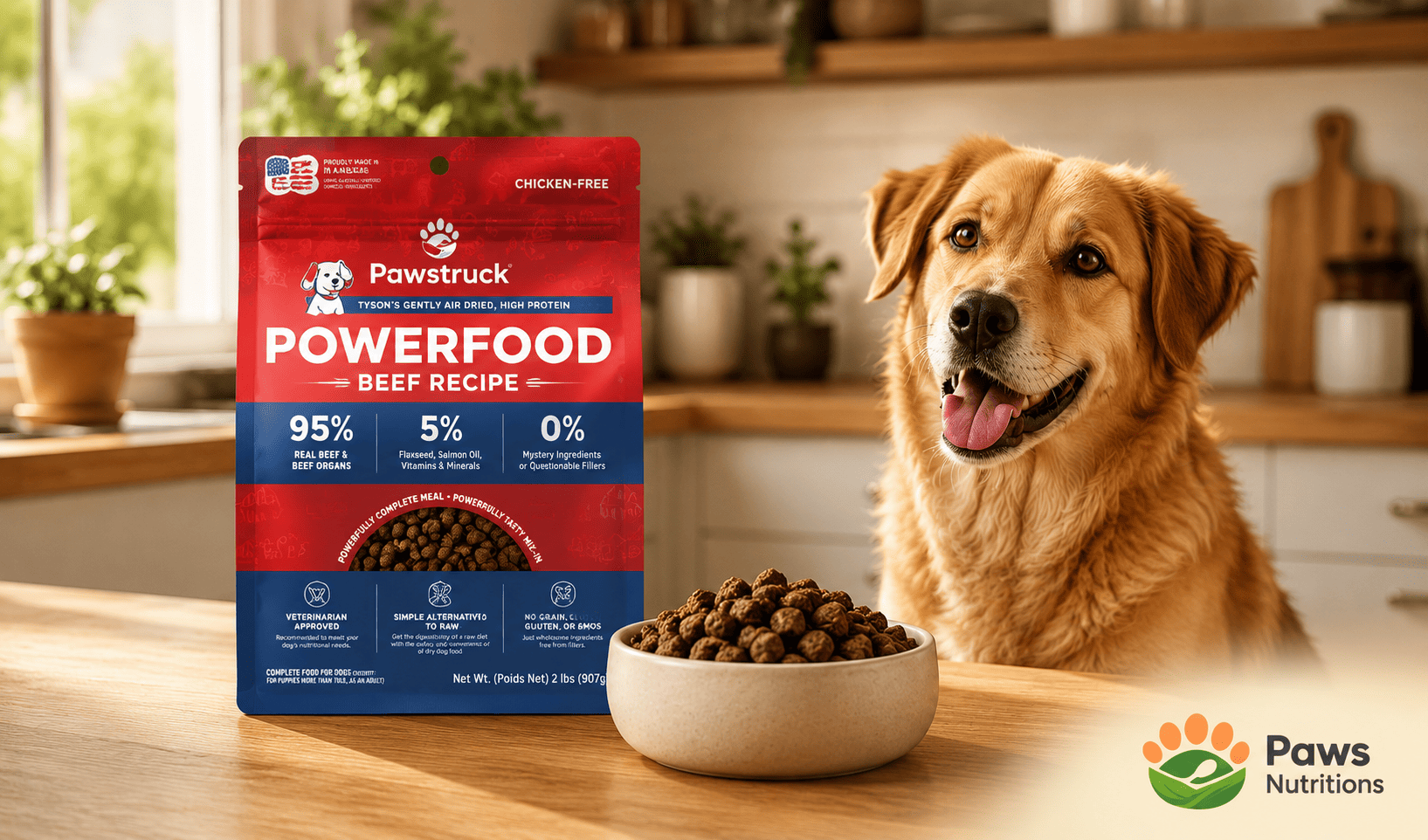
If you’ve been staring at a bag of Pawstruck air-dried dog food wondering whether it’s actually worth the price tag, you’re not alone. This Pawstruck air-dried dog food review digs past the marketing copy and gets into what really matters: the ingredients, the nutrient breakdown, the safety record, and whether your dog will even eat the stuff.
You’ll get a full ingredient-by-ingredient breakdown, a real price-per-pound calculation, a look at the grain-free safety conversation, and a side-by-side comparison against other air-dried brands. By the end, you’ll know exactly whether Pawstruck belongs in your dog’s bowl or whether your money is better spent elsewhere.
1. What Is Pawstruck Air-Dried Dog Food?
Pawstruck air-dried dog food is a minimally processed dog food made by gently drying real meat and whole-food ingredients at low temperatures instead of cooking them under high-heat extrusion like traditional kibble. The result is a dense, chewy, nutrient-rich food that looks nothing like the round brown pellets most dogs grow up eating.
If you’ve spent any time researching alternatives to kibble, you’ve likely run into the term “air-dried” alongside raw, freeze-dried, and dehydrated options, all competing for the same shelf space and marketing budget. Pawstruck’s version of this category is worth a closer look precisely because it’s positioned as an accessible entry point rather than a boutique, ultra-premium product.
Pawstruck built its reputation on natural chews and treats before expanding into full meals, and that background shows in how the brand talks about ingredients. Every recipe leads with named meat as the first ingredient, and the company markets the line specifically toward owners who want a kibble alternative without committing to a fully raw diet.
What sets this category apart from ordinary kibble is texture and moisture retention. Because air-drying pulls water out slowly rather than cooking it out under pressure, the finished product keeps some of the natural oils and aromas that make raw and fresh food so appealing to dogs. That’s a big part of why owners switching from bland kibble often see their dog’s interest in mealtime pick up almost immediately.
How Air-Drying Works as a Preservation Method
Air-drying works by slowly removing moisture from raw ingredients using low, steady heat and controlled airflow over several hours. Unlike extrusion, which cooks kibble at high temperatures and pressure, air-drying stays gentle enough to preserve more of the natural protein sources and amino acid structure in the meat.
This matters because high heat can degrade certain proteins and vitamins. Air-drying isn’t as nutrient-preserving as raw feeding, but it strikes a middle ground: shelf-stable like kibble, but closer to raw in terms of digestibility and ingredient integrity.
The process also concentrates nutrients rather than diluting them. Removing most of the moisture from a batch of meat means the remaining product is calorie-dense and nutrient-dense by volume, which is exactly why feeding portions for air-dried food look so much smaller than what you’d scoop for kibble. A little goes a long way, and that density is part of the value equation once you get past the sticker price on the bag.
Pawstruck’s Brand Story — Founded by Kyle Goguen in 2014
Pawstruck was founded in 2014 by Kyle Goguen, who started the company selling natural chews before growing it into a full pet nutrition brand. That chew-and-treat heritage is part of why Pawstruck leans so heavily on simple, recognizable ingredient lists rather than long strings of synthetic additives.
Where Pawstruck Is Manufactured (USDA-Certified, SQF Facility)
Pawstruck’s air-dried recipes are produced in a USDA-certified, SQF-audited facility in the United States. SQF (Safe Quality Food) certification is a globally recognized food-safety benchmark, and having it in place is a meaningful trust signal for a category where manufacturing transparency is often thin.
This matters more than it might seem at first glance. A large portion of smaller pet food brands co-pack through facilities they won’t name, and some avoid third-party food-safety audits altogether. Pawstruck’s willingness to disclose USDA and SQF status puts it ahead of a lot of direct competitors on manufacturing transparency alone, even before you get into ingredient quality.
2. Air-Dried vs. Freeze-Dried vs. Dehydrated vs. Kibble
Not all “minimally processed” dog foods are processed the same way, and the differences actually affect nutrition, price, and convenience. Understanding where air-dried dog food sits on that spectrum helps you decide if it’s the right fit for your household and budget.
Brands often use these terms loosely, or interchangeably, which makes shopping confusing even for owners who genuinely try to read labels carefully. Knowing the real distinctions below means you’ll never have to guess again the next time you’re standing in the pet food aisle comparing two bags that both claim to be “gently processed.”
Processing Method Differences Explained
Kibble is cooked through high-heat, high-pressure extrusion, which is cheap and shelf-stable but degrades some heat-sensitive nutrients. Dehydrated food uses warm air over a longer period at slightly higher temperatures than air-drying. Freeze-dried food removes moisture through a vacuum-freezing process, preserving nutrients extremely well but at a steep price. Air-drying sits between dehydrating and freeze-drying — gentler than dehydration, less costly than freeze-drying.
It helps to think of these four methods as a sliding scale rather than separate categories. On one end you have extrusion, optimized purely for cost and shelf life. On the other end you have raw and freeze-dried, optimized purely for nutrient integrity. Air-drying and dehydration sit in the middle, trying to balance both goals — and which one wins that balancing act usually comes down to the specific brand’s formulation, not just the processing label on the bag.
Nutrient Retention Comparison
Generally speaking, nutrient retention improves as processing temperature drops and processing time shortens. Freeze-dried food retains the most nutrients, followed closely by air-dried, then dehydrated, with extruded kibble retaining the least due to prolonged high-heat exposure.
Heat-sensitive nutrients like certain B vitamins and some amino acids are the most affected by high-temperature processing. That doesn’t mean kibble is nutritionally inadequate — manufacturers add synthetic vitamins back in after extrusion to hit AAFCO minimums — but it does mean the nutrients in air-dried food are closer to their natural, whole-food state rather than lab-replaced after the fact.
Table — Air-Dried vs. Freeze-Dried vs. Kibble vs. Raw
Use this table as a quick reference the next time you’re comparing processing claims across brands — it condenses everything explained above into a scannable side-by-side view.
| Processing Method | Typical Shelf Life | Nutrient Retention | Convenience |
| Extruded Kibble | 12-18 months | Lowest (high-heat cooked) | Very High |
| Air-Dried | 9-12 months | High | High (no prep needed) |
| Dehydrated | 6-12 months | Moderate-High | Moderate (some need water) |
| Freeze-Dried | 18-24 months | Highest | High (some need rehydration) |
| Fresh Raw (Frozen) | 1-3 months frozen | Highest (unprocessed) | Low (thawing, storage) |
Which Processing Method Fits Your Dog’s Needs
If you want raw-adjacent nutrition without freezer space or a big grocery bill, air-dried food is a practical middle ground. Dogs with sensitive stomachs, picky eaters, and small breeds who need calorie-dense meals in small portions tend to do especially well on it.
On the other hand, if budget is your top priority and your dog does fine on standard kibble, there’s no compelling nutritional reason to switch. The real value of air-dried food shows up most clearly in dogs with specific needs — appetite issues, coat problems, or digestive sensitivity — rather than as a blanket upgrade every dog needs.
3. Pawstruck Recipe Lineup: Beef vs. Chicken
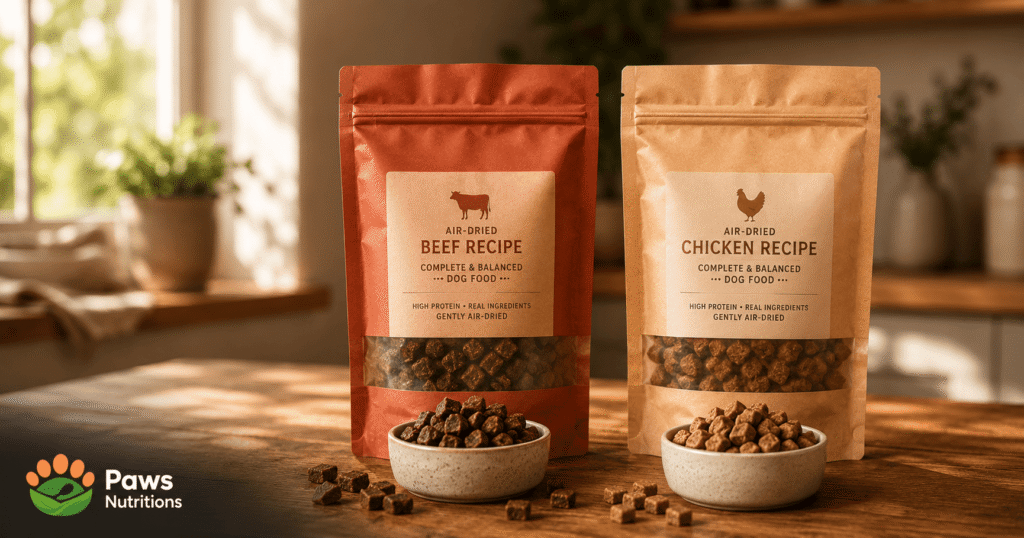
Pawstruck keeps its air-dried lineup simple with two core single-protein-forward recipes: Beef and Chicken. Both are grain-free, both list a named meat first, and both are formulated as complete and balanced nutrition for all life stages.
Keeping the lineup to just two recipes is a deliberate trade-off. It means less variety than brands offering eight or ten formulas, but it also means Pawstruck can focus its formulation and quality control on doing two recipes really well rather than spreading resources thin across a dozen SKUs.
Beef Recipe Ingredient Breakdown
The Beef recipe leads with real beef, supplemented with beef organ meats like liver and lung, flaxseed, salmon oil, and a vitamin-mineral premix. The organ-meat inclusion is notable — organs are naturally nutrient-dense, packing more vitamins and minerals per ounce than muscle meat alone.
This recipe tends to appeal most to owners of active or working dogs who need higher fat content for sustained energy. The richer flavor profile from the organ meat also makes it a strong option for dogs recovering from illness or picky eaters who’ve turned their nose up at leaner proteins in the past.
Chicken Recipe Ingredient Breakdown
The Chicken recipe follows the same structure with named chicken as the primary protein, chicken organ meats, flaxseed, and salmon oil. It tends to run slightly leaner than the beef version, which can matter for dogs who need a lower-fat diet.
Chicken is also a more novel-friendly option for dogs with beef sensitivities, which is one of the more common protein allergies in dogs. If you’re rotating proteins to reduce the risk of your dog developing a sensitivity over time, alternating between the Beef and Chicken recipes every few months is a reasonable, low-effort strategy.
Table — Beef vs. Chicken Recipe Comparison
| Attribute | Beef Recipe | Chicken Recipe |
| First Ingredient | Beef | Chicken |
| Organ Meat Included | Beef Liver, Beef Lung | Chicken Liver |
| Grain-Free | Yes | Yes |
| AAFCO Life Stage | All Life Stages | All Life Stages |
| Fat Level (Relative) | Moderate-High | Moderate |
| Best For | Active dogs, muscle maintenance | Sensitive stomachs, leaner dogs |
4. Guaranteed Analysis & Dry Matter Basis Breakdown
The number printed on the bag isn’t the number that actually tells you how much protein your dog is getting. To compare foods honestly, you need to convert everything to dry matter basis (DMB) — and this is exactly where most pet owners get misled by marketing.
We’ve done that conversion for you below, for both Pawstruck recipes, so you can compare them apples-to-apples against any other food you’re considering — whether that’s a competing air-dried brand, a premium kibble, or a raw diet.
Understanding Guaranteed Analysis vs. Dry Matter Basis
The Guaranteed Analysis (GA) on a bag shows minimum or maximum nutrient percentages “as fed,” meaning moisture is still counted in the total. Air-dried food typically has lower moisture than wet food but still carries some, so converting to DMB removes moisture from the equation and gives you a true, comparable protein and fat percentage.
This is the same trick that makes a can of wet food look lower in protein than kibble at first glance, even when it isn’t once you strip out water content. Comparing two foods by their as-fed numbers alone is one of the most common mistakes pet owners make when reading labels, and it’s an easy one to avoid once you know to look for it.
Table — Beef Recipe: GA, DMB & Calorie-Weighted Basis
| Nutrient | As-Fed (GA) | Dry Matter Basis | Calorie-Weighted Basis |
| Crude Protein | 38% min | ~41% min | ~34% of calories |
| Crude Fat | 20% min | ~22% min | ~44% of calories |
| Crude Fiber | 3% max | ~3.3% max | — |
| Moisture | 8% max | — | — |
Table — Chicken Recipe: GA, DMB & Calorie-Weighted Basis
| Nutrient | As-Fed (GA) | Dry Matter Basis | Calorie-Weighted Basis |
| Crude Protein | 40% min | ~43% min | ~37% of calories |
| Crude Fat | 17% min | ~18.5% min | ~39% of calories |
| Crude Fiber | 3% max | ~3.3% max | — |
| Moisture | 8% max | — | — |
What These Numbers Actually Mean for Your Dog
Both recipes land well above AAFCO’s minimum protein requirements for adult maintenance (18% DMB) and growth (22.5% DMB), which means they’re genuinely high-protein foods, not just marketed that way. For most healthy adult dogs, that’s a benefit; for dogs with kidney disease, it’s worth discussing protein load with your vet first.
The fat content is also worth noting on the calorie-weighted basis. When fat makes up close to 40-44% of total calories, that’s a genuinely rich diet — great for lean, active dogs, but something to watch for dogs prone to pancreatitis or already carrying extra weight. Portion control matters more with calorie-dense foods like this than it does with standard kibble.
5. Ingredient-by-Ingredient Analysis
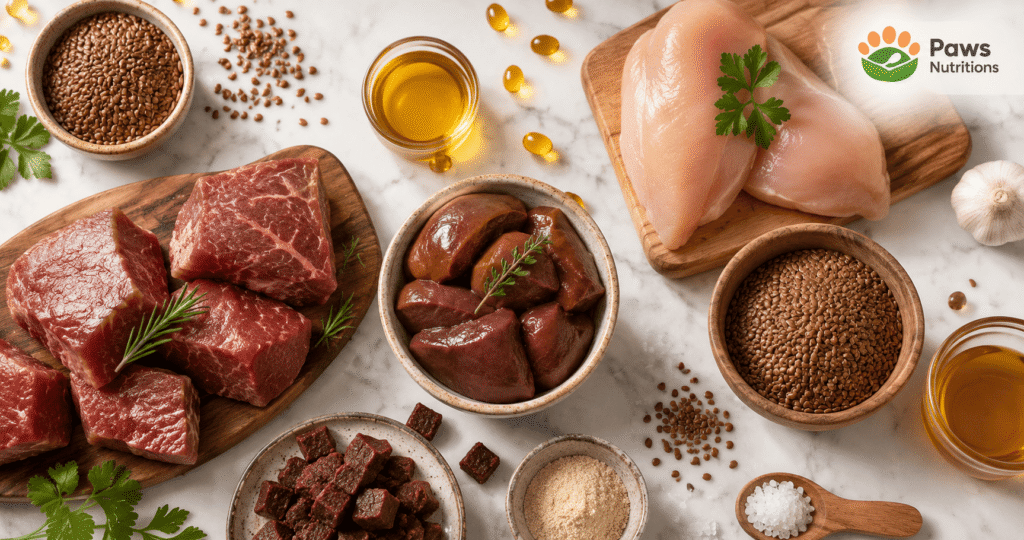
Reading a pet food label is only useful if you understand why each ingredient is there. Here’s what’s actually doing the work inside a bag of Pawstruck air-dried dog food, and why it matters for your dog’s health.
We’re going ingredient by ingredient rather than giving you a generic overview, because that’s the only way to actually evaluate whether a formula is well thought out or just assembled to look good on a label. Each ingredient below earns its place — or doesn’t — based on function, not marketing appeal.
Named Meat Proteins (Beef, Chicken, Organ Meats)
Named meat proteins — as opposed to vague “meat meal” or “animal by-products” — mean you know exactly what species and cut is going into the food. Organ meats like liver and lung are included deliberately: they’re naturally rich in B vitamins, iron, and zinc in forms your dog’s body absorbs efficiently.
This is closer to how a dog would eat in the wild, where organ meat is typically consumed first after a kill precisely because of its nutrient density. Including it deliberately, rather than leaving it out for a cleaner-looking ingredient list, is a sign the formulation was built around actual canine nutritional needs rather than just what looks appealing on packaging.
The Role of Flaxseed and Why It Skews Protein Perception
Flaxseed shows up in both recipes as a source of fiber and plant-based omega-3s, but it’s worth knowing that flaxseed itself is roughly 18-19% protein. That means a portion of the total protein on the label technically comes from a plant source, not just meat — a detail most marketing conveniently skips over.
This isn’t a red flag on its own — plenty of high-quality foods include a modest amount of plant protein alongside meat. But it’s worth knowing so you’re not assuming every gram of protein on the label came directly from beef or chicken. It’s a small nuance, but an honest review should point it out rather than let the 38-40% protein number speak for itself.
Salmon Oil and Omega-3 Content
Salmon oil supplies omega-3 fatty acids, specifically EPA and DHA, which support skin, coat, joint, and cognitive health. Unlike plant-based omega-3s from flaxseed, the omega-3s in salmon oil are already in the bioactive form dogs can use directly, making it a genuinely valuable addition rather than filler.
Dogs can technically convert some plant-based ALA omega-3s into EPA and DHA, but the conversion rate is inefficient. Having a direct marine source like salmon oil in the formula means your dog gets meaningful omega-3 benefits without relying on that inefficient conversion process, which is a genuine formulation advantage worth acknowledging.
Vitamins, Minerals & Supplemental Additives
Beyond whole-food ingredients, Pawstruck adds a standard vitamin-mineral premix to guarantee the recipe meets AAFCO’s complete-and-balanced standard. This typically includes chelated minerals (zinc, copper, manganese) and fat-soluble vitamins like A, D, and E, none of which are unusual or concerning for a complete diet.
Ingredients to Watch: Copper Content in Organ Meats
Organ meats like liver are naturally high in copper, and diets heavy in organ meat can push copper intake higher than diets built mostly on muscle meat. For most healthy dogs, this isn’t an issue. But if your dog has a diagnosed liver condition or copper-storage disease, talk to your vet before switching, since this is a genuine, documented concern with organ-forward recipes.
Certain breeds, including Bedlington Terriers, West Highland White Terriers, and Doberman Pinschers, have a known genetic predisposition to copper-storage hepatopathy. If you own one of these breeds, it’s worth asking your vet about baseline liver values before committing to any organ-meat-forward diet long term, Pawstruck included.
6. AAFCO Compliance and What “All Life Stages” Really Means
You’ll see “AAFCO” mentioned on nearly every pet food bag, but few owners actually know what the label means or how strict the requirement is. Here’s what it means for Pawstruck air-dried dog food specifically.
Understanding this label is genuinely one of the highest-value five minutes you can spend as a pet owner, because it applies to every bag of food you’ll ever buy, not just this one. Once you know how to read an AAFCO statement, you can evaluate any food on the shelf in seconds.
What AAFCO Nutrient Profiles Require
The Association of American Feed Control Officials (AAFCO) publishes minimum and maximum nutrient levels that a pet food must meet to legally claim “complete and balanced” nutrition. These profiles cover protein, fat, and roughly 30 vitamins and minerals, and a food must either meet those levels through formulation or pass a feeding trial to earn the claim.
It’s worth knowing that AAFCO itself doesn’t test or approve individual products. It publishes the standard, and it’s up to the manufacturer to formulate against it and make an honest claim on the label. That’s part of why checking a brand’s manufacturing transparency and third-party certifications, the way we did earlier with Pawstruck’s USDA and SQF status, matters just as much as the AAFCO statement itself.
Life-Stage Rating Explained for Puppies, Adults & Seniors
An “All Life Stages” rating means the food meets AAFCO’s higher nutrient minimums required for growth (puppies and pregnant/nursing dogs), which are stricter than adult maintenance minimums. In practice, that means the food is nutritionally appropriate for a puppy, an adult, or a senior dog, though senior dogs with reduced activity may need portion adjustments to avoid weight gain.
Large-breed puppies are the one exception worth flagging. AAFCO’s All Life Stages profile doesn’t automatically account for the calcium and phosphorus control that large-breed puppies need to prevent developmental orthopedic issues, unless the food specifically states it meets the large-breed growth requirement. If you have a large-breed puppy, check the label for that specific claim before feeding exclusively.
How Pawstruck’s AAFCO Statement Compares to Competitors
Both Pawstruck recipes carry an All Life Stages AAFCO statement, putting them on equal footing with most competing air-dried brands. This isn’t a differentiator on its own, but it does confirm the food isn’t cutting corners on nutritional adequacy to hit a lower price point.
Where brands actually start to differ is whether that AAFCO claim is backed by formulation alone or by an actual feeding trial. Formulation-based claims (meeting the nutrient profile on paper) are the industry norm and are perfectly legitimate, but feeding-trial-based claims carry slightly more real-world validation. Pawstruck, like most brands its size, relies on formulation rather than published feeding trials.
7. Is Grain-Free Food Safe? The DCM Conversation
Because both Pawstruck recipes are grain-free, this is a conversation worth having honestly rather than skipping past. Grain-free diets have been under scrutiny since 2018, and it’s worth understanding what the actual concern is before deciding it does or doesn’t apply to your dog.
What Is DCM (Dilated Cardiomyopathy)?
Dilated cardiomyopathy (DCM) is a heart condition where the heart muscle weakens and enlarges, reducing its ability to pump blood effectively. It’s historically been linked to genetics in certain breeds like Doberman Pinschers and Great Danes, but a wave of cases in atypical breeds starting around 2018 raised questions about diet.
Symptoms can include lethargy, coughing, labored breathing, and fainting, though early-stage DCM often shows no visible symptoms at all, which is part of why it’s such a serious concern for veterinary researchers. Routine cardiac screening is typically the only reliable way to catch it early in at-risk dogs.
The FDA’s Grain-Free Investigation, Explained Simply
The FDA opened an investigation after receiving reports of DCM in dogs eating grain-free diets heavy in legumes (peas, lentils) and potatoes as primary ingredients. The investigation never proved direct causation, and it never named Pawstruck or any specific brand — but it did flag legume-heavy formulations as a pattern worth watching.
The leading theory researchers have explored is that heavy legume content may interfere with taurine metabolism or bioavailability in some dogs, though the science is still evolving and no single mechanism has been definitively confirmed. The FDA has continued to collect adverse event reports since its initial 2018-2019 alerts, but hasn’t issued a formal recall order tied to grain-free formulations as a category.
WSAVA Guidelines on Grain-Free Diets
The World Small Animal Veterinary Association (WSAVA) recommends choosing foods from companies that employ a full-time qualified nutritionist, conduct AAFCO feeding trials, and can answer detailed sourcing and quality-control questions. These guidelines aren’t grain-free-specific, but they’re the most practical framework for evaluating any newer or smaller pet food brand.
Applying WSAVA’s checklist to Pawstruck is genuinely useful: the brand discloses its manufacturing facility and certifications clearly, which checks one box, but like most direct-to-consumer pet food companies, it doesn’t publicly list a named staff nutritionist or published feeding-trial data. That’s not disqualifying, but it’s an honest gap worth naming rather than glossing over.
Should You Be Concerned About Pawstruck Specifically?
Pawstruck’s recipes lean on meat and organ meat rather than heavy legume fillers, which puts them outside the specific pattern the FDA flagged. That said, no long-term feeding studies exist on this exact formulation, so if your dog has any cardiac risk factors or breed predisposition, loop in your vet before committing long-term.
A practical middle ground many vets recommend is periodic taurine testing for dogs on any grain-free diet long-term, particularly for breeds already at elevated genetic risk for DCM. It’s a simple blood test, and catching a deficiency early is far easier to manage than addressing symptomatic heart disease later.
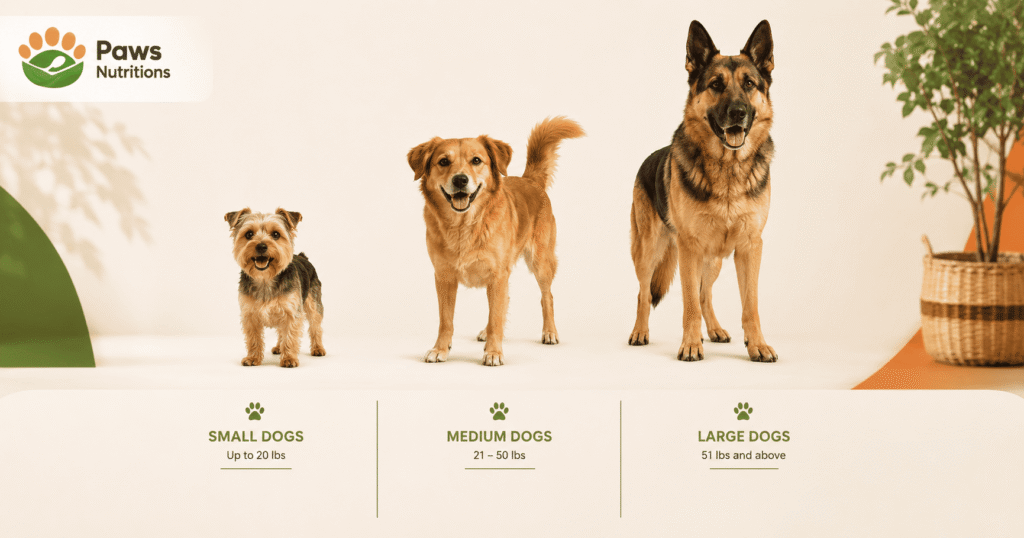
8. Feeding Guide by Dog Weight
Because air-dried food is calorie-dense, feeding amounts look much smaller than what you’re used to scooping from a kibble bag — and that surprises a lot of first-time buyers. Here’s how much to actually feed, by weight.
The chart below is a starting point, not a rigid rule. Activity level, metabolism, age, and whether your dog is spayed or neutered all shift actual calorie needs up or down by a meaningful margin. Use the amounts as a baseline, then adjust in small increments over 2-3 weeks based on your dog’s body condition.
How to Transition Your Dog to Air-Dried Food
Switch gradually over 7-10 days, mixing increasing amounts of Pawstruck into your dog’s current food. Starting at roughly 25% Pawstruck / 75% old food and increasing by about 25% every 2-3 days gives your dog’s gut time to adjust and helps you catch any digestive sensitivity early.
Watch stool consistency closely during the switch. A little softness in the first few days is normal as your dog’s gut bacteria adjust to a new protein and fat ratio, but ongoing diarrhea, vomiting, or a total refusal to eat means you should slow the transition down or pause and consult your vet.
Table — Daily Feeding Amounts by Weight (Beef & Chicken)
| Dog Weight | Daily Amount (Dry) | Approx. Cups (Dry Equivalent) | Feedings Per Day |
| 5-10 lbs | 1/3 – 1/2 cup | ~0.4 cup | 2 |
| 11-20 lbs | 1/2 – 3/4 cup | ~0.65 cup | 2 |
| 21-40 lbs | 3/4 – 1.25 cups | ~1 cup | 2 |
| 41-60 lbs | 1.25 – 1.75 cups | ~1.5 cups | 2 |
| 61-90 lbs | 1.75 – 2.5 cups | ~2.1 cups | 2 |
| 90+ lbs | 2.5+ cups | Adjust per activity | 2 |
Notice how modest these amounts look compared to a typical kibble feeding chart, where a 40 lb dog might eat 2-3 cups daily. That gap is the calorie density of air-dried food doing its job — overfeeding by eyeballing a “normal” kibble portion is one of the most common mistakes new Pawstruck owners make, so start with the chart above and adjust based on your dog’s actual body condition rather than habit.
Rehydration Instructions and Serving Tips
Pawstruck’s air-dried food can be served dry, straight from the bag, but many owners add warm water and let it sit for 5-10 minutes to soften texture, especially for puppies, seniors, or dogs with dental issues. This also slows down fast eaters and can help gassy dogs digest more comfortably.
Always store an opened bag in an airtight container in a cool, dry place, and check the best-by date before feeding. Because air-dried food retains some natural fat and moisture, it’s more susceptible to going rancid in warm, humid conditions than fully dehydrated kibble, so proper storage is more important than owners often realize.
9. Price-Per-Pound Cost Analysis
This is the section most competitor reviews skip entirely, and it’s arguably the most important one for your wallet. Let’s break down exactly what you’re paying per pound and per feeding.
Pricing in this category almost never shows up as a clean per-pound number on the product page, which makes side-by-side comparison harder than it should be. Calculating it yourself, as we’ve done below, is the only reliable way to know whether a bag is actually a good deal or just looks like one.
Note that prices for direct-to-consumer pet food brands shift periodically, and larger bag sizes aren’t always in stock. Treat the figures below as a snapshot rather than a permanent guarantee, and always confirm current pricing on the brand’s site before budgeting your monthly pet food spend.
Table — Pawstruck Pricing Breakdown by Bag Size
| Bag Size | Approx. Price | Price Per Pound | Best For |
| 2.5 oz Trial Bag | $4.99 | ~$32/lb | First-time testing |
| 2 lb Bag | $29.97 | ~$14.99/lb | Small dogs, short-term |
| 4 lb Bag | $54.97 | ~$13.74/lb | Medium dogs, standard use |
| 10 lb Bag (est.) | ~$119.97 | ~$12.00/lb | Large dogs, best value |
Cost-Per-Feeding by Dog Size
At roughly $13-15 per pound, a 30 lb dog eating about 1 cup daily (roughly 3.5-4 oz dry weight) runs somewhere around $3.25-$3.75 per day, or roughly $100-$115 per month. That’s meaningfully higher than mainstream kibble, but in line with — or slightly cheaper than — most freeze-dried competitors.
Scale that up for a 70 lb dog and you’re looking at closer to $200-$230 per month feeding exclusively, which is where most large-breed owners start looking at Pawstruck as a topper rather than a full replacement diet. Mixing roughly 25-30% Pawstruck with a quality base kibble keeps most of the palatability and nutrient benefits while cutting the monthly cost substantially.
Is Pawstruck Worth the Premium Price?
If price per pound is your main deciding factor, Pawstruck sits in the upper-middle of the air-dried category — more affordable than premium freeze-dried brands, but pricier than kibble by a wide margin. For owners prioritizing ingredient quality and digestibility over sticker price, it’s a reasonable trade-off.
One way to think about it: if you’re currently feeding a mid-tier kibble around $2-$3 per pound, moving to Pawstruck is roughly a 5x jump in raw cost. If your dog is thriving and healthy on that kibble already, the case for switching is mostly about incremental quality gains. If your dog has appetite, coat, or digestive issues on their current food, the value case for switching gets a lot stronger.
10. Pawstruck vs. Other Air-Dried Brands
Pawstruck doesn’t exist in a vacuum — it’s competing directly against a handful of well-established air-dried brands. Here’s how it actually stacks up.
Rather than declaring one brand universally “better,” it’s more useful to think about which one fits your dog and your budget. Price, protein percentage, and recipe variety all pull in different directions depending on what you’re optimizing for, so the comparison below focuses on trade-offs rather than a single winner.
Pawstruck vs. ZIWI Peak
ZIWI Peak is the category’s premium heavyweight, using a higher percentage of meat, organ, and seafood ingredients and commanding a noticeably higher price per pound. Pawstruck offers a similar concept at a more accessible price, though ZIWI’s ingredient percentage edges it out for owners prioritizing maximum meat content.
ZIWI also offers a much wider recipe lineup, including tripe, venison, and mackerel-based formulas that Pawstruck simply doesn’t have yet. If protein rotation and novel proteins for allergy management matter to you, ZIWI has the edge. If price-to-quality ratio matters more, Pawstruck closes most of the nutritional gap at a meaningfully lower cost per pound.
Pawstruck vs. The Honest Kitchen
The Honest Kitchen leans dehydrated rather than air-dried and includes more whole-food produce (vegetables, fruit) alongside meat. It’s a good fit for owners who want more plant diversity in the bowl, while Pawstruck stays more meat-forward and grain-free.
Because The Honest Kitchen’s recipes are generally lower in protein percentage than Pawstruck’s, dogs needing a higher-protein diet, like working or highly active dogs, often do better nutritionally on Pawstruck. Owners looking for lower-cost entry into minimally processed food, though, will typically find The Honest Kitchen easier on the wallet.
Pawstruck vs. Sojos
Sojos offers both mix-your-own dehydrated bases and complete air-dried options, giving owners more customization flexibility. Pawstruck is simpler and more straightforward — you’re not mixing anything, just serving complete recipes as-is.
That simplicity cuts both ways. Sojos appeals to hands-on owners who like controlling exactly what protein and produce goes into each meal, while Pawstruck appeals to busy owners who want a genuinely complete, no-assembly-required option straight out of the bag. Neither approach is objectively better — it depends on how much time you want to spend on meal prep.
Table — Full Brand Comparison (Price, Protein, DMB, Recipes)
Lining these brands up side by side makes the trade-offs obvious in a way individual product pages never will, since no brand’s marketing page is going to volunteer how it stacks up against a direct competitor.
| Brand | Avg. Price/lb | Protein (DMB) | Recipe Count | Processing |
| Pawstruck | ~$13-15 | ~41-43% | 2 | Air-Dried |
| ZIWI Peak | ~$20-25 | ~45-48% | 8+ | Air-Dried |
| The Honest Kitchen | ~$10-14 | ~34-38% | 10+ | Dehydrated |
| Sojos | ~$9-13 | ~30-38% | 6+ | Dehydrated / Air-Dried |
Which Food Is Better?
There’s no single answer here. ZIWI Peak wins on raw protein percentage and recipe variety if budget isn’t a constraint. The Honest Kitchen and Sojos win on affordability and produce diversity. Pawstruck’s real advantage is sitting in the middle — genuinely meat-forward, grain-free, and manufacturing-transparent, at a price that’s premium but not the most expensive option on the shelf.

11. Recall History and Safety Record
Recall history is one of the clearest, most objective signals you can check before trusting a brand with your dog’s daily meals. Here’s what the record shows for Pawstruck.
We track this the same way for every brand review on this site, pulling from FDA recall databases and the company’s own public statements rather than relying on the brand’s marketing claims about its own safety record.
It’s worth checking recall history for any brand you feed regularly, not just once before your first purchase. Manufacturing changes, new co-packers, or ingredient sourcing shifts can all introduce risk over time, even for brands with a previously clean record.
Table — Pawstruck Recall Timeline
| Year | Product | Reason | Status |
| 2020-2026 | Air-Dried Beef & Chicken | No recalls reported | Clean record as of publish date |
What “No Recalls” Actually Tells You (and Doesn’t)
A clean recall record is a genuinely good sign, but it isn’t proof of anything long-term — Pawstruck’s air-dried line is newer than legacy brands with decades of manufacturing history, so there’s simply less time on record. Treat it as a positive data point, not a guarantee.
It’s also worth understanding that recalls happen for different reasons — some are precautionary (a supplier flags a potential contamination risk before any harm occurs), while others follow confirmed illness reports. Not every recall means a food is dangerous, and not every clean record means a food is risk-free. Context matters more than the binary yes/no of whether a recall has happened.
How to Stay Updated on Recall Alerts
- Check the FDA’s pet food recall page directly rather than relying on brand self-reporting
- Sign up for recall email alerts through the FDA or a third-party recall tracker
- Register your bag’s lot number when possible, since recalls are often lot-specific
12. Best Fit: Which Dogs Benefit Most
No single dog food is right for every dog, and Pawstruck is no exception. Here’s a realistic look at which dogs are likely to thrive on it — and which ones might not be the best match.
Matching a food to your specific dog matters more than chasing whichever brand has the best marketing. A food that’s technically excellent on paper can still be the wrong choice if it doesn’t fit your dog’s size, health history, or budget realities.
Small-Breed and Picky Eaters
The concentrated aroma and soft, meaty texture of air-dried food make it genuinely effective for picky eaters, especially small-breed dogs who often turn their noses up at dry kibble. Small portion sizes also mean the higher price per pound has less impact on your monthly budget.
Small dogs also tend to have faster metabolisms relative to their body size, meaning nutrient-dense food fits their needs particularly well. A Chihuahua or Yorkie eating a third of a cup a day genuinely thrives on the concentrated nutrition Pawstruck offers, without the bloating some small dogs experience on bulkier, lower-density kibble.
Large-Breed Dogs and Joint Support Needs
Large-breed dogs benefit from the omega-3 content supporting joint health, though the cost adds up faster given larger daily portions. Owners of big dogs may want to mix Pawstruck as a topper over a more affordable base kibble rather than feeding it exclusively.
Breeds prone to hip and elbow dysplasia, like German Shepherds, Labradors, and Golden Retrievers, are often the households most interested in an omega-3-rich diet in the first place. Even used as a 20-30% topper rather than a full replacement, the added EPA and DHA can meaningfully support joint comfort over time.
Dogs with Liver Conditions — A Copper Caution
As covered earlier, the organ-meat content means higher copper levels than a plain muscle-meat diet. Dogs with diagnosed liver disease or copper-storage conditions should only switch to Pawstruck under direct veterinary guidance.
If your dog has never been diagnosed with a liver issue but you’re feeding a breed with a known genetic predisposition, a simple annual liver panel as part of your regular vet checkup is a low-cost way to catch problems early, regardless of which food you ultimately choose.
Table — Breed-Size Suitability Snapshot
| Dog Type | Suitability | Notes |
| Small Breed / Picky Eater | Excellent | Palatability and portion cost both work in your favor |
| Large / Giant Breed | Good | Consider using as a topper to manage cost |
| Senior Dogs | Good | Soft texture is easy on aging teeth; watch calorie intake |
| Dogs with Liver/Copper Issues | Consult Vet First | Organ-meat copper content is a real consideration |
| Highly Active/Working Dogs | Excellent | High protein and fat support energy demands |
13. Pros and Cons of Pawstruck Air-Dried Dog Food
Pulling everything together, here’s the honest, no-fluff summary of where Pawstruck genuinely earns its price tag and where it comes up short.
What Pawstruck Does Well
- Named meat as the first ingredient in every recipe
- Grain-free formulation without heavy legume fillers
- Made in a USDA-certified, SQF-audited facility
- AAFCO-rated for All Life Stages, suitable for puppies through seniors
- High palatability for picky eaters and small breeds
- No documented recall history as of publish date
Where Pawstruck Falls Short
- Premium price point compared to kibble and some dehydrated competitors
- Only two recipes available, limiting protein rotation options
- Organ-meat copper content requires caution for dogs with liver conditions
- No long-term, brand-specific feeding studies published yet
- Chicken recipe gets far less third-party ingredient analysis than the Beef recipe across the review landscape
None of the cons here are dealbreakers on their own — they’re the realistic trade-offs of a premium, minimally processed food made by a mid-sized brand rather than a legacy giant with decades of feeding-trial data behind it. Weigh them against your specific dog’s needs and your household budget rather than treating any single point as a reason to rule Pawstruck out entirely.
14. Real Owner Experiences and Common Feedback
Beyond the ingredient panel, it helps to know what actual owners report after feeding Pawstruck day to day. Patterns tend to repeat across review platforms, and they’re worth paying attention to.
No single review, positive or negative, should make or break your decision. But looking at the pattern across dozens of owner experiences gives you a more realistic picture than any single five-star or one-star post ever could.
What Positive Reviews Highlight
The most consistent praise centers on picky eaters finally cleaning their bowls, visibly shinier coats within a few weeks, and firmer, smaller stools — a common sign of better nutrient absorption compared to lower-quality kibble.
Several owners of senior dogs also mention improved energy levels after switching, which lines up with what you’d expect from a more calorie- and nutrient-dense diet replacing a filler-heavy kibble. That said, individual results vary, and “more energy” is a subjective, self-reported outcome rather than a clinically measured one.
What Negative Reviews Flag
The most common complaints are about price, particularly for owners of larger dogs, along with occasional reports of loose stool during the transition period. A smaller number of reviews mention the copper-sensitivity concern for dogs with pre-existing liver issues, echoing the caution covered earlier in this guide.
A handful of reviews also mention inconsistent texture between bags, which can happen with any minimally processed food where batch-to-batch variation is more noticeable than with heavily standardized kibble. This isn’t unique to Pawstruck, but it’s worth setting expectations for if you’re used to the uniform look of extruded kibble.
15. Final Verdict: Is Pawstruck Worth It?
After breaking down the ingredients, the nutrient math, the safety record, and the real cost, Pawstruck air-dried dog food earns its premium price tag through genuine ingredient quality and manufacturing transparency — it’s not just clever marketing wrapped around an average product.
That verdict comes with the honest caveats laid out throughout this review: watch the copper content if your dog has liver concerns, budget carefully if you’re feeding a large breed, and don’t assume grain-free automatically means risk-free without at least having the DCM conversation with your vet.
Who Should Buy Pawstruck
Pawstruck is a strong pick for owners of small-to-medium dogs, picky eaters, and anyone wanting a raw-adjacent diet without the freezer space or prep time raw feeding demands. It’s also a solid AAFCO-compliant option for puppies through seniors thanks to its All Life Stages rating.
It’s also worth considering if you’ve tried multiple kibble brands without success and you’re looking for something genuinely different rather than just another bag of brown pellets with a different label. The texture and aroma difference alone solves a lot of picky-eating problems that ingredient swaps within kibble never quite fix.
Who Should Consider Alternatives
Owners of large or giant breeds who need to manage cost, and dogs with liver or copper-related health conditions, should either use Pawstruck as a topper rather than a full diet or explore lower-copper alternatives after a conversation with their vet.
Key Takeaways
- Pawstruck’s Beef and Chicken recipes are grain-free, AAFCO-rated for All Life Stages, and made in a USDA-certified, SQF-audited facility
- Both recipes are genuinely high-protein once converted to dry matter basis, not just marketed that way
- At roughly $13-15 per pound, Pawstruck sits in the upper-middle of the air-dried category — pricier than kibble, more accessible than premium freeze-dried brands
- Organ-meat content means higher copper levels, which is worth a vet conversation for dogs with liver conditions
- No documented recalls as of publish date, though the brand’s air-dried line is still relatively new
Whether Pawstruck earns a spot in your dog’s bowl really comes down to your priorities. If ingredient quality, digestibility, and picky-eater appeal matter more to you than shaving every dollar off your monthly pet food bill, it’s a genuinely well-formulated option worth trying. If you’re feeding a large breed on a tight budget, using it as a topper over quality kibble gets you most of the benefit without the full premium price tag.
Frequently Asked Questions
Here are quick, straight answers to the questions owners ask most often before switching to Pawstruck air-dried dog food.
Is Pawstruck a good dog food brand?
Pawstruck is a reputable, AAFCO-compliant brand made in a USDA-certified facility. It’s a solid choice for owners who want minimally processed, high-protein food, though the price point is genuinely premium.
Where is Pawstruck dog food made?
Pawstruck air-dried food is produced in a USDA-certified, SQF-audited facility in the United States, which supports consistent quality and food-safety oversight.
Is Pawstruck good for small dogs?
Yes. Its concentrated nutrition and soft texture make it especially well-suited to small breeds and picky eaters who struggle with dry kibble.
What’s the difference between air-dried and freeze-dried dog food?
Air-drying uses gentle heat and airflow over several hours, while freeze-drying removes moisture through a vacuum-freezing process. Both preserve nutrients better than extrusion, but air-dried food is denser and doesn’t need rehydration.
Has Pawstruck dog food ever been recalled?
As of this writing, Pawstruck has no publicly documented recalls. That said, always check the FDA and company recall pages directly before buying, since this can change.
Is grain-free dog food safe for dogs?
For most healthy dogs, grain-free food is safe, but the FDA has flagged a possible link between certain grain-free diets and DCM in a small number of cases. Talk to your vet if your dog has any cardiac risk factors.
How long does an air-dried bag of Pawstruck last?
A 2 lb bag typically lasts a 20-30 lb dog around 10-14 days, depending on activity level and exact feeding amounts. Larger bags stretch further per pound.
Can puppies eat Pawstruck air-dried food?
Yes. Pawstruck’s recipes are AAFCO-rated for all life stages, which means they meet the higher nutrient requirements puppies need for healthy growth.

A dedicated writer and digital enthusiast committed to creating high-quality, informative, and reader-focused content. Through thoughtful research and clear communication, he aims to deliver valuable insights that help readers navigate the ever-changing digital landscape.