
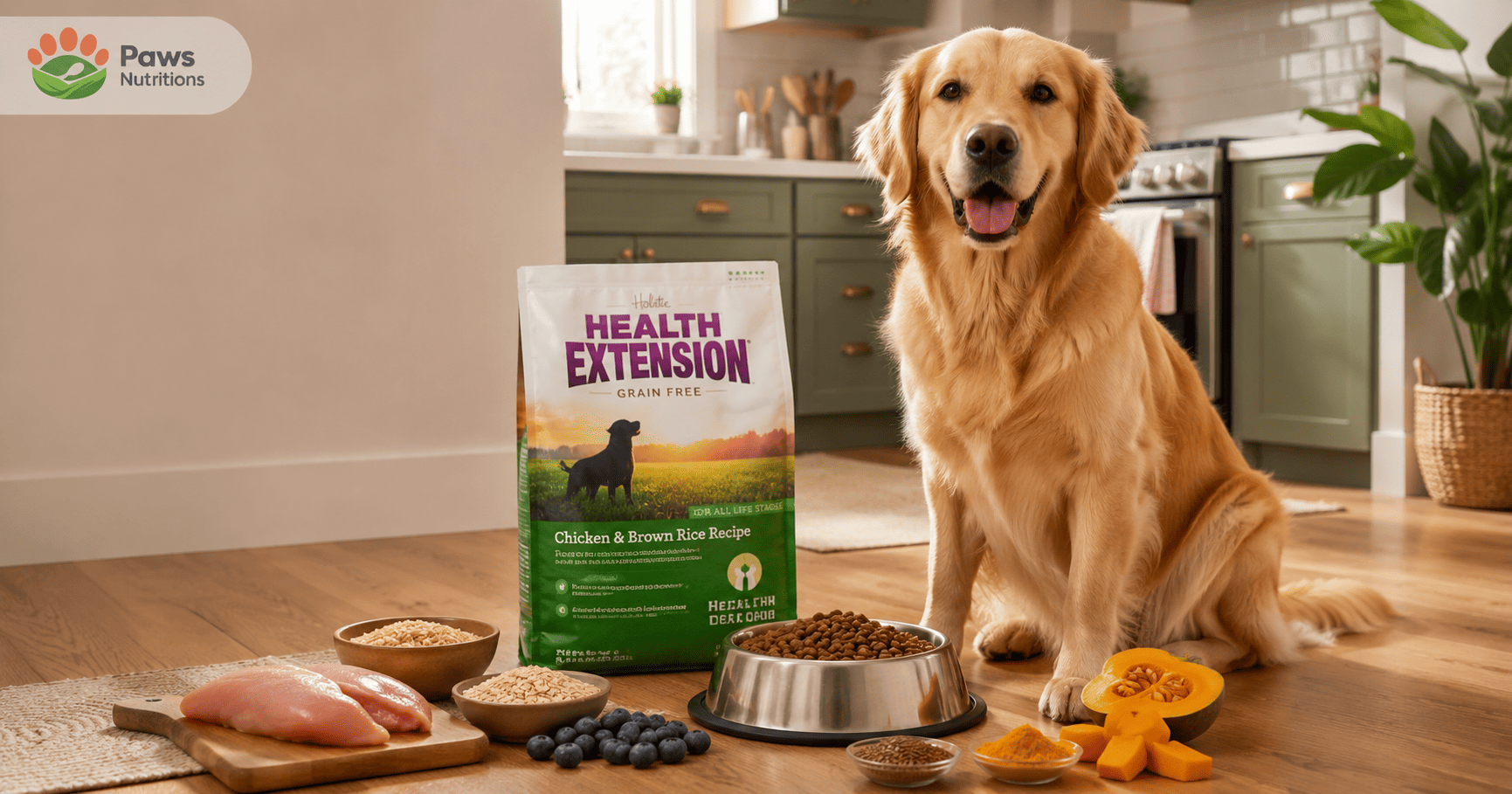
Standing in the pet food aisle wondering if Health Extension dog food is actually worth the extra few dollars? You’re not alone. With so many “holistic” brands claiming to be the healthiest option on the shelf, it’s hard to know which ones back up the marketing with real substance, and which ones just have a prettier bag.
That’s exactly what this guide sorts out for you. We dug into every recipe, checked the price per pound across bag sizes, verified the recall history under both the brand’s current and former name, and read through real owner reviews — the glowing ones and the mixed ones. By the end, you’ll know exactly whether this family-owned brand deserves a spot in your dog’s bowl, and which formula fits your dog best if it does.
What Is Health Extension Dog Food?
Health Extension dog food is a holistic pet food brand built around whole-food ingredients, added probiotics, and a long list of superfoods. It’s positioned as a mid-to-premium option for owners who want better nutrition without paying boutique-brand prices, and it’s carved out a loyal following among owners of small breeds and dogs with sensitive stomachs.
What sets it apart from a lot of newer “holistic” brands is that it isn’t a marketing invention from the last few years. It has decades of history behind it, a consistent manufacturing base, and a fairly conservative approach to formula changes — all things worth knowing before you commit your dog’s diet to it.
From Vets Choice to Health Extension: The Brand’s 1963 Origin Story
The company actually started in 1963 under the name Vets Choice. It wasn’t until 2015 that the brand rebranded to Health Extension, giving it the name most shoppers recognize today. If you ever come across an old review, forum post, or recall database entry mentioning “Vets Choice,” know that it’s referring to the exact same company you’re researching now.
This naming shift matters more than it might seem. Some recall-tracking databases and older review sites still file information under the original name, which means a search limited to “Health Extension” alone can miss relevant history. That’s exactly why any thorough review — including this one — needs to check both names.
Still Family-Owned — The Gruber Family, Three Generations
Unlike many pet food brands that get bought out by large conglomerates within a few years of gaining popularity, Health Extension has stayed with the Gruber family for over six decades. The company markets this heavily as a point of trust, and in practice, it does show up — the brand hasn’t taken outside investment or private equity money, which tends to keep formulas more stable over time compared to brands that get flipped between corporate owners every few years.
This ownership structure also means decisions about ingredient sourcing and quality control stay in-house rather than getting outsourced to whichever supplier offers the lowest bid that quarter. It’s not a guarantee of quality on its own, but it’s a meaningful data point.
Where Is Health Extension Dog Food Made?
Production happens at facilities in New York and New Jersey, with the company stating it tests every single batch before it ships to retailers. Some specialty proteins, like lamb and venison, are sourced from outside the U.S. (notably New Zealand, known for grass-fed livestock standards), but the brand is explicit that nothing is ever sourced from China — a detail that matters a lot to safety-conscious pet owners who remember past industry-wide sourcing scandals involving contaminated wheat gluten and other imported ingredients.
The company also states that its facilities never source raw materials, colors, flavors, or preservatives from China, and that testing happens on every single batch rather than on a sample basis. For pet owners who’ve been burned by an unfamiliar brand in the past, this level of sourcing transparency tends to build more trust than generic “made with love” marketing copy.
Why This Background Actually Matters for Your Buying Decision
It’s tempting to skip past brand history sections in pet food reviews, but with Health Extension, the backstory genuinely informs what you’re buying. A company that’s stayed privately held for over 60 years without chasing rapid national expansion tends to make more conservative decisions about ingredient sourcing and formula changes, since there’s no outside investor pressure pushing for cost-cutting to hit quarterly margins. That’s not a guarantee of quality, but it is a meaningful structural difference from brands that have been acquired and reformulated multiple times in the past decade.
Health Extension Product Line Overview
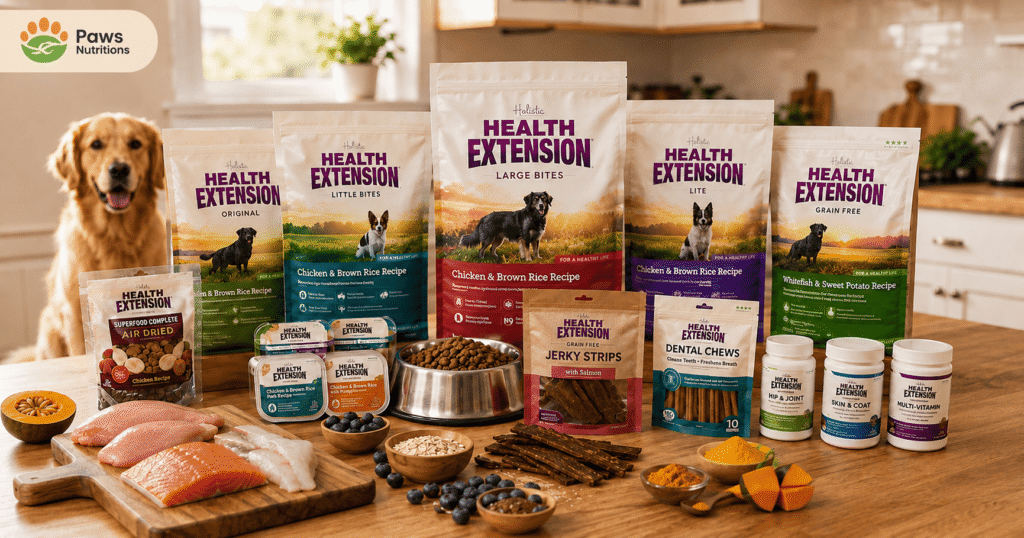
One thing that surprises first-time buyers: Health Extension isn’t just one bag of kibble sitting on a shelf. It’s a fairly wide catalog, and knowing the different lines helps you pick the right fit instead of guessing based on the first bag you see.
Dry Dog Food
The dry lineup includes the Original formulas (chicken and lamb varieties), Little Bites — a smaller kibble size designed for small breeds, puppies, and dogs who eat more slowly — plus Large Bites for bigger dogs, a Lite formula with roughly 50% less fat for weight management, and several grain-free recipes built around buffalo, whitefish, and salmon for dogs with grain sensitivities.
Canned and Wet Dog Food
Health Extension’s wet food comes in both grain-inclusive and grain-free options, including individually portioned Little Cups that are convenient for small dogs or for mixing into dry kibble as a topper. Flavors range from fairly standard (chicken, turkey) to more distinctive combinations like Tuscan Style Quail, French Bistro Rabbit, and Montana Grill Buffalo & Whitefish — a level of protein variety that’s genuinely uncommon at this price point.
The Ancestry Sub-Brand
In 2020, Health Extension added the Ancestry line, which leans into a more “ancestral diet” positioning with higher protein concentrations and fewer carbohydrate fillers. It’s aimed at owners who want something closer to a raw-inspired formula without the food safety complications of handling actual raw meat at home.
Air-Dried and Gently Cooked Options
For owners who want raw-like nutrient density without the handling risk, Health Extension also offers air-dried recipes. These retain more of the original moisture and nutrient profile than traditional extruded kibble, since the gentler drying process avoids the high-heat extrusion that can degrade certain heat-sensitive nutrients, while still being shelf-stable and easy to store.
Treats and Supplements
Rounding out the catalog are dental chews formulated to reduce plaque buildup, freeze-dried jerky treats, crunchy cookies, elk antlers for heavy chewers, and even yak cheese chews, alongside a small line of supplements. If you’re already feeding the kibble, these make it easy to keep your dog’s diet consistent across meals and snacks instead of introducing unrelated ingredients throughout the day.
How to Choose the Right Line for Your Dog
With this many options, picking the right starting point can feel overwhelming. As a general rule of thumb: small breeds and puppies do best starting with Little Bites, dogs with known grain sensitivities should look at the grain-free dry or wet options, overweight or less active adult dogs benefit from the Lite formula, and owners chasing a more raw-inspired diet without the handling risk should consider Ancestry or the air-dried line. If you’re not sure where your dog fits, starting with an Original formula and watching how they respond over a few weeks is a reasonable default.
Health Extension Dog Food Ingredients Analysis
Health Extension dog food takes a fairly straightforward, transparency-first approach to ingredients — but it’s worth understanding exactly what’s in the bag before you commit your dog’s diet to it long-term.
First Five Ingredients Breakdown
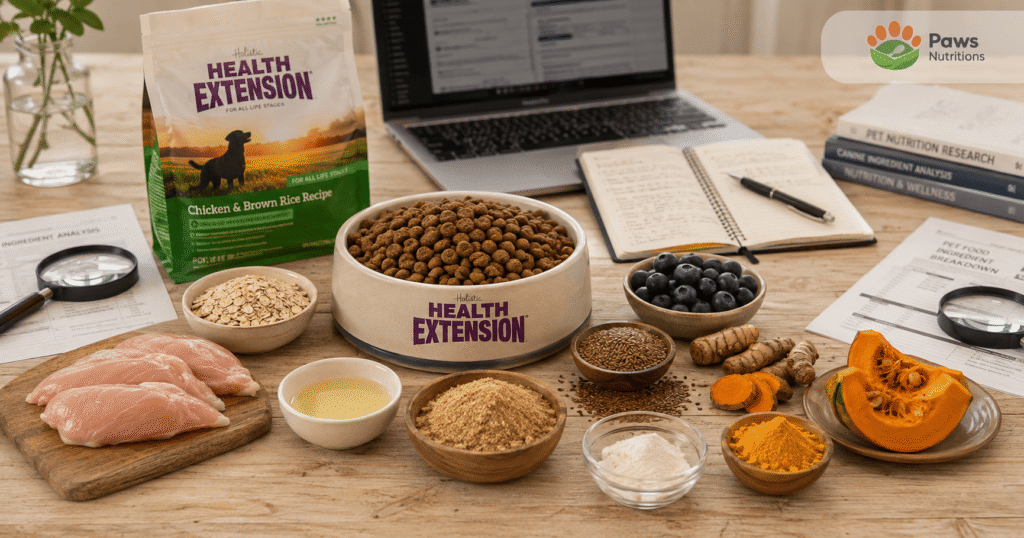
Most dry recipes lead with a named meat source — typically chicken, followed by chicken meal, brown rice, oatmeal, and chicken fat. Leading with a named protein (not a vague “meat meal” or “animal by-product”) matters because it tells you exactly what animal the primary protein comes from, which is genuinely important information for dogs with known protein sensitivities or allergies.
Chicken meal, specifically, is a concentrated protein source — it’s chicken with most of the moisture and fat removed, which means pound-for-pound it actually contributes more protein than fresh chicken alone. This is a detail that trips up a lot of pet owners who assume “meal” automatically means lower quality; in reality, it’s often a nutritional advantage when sourced from a named, single animal.
The 30+ Superfoods Explained
This is where Health Extension tries to differentiate itself from more conventional dry dog food brands. The brand adds ingredients like turmeric (an anti-inflammatory compound that may ease joint discomfort in older or arthritic dogs), apple cider vinegar (some early research suggests it may help reduce inflammation linked to urinary tract issues, though the evidence base is still developing and shouldn’t replace veterinary treatment for an active UTI), and probiotics for digestive support and a more balanced gut microbiome.
You’ll also find blueberries for antioxidant support, coconut-derived MCT oil, which has been studied for potential cognitive benefits in aging dogs, and smaller inclusions like pumpkin and flaxseed for fiber and omega-3 fatty acids. None of these ingredients are miracle cures, but together they represent a more thoughtful formulation approach than a bare-bones budget kibble.
Controversial Ingredients Addressed
Beet pulp shows up in several recipes, and it tends to spark debate in pet owner forums. In reality, beet pulp is a moderately fermentable fiber source that supports gut health, helps regulate blood sugar response, and improves stool quality — it’s not the “cheap filler” that some outdated pet food myths from the early 2010s claimed. That said, it’s fair to flag if your dog has a specifically diagnosed beet or root vegetable sensitivity, which is rare but does exist.
What Health Extension Leaves Out
Just as important as what’s included is what’s deliberately left out. Health Extension formulas skip corn, wheat, soy, artificial colors, artificial flavors, and artificial preservatives across the entire product line. This matters because corn and wheat are two of the more common grain-related sensitivities in dogs, and avoiding artificial preservatives (like BHA and BHT, which some studies have linked to potential long-term health concerns) is a genuine quality marker rather than just marketing language.
The brand also avoids rendered animal fats, animal by-products of unnamed origin, and added sugars in most of its recipes — three ingredient categories that tend to appear frequently in lower-cost, mass-market dog foods. This doesn’t automatically make Health Extension superior on every metric, but it does put the brand’s ingredient philosophy closer to what veterinary nutritionists generally recommend looking for on a label.
Digestibility and Bioavailability
One aspect that doesn’t get discussed enough in pet food reviews is digestibility — how much of the nutrition in the food a dog’s body can actually absorb and use, versus how much simply passes through. Named meat proteins and meat meals generally have higher digestibility and bioavailability than generic “meat and bone meal” or unnamed animal by-products, partly because the sourcing and processing tend to be more consistent. Health Extension’s ingredient choices, combined with the added probiotics that support gut health, point toward a formula designed with digestibility in mind rather than just hitting a minimum guaranteed analysis number.
Ingredient Sourcing and Quality Control
Beyond the “no China sourcing” policy already mentioned, Health Extension states that it works with a defined network of suppliers rather than sourcing opportunistically from whichever supplier offers the lowest bid that month. Consistency in sourcing tends to translate into more consistent recipes batch to batch, which matters a lot for dogs with sensitive stomachs who can react to even small formula shifts that wouldn’t bother a dog with a more resilient digestive system.
The brand’s batch-testing claims are also worth understanding in context. Testing every batch, rather than a sample of batches, is a stricter standard than some competitors follow, and it’s part of why the recall history has stayed clean even as the company has expanded its catalog significantly over the past decade.
Nutrient Analysis & AAFCO Standards
Ingredients only tell half the story — the actual nutrient analysis is what determines whether a food genuinely meets your dog’s dietary needs at every life stage.
Dry Matter Protein, Fat, and Carb Breakdown
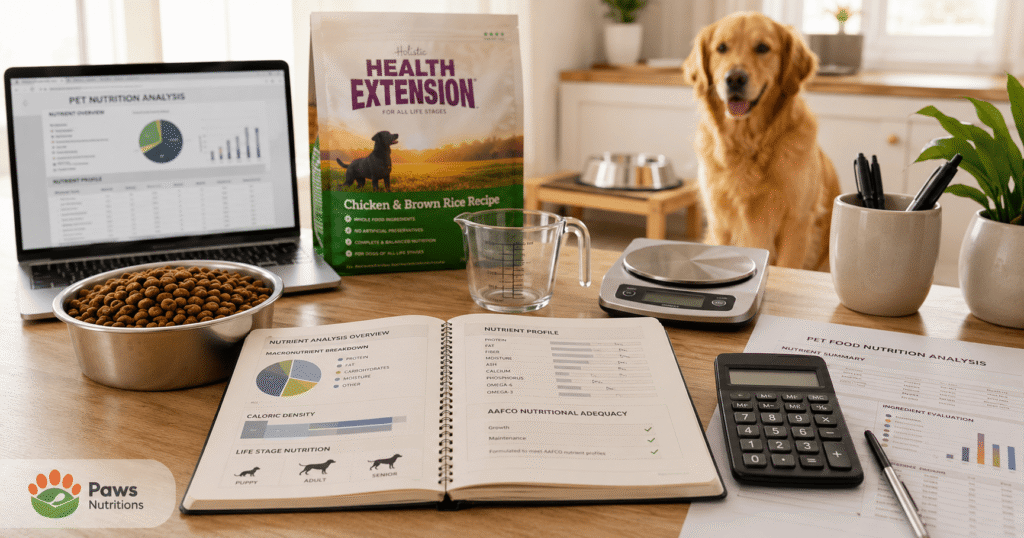
Across the dry food line, protein typically runs 24% to 27% on a dry matter basis, which comfortably clears the minimums most adult dogs need for maintenance. Fat content varies more by recipe, generally landing between 14% and 16% for standard formulas, dropping down to around 8% in the Lite line for dogs that need weight management support.
Carbohydrate content, calculated by difference, typically falls in the 40-45% range depending on the recipe — moderate for the category, and largely driven by the brown rice and oatmeal inclusions that also contribute fiber and B-vitamins.
What AAFCO Life-Stage Codes Mean
You’ll see terms like “All Life Stages,” “Growth,” or “Maintenance” printed on the bag — these come from AAFCO (Association of American Feed Control Officials) nutrient profiles, which set the minimum standards a food has to meet to legally claim it’s “complete and balanced.” A food labeled for “Growth” meets the higher energy, calcium, and phosphorus needs of puppies, while “Maintenance” is built specifically for adult dogs whose bodies aren’t actively growing bone and muscle mass anymore.
“All Life Stages” formulas, which make up most of the Health Extension dry line, are formulated to meet the higher Growth requirements, meaning they’re technically appropriate for puppies too — though very large-breed puppies should generally stick to breed-specific growth formulas to control calcium intake during rapid bone development.
How Health Extension Compares to the AAFCO Minimum
AAFCO sets 18% protein as the minimum for adult maintenance and 22.5% for growth. Health Extension’s formulas sit well above both floors across the board, which is a genuinely strong point compared to some budget competitors that hover right at the legal minimum with little margin.
Nutrient Comparison Table (Dry Matter Basis)
| Recipe | Protein % | Fat % | AAFCO Life Stage | Best For |
| Original Chicken & Brown Rice | 24% | 15% | All Life Stages | General adult feeding |
| Grain-Free Buffalo & Whitefish | 26% | 15% | All Life Stages | Grain-sensitive dogs |
| Little Bites Chicken & Brown Rice | 25% | 14% | All Life Stages | Small breeds |
| Lite Chicken & Brown Rice | 22% | 8% | Maintenance | Weight management |
| Ancestry Turkey Formula | 27% | 16% | All Life Stages | High-activity dogs |
| Grain-Free Salmon | 26% | 15% | All Life Stages | Novel protein needs |
Caloric Density and Guaranteed Analysis
Beyond protein and fat percentages, it’s worth glancing at caloric density — how many calories are packed into each cup. Health Extension’s standard formulas run in a fairly typical range for the category, generally between 350 and 400 kcal per cup depending on the recipe, while the Lite formula runs meaningfully lower to support weight loss or maintenance in less active dogs. The Guaranteed Analysis printed on every bag lists minimum protein and fat percentages alongside maximum fiber and moisture content — always worth cross-checking against your dog’s specific life stage and activity level rather than assuming one formula fits every dog in the house.
Health Extension Dog Food Prices (Price-Per-Pound Table)
This is the section most competitor reviews skip entirely — and for a lot of buyers, it’s actually the deciding factor once ingredient quality is confirmed to be roughly comparable.
Dry Food Pricing by Bag Size
Pricing follows a fairly typical bulk-discount curve: smaller bags cost noticeably more per pound than larger ones, which is standard across the pet food industry due to packaging and shipping economics. A 4 lb bag runs roughly $29.98, a 10 lb bag runs about $48.50, and a 30 lb bag drops to around $86.98 — a meaningful savings if your dog is going to be on this food for the long haul.
Canned and Wet Food Pricing
Wet food and portioned cups run noticeably higher per ounce than dry kibble, which is standard across the industry given the higher moisture content and smaller batch sizes. If you’re using wet food as a topper rather than a primary diet, the cost stays manageable; using it as the sole diet for a larger dog gets expensive fast.
Where to Buy It Cheapest
Chewy tends to offer the most consistent multi-size pricing along with autoship discounts that can shave several dollars off recurring orders. Amazon pricing fluctuates more frequently and is sometimes locked behind coupon codes that apply automatically at checkout, which makes the displayed price less reliable at a glance.
A quick note on accuracy: Online prices — especially on Amazon — change often and can vary by region, promotion, or subscription status. Always double-check the current price on the retailer’s site directly before you buy, rather than relying solely on any price listed in a review article.
Price-Per-Pound Comparison Table
| Bag Size | Approx. Price | Price Per Pound |
| 4 lb | $29.98 | $7.50/lb |
| 10 lb | $48.50 | $4.85/lb |
| 18 lb | Varies (often out of stock) | ~$3.61/lb |
| 30 lb | $86.98 | $2.90/lb |
The takeaway: if your dog is going to be eating this long-term, buying the largest bag size your storage space allows saves real money over the course of a year, sometimes by more than 60% per pound compared to the smallest bag.
Is Health Extension Expensive Compared to the Category?
Positioned against the broader pet food market, Health Extension lands in the mid-to-premium tier — noticeably more expensive than grocery-store brands like Pedigree or Ol’ Roy, but generally comparable to or slightly below well-known “holistic” competitors like Wellness or Merrick on a per-pound basis. For the ingredient quality and superfood inclusions you’re getting, most owners find the price gap over budget brands justifiable, though it’s a real consideration if you’re feeding a large-breed dog that goes through several pounds of food per week.
Subscription Savings
Both Chewy and the brand’s own site offer autoship or subscription discounts, typically shaving an additional 5% off the listed price and helping avoid the risk of running out unexpectedly. If you’ve settled on a formula your dog does well on, setting up a recurring order on the largest practical bag size is generally the most cost-effective way to buy long-term.
Health Extension Recall History
Recall history is one of the most important factors for any pet food purchase, and it’s something too many reviews either skip or address too vaguely to be useful.
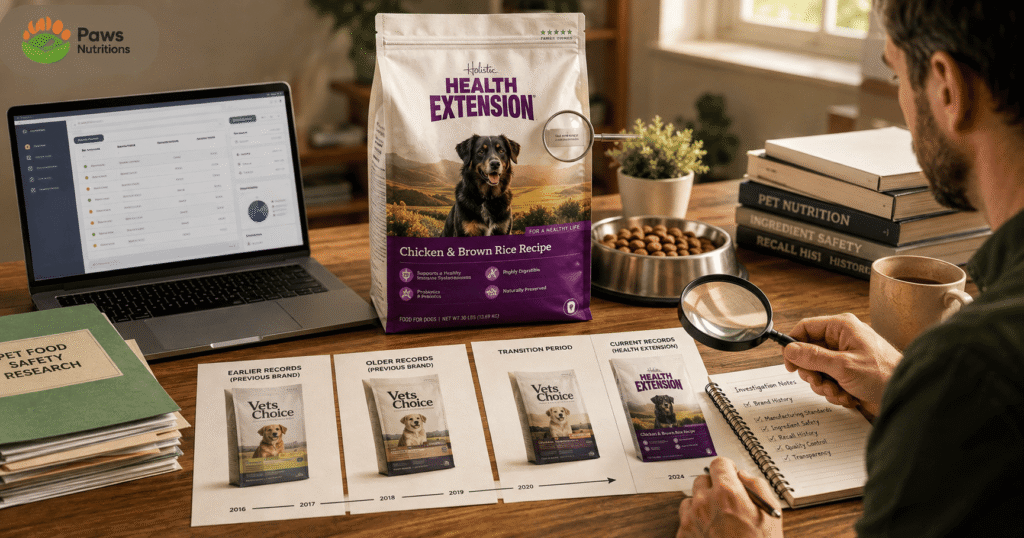
Confirmed Recall Search — Brand and Former Name
We ran a dual-query check, searching under both “Health Extension” and its former name, “Vets Choice,” since sibling-brand and legacy-brand recalls can easily get missed by a single search that only covers the current name. As of August 2026, we found no confirmed recalls or FDA warning letters under either name — a clean track record that’s genuinely rare in the pet food industry, where even major national brands have had at least one recall in the past decade.
How In-House Manufacturing Supports Safety
Because Health Extension manufactures much of its product in its own U.S. facilities rather than outsourcing to third-party co-packers, the company has more direct control over quality checks at every stage of production. This structural advantage — batch testing under one roof rather than across multiple contract manufacturers — likely contributes meaningfully to the clean recall history, since a large share of pet food recalls historically trace back to shared co-packing facilities rather than the brand’s own formula.
What to Do If You’re Concerned About a Batch
If you ever notice an unusual smell, texture, or your dog has an unexpected reaction after eating a bag, stop feeding it immediately, keep the packaging (the lot number is printed there and is essential for tracing the batch), and contact Health Extension’s customer service directly. This is good practice for any pet food brand, not just this one — even brands with a clean history can occasionally have an isolated batch issue.
How to Stay Updated on Future Recalls
A clean recall history today doesn’t guarantee one tomorrow, so it’s worth building the habit of checking periodically rather than assuming a brand is permanently in the clear. The FDA maintains a public pet food recall database, and signing up for recall alerts directly through the FDA’s website or a service like the American Veterinary Medical Association’s recall tracker takes just a couple of minutes and covers every brand you feed, not just this one.
Feeding Guide by Dog Weight
Getting portions right matters just as much as picking the right formula in the first place — overfeeding even a high-quality food can undo its benefits.
Adult Feeding Chart (By Weight Range)
As a general guideline for the Original Chicken & Brown Rice formula: dogs around 10 lbs need roughly ½ to ¾ cup per day, dogs around 30 lbs need about 1½ to 2 cups, and dogs around 60 lbs typically need 2½ to 3 cups, ideally split into two meals rather than one large feeding. Always check the specific bag for exact amounts, since calorie density varies by recipe — the Lite formula, for instance, requires a different portion than the standard Original.
Puppy Feeding Chart
Puppies need more frequent, calorie-dense meals to support rapid growth. A 10 lb puppy generally needs ¾ to 1 cup daily, split across three meals, gradually tapering to two meals a day by around six months old as growth rate slows.
Transition Schedule
Switching foods too quickly is one of the most common causes of digestive upset, including loose stools and vomiting. Use a 5-to-7-day transition: start with roughly 25% new food mixed with 75% old food, then shift the ratio by about 25% every two days until you’re fully on the new formula by day seven.
Storage Tips to Preserve Freshness
Because Health Extension doesn’t use artificial preservatives, the food can be somewhat more sensitive to air and humidity exposure than mass-market kibble that relies on synthetic preservation. Store bags in a cool, dry place, and consider transferring kibble into an airtight container after opening rather than relying on the bag’s built-in seal alone — this helps preserve both freshness and the potency of the added probiotics, which can degrade faster once exposed to air and moisture.
Real Owner Reviews — What Pet Parents Are Saying
Numbers on a bag only go so far — real feeding experience from actual owners fills in the rest of the picture.

Positive Patterns
Across owner reviews on Chewy and Dog Food Advisor, the recurring themes are firmer stools, improved coat shine, and better acceptance from picky eaters who had refused other brands. One long-time owner described switching a rescue Chow Chow with chronic digestive issues onto the Original formula, noting the dog’s stomach problems resolved once he settled into a routine on the food — and he stayed on it for over a decade afterward with consistently firm stools and no further issues.
Honest Look at the Mixed Reviews
It wouldn’t be a fair review without mentioning the less glowing feedback. A batch of 2023-era Chewy reviews flagged inconsistent texture and occasional inventory availability issues, with a few customers noting the product seemed to change slightly between orders, and others mentioning longer-than-expected shipping windows. This doesn’t appear to be an ongoing pattern in more recent reviews, but it’s worth knowing about if you’re planning to buy in bulk for the first time, in case your dog is particularly sensitive to minor recipe or texture changes.
Best Fits
Based on the pattern of positive feedback across multiple review platforms, Health Extension tends to work especially well for small breeds, dogs with sensitive stomachs, and seniors who benefit from the added joint-support superfoods like turmeric and glucosamine found in some formulas.
What the Star Ratings Actually Show
Aggregate ratings across the major review platforms we checked land consistently in the 4.0 to 4.5 out of 5 range, which is solid for the category without being suspiciously perfect. A small share of 1- and 2-star reviews tend to cluster around shipping delays and the occasional picky eater who simply didn’t like the taste — factors that say more about individual dog preference and third-party logistics than about the food’s underlying quality.
Health Extension vs. Competitor Brands
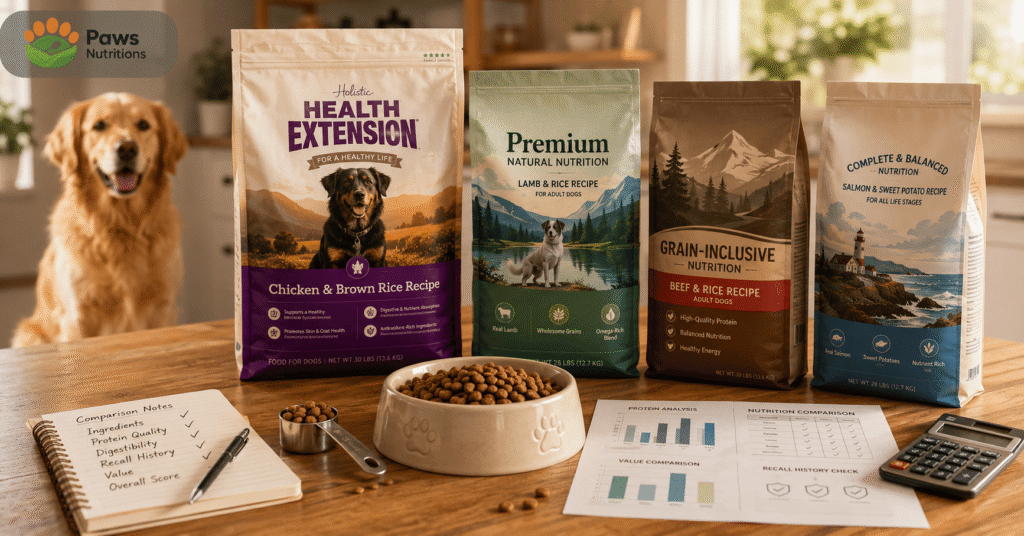
Here’s how Health Extension stacks up against three well-known names in a similar price tier, so you can see exactly where it wins and where it doesn’t.
| Brand | Protein % (DM) | Price/lb (mid-size bag) | AAFCO Stage | Recall History |
| Health Extension | 24–27% | ~$4.85/lb | All Life Stages | None found (dual-verified) |
| Wellness CORE | 34–38% | ~$4.50/lb | All Life Stages | Limited, historical |
| Merrick | 30–38% | ~$4.20/lb | All Life Stages | Limited, historical |
| Blue Buffalo | 24–36% | ~$3.80/lb | All Life Stages | Multiple historical recalls |
Which food is better? If protein percentage is your top priority, Wellness CORE and Merrick both edge ahead with higher numbers across their lines. But if a clean recall record and a family-owned, U.S.-manufactured story matter more to you, Health Extension holds a genuine edge that shows up nowhere else in this comparison — and it’s not a trivial one, given how many popular brands have at least one recall in their history.
It’s also worth noting that a higher protein percentage isn’t automatically “better” for every dog. Very high-protein diets are genuinely useful for working dogs, athletic breeds, or dogs recovering from muscle loss, but a moderate protein level like Health Extension’s is often a more appropriate everyday choice for the average house pet living a less physically demanding lifestyle — so this comparison table shouldn’t be read as a simple ranking of “best to worst.”
Pros and Cons of Health Extension Dog Food
Pros
- Named meat protein listed as the first ingredient across the entire line
- 30+ superfoods included, such as turmeric, probiotics, and MCT oil
- No confirmed recalls under either brand name as of August 2026
- Family-owned since 1963, with U.S.-based manufacturing
- Wide product range covering dry, wet, air-dried, and treats
- Batch testing performed on every production run, not just samples
- No corn, wheat, soy, or artificial preservatives in any recipe
Cons
- Premium pricing compared to mainstream grocery-store brands
- Protein percentage runs somewhat lower than some competing “holistic” brands
- Limited retail availability — mostly online or specialty pet stores rather than big-box retailers
- A handful of 2023 reviews noted inconsistent texture between batches
- Some specialty proteins are imported rather than fully domestic
Weighing these against each other, the cons are mostly trade-offs rather than genuine red flags — the kind of thing you’d expect to see when a brand prioritizes ingredient quality and recall safety over chasing the absolute lowest shelf price or the widest possible retail footprint.
Who Should (and Shouldn’t) Feed Health Extension
Best For
- Small breed owners — the Little Bites line is purpose-built for smaller mouths and slower eaters
- Sensitive stomach dogs — the added probiotics and relatively simple recipes tend to agree well with dogs who react poorly to more complex formulas
- Senior dogs — joint-support superfoods like turmeric and glucosamine-containing recipes add genuine practical value here
Consider Alternatives If
- You’re on a tight budget and need the absolute lowest price per pound available
- Your dog needs a very high-protein diet for intense athletic or working performance
- You strongly prefer buying exclusively from physical stores near you rather than online
A Note on Multi-Dog Households
If you’re feeding more than one dog, it’s worth mapping out the total monthly cost across all of them before committing, since the price-per-pound savings on larger bags compound quickly with multiple mouths to feed. Households with dogs of very different sizes often find it convenient to buy one large bag of an All Life Stages formula rather than separate bags for each dog, provided none of them has a specific dietary restriction that requires a dedicated recipe.
Common Feeding Mistakes to Avoid
Even with a well-formulated food like Health Extension, how you feed it matters just as much as what you feed.
Free-Feeding Instead of Scheduled Meals
Leaving a full bowl out all day makes it hard to track how much your dog is actually eating and can contribute to weight gain over time. Scheduled meals — typically twice daily for adults — make it much easier to notice if your dog’s appetite changes, which is often one of the earliest signs of a health issue.
Ignoring the Feeding Chart for Your Dog’s Actual Activity Level
Feeding charts on the bag assume a moderately active dog. A couch-loving senior and a high-energy working breed of the same weight have genuinely different calorie needs, so treat the printed chart as a starting point rather than a fixed rule, and adjust based on your dog’s body condition over a few weeks.
Mixing in Too Many Extras
Superfoods and probiotics are already built into the formula, so piling on additional supplements without veterinary guidance can throw off the intended nutrient balance rather than improving it. If you want to add something extra, run it by your vet first, especially for dogs with existing health conditions.
Frequently Asked Questions
Is Health Extension a good dog food?
Yes — it uses named meat proteins as the first ingredient, exceeds AAFCO’s minimum protein requirement, and has never had a recall as of August 2026.
Is Health Extension dog food worth the price?
For most owners, yes. It sits in the premium-but-not-ultra-premium tier, and the superfood inclusions and ingredient transparency justify the cost over budget brands.
Where is Health Extension dog food made?
It’s manufactured in the USA at facilities in New York and New Jersey, with select ingredients like lamb and venison sourced from USDA-inspected farms in New Zealand.
Has Health Extension dog food ever been recalled?
No. Searches under both “Health Extension” and its former name, “Vets Choice,” show no recalls or FDA warnings through August 2026.
Is Health Extension dog food good for puppies?
Yes — the brand offers puppy-specific formulas like Little Bites Puppy, formulated to AAFCO Growth standards with balanced protein and fat for development.
What is the difference between Health Extension and Vets Choice?
They’re the same company. Vets Choice rebranded to Health Extension in 2015, though it remains under the same family ownership since 1963.
Final Verdict: Is Health Extension Dog Food Worth It?
After digging through the ingredient lists, nutrient tables, pricing across bag sizes, and a clean dual-verified recall history, Health Extension dog food earns a solid recommendation — particularly for owners of small breeds, sensitive-stomach dogs, and seniors who’ll benefit most from its formulation choices. It doesn’t chase the highest possible protein number the way some competitor brands do, but it makes up for that with genuine ingredient transparency, a family-owned manufacturing story spanning three generations, and a track record free of recalls under either its current or former name.
If rock-bottom price per pound is your only concern, you’ll find cheaper options at the grocery store, though likely with lower-quality protein sources. But if you want a holistic, thoughtfully formulated food from a company that’s been doing this since 1963 without selling out to a larger conglomerate, Health Extension deserves a real look — just buy the largest bag size your storage allows to get the best value per pound, and keep an eye on your dog’s individual response during the first few weeks, as you would with any new food.
| Disclaimer: This article is for educational purposes only. PawsNutritions has no affiliate, sponsorship, or paid promotional relationship with Health Extension or any brand mentioned in this article. Any brand names or product links referenced are included solely to help you make an informed decision and do not represent an endorsement or business relationship of any kind. |

A dedicated writer and digital enthusiast committed to creating high-quality, informative, and reader-focused content. Through thoughtful research and clear communication, he aims to deliver valuable insights that help readers navigate the ever-changing digital landscape.