
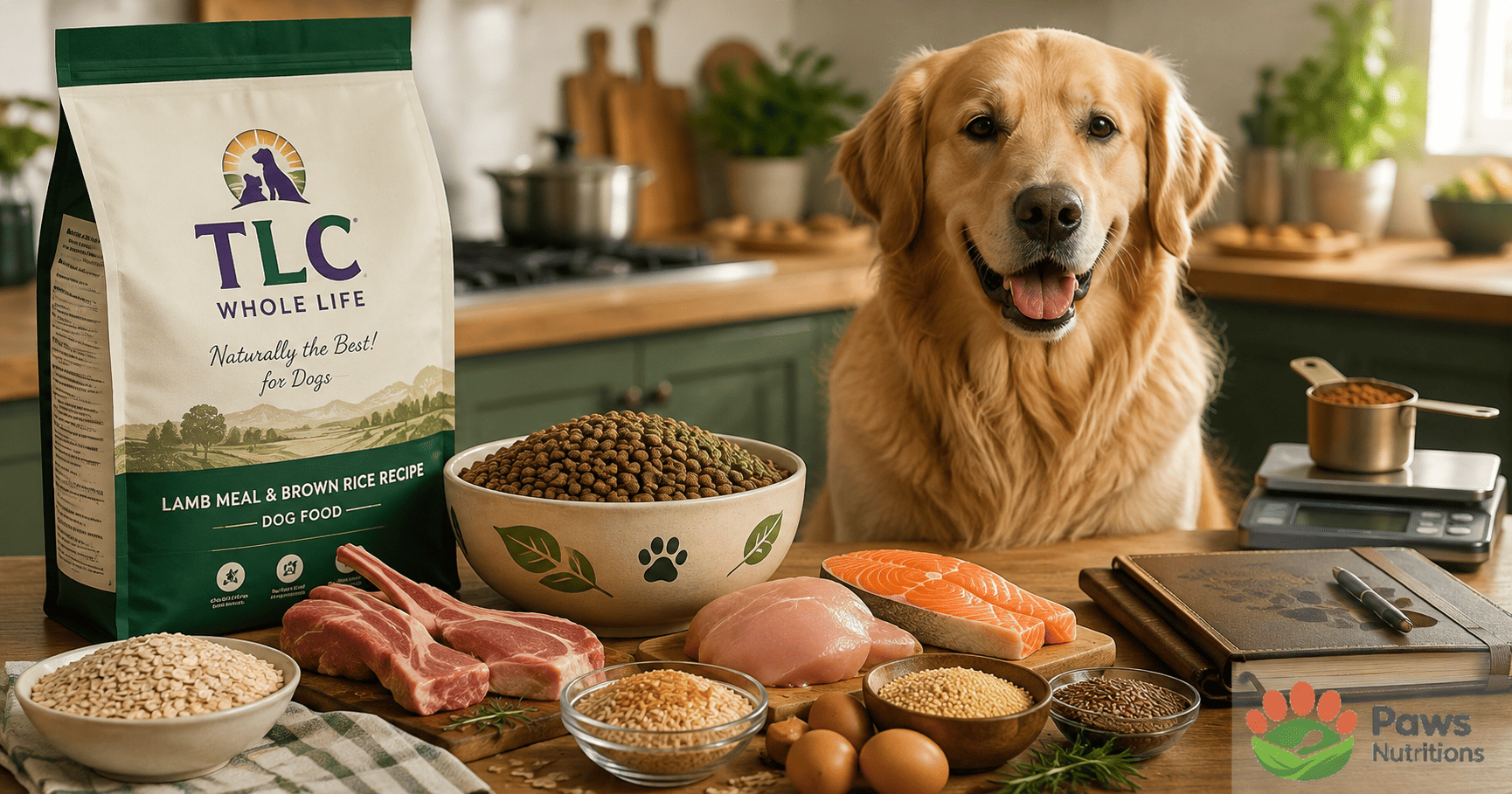
Choosing a dog food can look deceptively simple. The bag says “premium,” the ingredient list looks impressive, and hundreds of pet owners may swear their dogs love it. But the real questions are more practical: Is the food nutritionally complete? What does it actually cost to feed? Are the ingredients meaningful? Has it been recalled? And does it make sense for your particular dog?
This TLC dog food review looks beyond the marketing. It examines TLC Whole Life Dog Food and Whole Life Puppy Food, including their ingredient panels, guaranteed analysis, dry matter nutrition, AAFCO adequacy statements, price, feeding recommendations, safety record, owner experiences, and alternatives. The goal is to help you decide whether TLC deserves a place in your dog’s bowl.
TLC Dog Food at a Glance
TLC Pet Food official site currently lists Whole Life Dog Food at $75.95 for a 30-lb case, packaged as two 15-lb bags. Whole Life Puppy Food is also listed at $75.95 for a 30-lb case. TLC says the food is sold online, delivered free except for certain remote locations, and available through Auto ship.
| Category | Assessment |
|---|---|
| Ingredient quality | Above average |
| Protein | Strong for dry kibble |
| Fat | Moderate-to-high |
| Grain-inclusive | Yes |
| Calories | 440 kcal/cup adult; 450 kcal/cup puppy |
| AAFCO status | All Life Stages adult formula; growth puppy formula |
| Large-breed puppy suitability | Adult Whole Life formula is specifically formulated for growth of large-size dogs |
| Price | $2.53/lb at current listed price |
| Delivery | Direct-to-consumer |
| Recall finding | No TLC recalls listed in Dog Food Advisor’s recall database through August 2026 |
| Main concern | Online-only purchasing and multiple animal proteins may not suit every allergy-management situation |
The overall picture is favorable, but there is an important distinction between a good-looking food on paper and the right food for an individual dog. TLC’s current formula provides concentrated animal proteins, whole grains, omega fatty acids, probiotics, and added joint-support ingredients. At the same time, it isn’t a limited-ingredient diet, and its online-only model won’t appeal to every owner.
Who TLC Dog Food Is Best For
TLC is particularly interesting for owners who want a grain-inclusive dry food, multiple named animal-protein ingredients, direct delivery, and an All Life Stages option. The formula is also designed to cover growth of large-size dogs, which gives it broader life-stage coverage than many ordinary adult kibbles.
It may be less suitable when your dog needs a veterinary therapeutic diet, a truly limited ingredient formula, or an elimination diet for suspected food allergies. Because TLC Whole Life contains lamb, chicken, salmon, eggs, and other animal-derived ingredients, it isn’t a simple single-protein food.
What Is TLC Pet Food?
TLC Pet Food’s History and Brand Model
That direct-to-consumer approach is one of TLC’s biggest practical differences. Instead of buying a bag at a supermarket or pet-store shelf, you order online and arrange delivery. TLC also offers Auto ship, allowing customers to schedule repeat shipments and adjust their delivery frequency. The current site states that delivery is free except for certain remote locations.
Where Is TLC Dog Food Made?
TLC positions its food as Canadian-made and emphasizes fresh ingredients sourced from North American farms, fisheries, and suppliers. The company says ingredients arrive daily and that its food is made to meet AAFCO nutrient profiles.
However, there’s an important difference between a company’s quality claims and independent verification of every manufacturing detail. When evaluating any pet-food company, WSAVA recommends looking at who formulates the diet, the qualifications of the nutritionist, ingredient and finished-product quality control, nutrient analysis, and available research—not simply relying on words such as “premium” or “holistic.” (WSAVA)
TLC vs. Whole Life Pet: Are They the Same Company?
The name can create confusion because Whole Life appears prominently in TLC’s product branding. The relevant dog-food brand here is TLC Pet Food and its Whole Life formulas. Consumers should check the actual manufacturer and product label rather than assuming that every company using “Whole Life” in its name is connected to TLC.
TLC Dog Food Product Lineup
TLC’s current dog-food range centers on two major dry-food formulas: Whole Life Dog Food and Whole Life Puppy Food. Both are sold in a 30-lb case consisting of two 15-lb bags, currently listed at $75.95.
Whole Life Dog Food
The adult/All Life Stages formula contains lamb meal, chicken meal, oatmeal, fresh chicken, whole grain barley, whole brown rice, millet, chicken fat, salmon meal, eggs, chicken liver, salmon oil, quinoa, flaxseed, probiotics, glucosamine, and green-lipped mussels.
Whole Life Puppy Food
The puppy formula increases the guaranteed minimum protein and fat levels to 28% protein and 17% fat, compared with 26% and 16% in the current Whole Life Dog Food formula. It provides 450 kcal per cup versus 440 kcal per cup for the adult/All Life Stages formula.
TLC says its puppy formula is designed for growth, including large-size dogs, while its Whole Life Dog Food is also formulated for All Life Stages, including growth of dogs expected to reach 70 lb or more as adults.
TLC Dog Food Ingredients: What’s Really in the Recipe?
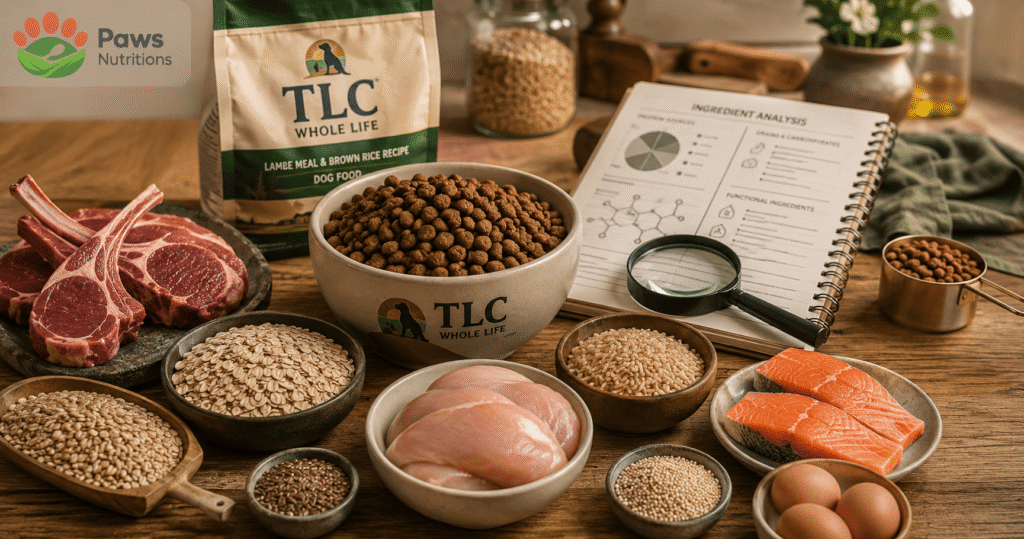
The ingredient list is one of the strongest parts of the current formula. The first four ingredients are lamb meal, chicken meal, oatmeal, and fresh chicken, followed by whole grain barley, whole brown rice, millet, chicken fat, and salmon meal. That gives the recipe a clear animal-protein emphasis while still using grains as substantial carbohydrate sources.
The key point is that ingredient order isn’t the whole story. Fresh chicken contains substantial water before cooking, whereas meat meals are concentrated ingredients. That’s why lamb meal and chicken meal can contribute significant protein even though “fresh chicken” sounds more substantial to a casual label reader. Dog Food Advisor makes the same distinction in its detailed label analysis, noting that meat meals are concentrated protein ingredients and that raw chicken loses much of its water during processing. (Dog Food Advisor)
First Five Ingredients Explained
| Ingredient | What it contributes |
|---|---|
| Lamb meal | Concentrated animal protein |
| Chicken meal | Concentrated animal protein and amino acids |
| Oatmeal | Whole-grain carbohydrate and fiber |
| Fresh chicken | Animal protein and palatability |
| Whole grain barley | Carbohydrate, fiber, and nutrients |
This is a meaningful combination for a dry food. You aren’t looking at a recipe where a cheap carbohydrate dominates the first few positions. Instead, two concentrated meat ingredients lead the list, followed by grains and fresh meat.
Meat Meal vs. Fresh Meat
Think of meat meal as meat that has already had much of its water removed. That makes it more concentrated by weight. Fresh chicken, on the other hand, brings considerable moisture into the manufacturing process. Once the kibble is cooked, much of that water disappears.
So “meal” isn’t automatically a negative ingredient. In a dry food, named meat meals can actually be useful protein sources. The more important question is what type of meal is used and how the overall nutrient profile looks.
Grains in TLC Dog Food
TLC uses oatmeal, barley, brown rice, millet, and quinoa rather than taking a grain-free approach. For most healthy dogs, the presence of grains alone isn’t a reason to reject a food. What matters is whether the finished diet provides appropriate nutrients and suits the individual dog.
This can also be useful for owners who prefer a grain-inclusive diet. If your dog has a diagnosed food allergy, however, you shouldn’t assume that grain-inclusive automatically means hypoallergenic.
Functional Ingredients and Supplements
The formula also includes salmon oil, DHA, flaxseed, chicory root, probiotics, glucosamine, and chondroitin. TLC lists minimum levels of 500 ppm glucosamine and 200 ppm chondroitin in the current adult formula. (TLC Pet Food)
These additions give the recipe more nutritional complexity than a basic meat-and-grain kibble. Salmon oil supplies DHA and omega-3 fatty acids, while chicory root and mannan-oligosaccharides provide prebiotic components. The probiotics are intended to support digestive health, although the presence of a probiotic on a label shouldn’t be treated as a guarantee that every dog will have better digestion.
Ingredient Quality Verdict
Ingredient rating: 8.5/10
The strongest features are the named animal proteins, meat meals near the beginning of the list, whole grains, salmon oil, eggs, liver, and added functional ingredients. The main limitation is that this is not a minimalist formula. It contains numerous animal and plant ingredients, so it isn’t the obvious choice for a strict elimination diet.
TLC Dog Food Nutrition Facts
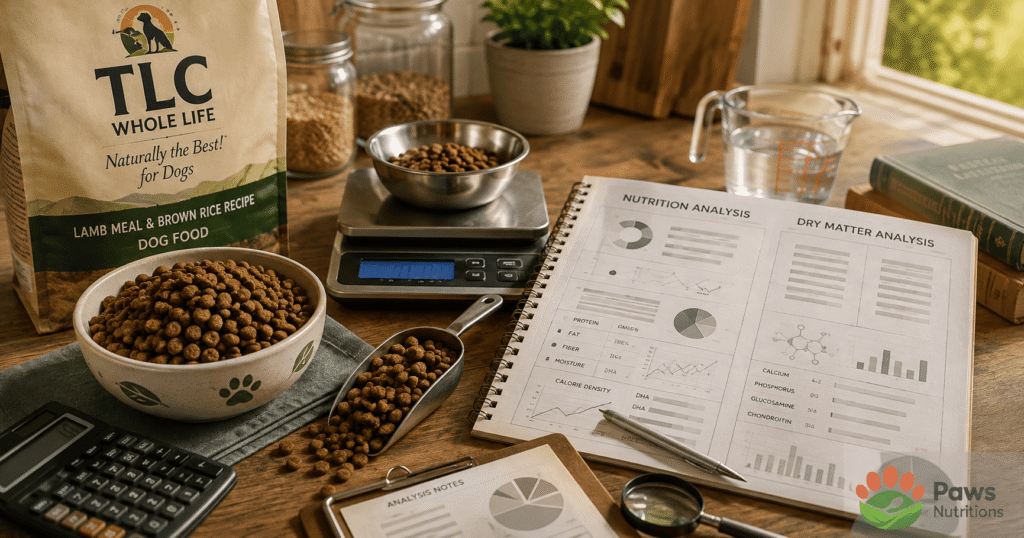
The current Whole Life Dog Food guaranteed analysis lists 26% crude protein, 16% crude fat, 4% maximum crude fiber, 8% maximum ash, and 10% maximum moisture. It provides 440 kcal per cup.
| Nutrient | Guaranteed Analysis |
|---|---|
| Crude protein | 26% min |
| Crude fat | 16% min |
| Crude fiber | 4% max |
| Ash | 8% max |
| Moisture | 10% max |
| Calcium | 1.3% min |
| Phosphorus | 0.8% min |
| Omega-3 | 0.25% min |
| Omega-6 | 2.5% min |
| DHA | 0.06% min |
| Glucosamine | 500 ppm min |
| Chondroitin | 200 ppm min |
| Calories | 440 kcal/cup |
Guaranteed Analysis vs. Dry Matter Basis
Guaranteed analysis is reported on an as-fed basis, meaning the moisture in the food remains part of the calculation. Dry matter basis removes that moisture so foods with different moisture levels can be compared more fairly.
Using the current guaranteed analysis, TLC’s protein works out to roughly 28.9% on a dry matter basis, while fat is approximately 17.8% DMB. These are calculated estimates rather than laboratory results. Dog Food Advisor’s current analysis reports approximately 29% DMB protein and 18% fat, which is broadly consistent with that calculation.
Dog Food Advisor currently rates TLC Whole Life at 5 stars / Highly Recommended, and its analysis estimates about 29.9% protein, 18.5% fat, and 39.9% carbohydrates on its particular dry-matter calculation.
Is TLC Dog Food High in Protein?
For a dry kibble, the answer is yes, relatively speaking. A minimum of 26% crude protein on the label translates to roughly 29% on a dry-matter basis. That’s a solid protein level for many healthy adult dogs.
But don’t confuse “higher protein” with “better for every dog.” Protein requirements depend on age, body condition, activity, health status, and the overall amino-acid profile. A senior dog with a medical condition, for example, may need individualized nutritional guidance rather than simply the highest-protein food available.
Fat, Fiber and Carbohydrates
The 16% minimum fat level provides a substantial energy source, while the 4% maximum fiber level is relatively moderate. Using the label’s protein, fat, fiber, ash, and moisture figures, carbohydrate can be estimated by difference at about 40% on a dry-matter basis. That calculation is an estimate, not a declared carbohydrate value.
The formula therefore isn’t a low-carbohydrate food. It’s better described as a meat-forward, grain-inclusive dry kibble with moderate-to-high protein and fat.
Is TLC Dog Food AAFCO-Complete and Balanced?
The current Whole Life Dog Food is formulated to meet the AAFCO Dog Food Nutrient Profiles for All Life Stages, including growth of large-size dogs weighing 70 lb or more as adults. TLC also says the food is complete and balanced without requiring additional supplements.
Whole Life Puppy Food is formulated for growth, including large-size dogs, and provides 28% protein and 17% fat with 450 kcal per cup.
AAFCO vs. WSAVA
AAFCO and WSAVA shouldn’t be treated as interchangeable certifications.
AAFCO nutrient profiles provide nutrient requirements used for pet-food nutritional adequacy statements. WSAVA, meanwhile, provides recommendations for evaluating pet-food companies and diets, including questions about qualified nutritionists, formulation expertise, quality control, finished-product analysis, research, calories, and manufacturer transparency.
That’s an important distinction. A food meeting an AAFCO nutrient profile tells you something valuable about nutritional adequacy, but it doesn’t automatically answer every question about manufacturing quality or long-term feeding research.
Is TLC Dog Food Safe?
TLC Dog Food Recall History
As of the current research for this 2026 review, Dog Food Advisor’s recall database shows no TLC recalls through August 2026. Its current TLC review specifically states “No recalls noted.”
That is a positive safety signal, but it should be worded carefully. A lack of listed recalls isn’t proof that a food can never experience a quality problem. FDA itself notes that its public recall pages don’t necessarily contain every recall notice and maintains an archive for older notices. (U.S. Food and Drug Administration)
For that reason, the strongest conclusion is: no documented TLC dog-food recall was identified in the major public recall sources checked for this review, rather than claiming that TLC is guaranteed recall-free.
What About Canadian Manufacturing?
TLC emphasizes its Canadian roots and direct-delivery model. However, consumers shouldn’t assume that “Canadian-made” by itself proves superior nutrition or safety. Manufacturing quality depends on the actual controls used by the company.
WSAVA recommends asking whether a company validates ingredients, analyzes finished diets, performs appropriate microbiological and safety checks, and has qualified nutrition professionals involved in formulation. (WSAVA)
Overall Safety Verdict
Safety rating: 8.5/10
The absence of identified recalls is reassuring, and the product has a complete-and-balanced nutritional adequacy statement. Still, the article should distinguish verified regulatory information from the company’s own manufacturing and quality claims.
TLC Dog Food Price: How Much Does It Cost?
TLC currently lists Whole Life Dog Food at $75.95 for a 30-lb case containing two 15-lb bags. That works out to approximately $2.53 per pound before considering any applicable taxes or other circumstances. Whole Life Puppy Food is listed at the same $75.95 price for 30 lb.
| Product | Current listed price | Package | Approx. price/lb |
|---|---|---|---|
| Whole Life Dog Food | $75.95 | 30 lb | $2.53 |
| Whole Life Puppy Food | $75.95 | 30 lb | $2.53 |
TLC promotes free delivery except for certain remote locations and offers Autoship. That matters because the sticker price isn’t the whole cost of ownership. If a competing food costs slightly less per bag but requires a store trip every few weeks, TLC’s delivery model may be worth something to a busy owner.
Estimated Daily Feeding Cost
Using the current $2.53/lb price, the cost depends heavily on how much your dog eats. TLC’s adult feeding guide recommends roughly ½–¾ cup daily for dogs weighing 5–10 lb, ¾–1¾ cups for 11–35 lb, 1¾–2⅔ cups for 36–55 lb, 2⅔–3½ cups for 56–75 lb, and 3½–4½ cups for 76–110 lb.
Because TLC reports approximately 4 oz/115 g per 8-fl-oz cup, a rough calculation puts a cup at about 0.25 lb. That means the retail price translates approximately as follows:
| Example dog | Approx. cups/day | Approx. food cost/day* |
|---|---|---|
| 10 lb | 0.5–0.75 | $0.32–$0.48 |
| 25 lb | 0.75–1.75 | $0.48–$1.11 |
| 50 lb | 1.75–2.67 | $1.11–$1.69 |
| 75 lb | 2.67–3.5 | $1.69–$2.22 |
| 100 lb | 3.5–4.5 | $2.22–$2.85 |
*Approximate calculation using the current listed price and TLC’s stated cup weight. Actual consumption varies by dog.
This is where cost per day becomes more useful than price per bag. A 30-lb bag can look expensive until you compare the amount of food your dog actually needs.
TLC Dog Food Feeding Guide
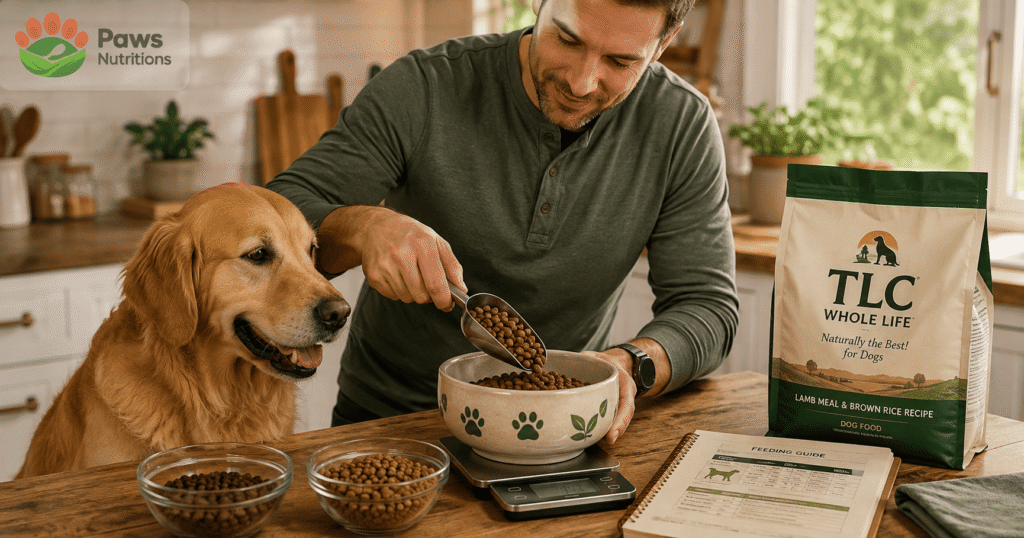
TLC’s current adult guide is intended for dogs 10 months and older and provides feeding ranges based on body weight. The company explicitly says the amounts are starting guidelines that should be adjusted for breed, activity level, and individual needs.
Adult TLC Feeding Guide
| Dog weight | Suggested daily amount |
|---|---|
| 5–10 lb | ½–¾ cup |
| 11–35 lb | ¾–1¾ cups |
| 36–55 lb | 1¾–2⅔ cups |
| 56–75 lb | 2⅔–3½ cups |
| 76–110 lb | 3½–4½ cups |
| Over 110 lb | Add ½ cup per additional 10 lb |
TLC recommends dividing the daily amount into equal portions if you feed more than once per day and keeping fresh water available.
How to Transition Your Dog to TLC
Don’t make a sudden switch simply because your dog seems excited about the new food. TLC recommends introducing Whole Life Dog Food over 10–15 days, increasing the proportion of TLC every two days until the transition is complete.
For example, if a 50-lb Labradoodle has eaten the same kibble for years, suddenly replacing 100% of the old food with TLC could create loose stools even if TLC itself is perfectly suitable. A slower transition gives the digestive system time to adjust.
TLC Puppy Food vs. TLC Adult Dog Food
The two formulas are similar in concept but aren’t identical.
| Feature | Whole Life Puppy | Whole Life Dog Food |
|---|---|---|
| Protein | 28% min | 26% min |
| Fat | 17% min | 16% min |
| Fiber | 5.5% max | 4% max |
| Calories | 450 kcal/cup | 440 kcal/cup |
| AAFCO purpose | Growth | All Life Stages |
| Large-breed growth | Yes | Yes |
| Package | 30 lb | 30 lb |
| Current listed price | $75.95 | $75.95 |
TLC says its puppy formula is designed for growing puppies and provides a natural transition to Whole Life Dog Food. The company also says the adult formula can be used throughout all life stages, including growth of large-size dogs.
When Should You Switch a Puppy?
The answer depends on the individual dog and which formula you’re feeding. Diamond H Ranch, which recommends TLC to its puppy buyers, describes a transition from the puppy formula to Whole Life Dog Food at around 10–12 months for small- to mid-sized breeds. It also notes that TLC recommends the All Life Stages formula for large-breed puppies.
For a rapidly growing large-breed puppy, don’t choose solely on the protein number. Calcium, phosphorus, calories, body condition, growth rate, and the food’s specific nutritional adequacy statement all matter.
Is TLC Dog Food Good for Your Dog?
The answer is potentially yes, but the individual dog matters more than the marketing label.
A healthy adult Golden Retriever that maintains a good body condition, has normal stools, enjoys the food, and has no diagnosed dietary restriction could be a reasonable candidate for TLC Whole Life. The formula is complete and balanced for All Life Stages and includes named animal proteins, grains, omega fatty acids, probiotics, and joint-support ingredients.
A different dog may need something else. For example, a dog with a confirmed chicken allergy wouldn’t be an obvious candidate because chicken appears prominently in the ingredient list. Likewise, a dog under veterinary management for a medical condition may need a therapeutic diet rather than a general-purpose kibble.
Is TLC Good for Large-Breed Dogs?
One of TLC’s stronger claims is nutritional adequacy for growth of large-size dogs. The current Whole Life Dog Food statement specifically includes growth of dogs expected to reach 70 lb or more as adults.
That doesn’t mean every large-breed puppy will thrive on the same feeding amount. Large-breed puppies need careful calorie and mineral management, so body condition and regular veterinary monitoring remain important.
Is TLC Good for Goldendoodles and Labradoodles?
There is no nutritional reason to assume every Goldendoodle or Labradoodle needs a breed-specific food. These dogs vary widely in size, activity, and dietary tolerance.
Interestingly, owner discussions do contain TLC experiences involving these breeds. Recent Dog Food Advisor reviews include a positive Labradoodle experience, while Reddit discussions include owners reporting good stool quality and digestion on TLC. These are useful real-world observations, but they aren’t controlled evidence that TLC is specifically better for doodles.
Is TLC Good for Sensitive Stomachs?
The answer is more complicated.
TLC contains several animal proteins, grains, fiber sources, prebiotics, and probiotics. Some dogs may tolerate that combination very well. Others may experience digestive upset during a food change or may react to a particular ingredient.
That distinction matters. Loose stool after switching foods doesn’t automatically mean the new food is inherently bad. Transition speed, portion size, treats, stress, and individual intolerance can all affect digestion.
Is TLC Good for Dogs With Food Allergies?
It shouldn’t be marketed as an allergy diet. The formula includes multiple animal proteins, including lamb, chicken, salmon, eggs, and chicken liver. For a dog undergoing a genuine elimination trial, your veterinarian may recommend a carefully controlled novel-protein or hydrolyzed diet instead.
What Do Real Dog Owners Say About TLC?
Owner feedback is mixed in the way you’d expect from almost any commercial dog food, but several themes appear repeatedly.
Positive TLC Dog Food Reviews
The current reviews displayed by Dog Food Advisor include owners reporting good taste acceptance, smaller stool volume, responsive customer service, and satisfaction with delivery. One Labradoodle owner described the food as good value and praised free shipping.
TLC’s own website also displays customer testimonials describing good stools, coat quality, long-term use, and reliable delivery. Those testimonials are useful for understanding customer sentiment, but they should be treated as brand-published testimonials, not independent clinical evidence.
Negative and Mixed Experiences
Reddit discussions reveal a different side of the story. Some owners have questioned TLC’s business model or said they were uncomfortable with breeder recommendations, while other owners say their dogs did very well on the food. One Goldendoodle owner reported better digestion on TLC after switching away from another food.
This is exactly why owner reviews should be interpreted carefully. A single dog thriving on a food doesn’t prove the food is universally superior, just as one dog developing diarrhea doesn’t prove the formula is unsafe.
What About Allergies and Skin Problems?
One older lifestyle review described a dog with previous skin and ear problems whose owner believed the dog’s condition improved after feeding TLC exclusively. The article also describes a serious reaction after the dog ate pizza, after which the owner removed other foods and treats.
That’s an interesting personal story, but it isn’t proof that TLC treats allergies. Food allergies require proper diagnosis, and improvement after removing other foods can have several explanations.
TLC Dog Food Customer Service & Buying Experience
The biggest practical advantage of TLC’s model is convenience. The company sells its food online, offers Autoship, and currently advertises free delivery except for certain remote locations. Its product page also promotes a 100% money-back guarantee.
Independent experiences generally reinforce the convenience angle. The 2018 It Was Worth It review described quick delivery and the ability to schedule Auto ship, while more recent Dog Food Advisor reviews praise customer service and delivery.
The downside is equally obvious: you can’t simply walk into a local store and grab a bag. If your dog runs out unexpectedly, online ordering can be less convenient than buying a mainstream brand from a nearby retailer.
TLC Dog Food vs. Other Premium Brands
The best comparison depends on what you value.
| Feature | TLC Whole Life | ACANA | The Farmer’s Dog |
|---|---|---|---|
| Food type | Dry kibble | Dry/fresh/freeze-dried options | Fresh prepared |
| Delivery model | Direct online | Retail + online | Direct subscription |
| Grain-inclusive options | Yes | Yes | Recipe-dependent |
| AAFCO complete diets | Yes | Yes, by formula | Yes |
| Personalization | Limited | Limited by recipe | High |
| Starting price | $75.95/30 lb | Varies by formula | About $2/day starting plans |
| Best fit | Meat-forward kibble + delivery | Broad product choice | Personalized fresh feeding |
ACANA currently offers a much broader product range, including grain-inclusive, grain-free, puppy, senior, large-breed, limited-ingredient and other formulas. Its current Classics line also provides a feeding-cost calculator. (ACANA)
The Farmer’s Dog is a fundamentally different proposition. It sells personalized fresh-food plans based on the dog’s profile, and its current FAQ says plans start at about $2 per day, with exact pricing depending on factors such as weight, age, activity, and recipe.
TLC therefore makes the most sense for someone who wants the convenience of home delivery without moving from dry kibble to fresh food.
TLC Dog Food Pros and Cons
Pros
- Named animal proteins lead the ingredient list.
- Uses both meat meals and fresh chicken.
- Grain-inclusive formula with oatmeal, barley, brown rice, and millet.
- Includes salmon oil and DHA.
- Includes glucosamine and chondroitin.
- Includes prebiotics and probiotics.
- Complete and balanced according to the company’s AAFCO statements.
- Adult Whole Life formula covers All Life Stages, including large-size growth.
- Current price works out to about $2.53/lb.
- Free delivery is advertised except for certain remote locations.
- Autoship provides recurring delivery.
- No TLC recalls were identified in the current Dog Food Advisor recall database through August 2026.
Cons
- Available primarily through an online direct-to-consumer model.
- Multiple animal proteins make it unsuitable as a simple elimination diet.
- Current price is higher than many conventional grocery-store kibbles.
- Owner experiences vary, particularly around digestion and food transitions.
- Some of the strongest health-related claims come from the brand or individual owners rather than controlled feeding studies.
- The formula isn’t a substitute for a therapeutic veterinary diet.
TLC Dog Food Review: Overall Ratings
| Category | Rating |
|---|---|
| Ingredient quality | 8.5/10 |
| Nutrition | 8.5/10 |
| Safety | 8.5/10 |
| Digestibility | 8/10 |
| Puppy options | 8.5/10 |
| Value | 8/10 |
| Convenience | 9/10 |
| Transparency | 8/10 |
| Overall | 8.4/10 |
These ratings reflect the formula, nutritional adequacy information, current pricing, delivery model, available safety information, and the limitations of owner-review evidence. They aren’t a veterinary diagnosis or a guarantee that every dog will respond the same way.
Frequently Asked Questions About TLC Dog Food
Is TLC dog food good for dogs?
Yes, TLC can be a reasonable choice for many healthy dogs. The Whole Life formula provides concentrated animal proteins, grains, omega fatty acids, probiotics, joint-support ingredients, and an AAFCO All Life Stages nutritional adequacy statement. Individual tolerance still matters.
Where is TLC dog food made?
TLC presents itself as a Canadian pet-food company and emphasizes ingredients sourced from North American farms, fisheries, and suppliers. The company sells its food directly to customers online.
Has TLC dog food ever been recalled?
No TLC recall was listed in Dog Food Advisor’s current recall history through August 2026. However, “no documented recall found” is more accurate than claiming a product is permanently recall-free.
Is TLC dog food only available online?
TLC’s current model is direct-to-consumer online sales. Its product pages state that the food is sold online and delivered to customers.
Does TLC dog food require a subscription?
No. Auto ship is an optional recurring-delivery feature. TLC says customers can schedule shipments according to their needs.
How much does TLC dog food cost?
The current listed price for Whole Life Dog Food is $75.95 for a 30-lb case, or approximately $2.53 per pound. Puppy Food is currently listed at the same price and package size.
Is TLC good for sensitive stomachs?
It may work well for some dogs, but it isn’t a limited-ingredient or veterinary sensitive-stomach diet. If your dog has persistent vomiting, diarrhea, itching, or suspected food allergy, discuss dietary testing with your veterinarian rather than relying on anecdotal reviews.
Is TLC good for large-breed puppies?
TLC states that both its Whole Life Puppy Food and Whole Life Dog Food meet AAFCO nutrient profiles covering growth of large-size dogs expected to reach 70 lb or more as adults. The appropriate formula and feeding amount should still be selected based on the puppy’s growth and veterinary guidance.
Final Verdict: Is TLC Dog Food Worth Buying in 2026?
For many healthy dogs, TLC is a solid premium dry-food option, but it’s not automatically the best choice for every dog.
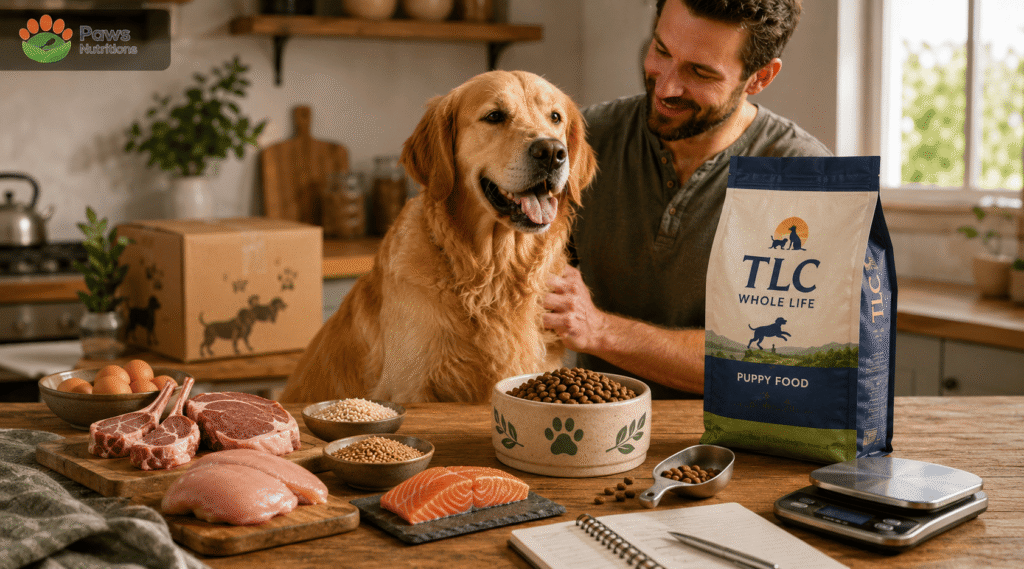
The strongest argument in favor of TLC is the combination of named meat meals, fresh chicken, whole grains, salmon oil, probiotics, joint-support ingredients, complete-and-balanced nutritional adequacy, and direct delivery. The current Whole Life formula provides 26% minimum protein, 16% minimum fat, 440 kcal per cup, and an All Life Stages AAFCO statement that includes large-size growth.
The price is also easier to evaluate when converted to a feeding cost. At the current $75.95 price for 30 lb, you’re paying about $2.53 per pound, with the actual daily expense depending on your dog’s weight and appetite. Free delivery and Auto ship add convenience, particularly for owners who don’t want to carry heavy bags home.
The biggest reasons to look elsewhere are specific rather than universal. A dog with a diagnosed food allergy may need a more controlled ingredient profile. A dog with a medical condition may need a therapeutic diet. And an owner who wants to buy food locally at short notice may find the direct-to-consumer model inconvenient.
Best Reasons to Buy TLC
Choose TLC if you want:
- A meat-forward grain-inclusive kibble
- Multiple named animal proteins
- Added omega-3s, DHA, probiotics, glucosamine and chondroitin
- An All Life Stages option
- Large-breed growth coverage
- Home delivery
- Autoship convenience
- A food currently priced around $2.53/lb
Reasons to Consider an Alternative
Consider another food if your dog needs:
- A therapeutic veterinary formula
- A hydrolyzed or very limited-ingredient diet
- A different protein profile
- A fresh-food feeding model
- Easy local retail availability
Bottom Line
TLC Whole Life Dog Food earns an overall 8.4/10 in this review. Its ingredient panel and nutritional profile are stronger than those of many ordinary dry kibbles, while its direct-delivery model makes recurring feeding unusually convenient. The current recall research is also reassuring, with no TLC recall listed in the reviewed recall database through August 2026.
The key is to judge the food against your dog’s needs, not against marketing claims or another owner’s experience. A healthy dog that maintains a good body condition, enjoys TLC, and produces consistently normal stools may do very well on it. If your dog has allergies, chronic digestive problems, or a diagnosed medical condition, the better choice may be a diet selected with your veterinarian.
Review Methodology
This review distinguishes between manufacturer information, independent nutritional analysis, regulatory recall information, and anecdotal owner experiences. TLC’s current product pages and feeding guides were used for formula, nutrition, price, and feeding information; Dog Food Advisor was used as an independent ingredient/nutritional review and recall-history source; owner discussions were treated as anecdotal evidence rather than clinical proof. WSAVA’s nutrition-selection guidance was used to frame questions around formulation, quality control, adequacy, and transparency.
Disclaimer: This article is for educational purposes and isn’t a substitute for veterinary advice. If your dog has a medical condition, persistent digestive symptoms, suspected food allergy, or special nutritional needs, consult your veterinarian before changing diets.

A dedicated writer and digital enthusiast committed to creating high-quality, informative, and reader-focused content. Through thoughtful research and clear communication, he aims to deliver valuable insights that help readers navigate the ever-changing digital landscape.