
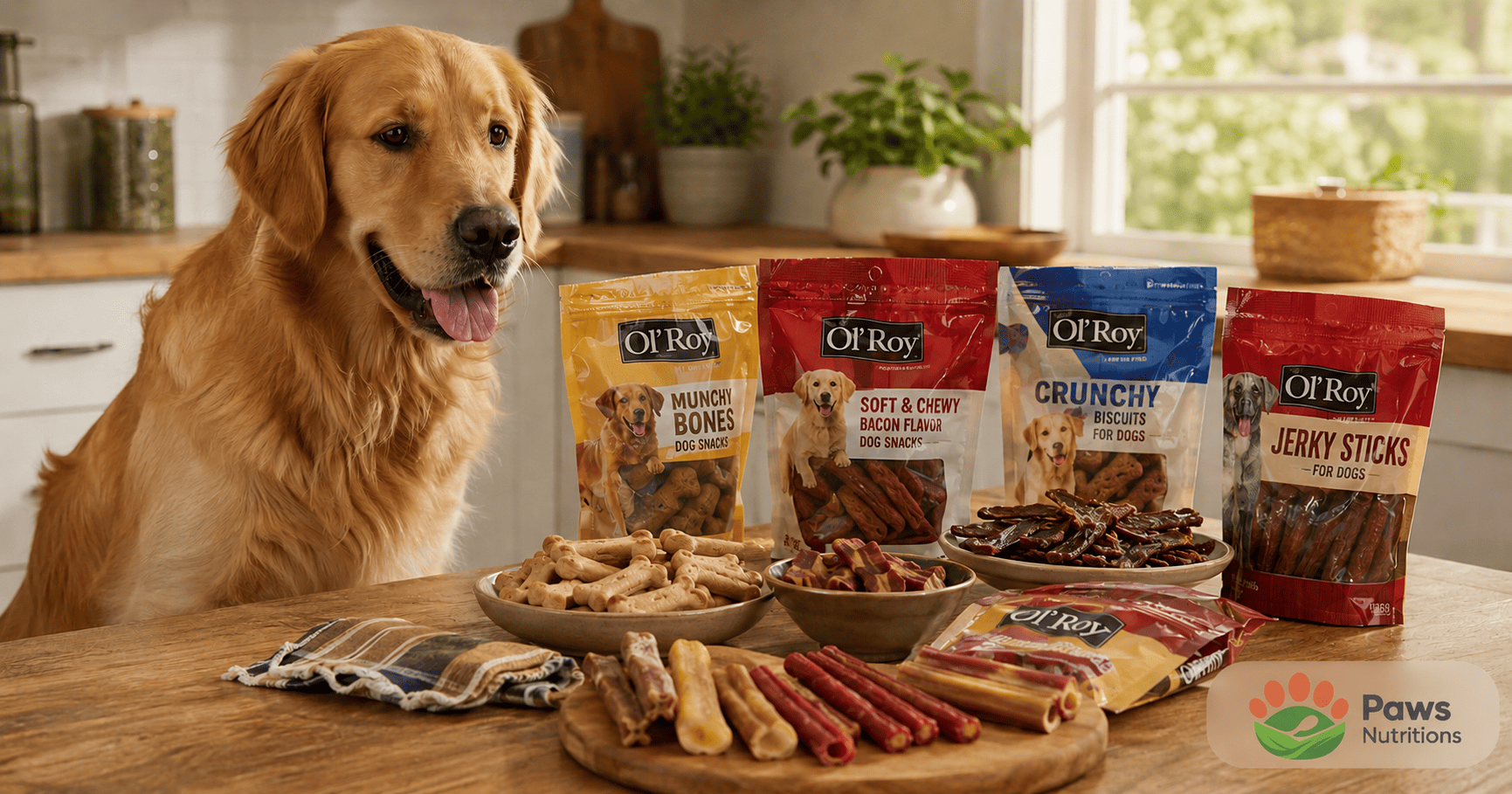
If your cart already has an Ol’ Roy bag in it every time you leave Walmart, you’re not alone. Ol’ Roy dog treats sit on nearly every store shelf in America, priced low enough that grabbing a bag feels like an afterthought. But an afterthought purchase still ends up in your dog’s mouth, and that deserves a closer look.
Here’s the problem: search around and you’ll find a Walmart price tag, a pile of unfiltered complaints on ConsumerAffairs, or a food-only review that skips treats entirely. Nobody has pulled the ingredients, the verified recall record, the manufacturer history, and real price-per-ounce math into one place. That’s exactly what this guide does, flavor by flavor, so you can decide with facts instead of guesswork.
What Is Ol’ Roy Dog Treats? (Brand Overview)
Ol’ Roy dog treats are part of Walmart’s exclusive, in-house pet food brand — one of the biggest private-label success stories in American retail. If you’ve ever wondered why you can’t find Ol’ Roy anywhere else, that’s because it isn’t meant to be found anywhere else. Walmart owns the brand outright, which lets the retailer control pricing far more tightly than a national name-brand company ever could, cutting out the layers of distributor and wholesaler markup that inflate the cost of shelf-brand competitors.
Before getting into ingredients, prices, and recall data, it helps to understand the basic shape of the brand itself — who owns it, how long it’s been around, and where you can actually buy it.
Who Owns Ol’ Roy — Walmart’s Private-Label Story
Ol’ Roy was named after Sam Walton’s own bird dog, and the brand has carried that folksy, homegrown image since it launched in the early 1980s. Walmart doesn’t manufacture the treats itself; instead, it contracts with third-party pet food producers and puts its own label on the finished product. This is the same private-label model used for brands like Kirkland at Costco, just applied to pet food.
How Long Ol’ Roy Has Been on Shelves
Ol’ Roy has been a fixture in Walmart’s pet aisle for more than four decades, and at various points it has outsold every major national dog food brand in the United States, largely on price alone. That kind of staying power says something about consumer habits, even if it doesn’t say much about ingredient quality on its own.
Where You Can (and Can’t) Buy Ol’ Roy Treats
This trips up a lot of shoppers: Ol’ Roy dog treats are not sold on Amazon or Chewy. Because it’s a Walmart-exclusive private label, you’ll only find it in Walmart stores, on Walmart.com, or through Walmart+ delivery and pickup. If you spot something labeled “Ol’ Roy” on a third-party marketplace, treat that listing with suspicion — it’s either a reseller marking up an in-store purchase or a mislabeled product entirely.
This exclusivity cuts both ways for shoppers. On one hand, you always know exactly where to look. On the other, you lose the convenience of price comparison and subscription-based auto-delivery that Chewy and Amazon offer for most other treat brands, so restocking means an actual trip to the store or a Walmart.com order.
How Pet Owners Generally Perceive the Brand
Ask around any pet forum and you’ll get a split reaction: longtime Walmart shoppers who’ve fed Ol’ Roy for years without issue, and nutrition-focused owners who steer clear entirely based on ingredient quality alone. Both reactions are reasonable — they’re just answering different questions. One group is asking “does my dog tolerate this,” and the other is asking “is this the best available option regardless of cost.”
Who Actually Manufactures Ol’ Roy Dog Treats?
This is the part almost nobody covers, and it matters more than you’d think. “Ol’ Roy” is a brand name on a bag, not a factory. Multiple manufacturers have produced different parts of the lineup over the years, and knowing who makes what helps you understand the recall history later in this guide — because a recall search that only checks the word “Ol’ Roy” misses recalls filed under the manufacturer’s own name instead.
Doane Pet Care, Mars, Inc. and the Food Line
For decades, Ol’ Roy’s dry and canned food lines were produced by Doane Pet Care, once the largest private-label pet food manufacturer in the country. Mars, Inc. — the company behind Pedigree, Whiskas, and Greenies — acquired Doane’s U.S. operations in 2006. That acquisition folded a huge chunk of Walmart’s supply chain into one of the world’s biggest pet food conglomerates.
Sunshine Mills and the Treats Line
Ol’ Roy’s biscuit and treat products have a separate manufacturing history tied to Sunshine Mills, Inc., an Alabama-based pet food producer. Sunshine Mills also manufactures Sportsman’s Pride, Sprout Sporting Dog Food, Intimidator, FRM Gold Select, and Nature’s Menu — brands you’ve probably never heard of, all coming out of the same production facilities.
J.M. Smucker’s Role in Ol’ Roy’s Canned History
J.M. Smucker Company has also manufactured portions of the Ol’ Roy canned lineup. This matters because Smucker was the company at the center of the 2018 pentobarbital contamination recall discussed later — a recall that touched several of its house brands, Ol’ Roy’s canned line included.
Why This Multi-Manufacturer Structure Matters to You
Most shoppers assume “Ol’ Roy” means one factory, one formula, one quality-control team. In reality, it’s closer to an umbrella brand stretched across at least three separate manufacturing relationships over the decades — Doane/Mars for kibble, Sunshine Mills for treats, and Smucker for select canned lines. That structure explains why a recall affecting one Ol’ Roy product line doesn’t necessarily mean the entire brand is compromised, and it’s the exact context you need before reading the recall section later in this guide.
Full Ol’ Roy Dog Treats Product Lineup
The Ol’ Roy treats aisle is bigger than most shoppers realize — it spans crunchy biscuits, soft chews, jerky-style strips, dental treats, and long-lasting natural chews. Here’s a breakdown of the major product lines you’ll actually find on shelf, so you know what you’re comparing before you toss a bag in the cart.
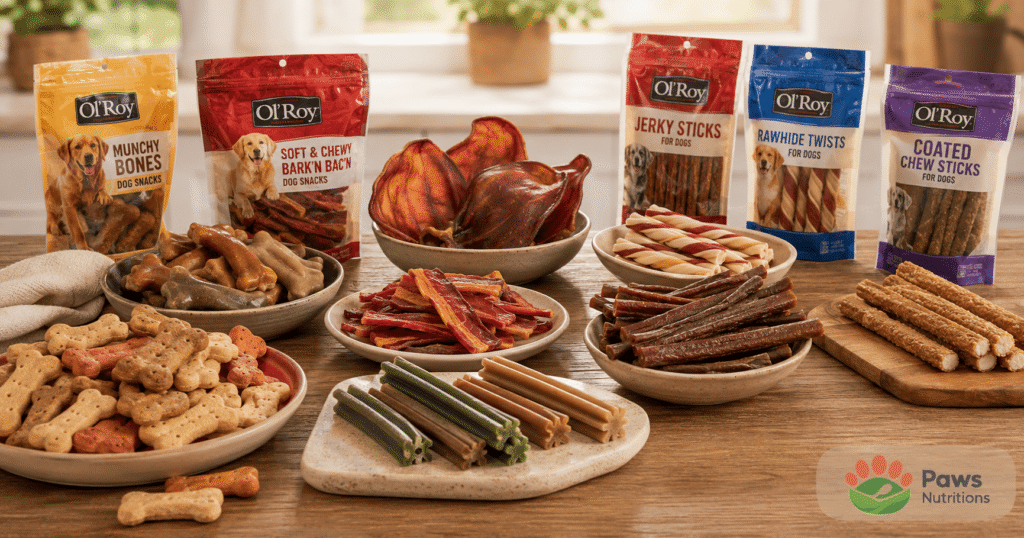
Ol’ Roy Multi-Flavored Biscuits
Bone-shaped crunchy biscuits sold in turkey, chicken, beef, sausage, and bacon flavors. These come in tub and pouch sizes and are marketed heavily toward training and small daily rewards, and their small individual size makes them well-suited to rapid-fire training sessions where you’re rewarding every few seconds.
Ol’ Roy Munchy Bones
A chewier treat line available in chicken, liver, peanut butter, bacon-cheese, and Greek yogurt flavors, sized for medium and large dogs. Sold individually and in mixed variety packs, these tend to last longer per treat than a biscuit, making them a reasonable choice for owners who want fewer, longer-lasting rewards rather than constant small snacks.
Ol’ Roy Bark’n Bac’n
Soft, bacon-flavored chews positioned as a budget alternative to jerky-style treats. Available in original and “lean” formulations, and consistently one of the brand’s best-reviewed products on Walmart.com, largely thanks to the strong bacon scent that most dogs respond to immediately.
Ol’ Roy Jerky Sticks
Beef-flavored soft chews sold individually or in two-packs, marketed as a higher-value, meat-forward option within the lineup. Texture-wise, these sit closer to a training treat than a long-chew product, so expect quick consumption rather than extended gnawing.
Ol’ Roy Rawhide and Rawhide-Free Twist Sticks
Traditional beef-hide twist sticks alongside a rawhide-free peanut butter alternative for owners avoiding rawhide altogether — a useful option if your dog has had digestive trouble with traditional rawhide chews in the past.
Ol’ Roy Smoked and Natural Pig Ear Chews
Long-lasting chew treats sold in small counts (5–12 per bag), positioned as an economical alternative to name-brand pig ears. These are dense and calorie-heavy relative to their size, so a single ear can represent a meaningful chunk of a small dog’s daily treat allowance.
Ol’ Roy Dental Chews
A functional treat line built around wheat starch, gelatin, and glycerin, designed for prolonged chewing that helps reduce tartar buildup. Unlike the meat-forward treats in the lineup, these are formulated more like a mechanical cleaning tool than a flavor reward.
Ol’ Roy Beefhide-Coated Munchy Sticks
Chicken-flavored coated chew sticks sold in 40-count bags, aimed at small to medium dogs. The high count-per-bag makes this one of the better bulk-value options if your dog goes through chews quickly.
Table 1: Ol’ Roy Dog Treats Product Lineup
| Product Line | Common Sizes | Flavor Options | Texture |
| Multi-Flavored Biscuits | 5 lb box, 36 oz tub, 60 oz pouch | Turkey, chicken, beef, sausage, bacon | Crunchy |
| Munchy Bones | 20 oz, 60 oz variety | Chicken, liver, peanut butter, bacon-cheese, Greek yogurt | Chewy |
| Bark’n Bac’n | 25 oz, 2-pack box | Original, Lean | Soft |
| Jerky Sticks | 25 oz, 2-pack box | Beef | Soft |
| Rawhide/Rawhide-Free Twist Sticks | 16–50 ct | Beef, peanut butter, chicken | Chewy |
| Pig Ear Chews | 5–12 ct | Smoked, natural | Hard/long-lasting |
| Dental Chews | Varies | Unflavored/mild | Firm, chewy |
| Beefhide-Coated Munchy Sticks | 16.9 oz, 40 ct | Chicken | Chewy |
Ol’ Roy Dog Treats Ingredients: What’s Really in the Bag
Ingredient quality is where budget treats live or die, and Ol’ Roy is no exception. Looking at the label on a dry matter basis (DMB) — the fairest way to compare products with different moisture levels — gives a clearer picture than the front-of-bag marketing does, and it’s the same method independent reviewers use to evaluate the brand’s main food line.
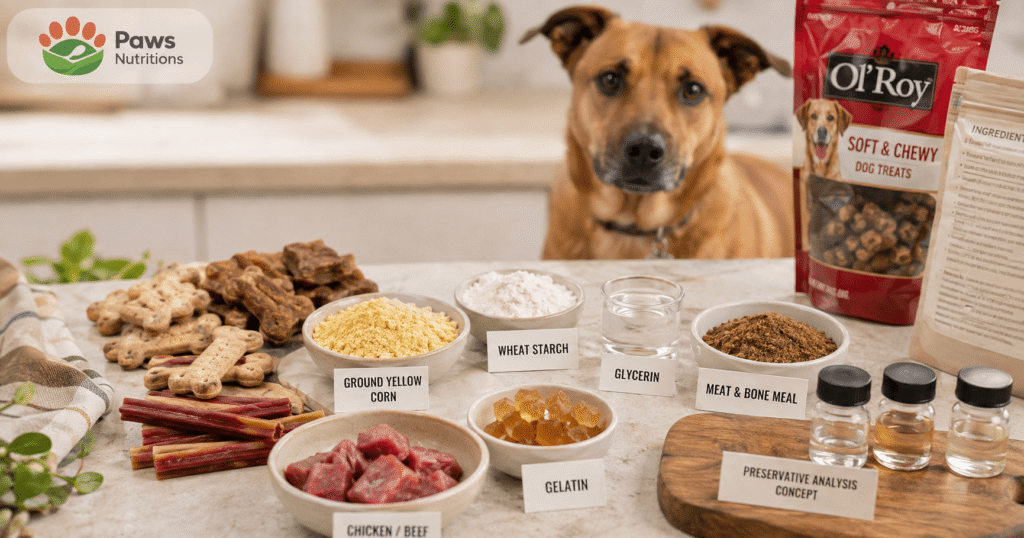
Dry Matter Basis Breakdown of Flagship Treats
Ol’ Roy’s related dry food line (used here as an ingredient-profile reference since the company shares formulation philosophy across products) runs roughly 24% protein, 12% fat, and around 51% carbohydrate on a DMB basis. Treats generally track lower in protein and higher in carbohydrate filler than the main food line, since biscuits and chews rely on starches for texture and shelf stability.
Common Ingredients Across the Line
Expect to see ground yellow corn, wheat starch, glycerin, meat and bone meal, and various animal by-product ingredients repeated across most Ol’ Roy treat SKUs. Dental chews specifically lean on wheat starch and gelatin rather than meat protein, which is worth knowing if you’re buying them expecting a meaty snack.
Controversial or Red-Flag Ingredients
A few ingredients recur across the Ol’ Roy portfolio that nutrition-focused shoppers tend to flag: BHA (a preservative linked in some studies to carcinogenic potential), menadione (a synthetic vitamin K source associated with liver-toxicity concerns), and artificial dyes used in some biscuit varieties. None of these are illegal or unregulated — they’re all permitted under current U.S. pet food law — but they sit at the lower end of the quality spectrum compared to preservative-free competitors.
What’s Missing
You won’t find probiotics, named single-source meat proteins (like “chicken” instead of “meat and bone meal”), or grain-free formulations anywhere in the current Ol’ Roy treats lineup. For dogs with sensitive digestion or known grain sensitivities, that absence matters.
Why Meat By-Products Aren’t Automatically a Dealbreaker
It’s easy to see “meat and bone meal” on a label and assume the worst, but the picture is more nuanced. By-product meals are concentrated protein sources — they typically contain far more protein by weight than fresh meat once moisture is factored out. The real concern isn’t the category itself; it’s the lack of a named species. “Meat and bone meal” could come from cattle, pigs, sheep, or goats, which makes it impossible to rule out for a dog with a confirmed protein allergy. A “chicken meal” or “beef meal,” by contrast, at least tells you what you’re feeding.
Why Dry Matter Basis Matters More Than the Front of the Bag
Guaranteed analysis panels list protein and fat as a percentage of the product *as-fed*, moisture included. That number looks very different once you strip out water content and compare products on an apples-to-apples dry matter basis. A soft treat that looks protein-rich on the label can drop several percentage points once you run the DMB math, which is exactly why nutrition-focused reviewers insist on it instead of trusting the guaranteed analysis panel at face value.
Table 2: Estimated Dry Matter Basis by Treat Category
| Treat Category | Protein (DMB) | Fat (DMB) | Carbohydrate (DMB) |
| Biscuits | ~14–18% | ~8–10% | ~65–70% |
| Munchy Bones | ~10–14% | ~6–9% | ~70–75% |
| Bark’n Bac’n / Jerky Sticks | ~18–22% | ~10–14% | ~55–60% |
| Dental Chews | ~5–8% | ~2–4% | ~80%+ |
Figures are estimated from label-declared guaranteed analysis ranges and typical treat formulation patterns; exact values vary by flavor and production lot.
AAFCO & WSAVA Standards — Do Ol’ Roy Treats Meet Them?
Treats occupy a different regulatory space than main-diet dog food, and that distinction matters when you’re evaluating a bag of biscuits against a bag of kibble. It’s one of the most misunderstood parts of pet food labeling, and it applies to every brand on the shelf, not just Ol’ Roy.
How Treats Are Regulated Differently Than Main Diets
Unlike complete-and-balanced dog food, treats aren’t required to meet full AAFCO nutrient profiles. They fall under a “supplemental” or “snack” classification, which means manufacturers only need to ensure the product is safe to eat — not nutritionally complete. Ol’ Roy’s treat packaging generally reflects this, listing products as snacks rather than balanced meals.
What AAFCO Compliance Actually Means for a Snack Product
Because treats are exempt from complete-and-balanced requirements, a bag of Ol’ Roy biscuits can legally contain mostly starch and flavoring without violating any regulation. That’s standard across the entire budget treat category, not unique to Ol’ Roy — but it’s exactly why treats should never exceed roughly 10% of a dog’s daily caloric intake.
WSAVA Guidelines and Where Private-Label Treats Fall Short
The World Small Animal Veterinary Association (WSAVA) publishes guidelines encouraging pet food companies to employ a full-time nutritionist, conduct feeding trials, and publish detailed sourcing information. Like most private-label brands, Ol’ Roy does not publicly disclose this level of detail, which makes it harder for owners to verify quality claims beyond what’s printed on the bag.
What This Means in Practice for Your Dog
None of this means Ol’ Roy treats are unsafe to feed under normal circumstances — the “supplemental” classification simply reflects how treats are meant to function in a dog’s diet: as an occasional addition, never a meal replacement. The practical takeaway is that you, not the manufacturer, carry the responsibility for keeping treats a small slice of your dog’s total daily calories, since the regulatory framework isn’t designed to enforce that balance for you.
Ol’ Roy Dog Treats Recall History (Verified 2006–2026)
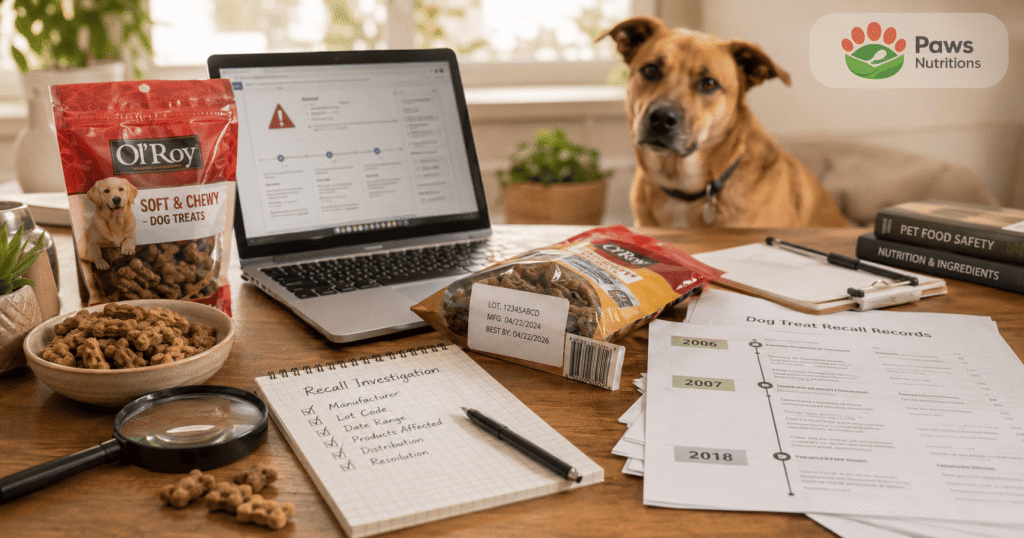
This is the section most competitor articles get wrong, either by only covering the food line or by stopping their research years ago. Here’s the full, dual-verified timeline covering both the Ol’ Roy brand name directly and the manufacturers behind it, built by cross-checking FDA recall announcements against manufacturer statements rather than relying on a single secondhand source.
A quick note on methodology before diving in: a recall is confirmed here only when it’s traceable to an official FDA announcement, a manufacturer press release, or verified reporting from an established pet food recall tracker — not a single forum post or an unconfirmed social media claim.
2007 Melamine Contamination
In March 2007, as part of the sweeping Menu Foods melamine crisis that shook the entire pet food industry, several Ol’ Roy treats — including Beef Jerky, Stack Strips, Snack Sticks, and Bark’n Bac’n — were pulled from shelves due to potential melamine contamination.
2007 Multi-Flavored Biscuit Recall
Later that same year, Sunshine Mills recalled a batch of Ol’ Roy multi-flavored biscuits. This recall is directly tied to the treats line specifically, rather than the food line, and confirms Sunshine Mills’ role as treats manufacturer even at that early date.
2006 Canned Lining Issue
In June 2006, Simmons Pet Food recalled certain Ol’ Roy canned varieties after discovering “random flaking” from the interior can lining — a packaging defect rather than an ingredient safety issue.
2018 Pentobarbital Contamination
In February 2018, the FDA announced that J.M. Smucker Company was recalling multiple canned pet food brands, including Ol’ Roy, Gravy Train, Kibbles ‘n Bits, and Skippy, due to potential contamination with pentobarbital — a euthanasia drug. This recall affected Ol’ Roy’s canned product line, not the treats discussed in this guide.
Has Ol’ Roy Been Recalled Since 2018?
Based on FDA recall databases and manufacturer announcements checked directly for this guide, there is no confirmed Ol’ Roy-branded recall — food or treats — since the February 2018 pentobarbital incident. That’s a genuinely clean multi-year stretch, even though anecdotal complaints on consumer forums continue year after year.
It’s worth separating two different things here: a verified regulatory recall, which involves the FDA, a specific lot code, and a public company announcement, versus an individual consumer complaint, which is a single owner’s account of what happened to their dog without independent confirmation of cause. Both matter, but they’re not the same category of evidence, and treating them as equivalent — as several competitor sites do — overstates the current risk picture.
How to Check for New Ol’ Roy Recalls Yourself
Recall trackers on individual review sites can lag behind official announcements. The most reliable approach is to check the FDA’s own “Recalls, Market Withdrawals & Safety Alerts” page directly, searching both “Ol’ Roy” and “Sunshine Mills,” and to sign up for a free recall alert service if you feed the brand regularly. This takes a couple of minutes and gives you a direct line to verified information instead of secondhand summaries.
Table 3: Ol’ Roy Recall Timeline (Verified)
| Date | Product Affected | Manufacturer | Reason |
| June 2006 | Canned dog food | Simmons Pet Food | Can lining defect |
| March 2007 | Multiple treats & foods | Menu Foods | Melamine contamination |
| April 2007 | Multi-flavored biscuits | Sunshine Mills | Contamination concern |
| June 2007 | Complete Nutrition (single lot) | Doane Pet Care | Possible salmonella |
| February 2018 | Canned dog food | J.M. Smucker Co. | Pentobarbital contamination |
Parent Company Recall Check: Mars Petcare & Sunshine Mills Sibling Brands
A recall search that stops at the brand name alone misses half the picture. Since Ol’ Roy shares manufacturers with several other brands, checking those companies’ recent recall records separately is essential — and it’s a step almost no competitor article takes. This dual-query approach — searching the brand name and then searching the parent company or manufacturer name independently — is standard practice for thorough pet food research, yet it rarely shows up in consumer-facing reviews.
Mars Petcare’s 2024–2026 Pedigree Recalls
Mars Petcare has issued at least two notable recalls in recent years: a May 2024 voluntary recall of 315 bags of Pedigree Adult Complete Nutrition due to potential loose metal contamination, and a July 2026 recall of two lots of Pedigree canned food after fraudulently diverted product containing metal and plastic fragments reached store shelves. Both recalls name Pedigree specifically — neither touches Ol’ Roy.
Sunshine Mills’ 2019–2022 Recall Pattern
Sunshine Mills has a more troubled recent record. Following a 2019 FDA warning letter, the company issued Salmonella recalls in August 2020 and June 2021, and Aflatoxin (mold toxin) recalls in September 2020, October 2020, and July 2021, followed by a second FDA warning letter in March 2022 citing repeated failure to implement preventive controls. Every one of those recalls names Sportsman’s Pride, Sprout Sporting, Intimidator, FRM Gold Select, or Nature’s Menu — not Ol’ Roy.
What This Shared-Manufacturer History Means for Ol’ Roy Buyers
Sharing a manufacturer with a brand that’s had recall trouble doesn’t automatically mean Ol’ Roy products are equally at risk — different product lines can run through different facilities, formulations, and quality checkpoints even under the same parent company. But it does mean an informed buyer should periodically check FDA recall listings under both the Ol’ Roy name and Sunshine Mills directly, not just one or the other.
Table 4: Parent & Sibling Brand Recall Cross-Reference
| Manufacturer | Sibling Brands | Recent Recall Years | Ol’ Roy Named? |
| Mars Petcare | Pedigree, Whiskas, Greenies | 2024, 2026 | No |
| Sunshine Mills | Sportsman’s Pride, Sprout, Intimidator, FRM Gold Select, Nature’s Menu | 2019–2022 | No |
Ol’ Roy Dog Treats Pricing Guide
Price is Ol’ Roy’s whole reason for existing, so it’s worth breaking down properly instead of just repeating “it’s cheap.” The numbers below come from Walmart product listings and Walmart’s own official Ol’ Roy storefront, cross-checked against each other for consistency.
Price-Per-Ounce Comparison Across the Lineup
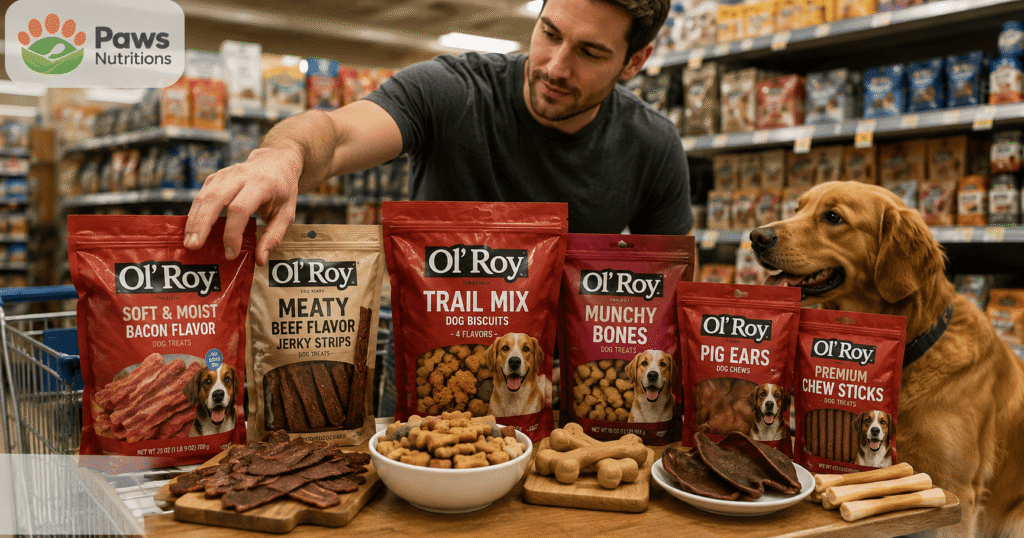
Across the SKUs checked for this guide, Ol’ Roy dog treats consistently land between roughly $0.20 and $0.40 per ounce for soft treats and biscuits, climbing to $1.00–$1.45 per ounce for pig ears and coated chew sticks — a pricing pattern typical of the budget treat category, where softer mass-produced snacks cost less per ounce than individually processed chews.
Value Packs and Multi-Packs Explained
Multi-packs, like the two-box Bark’n Bac’n and Jerky Stick bundles, tend to shave a few cents per ounce off the single-pack price — worth grabbing if you have a treat-hungry dog and the storage space to keep a backup bag sealed.
How Ol’ Roy Pricing Compares to Milk-Bone and Pup-Peroni
Name-brand competitors like Milk-Bone and Pup-Peroni typically run 30–60% more per ounce than the equivalent Ol’ Roy product, without a proportional jump in ingredient quality on most SKUs. That gap is exactly why Ol’ Roy remains a fixture in budget-conscious households.
Why Pig Ears and Coated Sticks Cost So Much More Per Ounce
Notice the jump between soft treats (around $0.20–$0.40/oz) and pig ears or coated munchy sticks (over $1.00/oz) in the table below. That’s not a pricing quirk — hard, long-lasting chews require more individual processing per unit, and they’re sold in much smaller counts per bag, which naturally pushes the per-ounce math higher even within the same discount brand.
How to Verify Current Pricing Before You Buy
Walmart adjusts online pricing frequently, and in-store prices can differ slightly by region. Before committing to a bulk purchase, it’s worth pulling up the specific product page on Walmart.com or checking the shelf tag in-store, rather than relying on any published price list — including the one below — as a guaranteed current figure.
Table 5: Price-Per-Ounce Snapshot
| Product | Size | Approx. Price | Price/oz |
| Bark’n Bac’n (single) | 25 oz | $5.83 | $0.23 |
| Jerky Sticks, Beef (single) | 25 oz | $5.83 | $0.23 |
| Bark’n Bac’n (2-pack box) | 25 oz ×2 | $9.88 | $0.20 |
| Multi-Flavored Biscuits, Mini Breeds | 36 oz tub | $7.97 | $0.22 |
| Munchy Bones, Chicken & Bacon | 21 oz | From $8.27 | $0.39 |
| Smoked Jumbo Pig Ear Chews | 10 oz, 5 ct | $10.47 | $1.05 |
| Rawhide-Free Chicken Twist Sticks | 16 oz | $21.11 | $1.32 |
| Beefhide-Coated Munchy Sticks | 16.9 oz, 40 ct | $24.25 | $1.44 |
Prices fluctuate daily on Walmart.com and vary by store location — verify current pricing before purchase.
Are Ol’ Roy Dog Treats Safe? What the Reviews Really Show
This is the question most owners actually care about, and the honest answer requires looking at two very different data sources side by side rather than trusting either one in isolation.
Walmart Verified-Purchase Ratings
On Walmart.com, several flagship Ol’ Roy treats — Bark’n Bac’n, Jerky Sticks — carry verified-purchase ratings between 4.7 and 4.8 stars across thousands of reviews. That’s a genuinely strong satisfaction signal from people who actually bought and fed the product.
ConsumerAffairs Complaint Patterns
ConsumerAffairs tells a rougher story. Recurring complaint themes include digestive upset (vomiting, diarrhea) after bacon-flavored treats and biscuits, occasional reports of insect larvae in chew treat packaging, allergic-reaction symptoms like hives and swelling, and complaints about shrinking package sizes at stable prices. Some reviewers attribute serious health outcomes to the product, though these anecdotal claims don’t always correspond to an actual verified FDA recall in the same timeframe.
Reconciling High Star Ratings With Serious Complaint Reports
Both data sets can be true at once. Most dogs eating Ol’ Roy dog treats show no problems at all — hence the strong Walmart ratings — while a smaller subset experience genuine adverse reactions, often tied to individual sensitivities, specific flavor lines (bacon and dye-heavy varieties come up repeatedly), or isolated quality-control lapses rather than a systemic brand-wide failure.
Think of it the way you’d think of any mass-market snack food: millions of bags sell without incident every year, but a product manufactured at industrial scale will always generate a visible number of complaints in absolute terms, even when the underlying failure rate is low. A first-time buyer’s smartest move is simple — introduce any new Ol’ Roy treat in a small quantity, watch your dog for 24 hours, and only then make it a regular part of the rotation.
What to Do If You Suspect a Bad Batch
If your dog reacts badly to a specific bag, don’t just throw it away. Photograph the packaging, note the lot code and best-by date, and report the issue to Walmart customer service and, if symptoms are serious, to the FDA’s consumer complaint system. Individual reports like this are exactly how regulators identify emerging patterns before they escalate into a formal recall.
Table 6: Rating Comparison Snapshot
| Source | Signal | What It Captures |
| Walmart verified purchases | 4.7–4.8★ (thousands of reviews) | General satisfaction, purchase-to-repurchase behavior |
| ConsumerAffairs | Mixed to negative, unmoderated | Individual adverse events, complaint patterns |
| DogFoodAdvisor (food line) | 1–3.5★ depending on recipe | Independent ingredient-quality scoring |
Brand Claims vs. Reality — Where the Marketing Doesn’t Match the Label
Package copy on budget treats tends to lean generous. It’s worth checking a couple of the more common claims against what’s actually printed on the ingredient panel, since front-of-bag language and the fine-print ingredient list don’t always tell the same story.
“Real Meat as the #1 Ingredient” Claims Checked Against Ingredient Panels
Several Ol’ Roy treat packages, including Bark’n Bac’n, market “real meat as the #1 ingredient.” On the products where this claim appears, it does generally check out against the ingredient panel — but “real meat” as a first ingredient in a soft treat doesn’t guarantee a high overall meat percentage once moisture, glycerin, and starches are factored in.
Flavor Marketing vs. Actual Meat Content
Flavor names like “bacon,” “T-bone,” and “cheese” describe flavoring profiles, not necessarily a proportional amount of that named ingredient. This is standard industry practice across the entire budget treat category, not an Ol’ Roy-specific issue, but it’s worth knowing before you assume “bacon flavor” means bacon is a primary ingredient.
Sourcing Transparency — What Ol’ Roy Doesn’t Publish
Unlike some premium and mid-tier competitors, Ol’ Roy’s packaging and website don’t disclose where individual ingredients are sourced from, whether any are imported, or which specific facility produced a given batch beyond the lot code. For owners who prioritize full supply-chain transparency, this is one of the clearer trade-offs that comes with the low price point.
Feeding Guide — How Many Ol’ Roy Treats Are Safe Per Day
Treats are supplemental by design, and that’s just as true for Ol’ Roy as it is for any premium brand on the market. Overfeeding treats — regardless of brand — is one of the most common, and most avoidable, causes of unwanted weight gain in dogs.
The 10% Treat Rule
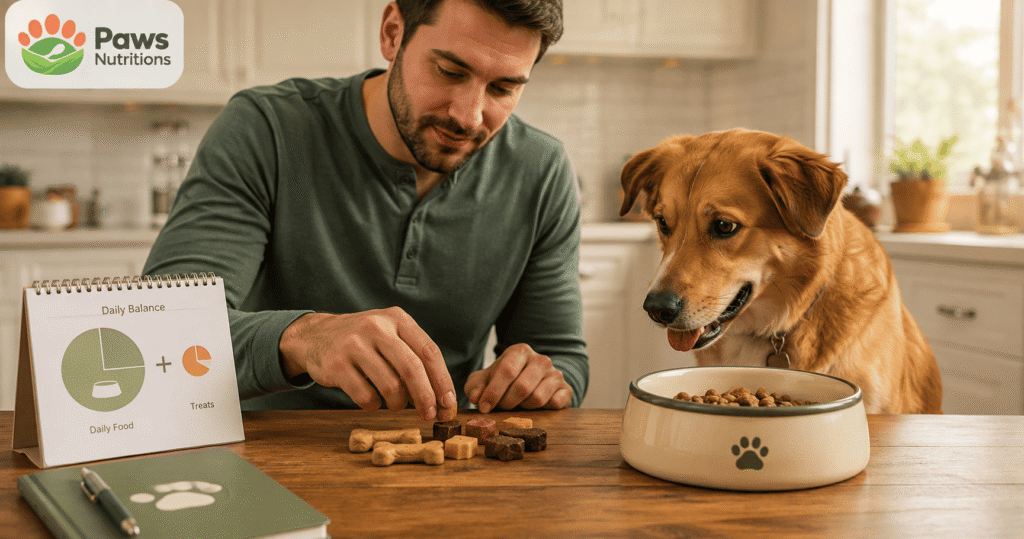
Veterinary nutritionists generally recommend keeping treats to no more than 10% of a dog’s total daily caloric intake, regardless of brand. For a 30-pound dog eating around 700–800 calories a day, that works out to roughly 70–80 calories from treats — a couple of Munchy Bones or a small handful of biscuits, not a full bag.
Treats to Watch for Small Breeds and Puppies
Harder chews like pig ears and coated munchy sticks pose a higher choking and digestive-blockage risk for small breeds and puppies with developing teeth. Softer options like Bark’n Bac’n or biscuits broken into smaller pieces are generally the safer starting point for smaller dogs.
Signs Your Dog May Be Reacting to an Ol’ Roy Treat
Watch for vomiting, diarrhea, excessive itching, hives, or lethargy within a few hours of a new treat. If symptoms appear, stop the treat immediately, note the flavor and lot code from the packaging, and contact your veterinarian — especially if symptoms persist beyond 24 hours.
Table 8: Rough Daily Treat Allowance by Dog Weight
| Dog Weight | Approx. Daily Calories | Treat Calorie Budget (10%) | Rough Ol’ Roy Serving |
| 10 lbs | 300–400 | 30–40 cal | 1 small biscuit |
| 30 lbs | 700–800 | 70–80 cal | 1–2 Munchy Bones or 3–4 biscuits |
| 60 lbs | 1,200–1,400 | 120–140 cal | 2–3 Munchy Bones or a small handful of biscuits |
| 90+ lbs | 1,700–2,000 | 170–200 cal | 3–4 Munchy Bones or 1 Bark’n Bac’n serving plus biscuits |
These are general estimates, not veterinary prescriptions — activity level, age, and health conditions all shift actual calorie needs.
Ol’ Roy Dog Treats vs. Other Budget Brands
Ol’ Roy isn’t the only name in the budget treat aisle. Here’s how it stacks up against two of its closest national competitors on the three factors that actually matter: price, recall record, and who each brand tends to suit best.
Ol’ Roy vs. Milk-Bone
Milk-Bone generally runs higher per ounce than Ol’ Roy’s biscuit line, with a broader third-party recall history of its own and a similarly starch-forward ingredient profile. Neither brand markets itself as premium, but Milk-Bone carries stronger name recognition.
Ol’ Roy vs. Pup-Peroni
Pup-Peroni sits closer to Ol’ Roy’s Jerky Sticks and Bark’n Bac’n in texture and format, typically at a moderately higher price point, with a comparable ingredient profile built around meat by-products and preservatives rather than named whole-muscle meat.
When Ol’ Roy Makes Sense (and When It Doesn’t)
Ol’ Roy makes the most sense for budget-conscious households feeding multiple dogs, or as an occasional training reward where volume matters more than premium sourcing. It makes less sense for dogs with known food sensitivities, allergies, or owners specifically seeking grain-free or single-source-protein formulations.
If you’re training a puppy through dozens of daily repetitions, the math genuinely favors a lower-cost biscuit over a premium jerky treat — you’ll go through volume fast either way, and price-per-rep matters more than price-per-bag at that stage. Save the higher-end treats for high-value rewards, like recall training in distracting environments, where you actually need the extra enticement.
Table 7: Budget Treat Brand Comparison
| Brand | Typical Price/oz | Recall History | Best For |
| Ol’ Roy | $0.20–$0.40 (soft treats) | Clean since 2018 (brand-specific) | Multi-dog, budget households |
| Milk-Bone | $0.30–$0.50 | Periodic recalls, various decades | Owners wanting brand recognition |
| Pup-Peroni | $0.35–$0.55 | Occasional recalls | Meat-forward soft chew preference |
Pros and Cons of Ol’ Roy Dog Treats
Stacking everything covered so far into a quick-scan format makes the trade-offs easier to weigh at a glance, especially if you’re standing in the Walmart aisle trying to decide between three similarly priced bags.
Where Ol’ Roy Delivers
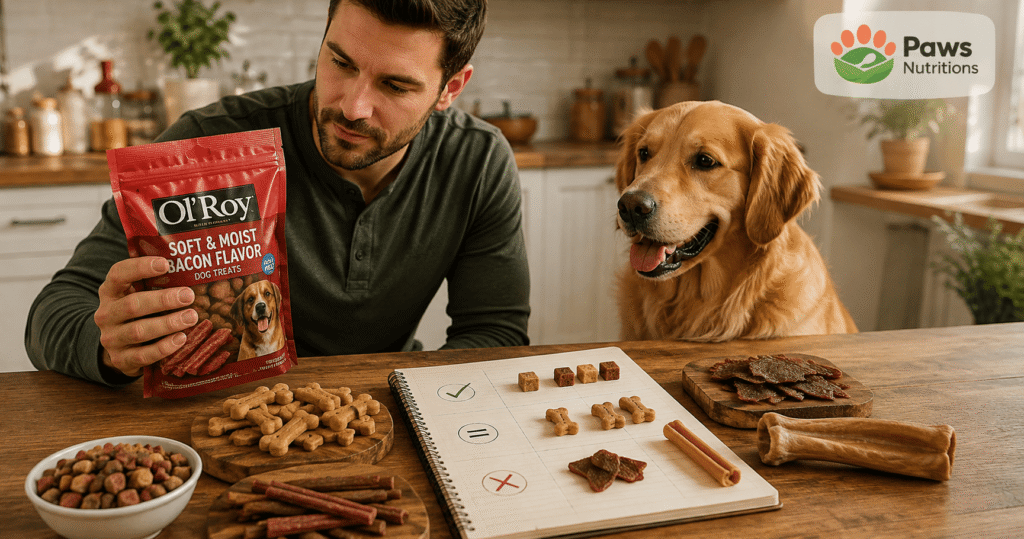
- Genuinely low price-per-ounce across nearly the entire lineup, even before comparing against name brands
- Wide availability at any Walmart location nationwide, plus Walmart.com and Walmart+ delivery
- Strong verified-purchase satisfaction ratings on flagship SKUs like Bark’n Bac’n and Jerky Sticks
- No confirmed brand-specific recall since 2018, based on FDA records checked for this guide
- Enough variety — biscuits, chews, jerky-style, dental — to cover most everyday reward use cases in one aisle
Where It Falls Short
- Heavy reliance on corn, wheat starch, and generic meat by-products rather than named whole-muscle protein
- Contains BHA and menadione in several formulations, ingredients some owners actively avoid
- No probiotic or grain-free options anywhere in the current lineup
- Shares manufacturers with brands that have had recent recalls, even though Ol’ Roy itself hasn’t been named
- Not available on Amazon or Chewy, which removes the convenience of subscribe-and-save auto-delivery
Frequently Asked Questions About Ol’ Roy Dog Treats
These are the questions shoppers search for most often when researching Ol’ Roy dog treats — answered directly, without the runaround.
Are Ol’ Roy dog treats safe for dogs?
Yes, for most dogs. Ol’ Roy treats meet standard U.S. pet food safety requirements, though individual dogs with sensitivities may react to specific flavors like bacon or dye-heavy biscuits.
Who makes Ol’ Roy dog treats?
Ol’ Roy treats are primarily manufactured by Sunshine Mills, Inc., while the food line has historically involved Doane Pet Care (Mars, Inc.) and J.M. Smucker Company.
Has Ol’ Roy dog food or treats been recalled?
Yes, historically — most recently in February 2018 for canned food due to pentobarbital contamination. No confirmed Ol’ Roy-branded recall has occurred since then.
Where can I buy Ol’ Roy dog treats?
Ol’ Roy is a Walmart-exclusive private label, sold only in Walmart stores, on Walmart.com, and via Walmart+ delivery. It is not sold on Amazon or Chewy.
What are Ol’ Roy dog treats made of?
Most varieties rely on corn, wheat starch, glycerin, and meat by-products, with some formulations containing preservatives like BHA and menadione.
How much do Ol’ Roy dog treats cost?
Prices typically range from about $0.20 to $0.40 per ounce for soft treats and biscuits, rising to over $1.00 per ounce for pig ears and coated chew sticks.
Final Verdict: Is Ol’ Roy Worth Buying?
Ol’ Roy dog treats deliver exactly what the price tag promises: an affordable, widely available way to reward your dog without breaking your grocery budget. The ingredient panel won’t win any awards, and a handful of preservatives and generic meat sources keep it firmly in budget territory rather than premium — but the brand’s clean recall record since 2018 and consistently strong verified-purchase ratings suggest most dogs handle it just fine.
If your dog has no known sensitivities and you’re feeding treats in reasonable, supplemental amounts, Ol’ Roy is a defensible budget choice. If your dog has allergies, a sensitive stomach, or you’re specifically looking for grain-free or single-source-protein snacks, your money is better spent elsewhere — even if that means paying more per ounce for peace of mind.
Whichever way you decide, the core habit matters more than the brand name on the bag: introduce anything new slowly, keep treats under roughly 10% of daily calories, watch for reactions in the first 24 hours, and check FDA recall listings under both the Ol’ Roy name and Sunshine Mills periodically. That’s the same due-diligence process worth applying to any budget pet food purchase, not just this one.
Disclaimer: This article is written for educational and informational purposes only. It is not sponsored, paid, or affiliated content, and PawsNutritions has no business relationship with Ol’ Roy, Walmart, Mars Inc., Sunshine Mills, J.M. Smucker, or any other brand mentioned above. Any brand or retailer names referenced are included solely to help readers make informed decisions and do not represent an endorsement or partnership. Always consult your veterinarian before making changes to your dog’s diet.

A dedicated writer and digital enthusiast committed to creating high-quality, informative, and reader-focused content. Through thoughtful research and clear communication, he aims to deliver valuable insights that help readers navigate the ever-changing digital landscape.