
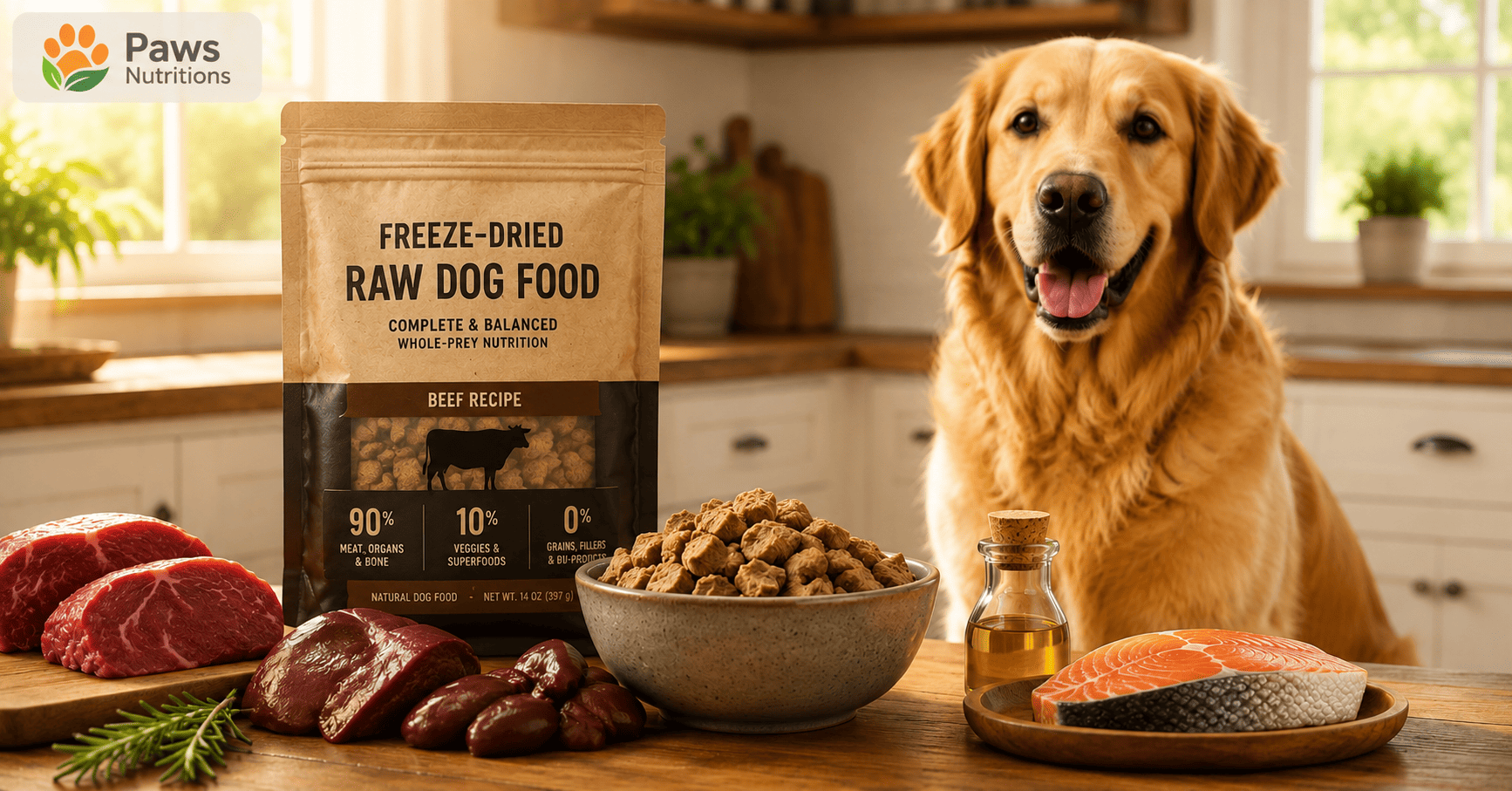
If you’ve been staring at a bag of Vital Essentials freeze-dried dog food wondering whether it’s really worth the price tag, you’re not alone. Raw feeding sounds great in theory, but between confusing labels, a suspiciously similar-sounding brand, and old recall headlines still floating around online, it’s genuinely hard to know what you’re buying for your dog.
This Vital Essentials freeze-dried dog food review breaks down the real dry matter basis nutrition, current recall status, price per ounce, and how it stacks up against Primal and Stella & Chewy’s. You’ll also learn exactly how to feed it safely, so you can decide with confidence instead of guesswork.
Quick Verdict: Is Vital Essentials Freeze-Dried Worth It?
Short answer: yes, for most healthy adult dogs and dogs without a raw-feeding-related medical restriction. Vital Essentials freeze-dried dog food uses whole-prey ingredients, keeps its ingredient list short, and has stayed free of any confirmed recall since April 2018. The trade-off is cost — this is one of the pricier ways to feed your dog.
It’s best suited to owners who want the benefits of a raw diet without the freezer space, prep work, or shelf-life headaches of frozen raw. It’s not the right fit if you’re feeding on a tight budget or your dog has a medical condition that calls for a vet-formulated therapeutic diet.
Table 1: Quick-Facts Snapshot
| Attribute | Detail |
| Brand | Vital Essentials |
| Parent company | Carnivore Meat Company |
| Founded | 1968 (brand launched 2009) |
| Headquarters | Green Bay, Wisconsin, USA |
| Form factor | Freeze-dried raw (nibs and patties) |
| AAFCO life stage | All Life Stages (most recipes) |
| Average rating across reviewers | 4.5–5 out of 5 stars |
What Is Vital Essentials Freeze-Dried Dog Food?
Vital Essentials is a raw pet food brand owned by Carnivore Meat Company, a family-owned business that has been producing meat products since 1968. The Vital Essentials brand itself launched in 2009, and the company built its own freeze-drying and frozen-raw production facility in Green Bay, Wisconsin, so it controls the entire process from sourcing to packaging, rather than outsourcing production to a third-party co-packer.
That vertical control matters more than it might sound. When one company handles sourcing, formulation, freeze-drying, and packaging under one roof, there are fewer handoffs where quality can slip — and it’s part of why Vital Essentials can back up its safety certifications with a facility it directly manages, rather than pointing to a supplier’s standards.
The Alpha Prey Model diet explained
Vital Essentials builds its recipes around what it calls the Alpha Prey Model — roughly 45% muscle meat, 45% organ meat, and 10% bone. The idea is to mimic what a wild canine would naturally eat from a whole animal, rather than relying on isolated protein meals or plant-based fillers to hit a guaranteed analysis number.
In practice, this ratio is why the ingredient panels look the way they do — beef, then beef liver, then beef lung, then beef kidney, then beef heart, in roughly descending order by weight. Each organ contributes something the others don’t: liver is dense in vitamin A and copper, kidney supplies selenium, and heart is a natural source of taurine, an amino acid tied to healthy heart function in dogs and cats alike.
The freeze-drying process itself
Freeze-drying works by freezing the raw meat solid, then slowly removing the ice through a vacuum process called sublimation — the ice turns straight to vapor without ever becoming liquid water. Vital Essentials describes this as roughly a 48-hour cycle. Because no heat is applied, the process avoids the protein and vitamin losses that come with cooking, while still giving the finished product a long, shelf-stable life.
Where and how it’s made
All Vital Essentials freeze-dried products are made in the company’s own USA facility. Carnivore Meat Company holds EU Certification and GFSI-FSSC 22000 (ISO) certification, and the company says it developed its food safety program in partnership with Kansas State University, with “Superior” ratings from FDA audits. The company sources meat from farm-raised, hormone- and antibiotic-free suppliers in the US and EU.
Vital Essentials vs. “Vital” Fresh Dog Food — Don’t Confuse These Brands
| Heads up: Vital Essentials (freeze-dried raw, Carnivore Meat Company) and Freshpet Vital Clean Nutrition (refrigerated rolls, Freshpet Inc.) are two completely different companies that happen to both use the word “Vital.” They are not related, and mixing them up is an easy mistake to make when you’re comparison-shopping. |
Vital Essentials makes shelf-stable freeze-dried and frozen raw meals you store at room temperature or in the freezer. Freshpet Vital Clean Nutrition, on the other hand, is a refrigerated, gently cooked roll you keep in the fridge and use within about a week of opening. If a product page mentions cranberries, sweet potatoes, or brown rice, you’re looking at Freshpet Vital, not Vital Essentials.
Table 2: Vital Essentials vs. Freshpet Vital
| Factor | Vital Essentials | Freshpet Vital Clean Nutrition |
| Company | Carnivore Meat Company | Freshpet, Inc. |
| Headquarters | Green Bay, WI | Bedminster, NJ |
| Format | Freeze-dried raw / frozen raw | Refrigerated cooked rolls |
| Storage | Pantry or freezer | Refrigerator only |
| Protein source | 98%+ meat, organ, bone | Meat plus produce and grains |
Vital Essentials Product Line & Recipe Options
Vital Essentials sells the same core recipes across several formats, so you can pick whichever one fits your feeding routine and your dog’s size.
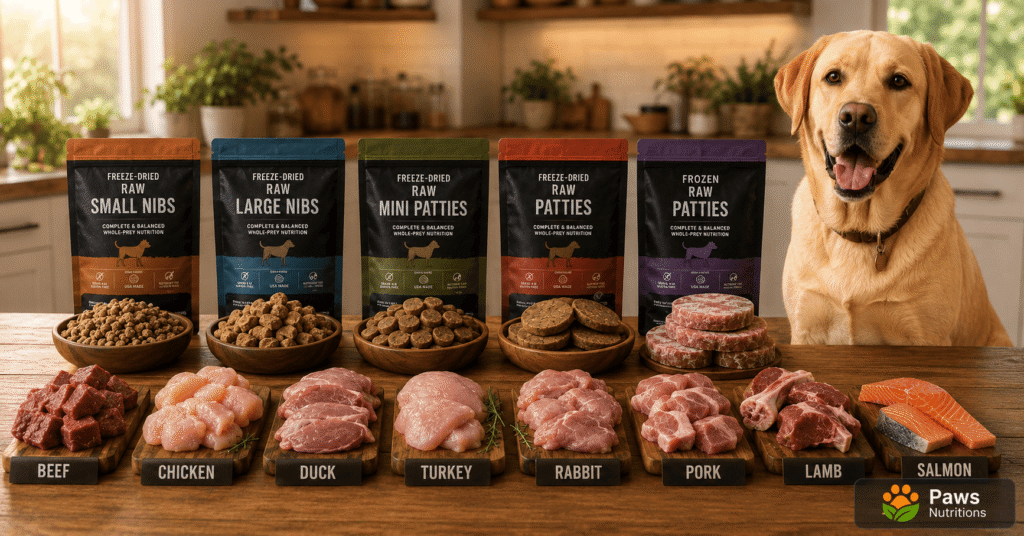
Mini Nibs, Nibs, Mini Patties, Patties, and Frozen Patties
- Mini Nibs — small, blueberry-sized freeze-dried pieces you can scoop and serve like kibble, no rehydration required
- Nibs — the same concept in a larger size, better suited to bigger dogs or slower eaters
- Mini Patties — freeze-dried bricks meant to be rehydrated with water before serving
- Patties — a larger freeze-dried patty, typically rehydrated and portioned for bigger dogs
- Frozen Patties — true frozen raw, thawed in the fridge overnight before feeding
Available protein varieties
Across the range, Vital Essentials offers single-protein recipes in beef, chicken, turkey, duck, rabbit, pork, and combination options like lamb and whitefish or beef and salmon. Single-protein recipes make it easier to identify and manage food sensitivities, since you know exactly what your dog is (and isn’t) reacting to.
Table 3: Vital Essentials Recipe Ratings Overview
| Recipe | AAFCO Stage | Reviewer Rating |
| Beef Entrée Mini Nibs | All Life Stages | 4.5 / 5 |
| Chicken Entrée Mini Nibs | All Life Stages | 5 / 5 |
| Duck Entrée Mini Nibs | All Life Stages | 5 / 5 |
| Rabbit Entrée Mini Nibs | All Life Stages | 5 / 5 |
| Turkey Entrée Mini Nibs | All Life Stages | 5 / 5 |
| Beef & Salmon Protein Soft Nibs | All Life Stages | 5 / 5 |
| Lamb & Whitefish Protein Soft Nibs | All Life Stages | 4 / 5 |
Dry Matter Basis Nutrition Analysis
Comparing dog foods by the numbers on the bag can be misleading, because wet, fresh, and freeze-dried foods all carry different amounts of moisture. Dry matter basis (DMB) removes the water from the equation so you’re comparing protein, fat, and carbohydrate content apples-to-apples across brands and formats.
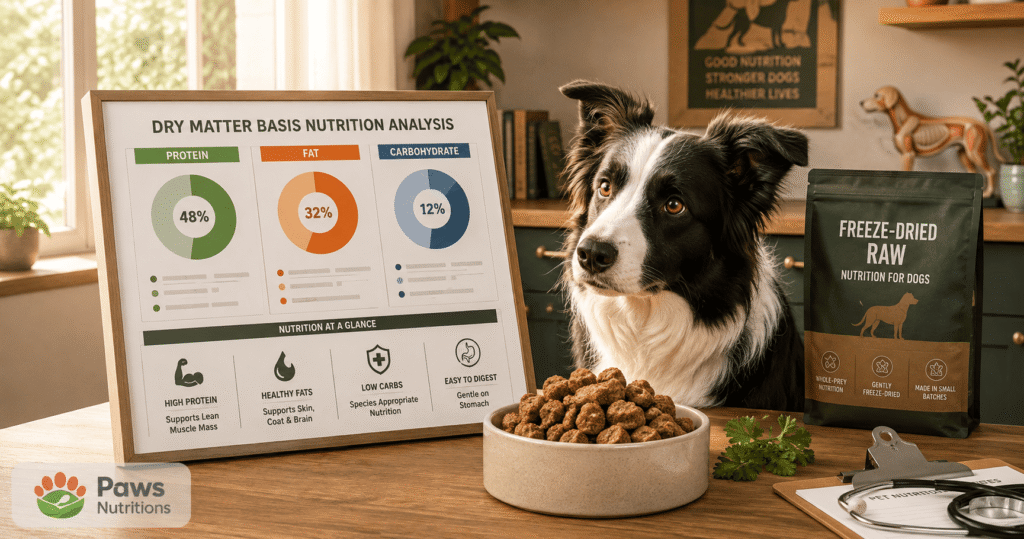
Beef Entrée Mini Nibs — full DMB breakdown
On a dry matter basis, the Beef Entrée Mini Nibs come in at roughly 44–45% protein, 35–36% fat, and about 3% carbohydrate, with an estimated fiber content around 8%. That’s a high-protein, moderate-fat profile typical of a raw, meat-first diet with minimal plant material.
How the protein varieties compare
Table 4: DMB Nutrient Comparison by Recipe
| Recipe | Protein (DMB) | Fat (DMB) | Carbs (DMB) |
| Beef Entrée | 44–45% | 35–36% | ~3% |
| Duck Entrée Mini Nibs | 49% | 26% | Low |
| Turkey Entrée Patties | 58% | 25% | ~4% (fiber) |
| Brand-wide average (frozen raw line) | ~54% | ~26% | ~8% |
Worth flagging: independent evaluators have specifically noted that the freeze-dried Turkey recipe runs higher in carbohydrate than the rest of the line, at around 15% on a dry matter basis, due to its formulation. If low-carb is a priority for your dog, beef, duck, or rabbit are closer to the brand’s typical profile.
Ingredient Analysis: What’s Really in the Bag
The Beef Entrée Mini Nibs ingredient panel reads: beef, beef liver, beef lung, beef kidney, beef heart, beef fat, beef tripe, fish oil, mixed tocopherols (preservative), vitamin E supplement, and a handful of chelated minerals — zinc, iron, copper, and manganese amino acid complexes.
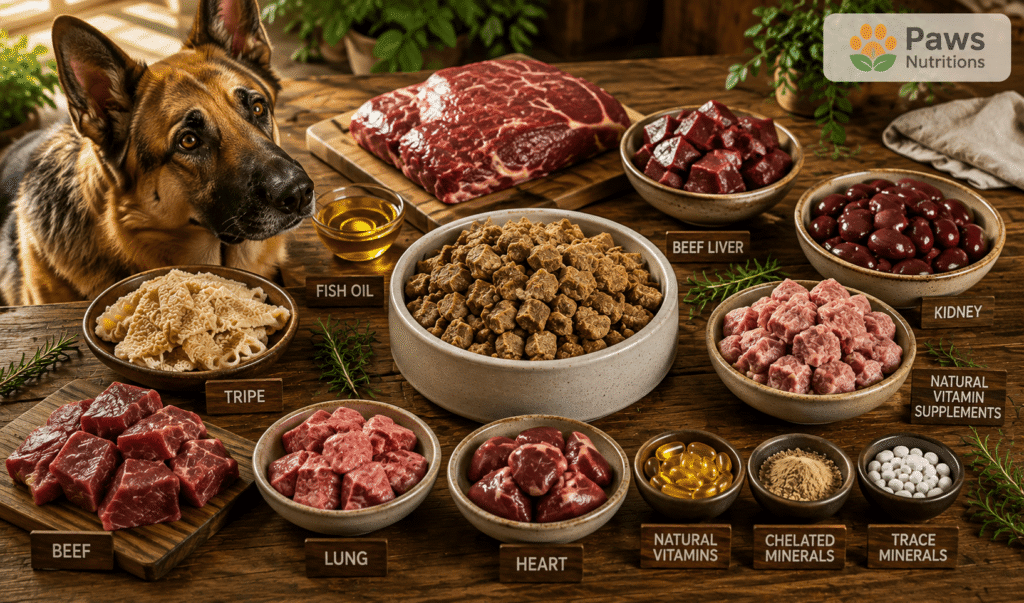
Primary ingredients breakdown
Every named ingredient in the first eight positions is a real, identifiable animal part — no meat meals, no unnamed “animal by-products.” Organ meats like liver, kidney, and heart are nutrient-dense and naturally rich in B vitamins, iron, and complete amino acid profiles, which is exactly what you’d expect from a diet modeled on whole-prey feeding.
Added vitamins and chelated minerals
Because the recipe leans so heavily on organ meat and bone, it only needs a small handful of added minerals — chelated forms are bonded to protein molecules, which makes them easier for your dog to absorb than standard mineral salts. Fewer than five minerals are added in total, a sign the base ingredients are already doing most of the nutritional heavy lifting.
What’s notably absent
You won’t find grains, legumes, artificial colors, synthetic flavorings, or rendered by-product meals anywhere on a Vital Essentials label. There are no plant-based protein boosters like pea protein or potato protein either, which keeps the amino acid profile coming almost entirely from animal sources.
This matters for a specific, practical reason: plant-based protein boosters can inflate the guaranteed analysis protein percentage on a label without actually supplying the full amino acid profile a dog needs. Because Vital Essentials skips that shortcut entirely, the protein number on the bag is coming from genuine animal tissue, not a blend engineered to look good on paper.
Brand Claims vs. Ingredient Panel: What Holds Up
Vital Essentials markets itself as free of fillers, by-products, and artificial preservatives. Checking that against the actual label, the claim holds up well: the ingredient list is short, every item is a named animal part, and the only preservative used is mixed tocopherols, a natural, vitamin-E-derived preservative rather than a synthetic one like BHA or BHT.
Where retailer listings and physical labels have disagreed
This isn’t unique to Vital Essentials, but it’s worth knowing: at least one verified Chewy reviewer for a different “Vital”-branded product reported that the online ingredient list didn’t match what was printed on the physical package, which caused an allergic reaction in their dog. The lesson applies across brands — always double-check the printed label on the bag against what’s listed online before feeding, especially if your dog has a known allergy.
AAFCO Compliance and Life Stage Suitability
Most Vital Essentials freeze-dried recipes carry an AAFCO “All Life Stages” nutritional adequacy statement, meaning the formula is designed to meet the higher nutrient demands of growth and reproduction, not just adult maintenance. That’s a meaningful distinction — a food labeled only for “maintenance” isn’t automatically appropriate for a growing puppy.
Is it appropriate for puppies and large-breed growth?
An All Life Stages label technically covers puppies, but AAFCO’s general profiles don’t include the large-breed-growth calcium and phosphorus caps that veterinary nutritionists recommend for giant and large-breed puppies specifically. If you have a large-breed puppy, talk to your vet about calcium and phosphorus ratios before committing to any all-life-stages raw diet, Vital Essentials included.
How this compares to WSAVA guidance
The WSAVA (World Small Animal Veterinary Association) doesn’t certify or endorse specific commercial diets, but its global nutrition guidelines emphasize feeding trials, quality control, and a full-time qualified nutritionist on staff as markers of a trustworthy manufacturer. Vital Essentials publishes AAFCO nutrient profile compliance and a food-safety program developed with a university partner, though it doesn’t publicly disclose whether it runs AAFCO feeding trials versus formulation-only compliance.
Is Vital Essentials Safe? DCM, Grain-Free Raw Diets, and What the Research Shows
You may have seen headlines connecting grain-free dog food to DCM (dilated cardiomyopathy), a serious heart condition. The FDA opened an investigation into a possible link starting in 2018, largely centered on grain-free, legume-heavy kibble diets — not raw, whole-prey diets like Vital Essentials, which don’t rely on peas, lentils, or potatoes as primary ingredients.
Treats and toppers vs. a complete raw diet
It’s worth separating two very different use cases here. Using a freeze-dried topper or treat occasionally carries minimal nutritional risk either way. Feeding an all-life-stages formula as your dog’s sole, complete diet is a bigger commitment, and it’s worth confirming with your vet that the specific recipe you’ve chosen fits your dog’s individual health profile, especially if they have any pre-existing heart or kidney concerns.
Bacterial safety: Salmonella and safe handling
Freeze-drying doesn’t cook the meat, so raw-diet safety guidance still applies. Wash your hands, bowls, and prep surfaces with hot, soapy water after every feeding, store the product in a cool, dry place, and avoid feeding raw diets to households with immunocompromised members, infants, or elderly residents without talking to a doctor first.
Common feeding mistakes to avoid
- Switching too fast — transition over 5–7 days by gradually increasing the ratio of new food to old
- Feeding dry Mini Nibs to a dog who doesn’t drink much water, without adding any extra moisture
- Leaving rehydrated patties out at room temperature for extended periods before serving
- Skipping hand-washing after handling, especially in households with young kids or older pets
Vital Essentials Recall History
A clean recall record matters just as much as a messy one — and it’s something most reviews of this brand leave out of date.
Table 5: Vital Essentials Recall Timeline
| Date | Product | Reason |
| July 2015 | Select raw products | Voluntary recall |
| January 2016 | Select raw products | Voluntary recall |
| February 2018 | Freeze-Dried Beef Nibblets Entrée | Possible Salmonella contamination |
| April 2018 | Freeze-Dried Beef Toppers & Frozen Beef Chub Entrée | Possible Salmonella contamination |
Current recall status
As of August 2026, we found no confirmed recalls for Vital Essentials or Carnivore Meat Company since the April 2018 event. All four historical recalls were voluntary, limited to specific lots, and issued after routine testing — not after confirmed pet illnesses.
How to check for the latest recall alerts yourself
Recall status can change at any time, so before you buy, it’s smart to check the FDA’s pet food recall page directly, or sign up for a recall alert email service. Don’t rely solely on any single third-party review site’s recall list, since — as we found in our own research — several of them stop updating years before the “current” date shown on the page.
How Much Does Vital Essentials Cost?
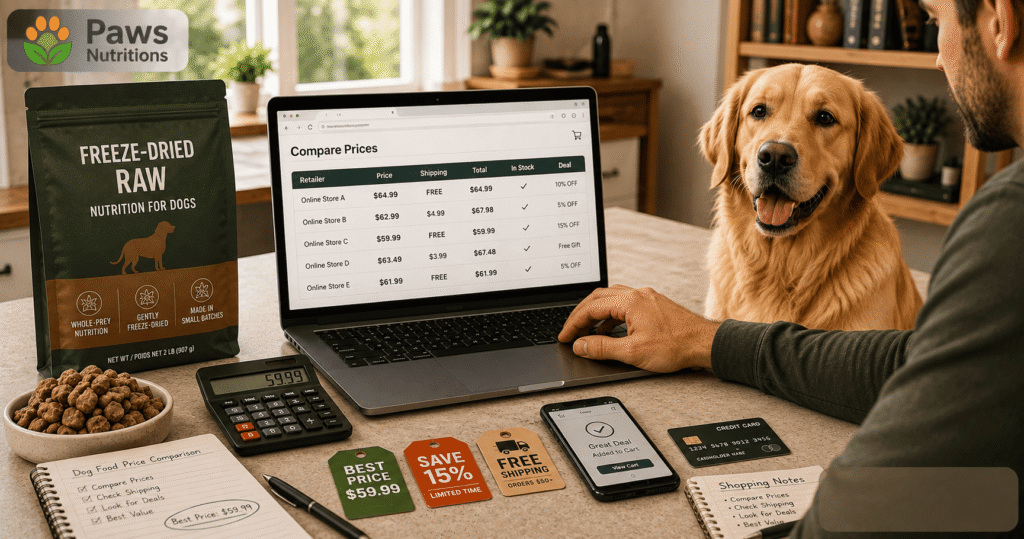
Vital Essentials sits firmly in the premium tier of dog food pricing, which tracks with its whole-meat, minimally processed formulation.
Table 6: Price-Per-Ounce Comparison
| Retailer | Product | Price | Price/oz |
| MudBay | Beef Mini Nibs, 14 oz | $35.99 | ~$2.57/oz |
| Chewy | Beef Crunchy Nibs, 14 oz | ~$35 (per verified buyer review) | ~$2.50/oz |
| Chewy Autoship | Various recipes | Up to 35% off list price | Varies |
| Amazon | Various recipes | Flag for manual verification | Varies |
For context, that’s noticeably higher per ounce than most kibble and even many canned foods, though it’s roughly in line with other premium freeze-dried raw brands like Primal and Stella & Chewy’s. Buying in the larger 3-lb or 48-oz bags, or subscribing through autoship where available, meaningfully lowers the effective cost per feeding.
Is it worth the price compared to other raw brands?
If you’re already committed to raw or freeze-dried feeding, Vital Essentials is competitively priced against its direct peers rather than being an outlier. The bigger budget question is really raw versus kibble, not Vital Essentials versus other raw brands — a 30-lb dog on a complete raw diet like this one will typically cost several times more per month than the same dog on a quality kibble. Many owners split the difference by using it as a topper a few times a week instead of a full-time diet.
How to Feed Vital Essentials Freeze-Dried
Complete meal vs. kibble topper
Because most recipes are labeled All Life Stages, you can feed Vital Essentials as your dog’s entire diet or sprinkle it on top of kibble as a flavor and nutrient boost. If you’re using it as a topper only, portion sizes should be much smaller than the complete-feeding guide on the bag.
Rehydrating patties vs. feeding nibs dry
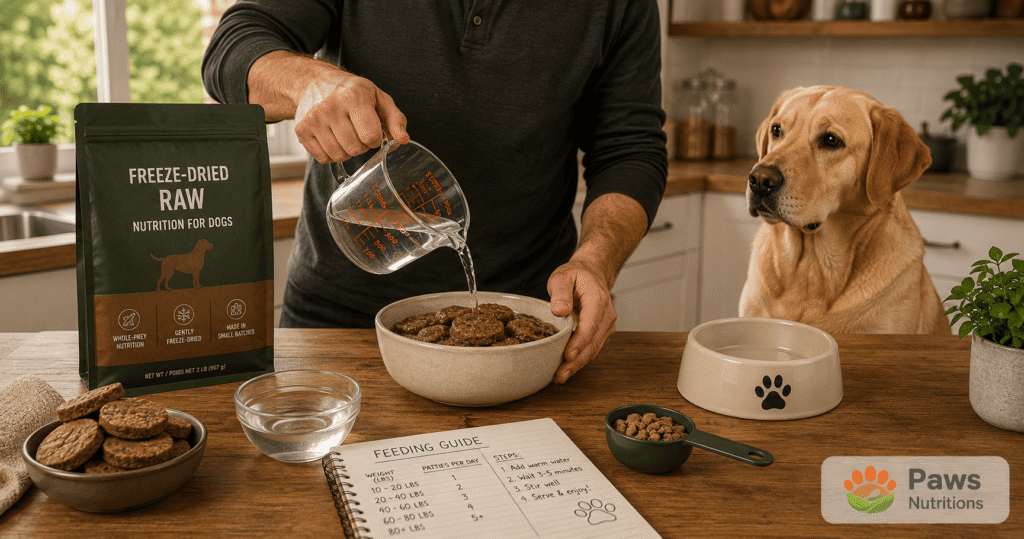
Mini Nibs and Nibs can be scooped straight from the bag like kibble — no water needed, though dogs who don’t drink much on their own may benefit from a splash added anyway. Patties and Mini Patties are meant to be rehydrated: add warm water, let the patty sit for roughly 15–20 minutes, then mash and serve.
Weight-based feeding guide
Table 7: Approximate Daily Feeding Guide (Complete Diet)
| Dog Weight | Approx. Daily Amount |
| Under 10 lbs | 1.5–2.5 oz |
| 10–25 lbs | 2.5–5 oz |
| 25–50 lbs | 5–8 oz |
| 50–75 lbs | 8–11 oz |
| 75–100+ lbs | 11–15+ oz |
These figures are a starting estimate based on typical adult-maintenance feeding ratios — always confirm against the specific bag’s feeding chart, since fat content (and therefore calorie density) varies by protein.
A practical example
Say you have a 45-lb adult Labrador mix transitioning off kibble. You’d start around day one by mixing in roughly 25% Vital Essentials with 75% of the old food, working up to a full switch by day seven. At full transition, that dog would land somewhere around 6–7 ounces per day of the Beef Mini Nibs, split across two meals, with a small amount of added water if she isn’t a big water-bowl drinker.
Real Owner Experiences and Reviews
Across verified retailer reviews, the most consistent theme is palatability — even notoriously picky eaters tend to go for it enthusiastically, and several owners specifically mention it working for dogs that had stopped eating other foods entirely.
Common complaints
- Cost — the single most repeated criticism across every source we reviewed
- Dehydration risk — Mini Nibs fed dry without added water can leave some dogs under-hydrated if they aren’t big water drinkers
- Prep time — rehydrated patties take more effort than scoop-and-serve kibble
Overall sentiment leans strongly positive, particularly around coat condition, stool quality, and energy levels within the first few weeks of switching — outcomes that line up with what you’d expect from a high-protein, low-carbohydrate, minimally processed diet.
Vital Essentials vs. Other Raw & Freeze-Dried Brands
Table 8: Brand Comparison
| Brand | Approx. Price/oz | Protein (DMB) | AAFCO Stage | Recall History |
| Vital Essentials | ~$2.50–2.60 | 44–58% | All Life Stages | Clean since April 2018 |
| Primal | ~$2.30–2.70 | 40–50% | All Life Stages (most) | Multiple historical recalls |
| Stella & Chewy’s | ~$2.20–2.60 | 42–48% | All Life Stages (most) | Multiple historical recalls |
| Instinct Raw | ~$2.00–2.40 | 48–50% | All Life Stages (most) | Limited historical recalls |
Which food is better?
There’s no single winner here — all four brands sit in a similar price and protein bracket. Vital Essentials stands out for its single-protein simplicity and the Alpha Prey Model’s organ-heavy ratio, which makes it a strong pick if you’re managing a food sensitivity. If ingredient variety within one bag matters more to you, Primal and Stella & Chewy’s offer more multi-protein blends.
Pros and Cons Summary
Who it’s a great fit for
- Dogs with food sensitivities who benefit from single-protein recipes
- Owners who want raw-diet benefits without a chest freezer
- Picky eaters who’ve struggled with other foods
Who should consider a different brand
- Budget-conscious households — this is a premium-tier price point
- Owners who prefer multi-protein recipes in a single bag
- Large-breed puppy owners who need vet-confirmed calcium/phosphorus ratios first
Frequently Asked Questions
Is Vital Essentials good for dogs?
Yes — it uses named whole-meat ingredients, minimal processing, and has a clean recall record since 2018, making it a solid premium raw option for most healthy dogs.
Has Vital Essentials dog food been recalled?
Yes, historically — in 2015, 2016, and twice in 2018, all for possible Salmonella. No confirmed recalls have occurred since April 2018 as of August 2026.
Is Vital Essentials a raw dog food?
Yes. It’s freeze-dried raw and frozen raw, meaning the meat isn’t cooked — only the moisture is removed in the freeze-dried lines.
What are the benefits of Vital Essentials dog food?
High protein, minimal processing, no grains or fillers, single-protein options for allergy management, and easy storage compared to frozen raw.
Is Vital Essentials better than Royal Canin?
They’re built for different goals — Vital Essentials favors minimally processed, whole-prey raw feeding, while Royal Canin focuses on breed- and condition-specific cooked kibble formulas backed by feeding trials.
Is “Vital” fresh dog food the same as Vital Essentials?
No. Freshpet Vital Clean Nutrition is a separate, unrelated brand made by Freshpet, Inc. — a refrigerated cooked roll, not a freeze-dried raw product.
Final Verdict
Vital Essentials freeze-dried dog food earns its premium price with a short, honest ingredient list, a genuinely clean recall record over the past several years, and a feeding format that fits real households better than a chest freezer full of frozen patties. It’s not the cheapest way to feed your dog, and it’s not the right call for every budget or every medical situation, but for owners who want raw feeding without the mess, it’s one of the more trustworthy options on the shelf in 2026.
Disclaimer: This article is written for educational purposes only. PawsNutritions is not sponsored by, affiliated with, or paid by Vital Essentials, Carnivore Meat Company, Freshpet, or any other brand mentioned above. Any brand names, product links, or retailer references included here are shared purely for the reader’s convenience and research — we have no commercial relationship with these companies. Always verify current pricing, ingredients, and recall status directly with the manufacturer or retailer before making a feeding decision, and consult your veterinarian for advice specific to your dog.

A dedicated writer and digital enthusiast committed to creating high-quality, informative, and reader-focused content. Through thoughtful research and clear communication, he aims to deliver valuable insights that help readers navigate the ever-changing digital landscape.