
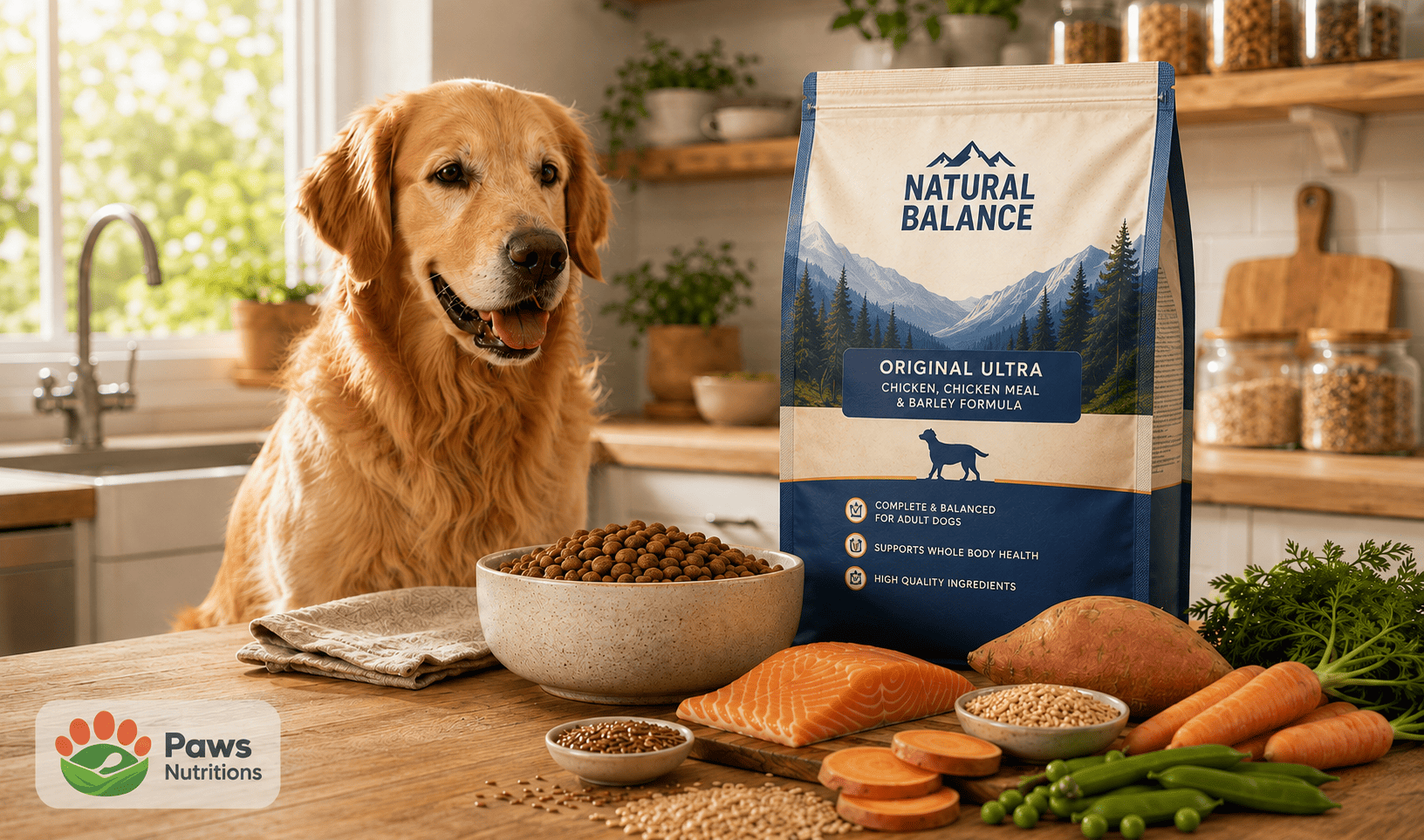
Natural Balance has built its reputation around simple recipes, limited ingredients, and formulas designed for dogs with food sensitivities. But choosing the right bag isn’t always simple. The brand now spans Limited Ingredient Diet (LID), Original Ultra, Reserve-style recipes, vegetarian food, wet diets, treats, and formulas for different life stages and body sizes. Meanwhile, customer experiences range from excellent results to serious complaints about palatability and digestive problems.
This Natural Balance dog food review examines the brand from several angles: ingredients, nutrition, sensitive-dog suitability, recalls, customer experiences, pricing, and competing foods. Current product information and 2026 sources are used where available, while customer reports are treated as experiences—not proof that a particular food caused an illness.
What Is Natural Balance Dog Food?
Natural Balance began in 1989, founded by actor Dick Van Patten and Joey Herrick. The company became particularly associated with limited-ingredient dog food, single-animal-protein recipes, and formulas aimed at dogs that don’t tolerate a long list of common ingredients. Dog Food Advisor currently identifies Nexus Capital Management as Natural Balance’s owner.
Today, the brand’s portfolio is broader than LID alone. Its products include grain-inclusive and grain-free dry foods, Original Ultra recipes, vegetarian formulas, wet foods, and other products. That variety is useful, but it also means you shouldn’t judge the entire brand from one recipe. A salmon-and-rice formula can have a very different nutritional profile from a vegetarian maintenance diet or an Original Ultra recipe.
Manufacturing and Where It’s Made
Manufacturing and sourcing questions matter because pet-food quality isn’t determined solely by the ingredient list. Natural Balance emphasizes quality testing and says it performs more testing than required by pet-food regulations. Its current website also provides detailed product pages containing ingredients, guaranteed analyses, calories, feeding guidance, and AAFCO nutritional statements.
However, “made in the USA” should not be treated as a blanket quality guarantee. Manufacturing location, ingredient sourcing, formulation, testing, and finished-product controls are separate questions. For a specific bag, check the current package and manufacturer’s product information rather than assuming every Natural Balance product has identical sourcing.
Brand Philosophy: Limited Ingredients and Single Proteins
The brand’s core idea is straightforward: reduce unnecessary ingredient complexity for dogs that may react to particular foods. Many LID recipes emphasize a single animal protein, while avoiding ingredients such as corn, wheat, and soy in relevant formulas. Dog Food Advisor describes the current LID range as containing both grain-inclusive and grain-free recipes.
That approach can be useful when you’re trying to identify a dietary trigger. But there’s an important distinction: limited ingredient does not automatically mean hypoallergenic. A dog can still react to an ingredient in a short recipe, and true food-allergy diagnosis is more complicated than simply counting ingredients.
How We Evaluated Natural Balance Dog Food
A good dog-food review should look beyond the first ingredient on the bag. Ingredient lists tell you what goes into a recipe, while the guaranteed analysis, calorie density, AAFCO nutritional statement, feeding directions, and the dog’s individual needs tell you whether that recipe makes sense in practice.
The evaluation also considers safety information and real-world customer experiences. This matters because a nutritionally complete recipe can still be a poor match for an individual dog if it causes digestive upset, isn’t palatable, or doesn’t fit the dog’s life stage.
Ingredient Quality
The first question is not simply “Is ingredient X good or bad?” Instead, look at the complete recipe. Animal-protein sources, concentrated meat or fish meals, carbohydrate sources, fats, fiber, vitamins, minerals, and functional additions all contribute to the final food.
For example, salmon followed by salmon meal gives a recipe a clear fish-protein identity. But the presence of vegetables, starches, oils, and supplements still matters because they influence the food’s overall nutritional profile.
Nutritional Adequacy
A food’s AAFCO nutritional statement is one of the most important pieces of label information. It tells you whether the recipe is formulated to meet the nutrient requirements for a particular life stage.
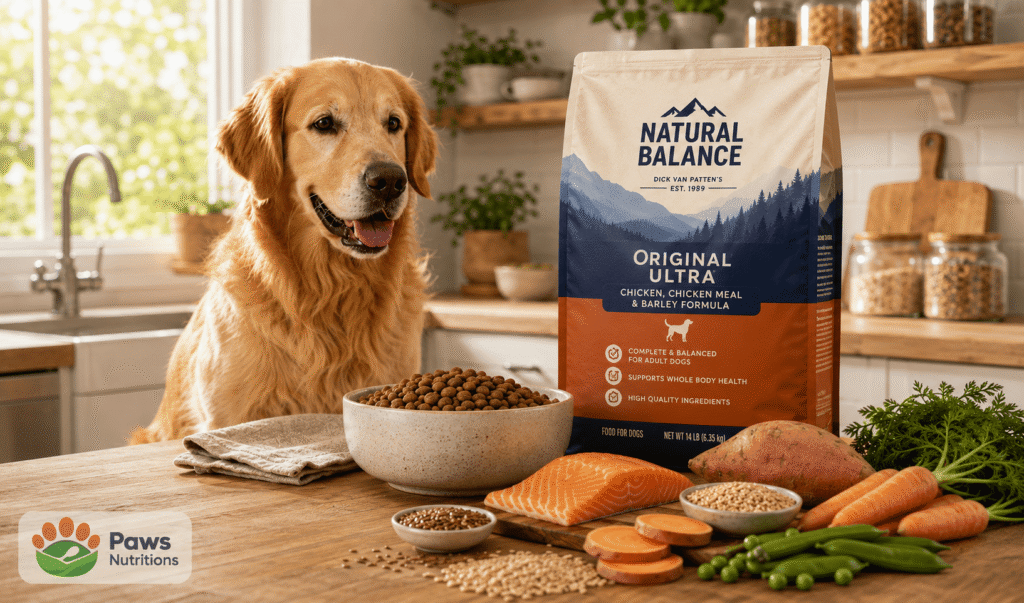
This becomes especially important when comparing formulas. Natural Balance’s current Original Ultra Chicken & Barley recipe, for example, is formulated to meet AAFCO nutrient profiles for all life stages, including growth of large-size dogs, according to its product page.
Protein and Fat Profile
Protein percentage alone doesn’t tell you everything about protein quality. You also want to know the major protein sources and how much of the recipe’s calories come from protein and fat.
A moderately active adult dog may do well on a moderate-protein kibble, while a highly active dog may need a different energy and nutrient profile. Conversely, simply choosing the highest protein percentage isn’t automatically better.
Calorie Density
Calories are easy to overlook. Two foods can contain similar protein percentages while providing noticeably different calories per cup.
Natural Balance Original Ultra Chicken & Barley currently lists 380 kcal per cup, with 24% minimum crude protein and 14% minimum crude fat.
That information becomes much more useful when you compare it with your dog’s weight, activity, body condition, and total daily calories.
Safety and Recall Record
Safety analysis separates verified recalls from individual consumer complaints. That’s essential. A customer saying a dog became sick after eating a product is not equivalent to an FDA-confirmed recall.
The FDA records a 2021 voluntary recall involving Natural Balance L.I.D. Green Pea & Chicken dry cat food because of possible Salmonella contamination. That was a cat-food recall, not a recall of the Natural Balance dog-food products reviewed here.
Dog Food Advisor’s current LID review lists Natural Balance dog-food recalls from 2010 and 2012.
Formula Variety
Variety is one of Natural Balance’s strongest practical advantages. You can find formulas aimed at ingredient-sensitive dogs, small breeds, different protein preferences, vegetarian households, and general adult nutrition.
The downside is that more choice makes comparison harder. You shouldn’t assume that “Natural Balance” represents one nutritional profile.
Value for Money
Price should be judged alongside calorie density, feeding amount, ingredient profile, and the dog’s individual needs. A cheaper bag isn’t necessarily cheaper per day, while an expensive bag isn’t automatically more nutritious.
Real-World Customer Experience
Customer reviews can reveal patterns that a label can’t: whether dogs accept the kibble, whether owners report stool changes, how customer service handles complaints, and whether owners notice changes after formula updates.
But reviews have major limitations. They are anecdotal and can’t establish causation. That distinction becomes particularly important with Natural Balance because the current ConsumerAffairs page contains both positive experiences and numerous serious negative reports.
Natural Balance Limited Ingredient Diet (LID) Review
Natural Balance LID is the brand’s most recognizable category and the one most closely aligned with owners searching for food for sensitive stomachs, food sensitivities, or ingredient intolerance.
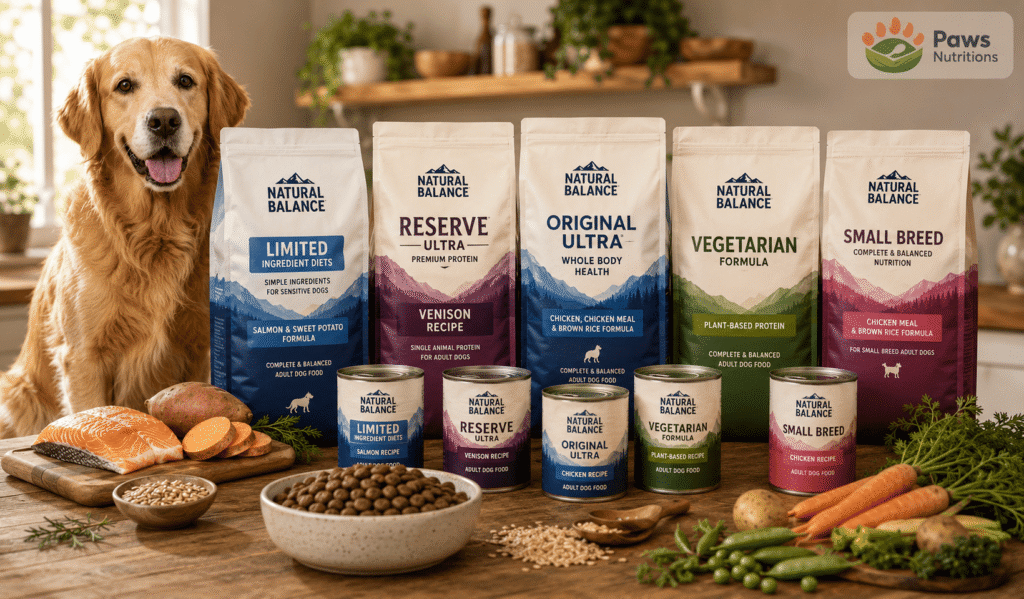
Dog Food Advisor’s January 2026 review describes 19 dry LID recipes with ratings ranging from 3.5 to 5 stars and an average rating of 4.5 stars. It also identifies both grain-inclusive and grain-free choices, plus recipes designed for small and large breeds.
What Makes LID Different?
The purpose of a limited ingredient diet is to simplify the recipe so that fewer ingredients are involved when you’re trying to identify or avoid a dietary trigger.
Think of it like troubleshooting a computer. If you’ve changed ten settings simultaneously, you don’t know which one fixed the problem. A shorter ingredient list can make dietary troubleshooting easier.
However, LID isn’t a diagnostic treatment by itself. Dogs with suspected food allergies may require a veterinarian-guided elimination diet, and an individual dog can react to any protein or ingredient.
Ingredient Analysis
A representative Natural Balance LID Salmon & Sweet Potato recipe reviewed by Dog Food Advisor begins with salmon and salmon meal, followed by sweet potatoes, potatoes, dried yeast, tapioca starch, beet pulp, canola oil, flaxseed, and salmon oil.
The first two ingredients provide a clear animal-protein identity, while sweet potato and potato supply carbohydrates. Flaxseed and salmon oil add fatty acids, and the recipe also contains taurine and chelated minerals.
The more controversial ingredients deserve context rather than sensationalism. Canola oil is primarily a fat source; beet pulp can provide fermentable fiber; and dried yeast can contribute nutrients and flavor. Their presence doesn’t automatically make the food unsafe. What matters is the whole formulation and how an individual dog responds.
Protein Sources
Natural Balance LID uses several animal proteins, including salmon, lamb, duck, and other options across its product range. The advantage is choice: if a dog has previously tolerated salmon but reacts poorly to chicken, for example, a different protein-centered recipe may be worth discussing with your veterinarian.
Dog Food Advisor specifically notes that the LID range emphasizes single animal protein recipes.
Still, don’t confuse a “novel” protein with a universally safe protein. A protein is novel only relative to what your individual dog has previously eaten.
Grain-Inclusive vs Grain-Free — Actual Health Implications
Natural Balance offers both grain-inclusive and grain-free LID recipes. Grain-free does not automatically mean lower carbohydrate, higher protein, or healthier.
For many dogs, properly cooked grains such as brown rice, barley, or oats can be useful carbohydrate and fiber sources. If your dog doesn’t have a specific reason to avoid grains, there’s generally no nutritional need to choose grain-free simply because the label sounds more specialized.
On the other hand, some dogs may need to avoid specific grains because of an individual intolerance. The correct choice should therefore be driven by your dog’s dietary history and veterinary guidance—not by the word “grain-free” alone.
Guaranteed Analysis vs Actual Nutrient Quality
One of the easiest mistakes in dog-food comparison is treating guaranteed analysis as the complete nutritional story.
Dog Food Advisor’s analysis of a representative LID Salmon & Sweet Potato recipe estimated approximately 27.7% protein, 12% fat, and 47.5% carbohydrates on a dry-matter basis.
Dry-matter calculations are useful because they remove the effect of water and make foods easier to compare. However, they still don’t tell you protein digestibility, amino-acid balance, ingredient sourcing, or how the food performs for an individual dog.
Calorie Density & Feeding Amounts
Feeding amounts should be adjusted based on body condition rather than blindly following the cup recommendation.
Natural Balance’s current vegetarian dry recipe, for example, provides 365 kcal per cup, while Original Ultra Chicken & Barley provides 380 kcal per cup.
That difference seems small, but it can matter over weeks and months. If your dog is gaining weight despite eating the “recommended” number of cups, the issue may simply be that the portion doesn’t match the dog’s energy requirements.
Who Is LID Best For?
LID makes the most sense when your dog has a suspected ingredient sensitivity, a history of digestive problems associated with certain foods, or a need for a simpler protein profile.
For example, imagine a Labrador that repeatedly develops loose stools whenever chicken-based foods are introduced but does well on fish. A salmon-centered LID recipe could be a reasonable food to discuss with the veterinarian. But if the dog develops vomiting, bloody diarrhea, facial swelling, or another serious reaction, changing foods at home shouldn’t replace veterinary care.
Natural Balance Original Ultra Review
Original Ultra takes a different approach from LID. Rather than focusing primarily on ingredient restriction, the line emphasizes whole-body nutrition, multiple ingredients, and additions such as fruits, vegetables, fatty acids, and functional nutrients.
Natural Balance currently lists Original Ultra Chicken & Barley as an all-life-stage recipe. Its product page provides a detailed nutrient profile and describes ingredients including barley and brown rice.
Ingredients
The Original Ultra line uses a broader ingredient philosophy than strict LID recipes. The brand highlights ingredients such as grains, fruits, vegetables, and other nutrient sources.
That broader recipe isn’t necessarily a disadvantage. In fact, it may be preferable for an otherwise healthy dog that doesn’t need an elimination-style diet.
Nutrition
The current Chicken & Barley recipe provides 24% minimum crude protein, 14% minimum crude fat, 5% maximum crude fiber, 10% maximum moisture, and 380 kcal per cup. It also lists omega-3 and omega-6 fatty acids, taurine, glucosamine, and L-carnitine among its guaranteed or added nutrients.
Dog Food Advisor currently gives both Original Ultra dry recipes five stars and notes that the range consists of two recipes.
Best Uses
Original Ultra is potentially a better fit for an adult or all-life-stage dog whose owner wants a broader nutritional profile rather than a highly restricted ingredient list.
It’s also worth considering when the dog doesn’t have a known dietary sensitivity and enjoys more varied ingredients.
Potential Drawbacks
The biggest limitation is variety within the Original Ultra dry line. Dog Food Advisor currently identifies only two recipes.
For a dog with multiple food sensitivities, LID provides more targeted choices. For a dog without those restrictions, however, the smaller Original Ultra selection may not be a major problem.
Natural Balance Dog Food Product Lines Explained
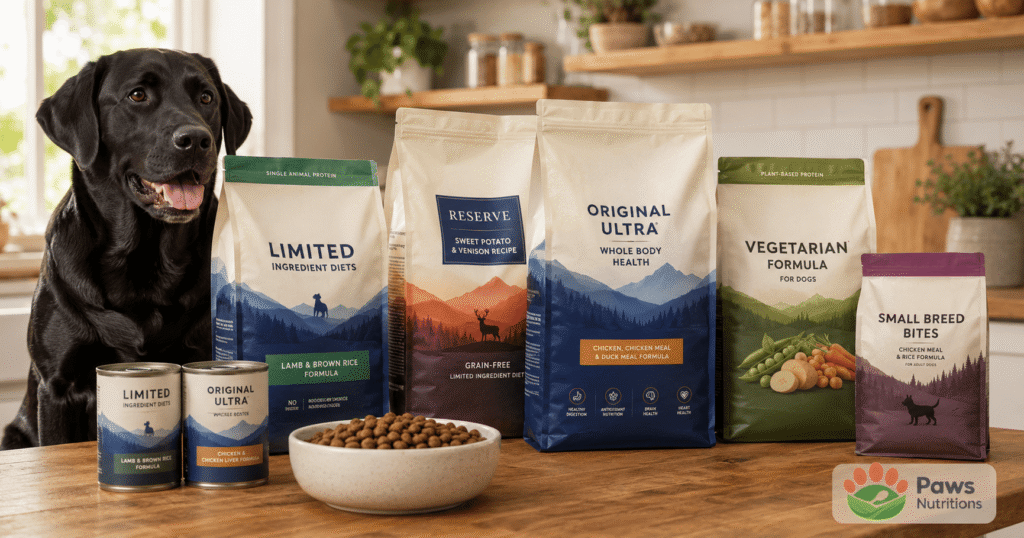
Natural Balance’s product portfolio is best understood as a collection of different nutritional strategies rather than one universal food.
Limited Ingredient Diet (LID)
LID is the brand’s flagship category for ingredient-sensitive dogs. Recipes emphasize simplified ingredient lists and commonly feature one primary animal protein.
LID Reserve
Reserve-style recipes focus on alternative or novel proteins, making them potentially useful when common proteins aren’t appropriate for a particular dog.
Always check the current ingredient panel, though. A novel-protein food is only useful for elimination purposes if the entire recipe avoids the ingredients you’re trying to eliminate.
Original Ultra Whole Body Health
Original Ultra focuses on broader nutritional variety and whole-body support. Current recipes include Chicken & Barley and Grain-Free Chicken & Sweet Potato, with both receiving five-star ratings from Dog Food Advisor.
Health Protection
Health Protection products are aimed more broadly at everyday nutrition rather than strict dietary restriction. They can make sense for dogs that don’t need a limited-ingredient strategy.
Vegetarian Formula
Natural Balance offers vegetarian and vegan-friendly recipes. Its current Vegetarian Recipe with Superfood Blend is formulated for adult maintenance, with 18% minimum protein, 8% minimum fat, 5% maximum fiber, and 365 kcal per cup.
This can be useful for dogs that need to avoid particular animal proteins, but it shouldn’t be selected merely because “plant-based” sounds healthier. Nutritional adequacy and the dog’s individual requirements matter more.
Wet Dog Food & Stews
Wet formulas can help increase dietary moisture and may be useful for dogs that prefer softer textures. Natural Balance’s current vegetarian canned recipe, for example, contains 78% maximum moisture and 363 kcal per can.
Treats and Other Products
Natural Balance also sells treats and complementary products. These shouldn’t be ignored when managing a food-sensitive dog because treats can introduce ingredients that undermine an otherwise carefully controlled diet.
Which Natural Balance Line Is Right for Your Dog?
| Your dog’s situation | Potentially suitable direction | Why |
|---|---|---|
| Food sensitivity | LID | Simplified ingredient profile |
| Suspected protein sensitivity | Appropriate novel-protein LID | Can reduce exposure to previously used proteins |
| Healthy adult without restrictions | Original Ultra or another complete formula | Broader nutritional approach |
| Need to avoid animal protein | Vegetarian formula | Plant-based complete-and-balanced option for its stated life stage |
| Prefers wet food | Wet/canned recipe | Higher moisture and different texture |
| Small breed | Small-breed-specific recipe where appropriate | Smaller kibble and tailored formulation |
| Puppy | Recipe with an appropriate growth/all-life-stage AAFCO statement | Life-stage nutrition matters |
Natural Balance Dog Food Nutrition Compared
The numbers below illustrate why comparing formulas individually is more useful than judging the brand as a whole.
| Formula | Protein | Fat | Fiber | Calories | AAFCO life stage |
|---|---|---|---|---|---|
| Original Ultra Chicken & Barley | 24% min | 14% min | 5% max | 380 kcal/cup | All Life Stages |
| LID Vegetarian | 18% min | 8% min | 5% max | 365 kcal/cup | Adult Maintenance |
| LID Vegetarian Small Breed | 18% min | 8% min | 5% max | 315 kcal/8-oz cup | Adult Maintenance |
Current Natural Balance product pages provide the values for the vegetarian recipes and Original Ultra Chicken & Barley.
For the LID Salmon & Sweet Potato recipe, Dog Food Advisor’s dry-matter analysis estimated 27.7% protein, 12% fat and 47.5% carbohydrates.
The key lesson: don’t compare protein percentages without checking moisture, calories, life stage, and the complete ingredient profile.
Is Natural Balance Good for Dogs With Allergies or Sensitive Stomachs?
Natural Balance can be a reasonable option for dogs with dietary sensitivities, particularly because its LID range offers simplified recipes and different animal proteins. The brand itself positions its Limited Ingredient foods for dogs with ingredient sensitivities, while its current vegetarian recipe specifically describes avoiding common animal-protein triggers.
However, food allergy management is more complicated than selecting a limited ingredient label. A dog may react to an ingredient that is still present in an LID food, and gastrointestinal symptoms can have many causes. Persistent diarrhea, vomiting, weight loss, blood in stool, or significant itching warrants veterinary assessment rather than repeated food changes.
Common Food Sensitivities in Dogs
Dogs can develop adverse reactions to various proteins or other food ingredients. Chicken, beef, dairy, and other ingredients are often discussed in canine food-allergy cases, but the important point is individual history.
If your dog has been eating chicken-based foods for years, switching to another chicken formula isn’t a meaningful elimination strategy.
How Limited Ingredient Formulas Help
The value of LID is simplification. Fewer major ingredients can make it easier to control what your dog consumes and identify patterns.
For a dog undergoing a genuine elimination diet, however, every treat, topper, chew, flavored medication, and supplement may matter. That’s why veterinarian-guided dietary trials are more reliable than casually switching between retail foods.
Ingredient Quality vs Ingredient Count
A short ingredient list isn’t automatically superior to a longer one.
Think of ingredients as tools in a toolbox. Having fewer tools doesn’t guarantee a better toolbox; you need the right tools for the job. A complete dog food still needs adequate amino acids, fatty acids, vitamins, minerals, and energy.
Omega-3, Omega-6 & DHA/EPA for Skin and Coat
Fatty acids can support normal skin and coat health. Natural Balance’s Original Ultra Chicken & Barley recipe currently lists omega-3 fatty acids at 0.65% minimum, omega-6 at 3.50% minimum, and EPA plus DHA at 0.12% minimum.
These nutrients are useful, but they shouldn’t be marketed as a cure for allergies. A dog with persistent itching may have environmental allergies, parasites, infection, or another medical condition.
Prebiotics, Probiotics & Digestive Support
Fiber sources such as beet pulp can influence stool quality and intestinal fermentation, while other ingredients may support digestive function.
One important detail from Dog Food Advisor’s LID analysis is that the representative Salmon & Sweet Potato recipe did not list probiotics.
That doesn’t make the food unsuitable. It simply means you shouldn’t assume every “sensitive stomach” food contains probiotics.
Life Stage and Dog Size Suitability
The right formula depends partly on how old and how large your dog is. A puppy growing rapidly has different nutritional requirements from a sedentary senior, even when both are the same breed.
Puppies
Look for a formula whose AAFCO statement supports growth or all life stages, rather than assuming every Natural Balance recipe is puppy-appropriate.
For example, Natural Balance Original Ultra Chicken & Barley is currently formulated for all life stages, including growth of large-size dogs.
Adults
Adult dogs have a broad range of energy needs. A 15-pound apartment dog and a 75-pound working dog may both be adults, but their calorie requirements can be dramatically different.
Seniors
Senior dogs don’t automatically need a low-protein diet. Their nutritional needs depend on body condition, activity, dental health, and medical status.
If your senior dog has kidney disease, diabetes, pancreatitis, or another diagnosed condition, ask your veterinarian whether a therapeutic diet is more appropriate than choosing a standard retail formula.
Small, Medium, and Large Breeds
Kibble size can matter for small dogs. Natural Balance’s Vegetarian Small Breed Bites, for example, are specifically shaped for smaller jaws and are listed at 315 kcal per 8-ounce cup.
Large dogs, meanwhile, need attention to growth nutrition when they’re puppies. Never assume that a food suitable for an adult large breed is automatically appropriate for a rapidly growing puppy.
Is Natural Balance Dog Food Safe?
Safety is where careful wording matters most. A recall is verified evidence about a specific product and lot; an online complaint is not. Mixing those two categories can make a dog-food review misleading.
Recall History
Dog Food Advisor currently lists Natural Balance dog-food recalls in 2010 and 2012.
The FDA also records a 2021 Natural Balance recall involving L.I.D. Green Pea & Chicken dry cat food for possible Salmonella contamination. Because that was a cat-food recall, it should not be presented as a recall of the dog-food formulas reviewed here.
Always check the exact product, lot number, and recall notice when evaluating a safety alert.
Quality Control and Batch Testing
Natural Balance says it conducts extensive testing and has promoted online batch-test information as part of its safety approach. ConsumerAffairs reproduces this company claim on its current Natural Balance profile.
Testing is encouraging, but it doesn’t mean every individual package can never have a problem. Quality systems reduce risk; they don’t make manufacturing risk zero.
Manufacturing Standards
Manufacturing controls include ingredient handling, cooking, storage, packaging, testing, and traceability. A complete assessment should therefore look at more than the front of the bag.
For consumers, practical checks include the lot code, best-by date, package integrity, odor, appearance, and storage conditions. If something looks or smells abnormal, don’t feed it while you investigate.
What a Recall Does — and Doesn’t — Tell You
A verified recall tells you that a specific product or lot was considered unsafe or potentially unsafe. It doesn’t prove that every product from the company is dangerous.
The opposite is also true: the absence of a recall doesn’t prove that every individual bag is perfect.
What Do Customers Say About Natural Balance?
Customer sentiment is unusually mixed. Consumer Affairs currently shows a 1.3/5 rating across 436 reviews, with 239 one-star reviews and 48 five-star reviews on the displayed profile. The page was updated August 14, 2026.
That is a meaningful reputation signal, but it needs context. Review sites naturally attract people who had unusually positive or negative experiences, so they shouldn’t be treated like controlled feeding trials.
Positive Experiences
Some owners report that Natural Balance works well for picky or sensitive dogs. ConsumerAffairs includes customers describing long-term use and positive experiences, while Dog Food Advisor’s current review also contains owners reporting improved allergy-related symptoms and good acceptance of certain LID recipes.
For example, one Dog Food Advisor reviewer reported that a venison-and-sweet-potato formula helped a dog with persistent ear problems after dietary elimination efforts. That’s an individual experience—not proof the food treats allergies—but it illustrates why owners seek these recipes.
Common Complaints
Negative reviews on Consumer Affairs frequently mention vomiting, diarrhea, refusal to eat, unusual kibble appearance, foreign material, suspected formula changes, and customer-service concerns. Several recent reviews describe severe gastrointestinal symptoms.
Those reports deserve attention, but they don’t establish causation. Dogs can develop gastrointestinal disease for many reasons, and individual reports don’t provide the controls necessary to determine whether food was responsible.
Palatability and Picky Eaters
Palatability is highly individual. One dog may devour a recipe while another turns its nose up at the same bowl.
Dog Food Advisor currently includes both positive reports of dogs loving particular LID formulas and a March 2026 report from owners whose dogs refused a grain-free venison recipe.
Digestive Response
Digestive response is one of the most important real-world variables. A food can look excellent on paper but still fail for an individual dog if it consistently produces loose stools or vomiting.
If digestive symptoms are severe, prolonged, bloody, or accompanied by lethargy or dehydration, don’t keep experimenting with kibble. Seek veterinary care.
Skin & Coat Experiences
Some owners report improvements in itching or ear-related problems after changing to LID recipes, while others report worsening symptoms. Consumer reviews therefore reinforce a central point: there is no single Natural Balance formula that will work for every sensitive dog.
Natural Balance Dog Food Pros and Cons
| Pros | Cons |
|---|---|
| Wide range of limited-ingredient formulas | Some formulas can be relatively expensive |
| Grain-inclusive and grain-free choices | Not every recipe suits sensitive dogs |
| Multiple animal-protein options | Customer experiences are highly mixed |
| Vegetarian options | Product-specific evaluation is necessary |
| Detailed current product-page nutrition information | Formula changes can complicate comparisons |
| Some recipes are suitable for multiple life stages | “LID” doesn’t mean hypoallergenic |
| Small-breed options | Customer complaints about quality require attention |
Bottom line: Natural Balance has genuine strengths, especially for owners seeking formula variety and limited-ingredient options, but the brand shouldn’t be evaluated as one single food.
Which Natural Balance Dog Food Is Best?
There isn’t one universal winner. The best choice depends on your dog’s age, size, dietary history, medical needs, protein tolerance, activity level, and calorie requirements.
| Need | Natural Balance direction | Key consideration |
|---|---|---|
| Sensitive stomach | LID | Choose ingredients your dog has historically tolerated |
| Suspected food sensitivity | LID | A veterinary-guided elimination diet may be more appropriate |
| Novel protein | LID/Reserve-style recipe | Verify the complete ingredient list |
| Grain-inclusive preference | Grain-inclusive LID or Original Ultra | Grains aren’t inherently unhealthy |
| General nutrition | Original Ultra or suitable complete formula | Match life stage and calories |
| Vegetarian diet | Vegetarian Recipe | Current recipe is for adult maintenance |
| Small breed | Small Breed Bites | Kibble size and calorie density matter |
| Puppy | Growth/all-life-stage recipe | Check AAFCO statement carefully |
| Senior dog | Appropriate adult formula based on needs | Medical conditions may require therapeutic food |
The most important rule is simple: choose the formula, not just the brand name.
Natural Balance vs Other Limited Ingredient Dog Foods
When comparing Natural Balance with another brand, don’t compare marketing claims. Compare the same variables across equivalent formulas.
Natural Balance Formula Comparison
| Factor | LID | Original Ultra | Vegetarian |
|---|---|---|---|
| Primary purpose | Ingredient-sensitive dogs | Broader nutrition | Avoid animal protein |
| Animal protein | Usually emphasized | Emphasized | None in vegan formulas |
| Grain-free options | Yes | Yes | No |
| Grain-inclusive options | Yes | Yes | Yes |
| Life stages | Varies by recipe | Some all-life-stage formulas | Adult maintenance |
| Best use | Sensitivity-focused feeding | General nutrition | Specific dietary restriction |
Natural Balance’s current product information confirms both grain-inclusive and grain-free choices, while the exact AAFCO life stage varies by recipe.
Natural Balance vs Other LID Brands
For a true apples-to-apples comparison, compare the exact recipe rather than the brand’s reputation.
| Factor | Natural Balance LID | Blue Buffalo Basics | Purina Pro Plan Sensitive Skin & Stomach | Hill’s Sensitive Stomach & Skin |
|---|---|---|---|---|
| Limited-ingredient positioning | Strong | Strong | More sensitivity-focused | More digestive/skin-focused |
| Novel proteins | Available in NB range | Available depending on recipe | Varies | Varies |
| Grain-inclusive choices | Yes | Yes | Yes | Yes |
| Veterinary therapeutic range | No | No | Broader veterinary ecosystem | Strong veterinary ecosystem |
| Best comparison point | Recipe-specific | Recipe-specific | Recipe-specific | Recipe-specific |
The key takeaway isn’t that one brand wins every category. Purina, Hill’s, Blue Buffalo, Merrick, Instinct, and Natural Balance all contain different formulas, so the actual recipe, nutritional statement, price, and your dog’s response should determine the choice.
Natural Balance Dog Food Price & Value
Price changes by retailer, formula, bag size, region, promotions, and subscription program. Because pet-food pricing can change quickly, a single advertised price shouldn’t be treated as a permanent 2026 price.
Price-Per-Pound Breakdown by Bag Size
Use this calculation when shopping:
Price per pound = package price ÷ package weight in pounds
For example, a $48 bag weighing 24 pounds costs $2 per pound. But price per pound still isn’t the whole story because one formula may contain more calories per cup than another.
Price vs Nutritional Value
A more useful value calculation is cost per 1,000 kcal.
That lets you compare foods with different calorie densities. A food that costs more per pound can sometimes cost less per day if it provides more calories per cup and your dog needs less of it.
Where to Buy
Natural Balance is sold through major pet retailers and online sellers, with availability varying by formula and size. The manufacturer’s product pages provide retailer links for individual recipes.
Before buying, compare the exact formula, package size, best-by date, and ingredient panel. Don’t assume that a retailer’s older product listing reflects the newest recipe.
How to Transition Your Dog to Natural Balance
A gradual transition is usually easier on the digestive system than changing food overnight. Natural Balance recommends transitioning over 7–10 days, replacing approximately 25% of the previous food with the new food every 2–3 days.
| Days | Old food | New food |
|---|---|---|
| 1–2 | 75% | 25% |
| 3–4 | 50% | 50% |
| 5–6 | 25% | 75% |
| 7–10 | 0% | 100% |
Watch stool consistency, appetite, vomiting, itching, and energy during the transition. If your dog develops significant symptoms, stop and contact your veterinarian rather than assuming the problem is simply “adjustment.”
Frequently Asked Questions
Is Natural Balance good for dogs with sensitive stomachs or allergies?
It can be a good option for some dogs, particularly its LID recipes, but limited ingredients don’t guarantee allergy control; dogs with suspected food allergies may need a veterinarian-guided elimination diet.
Does Natural Balance have grain-free dog food?
Yes. Natural Balance currently offers both grain-free and grain-inclusive recipes, including options within its LID and Original Ultra ranges.
Has Natural Balance dog food been recalled?
Yes, Natural Balance has had documented recalls, including dog-food recalls listed for 2010 and 2012; a 2021 FDA recall involved a Natural Balance dry cat-food product, not the dog food reviewed here.
What is the best Natural Balance dog food formula?
There isn’t one best formula for every dog. LID is the logical starting point for some sensitivity cases, while Original Ultra may suit dogs needing broader everyday nutrition; always match the recipe to your dog’s needs.
How do I transition my dog to Natural Balance food?
Transition gradually over about 7–10 days, increasing Natural Balance while reducing the old food in roughly 25% increments every 2–3 days.
Is Natural Balance dog food recommended by veterinarians?
Natural Balance states that veterinarians recommend its LID products for dogs with ingredient sensitivities, and its customer-care team includes registered veterinary technicians; that should not be interpreted as universal veterinary endorsement.
Final Verdict: Is Natural Balance Dog Food Worth It?
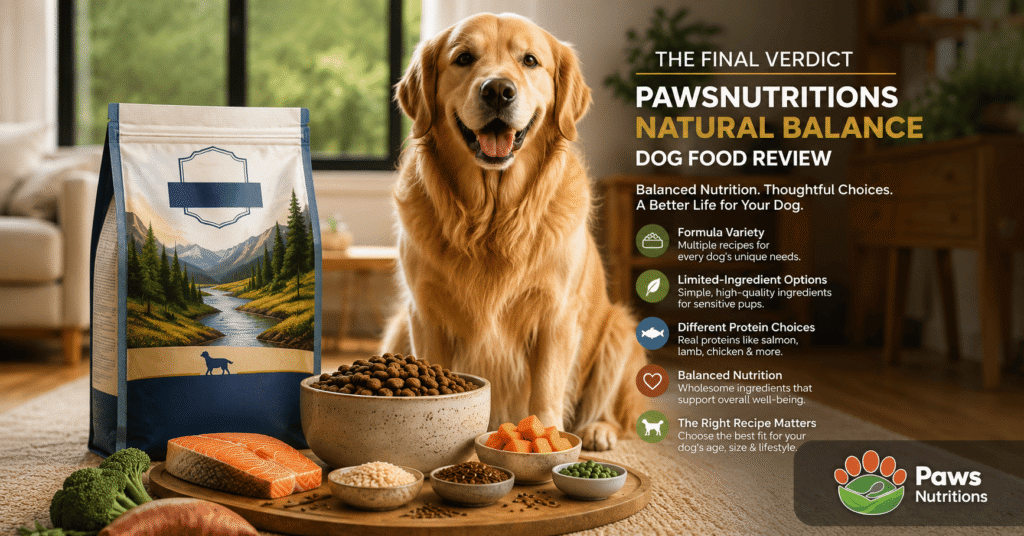
Natural Balance is worth considering, but the specific formula matters far more than the brand name. Its strongest advantage is variety: the company offers limited-ingredient recipes, multiple animal proteins, grain-inclusive and grain-free choices, small-breed options, vegetarian diets, wet food, and broader Original Ultra formulas.
For a dog with a known dietary sensitivity, the LID range can be particularly useful because it simplifies ingredient selection and provides different protein choices. For a healthy dog without food restrictions, Original Ultra or another complete-and-balanced formula may make more sense. The current Original Ultra Chicken & Barley recipe, for example, provides 24% minimum protein, 14% minimum fat, 380 kcal per cup, and an all-life-stage AAFCO statement.
The biggest caution is the gap between nutritional analysis and real-world reputation. Current customer-review platforms contain many serious complaints alongside positive experiences. Those complaints shouldn’t be treated as proof that the food caused illness, but they’re also not something a careful buyer should simply ignore.
If your dog has persistent vomiting, bloody diarrhea, unexplained weight loss, severe itching, recurrent ear infections, or another significant health problem, don’t rely on a retail food review to diagnose the cause. Your veterinarian can determine whether you’re dealing with food intolerance, allergy, infection, parasites, gastrointestinal disease, or another condition.
The Bottom Line
Best reason to consider Natural Balance: its broad selection of limited-ingredient and protein-specific formulas.
Biggest strength: formula variety and detailed nutritional information on current product pages.
Biggest weakness: individual customer experiences are highly inconsistent, and some formulas may be relatively expensive.
Best strategy: choose the exact recipe based on your dog’s life stage, dietary history, calorie needs, and health—not simply because the Natural Balance name appears on the bag.
Disclaimer: This article is for educational purposes and isn’t a substitute for veterinary advice. Product formulas, prices, availability, and safety information can change, so check the current package and manufacturer information before making a feeding decision.

A dedicated writer and digital enthusiast committed to creating high-quality, informative, and reader-focused content. Through thoughtful research and clear communication, he aims to deliver valuable insights that help readers navigate the ever-changing digital landscape.