
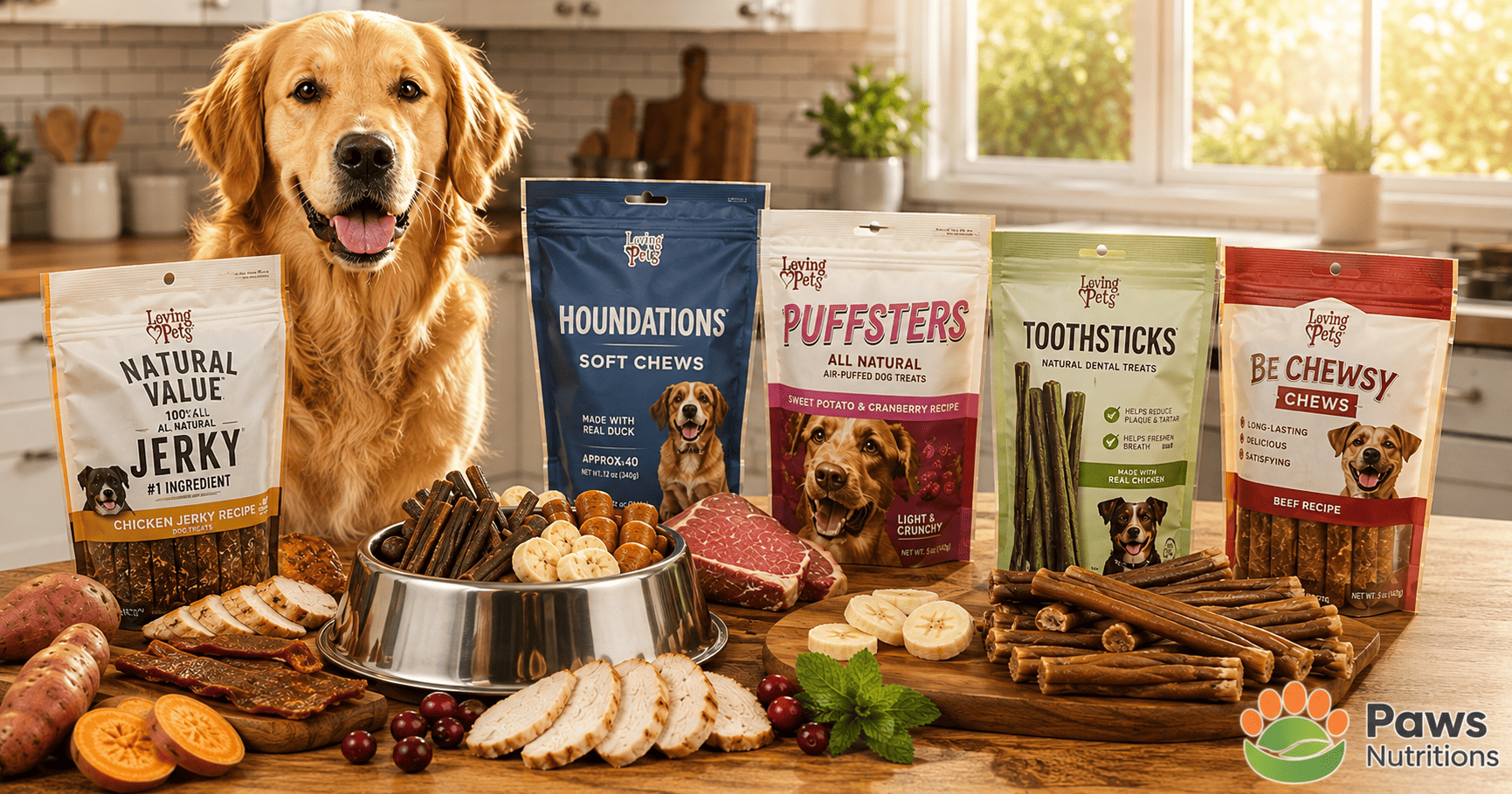
Standing in the treat aisle wondering if Loving Pets dog treats actually live up to the “natural” label on the bag? You’re not alone. With eight different product lines, a recall in the brand’s history, and pricing that swings wildly depending on where you shop, picking the right bag shouldn’t feel like guesswork.
This guide breaks down everything that actually matters: real ingredient panels, dry matter basis nutrition, the full 2017 recall timeline, and side-by-side pricing across Chewy, Walmart, and Amazon. You’ll also get a weight-based feeding guide and honest answers on where this brand falls short, so you can decide with confidence rather than crossing your fingers.
What Is Loving Pets? Brand Background You Should Know
Loving Pets Corporation started in 2005, founded by Eric Abbey and Shane Layton out of Cranbury, New Jersey. It’s a family-owned pet treat company, not a division of a larger conglomerate, which matters when you’re trying to trace recall history or ownership accountability. Unlike brands buried inside a portfolio of a dozen sibling labels, there’s no confusing web of parent-company recalls to untangle here, which simplifies your research considerably.
Where Loving Pets Treats Are Made
The company markets its treats as made in the USA, with sourcing and finishing done domestically. That’s a meaningful claim in a category where plenty of jerky-style treats are imported from overseas, sometimes from regions with historically inconsistent quality oversight. It’s worth verifying against the ingredient panel of whichever specific product you’re buying, since sourcing language can vary slightly line to line, and packaging occasionally lags behind formulation updates.
The “Tested in the USA” Quality Assurance Program
Loving Pets runs what it calls a Quality Assurance testing program, checking batches domestically before products ship. This isn’t third-party certified in the way some premium brands publish lab results publicly, but it does show the company built internal testing into its process after the 2017 recall, which we’ll cover in detail further down. For a mid-tier brand, having any documented internal QA step at all puts it ahead of plenty of competitors that disclose nothing.
Company Size and Manufacturing Scale
Loving Pets operates as a mid-sized manufacturer rather than a massive multinational pet food conglomerate. That scale cuts both ways: smaller operations generally allow tighter batch tracking and faster response to quality issues, but they also mean less budget for the kind of published third-party nutritional research that giant companies like Mars or Nestle Purina can fund. Keep that context in mind as you weigh this brand against bigger competitors later in the article.
Loving Pets Product Line Overview: 8 Treat Collections Explained
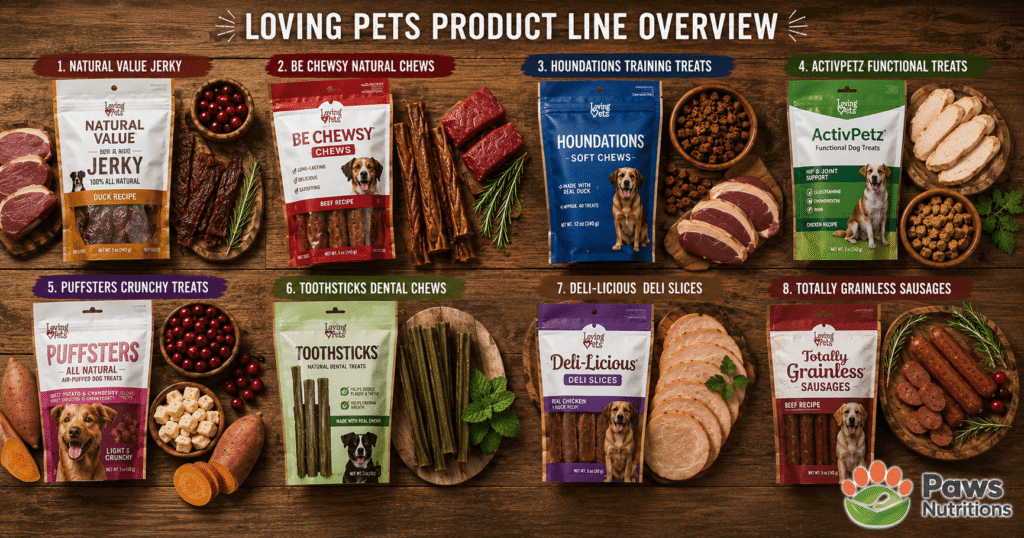
Here’s where a lot of reviews fall short: they treat Loving Pets like a single product instead of a full catalog. In reality, you’re choosing between eight distinct treat lines, each built for a different chewing style, dietary need, or life stage. Understanding this breadth upfront will save you from buying the wrong format for your dog’s specific needs.
Table 1: Loving Pets Product Line Matrix
| Line | Format | Primary Protein | Key Claim |
| Natural Value | Jerky strips | Duck, Beef, Chicken | Single-source protein, no fillers listed |
| Be Chewsy | Bully sticks, pig ears, antlers | Beef, deer | Long-lasting chews |
| Houndations | Soft training chews | Duck, Chicken, Salmon | Bite-sized, high-value training reward |
| ActivPetz | Functional jerky | Chicken | Supplement-infused (joint, skin & coat) |
| Puffsters | Crunchy puffed chips | Chicken + fruit/veg | Low-calorie snack format |
| Toothsticks | Dental chew sticks | Chicken, Mint | Dental cleaning action |
| Deli-Licious | Deli-style slices | Beef, Turkey | Human-grade deli style presentation |
| Totally Grainless | Grain-free sausages | Chicken, Duck | Grain-free formulation |
That range is actually one of the brand’s biggest strengths. If your dog is an aggressive chewer, Be Chewsy makes more sense than a soft Houndations chew, while a senior dog with dental concerns is probably better served by Toothsticks. A puppy just starting training sessions is a natural fit for the bite-sized Houndations line, since the small size keeps calorie intake in check during repetitive reward-based training.
Which Line Should You Start With?
If you’ve never tried Loving Pets before, Natural Value jerky is the safest starting point. It has the most reviews, the highest average ratings, the simplest ingredient panel, and gives you a clear read on whether your dog likes the flavor profile before you invest in the pricier specialty lines like ActivPetz or Puffsters.
Loving Pets Ingredient Analysis: What’s Actually Inside
Natural Value Jerky Ingredient Breakdown
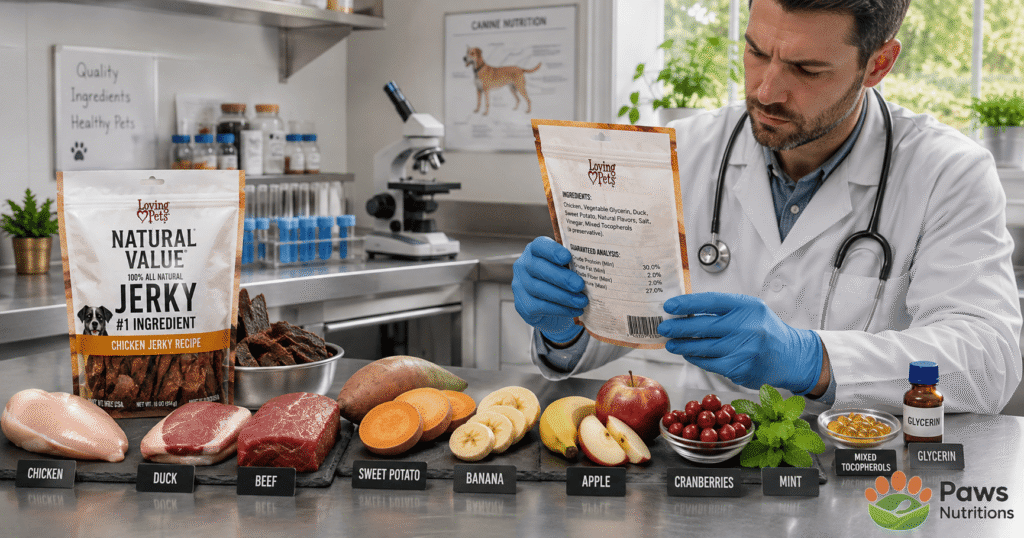
The Natural Value jerky line leads with a single named protein (duck, beef, or chicken) followed by glycerin, natural flavor, and a preservative system. That’s a fairly clean, short ingredient list compared to many mass-market jerky treats, though the glycerin inclusion is worth noting given the brand’s own marketing claims, which we fact-check in Section 6. There’s no artificial coloring listed on any Natural Value SKU, which is a genuine plus for owners avoiding dyes.
Houndations Soft Chew Ingredient Breakdown
Houndations chews use a similar named-protein-first approach but rely more heavily on humectants (glycerin, sorbitol) to keep the soft texture stable at room temperature. This is standard practice across the soft-treat category industry-wide, not unique to Loving Pets, but it does mean these aren’t a “no preservative” product in the strictest sense. The small, bite-sized format makes portion control genuinely easy during training sessions.
Puffsters Crunchy Treat Ingredient Breakdown
Puffsters lean on chicken combined with fruit or vegetable inclusions like sweet potato, banana, apple, or cranberry. The puffed format keeps calorie density lower per treat than the jerky or soft-chew lines, which makes it a reasonable pick if you’re doing frequent training reps and want to limit calorie creep. Dogs with a sweet tooth for fruit flavors tend to respond especially well to the banana and cranberry variants.
Common Additives, Preservatives & Fillers Across Lines
Across the catalog, the most common additives are glycerin (texture and moisture), natural flavor (palatability), and mixed tocopherols (a vitamin E-based preservative, generally considered gentler than synthetic options like BHA or BHT). None of the flagship lines list corn, wheat, or soy as primary fillers, which is a meaningful point in the brand’s favor for dogs with grain sensitivities. Salt content also stays relatively conservative across the board.
Grain-Free vs Grain-Inclusive Lines
Most Loving Pets treats are naturally grain-free by formulation, with Toothsticks and a few dental-focused SKUs being the exception since they sometimes include rice flour for texture and binding. If grain-free is a strict requirement for your dog, always check the specific SKU’s panel rather than assuming brand-wide consistency, since formulations can shift between production runs without a full packaging redesign.
Read the Label Before Every Purchase
This is the single most useful habit you can build as a Loving Pets shopper: don’t rely on brand-wide assumptions. A grain-free claim on one SKU doesn’t guarantee the same is true three shelves over. Manufacturers update formulations more often than most shoppers realize, so a five-second label check at the store protects you far better than memorizing which lines used to be grain-free last year.
Dry Matter Basis (DMB) Nutrition Breakdown
Guaranteed analysis numbers on the bag are calculated as-fed, meaning they include moisture content, which makes soft treats look lower in protein than they actually are on a dry basis. Converting to dry matter basis (DMB) gives you an apples-to-apples comparison across formats, and it’s the same method veterinary nutritionists use when they compare wet and dry pet foods against each other.
Table 2: DMB Nutrition Comparison (Top 5 SKUs)
| Product | As-Fed Protein | Moisture | DMB Protein | DMB Fat |
| Natural Value Duck Jerky | 32% | 20% | 40% | 11% |
| Natural Value Beef Jerky | 35% | 18% | 42.7% | 9% |
| Houndations Chicken Soft Chew | 18% | 35% | 27.7% | 10.8% |
| Toothsticks Chicken | 22% | 12% | 25% | 6.8% |
| Puffsters Sweet Potato & Chicken | 20% | 10% | 22.2% | 5.6% |
The takeaway: Natural Value jerky delivers the highest DMB protein of the lineup, making it a genuinely protein-dense treat rather than filler. Soft chews and puffed snacks run lower once you account for moisture, which is normal for their formats but worth knowing if you’re tracking your dog’s total daily protein intake, especially for active or working dogs with higher protein needs.
For context, most commercial dry dog foods run somewhere between 25% and 35% protein on a DMB basis, which means Natural Value jerky actually edges out a typical kibble on protein density. That’s a strong argument for using it as a high-value training reward rather than an everyday filler snack, since a little goes a long way nutritionally.
AAFCO & WSAVA Compliance: Are Loving Pets Treats Nutritionally Sound?
It’s worth setting expectations here: AAFCO (Association of American Feed Control Officials) does not require treats to meet full nutritional adequacy standards the way complete diets do, since treats are meant to make up a small percentage of daily intake. Loving Pets doesn’t claim complete-and-balanced status on any of its treat packaging, which is accurate and appropriate labeling that avoids a common industry pitfall.
The WSAVA (World Small Animal Veterinary Association) global nutrition guidelines focus more heavily on manufacturer transparency, such as whether a company employs a qualified nutritionist and publishes quality control data. Loving Pets doesn’t publish this level of detail publicly, which puts it roughly in line with most mid-tier treat brands rather than the small handful of premium brands that do. This isn’t disqualifying for a treat brand, but it’s a fair distinction to know before you compare it against companies that do publish that data.
What This Means for Everyday Feeding
In practice, this means you shouldn’t treat any Loving Pets product as a meal replacement, even during travel or a hectic day when a complete meal feels inconvenient. Keep treats supplementary to a properly balanced main diet, and use the feeding guide in Section 13 to stay within safe daily limits rather than letting treats creep into meal-sized portions.
Fact-Check: Does Loving Pets’ “No Preservatives” Claim Hold Up?
The Marketing Claim, Word for Word
On its site, Loving Pets contrasts its jerky against competitors, stating that soft jerky treats claiming to be natural and healthy often contain vegetable glycerin and preservatives that “you’ll never find in any Loving Pets product.” That’s a specific, checkable claim, and specific claims are exactly the kind worth verifying before you repeat them to other pet owners.
Cross-Referencing the Ingredient Panels
When you actually check the ingredient panels for the Houndations soft chew line and several Natural Value soft-format SKUs, glycerin appears directly on the label. This isn’t unusual or unsafe; nearly all soft treats need a humectant to stay pliable. But it does mean the marketing language oversells the distinction between Loving Pets and the “competitors” it’s contrasting itself against, since the exact ingredient being called out shows up in the brand’s own soft-format products.
What This Means for You
This isn’t a red flag about safety, it’s a reminder to read the actual ingredient list rather than the marketing copy on any brand’s website, Loving Pets included. Glycerin in small amounts is generally recognized as safe for dogs; it’s just not accurate to claim total absence when it’s present in specific product lines. Treat every brand’s marketing copy as a starting point for research, not the final word.
Loving Pets Dog Treats Recall History: What Really Happened
Timeline: The June 2017 Salmonella Recall
In June 2017, Loving Pets voluntarily recalled select lots of Barksters, Puffsters, and Whole Hearted products (the latter a private-label line manufactured by Loving Pets) over potential Salmonella contamination. This was a proactive, voluntary action rather than a mandated FDA seizure, which is generally viewed as the more responsible path for a manufacturer to take.
Table 3: Recall Timeline
| Date | Event |
| June 14, 2017 | Voluntary recall announced for select lots |
| June 2017 | FDA confirms recall tied to a single supplied ingredient |
| 2017-2018 | Recall investigation closed, no illnesses confirmed |
| 2018-2026 | No additional Loving Pets recalls on record |
Which Products & Lot Numbers Were Affected
The recall was limited to specific lot codes within the Barksters, Puffsters, and Whole Hearted lines, not the entire catalog. Loving Pets published the affected lot numbers directly and coordinated with retailers to pull stock, which is the standard, appropriate response protocol expected of a responsible manufacturer facing a contamination concern.
What Caused the Contamination
The company traced the issue to a single finished ingredient supplied by a third-party, USA-based vendor, not a failure in its own manufacturing process. No illnesses or injuries were reported to the company or FDA in connection with the recall, which suggests the voluntary action caught the issue before it caused real-world harm.
FDA Recall Status Today
This recall is listed as terminated and completed in FDA records, meaning the corrective action was verified and closed out. There’s no ongoing risk tied to current inventory on shelves today, and the company has since implemented the domestic QA testing program discussed in Section 1.
Has Loving Pets Had Any Recalls Since 2017?
Based on current FDA and AVMA recall databases, no additional Loving Pets recalls have occurred since 2017. That’s a nine-year clean track record following the incident, which is a genuinely reassuring signal for a brand this size, especially compared to some larger competitors with repeated recall events over the same period.
Should This Recall Concern You Today?
For a purchase decision made today, a single, resolved, nearly decade-old recall with no illnesses reported and no repeat incidents shouldn’t be a major deciding factor on its own. It’s more useful as context for how the company responded under pressure than as an active safety concern for current bags on the shelf.
Is Loving Pets Safe Today? Current Quality Control Practices
Loving Pets operates on a small-batch production model, which generally allows for tighter quality control compared to mass-scale manufacturing, since smaller runs are easier to trace and test comprehensively. Combined with the domestic testing program mentioned earlier, the company’s post-2017 safety posture looks meaningfully strengthened, and that shift appears to have paid off given the clean track record since.
Compared to the broader pet treat industry, where recalls happen with some regularity across nearly every major brand at some point, a single incident nearly a decade ago with no repeat occurrences puts Loving Pets in a reasonably strong position on safety history alone. It’s a track record worth weighing seriously against brands with more frequent or more recent recall activity.
DCM & Grain-Free Safety: Should You Be Concerned?
The FDA’s ongoing investigation into dilated cardiomyopathy (DCM) and its potential link to grain-free diets has made a lot of pet owners understandably cautious about anything labeled grain-free. It’s important to draw a clear distinction here: the DCM concern centers on complete, grain-free diets fed as a dog’s primary nutrition over months or years, not occasional treats fed in small quantities.
Treats making up a small percentage of a dog’s total daily calories, like the Totally Grainless line, carry a meaningfully different risk profile than a full grain-free kibble diet. That said, if your dog has any cardiac history, it’s worth discussing total grain-free intake, including treats, with your veterinarian rather than assuming treats are automatically exempt from the conversation entirely.
A Practical Rule of Thumb
If grain-free treats stay under that 10% daily calorie ceiling covered in Section 13, and the rest of your dog’s diet is a grain-inclusive, complete-and-balanced formula, the current body of evidence doesn’t point to meaningful DCM risk from the treats alone. The concern is almost entirely about total, long-term diet composition, not occasional snacking.
Loving Pets Dog Treats Pricing: Full Retailer Comparison
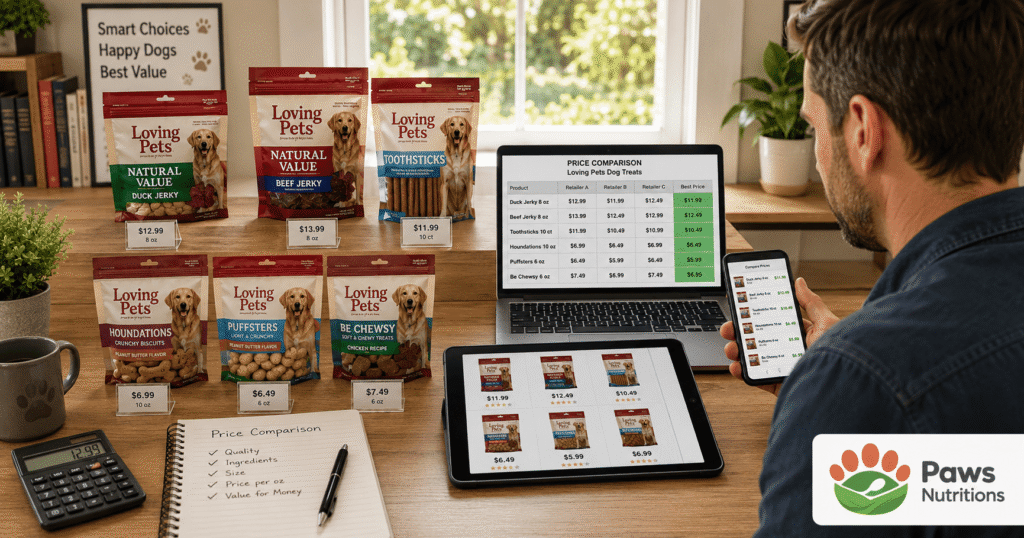
Pricing on Loving Pets dog treats varies more than you’d expect depending on retailer, package size, and ongoing promotions. Here’s what live pricing looked like across the three major retail channels at the time of writing, so you can compare real numbers instead of guessing.
Table 4: Per-Retailer Price Comparison
| Product | Chewy Price/oz | Walmart Price/oz | Amazon |
| Natural Value Duck Jerky (13oz) | $0.61 | Similar range | Verify live pricing |
| Natural Value Beef Jerky (14oz) | $0.86 | Similar range | Verify live pricing |
| Toothsticks Large Chicken (13oz) | $0.70 | Not confirmed | Verify live pricing |
| Be Chewsy Bully Stick (20ct) | $0.77/ea | Comparable multipack about $1.03/ea | Verify live pricing |
| Houndations Chicken Soft Chew (4oz) | $1.00 | Not confirmed | Verify live pricing |
| Puffsters Banana & Chicken (4oz) | $1.30 | Not confirmed | Verify live pricing |
A quick note on that last column: Amazon pricing shifts daily, sometimes multiple times a day, so treat any Amazon figure as a snapshot rather than a fixed number. Always double check the current listing before you buy, especially around Subscribe & Save discounts, which can meaningfully change the effective per-ounce cost by 5% to 15%.
Manufacturer Direct Pricing
Buying directly from lovingpetsproducts.com puts most SKUs in the $1.49 to $18.49 range depending on size and line, generally comparable to Chewy pricing without the benefit of Chewy’s autoship discount or free shipping thresholds. Unless you need a specific line the retailers don’t stock, buying direct rarely saves you money.
Best Value Picks vs Premium Picks
Most Affordable Loving Pets Treats Per Ounce
Toothsticks Small Chicken and the Be Chewsy Pig Ear 4-count bag both land under $0.50 per ounce, making them the best entry point if you’re testing the brand or feeding a household with multiple dogs. These are also solid picks if you’re budgeting tightly but still want a USA-made treat option.
Priciest Options and Whether They’re Worth It
Puffsters SKUs run highest per ounce, in the $1.11 to $1.49 range, largely because the puffed format is lighter by weight. If your dog goes through treats quickly, the cost-per-treat (rather than cost-per-ounce) usually tells a more useful story than raw per-ounce pricing, and Puffsters actually holds up reasonably well by that measure since each piece is small.
Cost Per Treat vs Cost Per Ounce
Per-ounce pricing is the right lens for comparing jerky bags against each other, but for bite-sized formats like Houndations or Puffsters, calculating cost per individual piece gives you a more accurate training-budget number. A $5 bag with 60 small pieces works out to roughly 8 cents per reward, which is genuinely affordable for daily training use.
Customer Reviews & Ratings: What Real Owners Say
Table 5: Rating Comparison Across Top SKUs
| Product | Rating | Review Count |
| Natural Value Duck Jerky (13oz) | 4.6 stars | 294 |
| Houndations Chicken Soft Chew | 4.7 stars | 66 |
| Toothsticks Small Chicken | 4.6 stars | 8 |
| Be Chewsy Pig Ear (13.75oz) | 3.8 stars | 198 |
| Puffsters Apple & Chicken | 3.9 stars | 15 |
Common Praise Themes
Reviewers consistently mention that dogs find the jerky and soft chew lines highly palatable, even picky eaters, and appreciate the shorter ingredient lists compared to bulk grocery-store treats. Several long-time buyers note they’ve stuck with Natural Value jerky for years without issue, which speaks to consistent formulation over time.
Common Complaint Themes
The Be Chewsy Pig Ear sits noticeably lower at 3.8 stars across nearly 200 reviews, with recurring complaints about strong odor and inconsistent thickness between individual pieces. This is a fair, useful data point worth factoring in if odor sensitivity is a concern in your home, particularly if you keep treats indoors.
What This Means for Your Buying Decision
Weight review counts alongside star ratings, not just the star number alone. A 4.6-star rating on 294 reviews (Natural Value Duck Jerky) is far more statistically reliable than a 4.6-star rating on 8 reviews (Toothsticks Small), even though the numbers look identical on the surface.
Weight-Based Feeding Guide for Loving Pets Treats
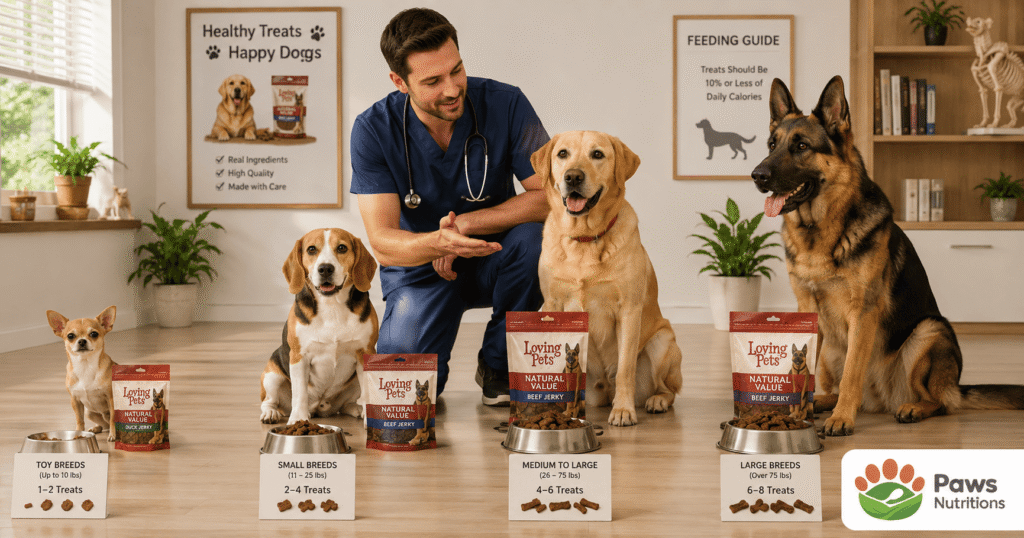
A general rule in veterinary nutrition is the 10% rule: treats should make up no more than 10% of your dog’s total daily calorie intake, with the remaining 90% coming from a complete, balanced diet. This keeps treats from displacing the nutrients your dog actually needs from a full meal.
Table 6: Feeding Guide by Weight
| Dog Weight | Daily Treat Calorie Budget | Approx. Jerky Pieces/Day |
| Under 10 lbs | About 30-40 kcal | 1-2 small pieces |
| 10-25 lbs | About 50-90 kcal | 2-3 pieces |
| 25-50 lbs | About 100-160 kcal | 3-5 pieces |
| 50-90 lbs | About 180-280 kcal | 5-7 pieces |
For puppies, stick to the lower end of the range and favor softer textures like Houndations over harder jerky until adult teeth are fully in. For senior dogs, Toothsticks and softer chews are generally easier on aging teeth and gums than the tougher Be Chewsy line, and smaller, more frequent treats tend to sit better with slower digestion.
If you’re doing heavy training sessions with a lot of repetition, break jerky pieces into smaller pinches rather than handing over a full-sized piece each time. This stretches the calorie budget across more rewards and keeps you well within the 10% guideline even during an intensive training day.
Loving Pets vs Competitor Brands: How It Stacks Up
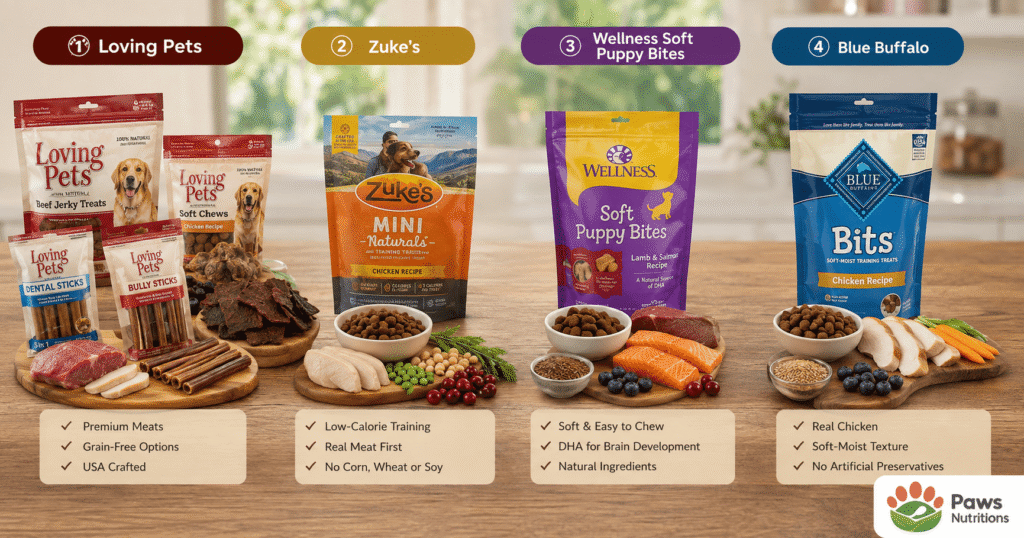
Table 7: Competitor Comparison
| Brand | Avg Price/oz | Recall History | AAFCO Stance | Avg Rating |
| Loving Pets | $0.61-$1.49 | 1 recall (2017, resolved) | Treat-only, no complete claim | 4.3 stars |
| Zuke’s | $0.90-$1.60 | Multiple historical recalls | Treat-only, no complete claim | 4.5 stars |
| Wellness Soft Puppy Bites | $0.70-$1.10 | No major recalls on record | Treat-only, no complete claim | 4.6 stars |
| Blue Buffalo Treats | $0.75-$1.40 | Multiple historical recalls | Treat-only, no complete claim | 4.4 stars |
Loving Pets vs Zuke’s
Zuke’s tends to run slightly more expensive per ounce with a comparable safety track record. Which treat is better? If low odor and a spotless recent recall record matter most, Loving Pets edges ahead; if you want smaller, lower-calorie training bites, Zuke’s Mini Naturals may fit better for high-frequency reward training.
Loving Pets vs Wellness Soft Puppy Bites
Wellness carries a slightly cleaner public recall record and marginally higher average ratings. Which treat is better? Wellness has a slight edge for puppy-specific soft training use, while Loving Pets wins on catalog variety and USA manufacturing consistency across a broader age range of dogs.
Loving Pets vs Blue Buffalo Treats
Blue Buffalo has a more complicated recall history over the years, spanning multiple product categories. Which treat is better? On safety history alone, Loving Pets currently looks like the stronger choice, though Blue Buffalo offers broader retail availability in physical big-box stores if convenience matters more to you than the safety-history gap.
Overall Competitive Position
Loving Pets sits comfortably in the mid-tier pricing bracket, undercutting Zuke’s on cost while holding a cleaner recent recall record than Blue Buffalo. It won’t out-rate Wellness on pure star averages, but the sheer breadth of its eight-line catalog is something none of these three competitors currently match.
Pros and Cons of Loving Pets Dog Treats
What Loving Pets Does Well
- USA-based manufacturing and testing across the core catalog
- Short, named-protein-first ingredient lists on most lines
- Wide format variety, from jerky to dental chews to bully sticks
- Nine-year clean recall record since the single 2017 incident
- Competitive pricing at the lower end of the catalog
- No artificial coloring listed across any current SKU
Where Loving Pets Falls Short
Marketing language occasionally overstates ingredient purity, as shown in the glycerin claim fact-check above. Pricing on premium lines like Puffsters runs higher per ounce than some competitors, and the brand does not publish the level of third-party nutritional transparency that top-tier premium brands do, which matters more to owners who want published lab data.
The Be Chewsy Pig Ear line’s below-average rating and recurring odor complaints are also worth weighing honestly, especially if you keep treats stored indoors or have a household member sensitive to strong smells.
Who Should (and Shouldn’t) Buy Loving Pets Dog Treats
Loving Pets dog treats make the most sense for budget-conscious owners who still want USA-made products with reasonably short ingredient lists and a strong recent safety record, especially if you’re feeding multiple dogs and need variety across chew styles without shopping five different brands.
Consider alternatives if your dog has a confirmed poultry or glycerin sensitivity, since most lines lean on chicken or duck as the primary protein and include glycerin in soft-format products. In that case, a limited-ingredient, single-protein brand may be a safer starting point until you’ve ruled out a reaction.
Great Fit For
- Owners feeding multiple dogs who want catalog variety in one brand
- Households prioritizing USA-made treats without a premium price tag
- Dogs with grain sensitivities but no confirmed poultry allergy
- Anyone who wants a treat brand with a proven recent safety record
Better to Skip If
- Your dog has a diagnosed chicken, duck, or glycerin allergy
- You require third-party published lab transparency before buying
- Strong odor from harder chews is a dealbreaker in your household
How to Choose the Right Loving Pets Line for Your Dog
By Life Stage
Puppies do best with softer Houndations chews; adult dogs can handle the full range including Be Chewsy; senior dogs generally fare better with Toothsticks or soft chews over harder jerky that could stress aging teeth or sensitive gums.
By Dietary Need
For grain-free requirements, stick to Natural Value, Houndations, or Totally Grainless and double-check the specific SKU. For lower-calorie training needs, Puffsters offers the smallest calorie footprint per treat, which helps during longer training sessions.
By Chewing Style
Aggressive chewers do best with Be Chewsy bully sticks or antlers, which last longer under heavy pressure. Gentle or senior chewers should stick with soft chews or dental sticks to avoid unnecessary tooth wear or choking risk from harder formats.
Quick Decision Summary
When in doubt, default to Natural Value for general everyday treating, Houndations for training, and Be Chewsy for supervised long-lasting chew time. That three-line combination covers the vast majority of everyday use cases without needing to explore the full eight-line catalog right away.
Ingredient Glossary: Key Terms Explained
A few recurring ingredient terms show up across the Loving Pets catalog that aren’t always self-explanatory. Here’s a quick reference so you can read any panel with confidence instead of guessing what a term means mid-purchase.
Table 8: Ingredient Glossary
| Term | What It Does | Should You Worry? |
| Glycerin | Keeps soft treats moist and pliable | Generally safe in small amounts; avoid if sensitive |
| Mixed Tocopherols | Natural vitamin E-based preservative | Considered gentler than synthetic preservatives |
| Natural Flavor | Improves palatability without artificial additives | Not a red flag on its own |
| Sorbitol | Secondary humectant for texture control | Safe in small doses; avoid excess in sensitive dogs |
| Rice Flour | Binding agent in some dental chews | Only relevant if avoiding grain entirely |
None of these terms are inherently dangerous, and all are commonly recognized as safe for dogs in the quantities used in commercial treats. Understanding them just helps you make an informed choice rather than reacting to unfamiliar words on a label out of uncertainty.
How to Store Loving Pets Treats for Maximum Freshness
Jerky and Soft Chew Storage
Once opened, Natural Value jerky and Houndations soft chews stay freshest in an airtight container kept in a cool, dry pantry, away from direct sunlight or stovetop heat. Refrigeration isn’t required for shelf-stable jerky, but it can extend freshness noticeably during hot, humid summer months when kitchens run warmer than usual.
Bully Sticks, Antlers, and Pig Ears
Be Chewsy’s harder chews hold up well at room temperature for months if kept dry, but odor can intensify in humid climates. A sealed container with a small amount of airflow, or storing in the freezer for longer-term stock, helps control the smell that reviewers frequently mention as a downside.
Watch the Best-By Date
Like most treats without heavy synthetic preservatives, Loving Pets products rely on mixed tocopherols, which offer shorter shelf stability than artificial preservatives like BHA. Always check the printed best-by date before buying in bulk, especially for lower-turnover SKUs you might find at a smaller local retailer.
Real Pet Owner Scenarios: Matching Treats to Everyday Situations
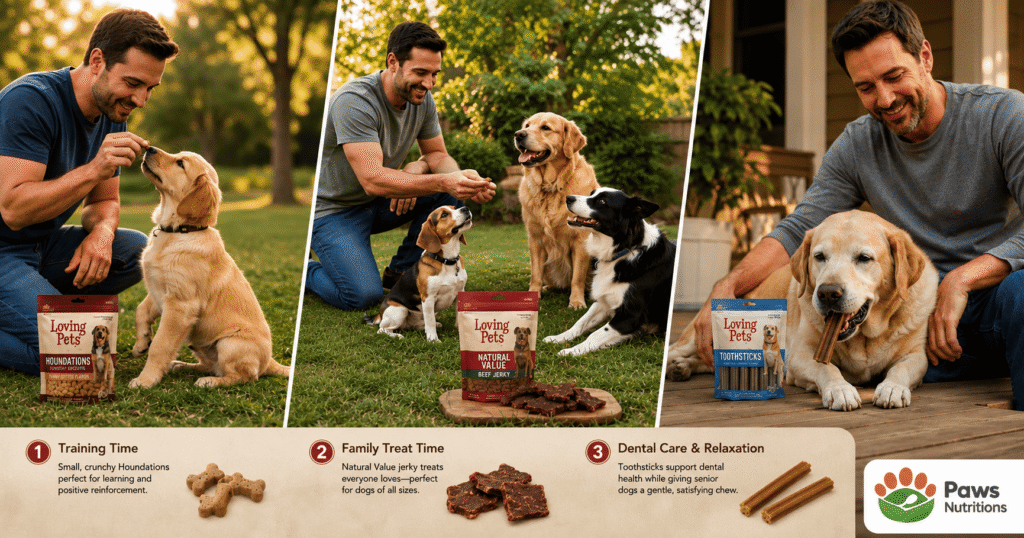
The New Puppy Owner
Say you’ve just brought home an eight-week-old puppy and you’re starting basic potty training. Houndations soft chews, torn into pea-sized pieces, give you dozens of quick, low-calorie rewards per session without overwhelming a tiny stomach, and the soft texture is gentle on baby teeth still coming in.
The Multi-Dog Household on a Budget
If you’re feeding three dogs of different sizes and ages, buying the larger Natural Value jerky bags in bulk from Chewy and portioning them by weight, using the feeding guide in Section 13, keeps costs down while still giving every dog an appropriately sized reward without needing three different product lines.
The Senior Dog With Dental Sensitivity
An older dog with worn teeth or mild gum recession does better with Toothsticks or a soft Houndations chew than a tough bully stick, which can put unnecessary strain on compromised teeth. The dental-focused format also offers a small hygiene benefit during daily chew time.
Common Mistakes to Avoid When Buying Loving Pets Dog Treats
Assuming Every SKU Shares the Same Ingredient Profile
The biggest mistake shoppers make is generalizing across the whole brand from a single product they’ve tried. As covered throughout this review, grain content, protein source, and humectant use all vary by line, so a good experience with Natural Value doesn’t guarantee the same profile in Puffsters or Toothsticks.
Overfeeding Based on Bag Size Alone
It’s easy to let a large bag of jerky translate into oversized daily portions simply because there’s plenty on hand. Stick to the weight-based feeding guide in Section 13 regardless of how much product is left in the bag, since overfeeding treats is one of the most common contributors to unwanted weight gain in dogs.
Ignoring the Recall Timeline Context
Some shoppers either dismiss the 2017 recall entirely or treat it as an active, ongoing concern, and both extremes miss the point. The useful takeaway is contextual: a single, resolved, nearly decade-old incident with no repeat occurrences and no reported illnesses, evaluated alongside the company’s improved QA program.
Frequently Asked Questions
Q: Is Loving Pets a good dog treat brand?
A: Yes, it’s a solid mid-tier brand with USA manufacturing, short ingredient lists, and a strong safety record since 2017.
Q: Are Loving Pets treats made in the USA?
A: Yes, the company manufactures and tests its treats domestically as part of its quality assurance program.
Q: Did Loving Pets have a recall?
A: Yes, one voluntary recall occurred in June 2017 over potential Salmonella; it’s since been resolved with no repeat incidents.
Q: What is Be Chewsy made of?
A: Be Chewsy includes bully sticks, pig ears, and antlers made from single-ingredient animal parts like beef and deer.
Q: Are Loving Pets treats grain-free?
A: Most lines are naturally grain-free, though a few dental SKUs like Toothsticks may include rice flour, so check the label.
Q: Where can I buy Loving Pets treats cheapest?
A: Chewy generally offers the most competitive per-ounce pricing, especially with autoship discounts applied.
Final Verdict: Is Loving Pets Worth Buying?
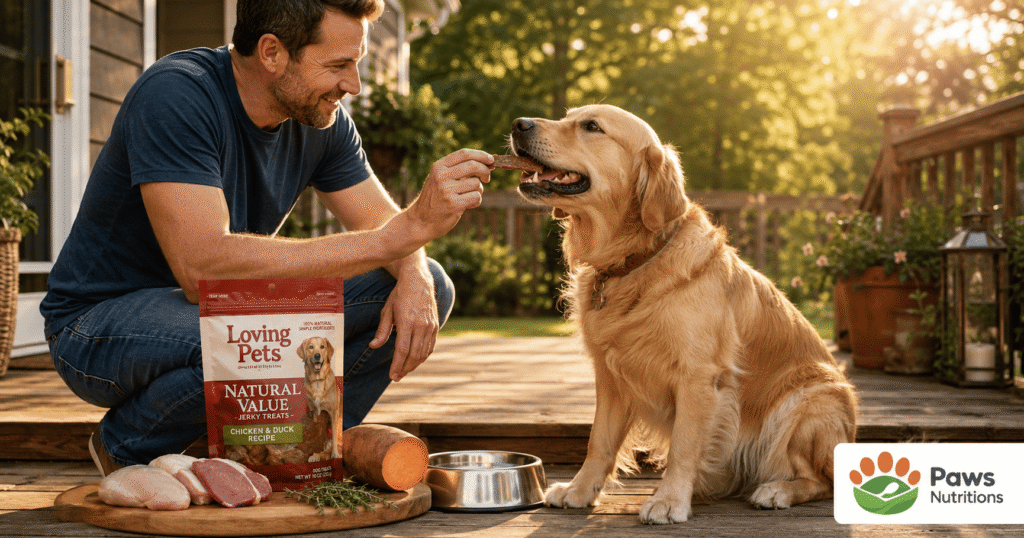
After digging through ingredient panels, recall records, and real pricing across three major retailers, Loving Pets dog treats hold up reasonably well as a mid-tier, USA-made option with a genuinely clean safety record over the past nine years. The catalog variety is a real strength if you have multiple dogs with different chewing needs, ages, or dietary restrictions to juggle.
Just go in with realistic expectations about the marketing language, particularly around the “no preservatives” claim, and always check the specific SKU’s ingredient panel rather than relying on brand-wide statements. For the price, this remains a reasonable, low-risk pick for most healthy adult dogs.
- Clean recall record for nine years running since the single 2017 incident
- Natural Value jerky is the strongest starting point for new buyers
- Verify glycerin content yourself rather than trusting marketing claims at face value
- Chewy offers the most consistently competitive per-ounce pricing
- Best suited to budget-conscious owners without confirmed poultry sensitivities
Disclaimer:This article is not sponsored, affiliated with, or a paid advertisement for Loving Pets or any brand mentioned above. It is written strictly for educational and informational purposes. Any brand names, product links, or comparisons referenced are included solely for the reader’s benefit, and PawsNutritions has no business relationship with these companies.

A dedicated writer and digital enthusiast committed to creating high-quality, informative, and reader-focused content. Through thoughtful research and clear communication, he aims to deliver valuable insights that help readers navigate the ever-changing digital landscape.