
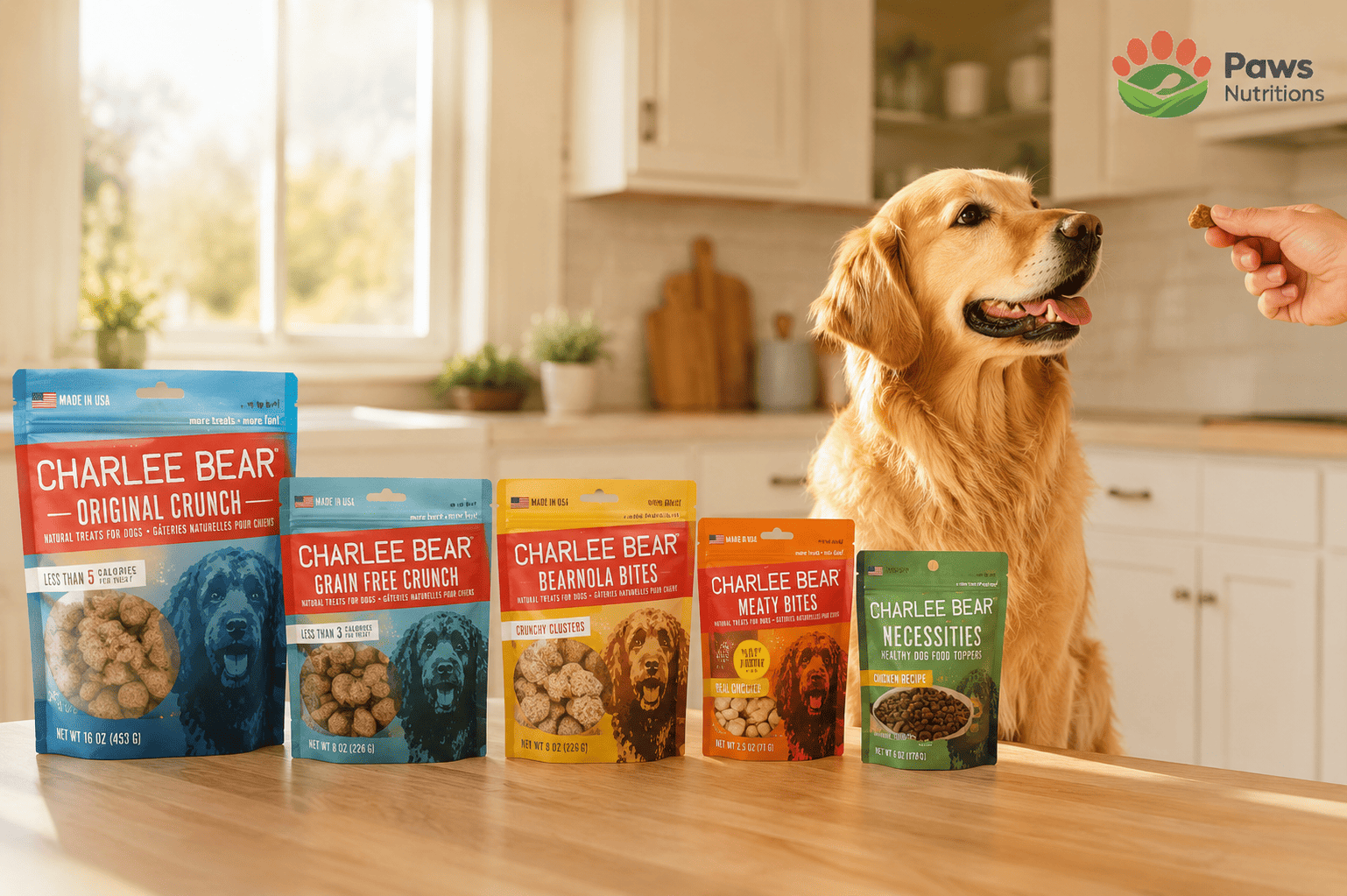
Finding a dog treat that’s low in calories, made with quality ingredients, and worth the price isn’t always easy. Charlee Bear Dog Treats are popular among pet parents and trainers, but questions about their ingredients, safety, nutrition, and overall value still leave many owners searching for reliable answers. If you’re wondering whether these bite-sized treats deserve a place in your dog’s routine, you’re in the right place.
This guide brings everything together in one place, from ingredient quality and nutritional analysis to recall history, pricing, and product comparisons. You’ll also discover how these treats measure up against AAFCO and WSAVA guidance, whether grain-free recipes raise any concerns, and which Charlee Bear products offer the best value for your budget. By the end, you’ll have the knowledge to choose confidently for your dog’s needs.
What Is Charlee Bear? Brand & Company Background
Charlee Bear has earned a loyal following by focusing on one simple idea: creating small, low-calorie treats that make everyday training easier. Unlike many oversized biscuits that quickly add unnecessary calories, these crunchy rewards are designed to let you reinforce good behavior repeatedly without feeling like you’re overindulging your dog. That practical approach has made the brand a familiar name among pet owners, obedience trainers, and agility enthusiasts alike.
Today, the brand offers far more than its original training treats. Alongside its classic recipes, Charlee Bear now includes grain-free dog treats, freeze-dried treats, crunchy snack varieties, and food toppers that cater to different feeding styles. This wider selection allows owners to choose products based on their dog’s dietary preferences, activity level, and training goals rather than relying on a one-size-fits-all option.
Who Makes Charlee Bear? (Gott Pet Products, LLC)
Charlee Bear is owned by Gott Pet Products, LLC, a Wisconsin-based company focused on premium pet nutrition and treats. In 2018, the company transitioned from the Charlee Bear Products name to Gott Pet Products, bringing several pet brands together under one organization while maintaining the familiar Charlee Bear branding that customers already trusted.
Although the company has expanded over the years, its philosophy has remained consistent: produce practical, rewarding treats that fit naturally into everyday training. Rather than marketing treats as meal replacements, the brand positions them as low-calorie rewards intended to complement a balanced diet and encourage positive behavior through frequent reinforcement.
Brand History and Company Evolution
Charlee Bear began with a straightforward mission—make training treats that dogs enjoy without forcing owners to worry about excessive calories. At a time when many rewards were large and calorie-dense, the company introduced compact crunchy treats that could easily fit into a pocket during walks, puppy classes, or obedience sessions.
Over the years, the product lineup expanded to meet changing consumer preferences. New grain-free recipes, freeze-dried meat treats, and premium snack options were introduced alongside the original crunchy formulas. This evolution allowed the brand to appeal to both everyday pet owners looking for affordable rewards and dog enthusiasts seeking higher-value treats for advanced training.
Where Are Charlee Bear Treats Manufactured?
One feature frequently highlighted by the company is that Charlee Bear treats are made in the USA. Domestic manufacturing appeals to many pet owners because it often provides greater confidence in production oversight, ingredient handling, and quality assurance compared with products sourced from multiple international facilities.
In addition to U.S. manufacturing, the company emphasizes routine quality control throughout production. Ingredients are selected according to recipe requirements, finished products undergo standard manufacturing checks, and recipes are preserved using approved food-safe preservation methods where applicable. While no manufacturer is immune to quality concerns, transparent production information helps owners make more informed purchasing decisions.
Product Line Overview
Instead of offering a single treat for every dog, Charlee Bear has developed several product families designed for different situations. Some prioritize affordability and everyday training, while others focus on premium ingredients or higher-value rewards for demanding training sessions.
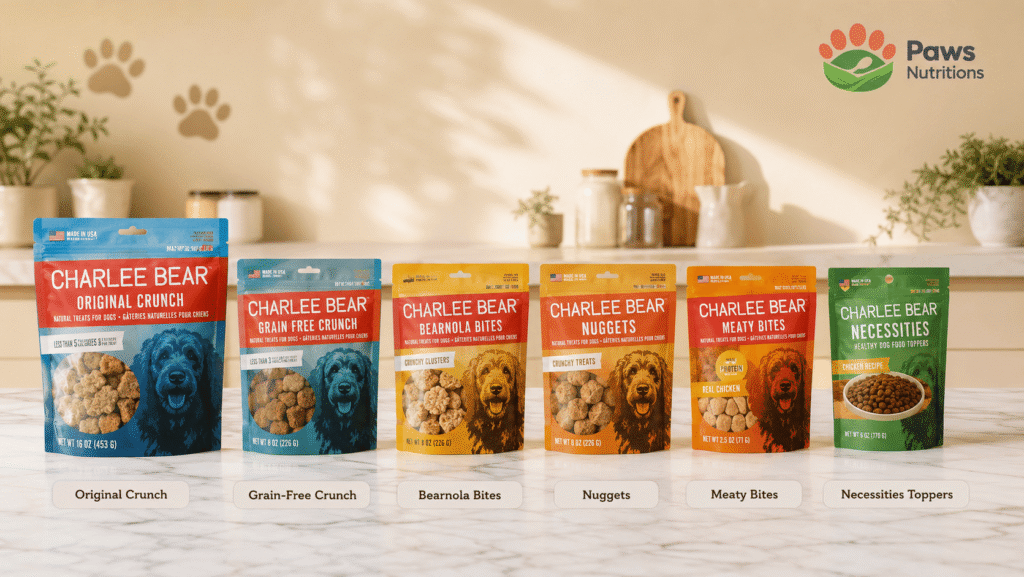
The current lineup includes:
- Original Crunch – Classic crunchy training treats available in multiple flavors.
- Grain-Free Crunch – Crunchy recipes formulated without grains.
- Bearnola Bites – Granola-inspired crunchy treats with added variety.
- Nuggets – Soft, bite-sized rewards suitable for training.
- Meaty Bites – Premium freeze-dried dog treats made with meat-forward recipes.
- Necessities Toppers – Freeze-dried meal toppers designed to enhance regular meals.
Each collection serves a different purpose, giving owners flexibility based on their dog’s preferences, calorie goals, and training intensity.
Quick Comparison of Every Charlee Bear Product Line
| Product Line | Texture | Grain-Free | Primary Protein Source | Typical Calories | Best For | Common Bag Sizes | General Price Range |
|---|---|---|---|---|---|---|---|
| Original Crunch | Crunchy | No | Poultry-based recipes | Around 3 kcal per treat | Daily training | 16 oz | Budget-friendly |
| Grain-Free Crunch | Crunchy | Yes | Turkey and other meat recipes | Around 2–3 kcal per treat | Grain-sensitive households | 8 oz | Mid-range |
| Bearnola Bites | Crunchy | Recipe dependent | Mixed protein sources | Moderate | Everyday rewards | 8 oz | Mid-range |
| Nuggets | Soft | Recipe dependent | Meat-focused | Higher than Original Crunch | High-value training | 6 oz | Premium |
| Meaty Bites | Freeze-dried | Yes | Meat-first recipes | Higher calorie density | Special rewards | 2.25 oz | Premium |
| Necessities Toppers | Freeze-dried | Yes | Meat-based ingredients | Used as meal enhancement | Meal toppers | Small bags | Premium |
Looking across the entire lineup, one trend becomes clear: Charlee Bear offers products for nearly every training style and budget. The classic Original Crunch treats provide the best everyday value, while the freeze-dried collections target owners who want more concentrated meat content and higher-value rewards. Understanding these differences early makes it much easier to choose the right product before diving deeper into ingredients, nutrition, and pricing in the sections ahead.
Charlee Bear Ingredient Breakdown by Product Line
Ingredients tell you far more about a dog treat than the marketing on the front of the bag ever will. While attractive phrases like “natural dog treats,” “low-calorie training treats,” or “grain-free” can catch your attention, the ingredient panel reveals what your dog is actually eating. Looking closely at protein sources, carbohydrates, preservatives, and functional ingredients helps you judge whether a treat offers genuine nutritional value or simply fills space with inexpensive fillers.
Charlee Bear offers several product lines with noticeably different recipes. Some are designed to be economical everyday training treats, while others emphasize premium meat ingredients or freeze-dried nutrition. Understanding these differences makes it easier to choose the right option for your dog’s age, activity level, dietary needs, and training routine.
Original Crunch Ingredients
The Original Crunch line is the brand’s classic training treat and remains its most widely recognized product. These recipes typically combine grains with animal proteins to create a crunchy, pocket-friendly reward that’s inexpensive enough for frequent training sessions.
Depending on the flavor, you’ll commonly find ingredients such as:
- Chicken liver
- Turkey liver
- Egg products
- Wheat flour
- Rice flour
- Oat flour
- Natural flavors
- Mixed tocopherols (natural preservative)
Unlike many premium meat treats, the Original Crunch recipes aren’t built around a high meat inclusion. Instead, they’re formulated to deliver a lightweight, crunchy texture while keeping calories low. For most healthy adult dogs, this balance works well because treats should complement—not replace—a complete and balanced diet.
Another advantage is consistency. The recipes avoid excessive artificial coloring or unnecessary decorative ingredients, keeping the formulations relatively straightforward for an everyday training reward.
Grain-Free Crunch Ingredients
The Grain-Free Crunch collection takes a different nutritional approach by removing traditional cereal grains altogether. Instead, these recipes rely on legumes and starches to provide structure while incorporating named animal proteins.
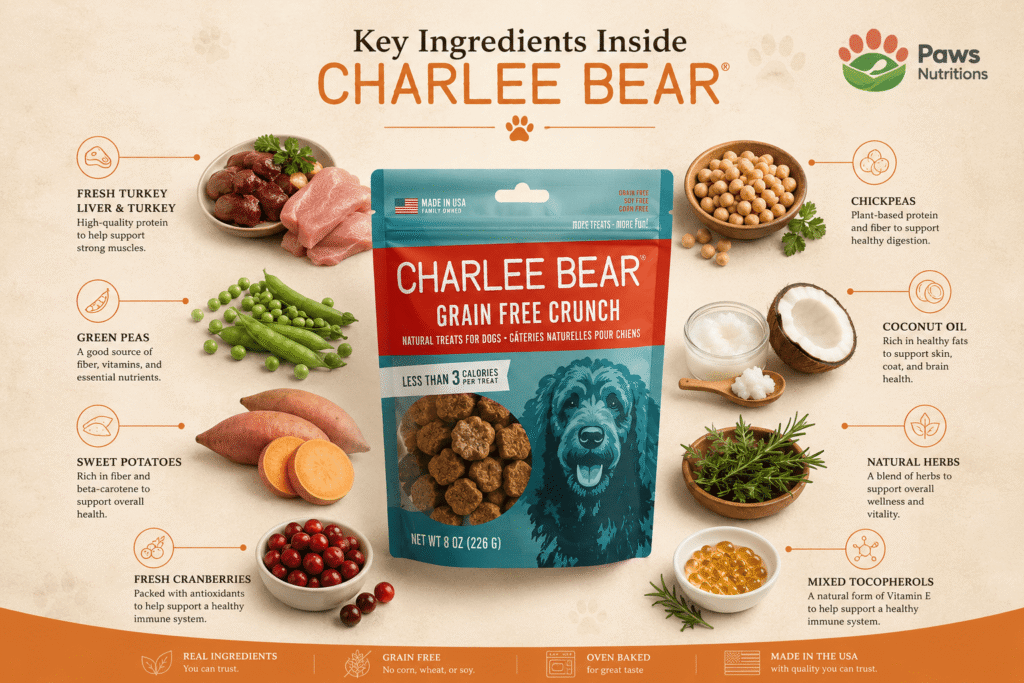
A representative Grain-Free Crunch recipe includes ingredients such as:
- Peas
- Chickpeas
- Turkey liver
- Turkey
- Potato
- Pea starch
- Dried egg product
- Sweet potato
- Cranberries
- Coconut oil
- Natural flavor
- Tapioca
- Cinnamon
- Mixed tocopherols
One thing immediately stands out: peas and chickpeas appear before the primary meat ingredients. This doesn’t necessarily make the recipe poor quality, but it does mean plant ingredients contribute a significant portion of the product’s overall composition. That’s an important distinction, especially for owners who prefer treats with a stronger emphasis on animal-based nutrition.
These recipes also include nutrient-rich additions such as cranberries, sweet potatoes, and coconut oil, which provide variety and help differentiate the Grain-Free line from the classic crunchy formulas.
Bearnola Bites Ingredients
Bearnola Bites were developed for owners looking for a slightly different texture and flavor profile while still maintaining the convenience of a training treat. The recipes combine grains, proteins, and fruit or vegetable ingredients to create a crunchy snack with broader ingredient diversity.
Although flavors vary, you’ll typically see a combination of:
- Animal protein sources
- Whole grains
- Oats
- Fruits
- Vegetables
- Natural flavors
- Preservatives approved for pet food use
Compared with Original Crunch, Bearnola Bites often feature a more varied ingredient list. They’re intended less as an ultra-low-calorie training reward and more as an everyday snack that still fits into a balanced feeding routine.
Meaty Bites Freeze-Dried Ingredients
The Meaty Bites collection moves in a completely different direction. Rather than emphasizing crunchy, low-calorie treats, these products focus on freeze-dried meat as the primary ingredient.
Most recipes contain:
- Named meat or poultry
- Organ meats
- Natural meat juices
- Minimal additional ingredients
Because the freeze-drying process removes moisture without using high cooking temperatures, many pet owners appreciate these treats for retaining much of their original flavor and aroma. That’s one reason they’re commonly used as high-value dog training treats when stronger motivation is needed.
The trade-off is cost. Freeze-dried products contain more concentrated nutrition and generally cost significantly more per pound than traditional crunchy treats.
Necessities Toppers Ingredients
Unlike the other Charlee Bear products, Necessities Toppers aren’t intended to be standalone treats. Instead, they’re designed to enhance your dog’s regular meals by adding flavor, aroma, and extra protein.
Most topper recipes emphasize:
- Meat-first ingredients
- Freeze-dried animal proteins
- Limited supporting ingredients
- Natural preservation methods
These products can be sprinkled over kibble or mixed into meals to encourage picky eaters. While they’re nutritionally richer than many training treats, they should still be used alongside a complete and balanced diet rather than replacing it.
Ingredients to Watch: Peas, Chickpeas & Legume-Forward Formulation
One of the most discussed aspects of the Grain-Free Crunch recipes is the prominent use of peas and chickpeas. These ingredients provide carbohydrates, fiber, and plant protein while helping create the crunchy texture expected from baked treats.
However, ingredient order matters. Because peas and chickpeas appear before turkey in representative Grain-Free recipes, they contribute more to the formulation than many owners might assume after seeing the package front. This doesn’t automatically indicate poor quality, but it does mean the treats are not primarily meat-based.
It’s also worth noting that peas and chickpeas became widely discussed during the FDA’s investigation into dilated cardiomyopathy (DCM) and grain-free diets. Current evidence has focused mainly on complete dog foods rather than treats, but it’s still useful to understand where these ingredients appear in the recipe. If your dog already eats a legume-heavy grain-free diet, choosing grain-inclusive treats may help diversify overall ingredient intake.
Natural flavors also deserve a brief mention. They’re common across the pet food industry and generally improve palatability, but manufacturers rarely disclose their exact composition. For most healthy dogs this isn’t a concern, though owners of pets with highly specific food sensitivities may prefer recipes with simpler ingredient lists.
Ingredient Quality Assessment
Overall, Charlee Bear uses ingredient strategies that vary considerably across its product families. The Original Crunch line prioritizes affordability and low calories, while the premium collections focus more heavily on animal proteins and specialized nutrition.
Here’s an overall assessment of ingredient quality across the brand:
| Category | Evaluation | Comments |
|---|---|---|
| Animal Protein Quality | Good | Named meat and liver ingredients appear throughout the product range, especially in premium lines. |
| Carbohydrate Sources | Moderate | Original Crunch relies on grains, while Grain-Free Crunch uses peas, chickpeas, and potatoes. |
| Plant Protein Contribution | Moderate to High | Grain-Free recipes obtain a noticeable portion of nutrition from legumes. |
| Artificial Colors | Excellent | No significant use of artificial coloring across the core product lines. |
| Preservatives | Good | Primarily preserved with mixed tocopherols, a commonly used natural preservative. |
| Ingredient Transparency | Very Good | Manufacturer provides complete ingredient panels and guaranteed analysis for individual products. |
| Overall Ingredient Quality | 8.5/10 | Solid everyday ingredients with stronger quality found in the freeze-dried premium lines. |
From a practical perspective, ingredient quality should always be evaluated alongside purpose. A lightweight training treat doesn’t need to mirror the nutrition of a complete meal because it’s intended to make up only a small portion of your dog’s daily calorie intake. Charlee Bear generally succeeds at balancing affordability, convenience, and ingredient transparency, although owners seeking meat-first recipes will likely find the Meaty Bites and Necessities Toppers more appealing than the grain-free crunchy options.
Charlee Bear Nutrition Facts
Nutrition labels can look intimidating at first, but they’re one of the best tools for evaluating any dog treat. While ingredients tell you what is inside the bag, the Guaranteed Analysis shows the minimum and maximum levels of key nutrients like protein, fat, fiber, and moisture. Looking at these values alongside calories gives you a much clearer picture of how each product fits into your dog’s overall diet.
It’s also important to remember that dog treats aren’t intended to provide complete nutrition. Instead, they’re designed to reward good behavior without contributing too many extra calories. That’s why comparing both the Guaranteed Analysis and the Dry Matter Basis (DMB) can reveal differences that aren’t obvious from the package alone.
Guaranteed Analysis Comparison Table
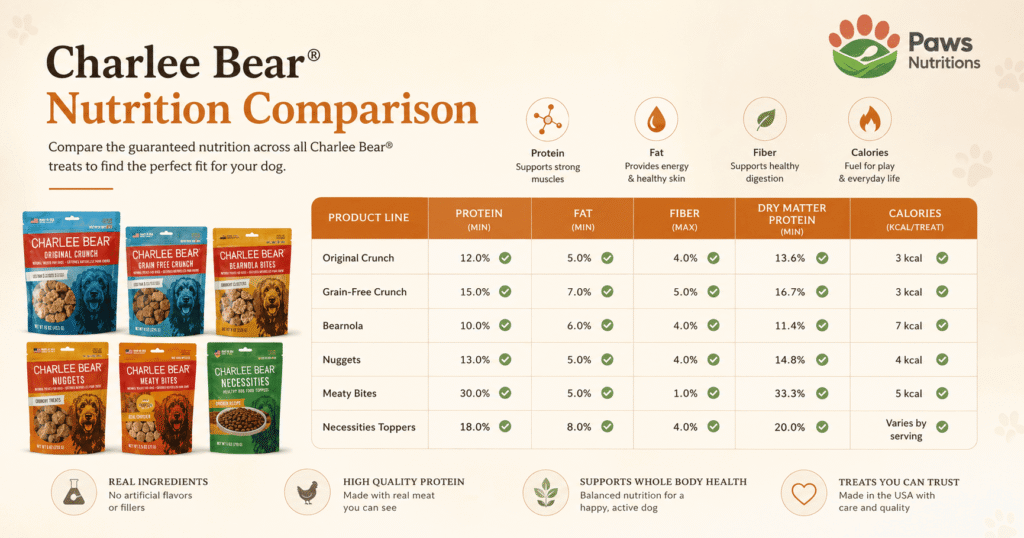
Each Charlee Bear product line has a slightly different nutritional profile because it’s formulated for a different purpose. The classic crunchy treats focus on low calories and frequent rewards, while the freeze-dried products prioritize meat content and flavor.
The table below summarizes the typical nutritional profile across the major product families. Individual flavors may vary slightly, so it’s always worth checking the specific product label before purchasing.
| Product Line | Crude Protein (Min.) | Crude Fat (Min.) | Crude Fiber (Max.) | Moisture (Max.) | Primary Nutrition Goal |
|---|---|---|---|---|---|
| Original Crunch | Moderate | Low | Moderate | Low | Everyday low-calorie training |
| Grain-Free Crunch | 22.0% | 5.5% | 5.5% | 10.0% | Grain-free training treats |
| Bearnola Bites | Moderate | Moderate | Moderate | Low | Everyday rewards |
| Nuggets | Higher | Moderate | Low | Moderate | High-value training |
| Meaty Bites | High | Higher | Low | Very Low | Protein-rich premium treats |
| Necessities Toppers | Very High | Moderate | Low | Very Low | Meal enhancement |
One interesting pattern emerges immediately. As you move from the Original Crunch recipes toward the freeze-dried collections, protein concentration generally increases while calorie density also rises. This is exactly what you’d expect because freeze-drying removes water, leaving nutrients much more concentrated.
How to Calculate Dry Matter Basis (DMB)
Many pet owners compare products using the numbers printed directly on the label. Unfortunately, that approach can be misleading because moisture levels vary between products. Dry Matter Basis (DMB) removes the water content so you’re comparing nutrients on an equal footing.
The calculation is surprisingly simple:
Dry Matter % = (Guaranteed Analysis % ÷ Dry Matter %) × 100
Where:
Dry Matter = 100 − Moisture
For example, if a treat contains:
- Protein: 22%
- Moisture: 10%
The dry matter calculation becomes:
- Dry Matter = 90%
- 22 ÷ 90 × 100
- 24.4% protein on a Dry Matter Basis
Using DMB doesn’t change the recipe—it simply provides a more accurate comparison between products with different moisture contents.
Full Dry Matter Basis Comparison Table
Applying the Dry Matter Basis calculation makes the nutritional differences easier to understand.
| Product Line | Moisture | Estimated DMB Protein | Nutrition Focus |
|---|---|---|---|
| Original Crunch | Low | Moderate | Balanced everyday reward |
| Grain-Free Crunch | 10% | ≈24.4% | Moderate protein with legume support |
| Bearnola Bites | Low | Moderate | Mixed nutritional profile |
| Nuggets | Moderate | Higher | Meat-focused rewards |
| Meaty Bites | Very Low | Very High | Concentrated meat nutrition |
| Necessities Toppers | Very Low | Extremely High | Meal enhancement rather than training |
This comparison highlights an important point: products with similar Guaranteed Analysis numbers can look quite different once moisture is removed. That’s one reason nutrition professionals often rely on Dry Matter Basis when comparing pet foods and treats.
However, DMB shouldn’t be the only factor guiding your decision. Ingredient quality, calorie content, and your dog’s individual needs are equally important.
Calorie Count Per Treat: Marketing Claims vs. Calculated Values
One of Charlee Bear’s biggest selling points is its low-calorie design. Many packages promote the treats as containing “less than 3 calories each,” making them attractive for training sessions where dozens of rewards may be given throughout the day.
Looking more closely at the manufacturer’s published nutritional information reveals an interesting detail. A representative Grain-Free Crunch Turkey, Sweet Potato & Cranberry recipe lists a calculated energy value of approximately 2.0 kcal per treat. Technically, this still supports the “less than 3 calories” claim, but it also shows that not every recipe sits close to the three-calorie mark.
In practical terms, this lower calorie count is actually good news for owners. If you’re teaching loose-leash walking, recall, or basic obedience, your dog may earn dozens of rewards in a single session. Choosing a treat with only about two calories each makes it much easier to reinforce positive behavior without significantly increasing daily calorie intake.
The key takeaway is that calorie values can differ slightly between recipes, so it’s worth checking the nutritional information for the exact flavor you plan to buy rather than assuming every product contains identical energy levels.
Are Charlee Bear Treats Good for Weight Management?
For many dogs, the answer is yes—provided they’re used correctly. One of the biggest challenges in canine weight management isn’t meals; it’s the steady stream of treats given throughout the day. Even a few high-calorie rewards can quietly add hundreds of extra calories each week.
Because many Charlee Bear Dog Treats contain only about two to three calories each, they fit naturally into positive reinforcement training without dramatically affecting your dog’s calorie budget. This makes them especially useful for:
- Puppies learning basic commands
- Dogs attending obedience classes
- Senior dogs that need lighter rewards
- Overweight dogs on veterinarian-approved weight-loss plans
- Small breeds that require careful calorie control
Imagine teaching a young Labrador to stay. A single 20-minute session could involve 25 to 30 rewards. Using large biscuits might add well over 150 calories, while low-calorie training treats could provide less than half that amount. Over weeks of consistent training, that difference becomes significant.
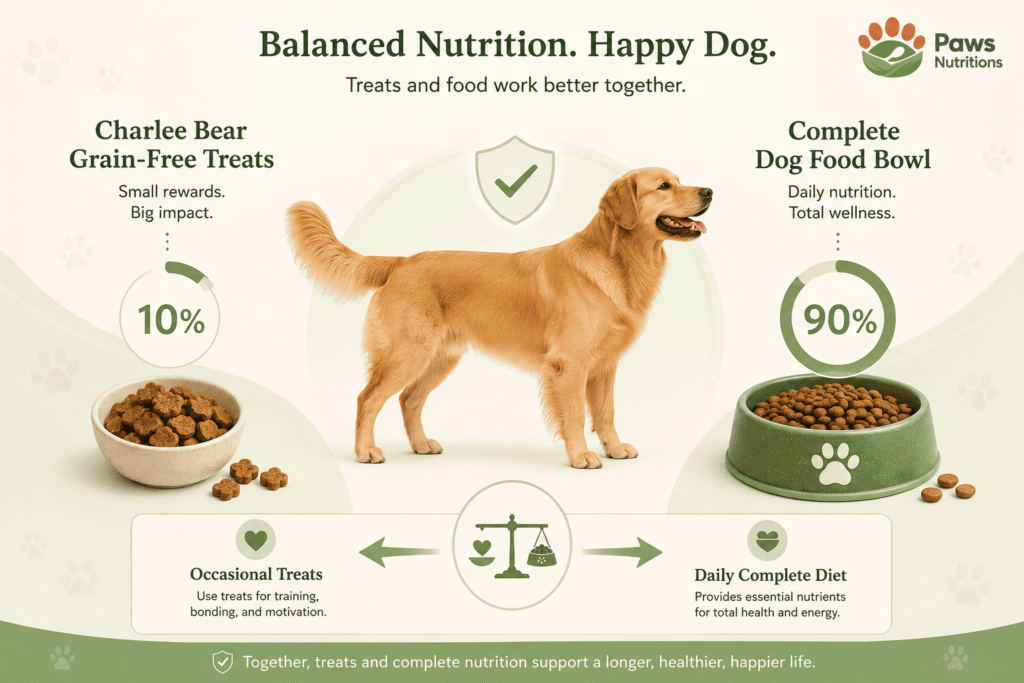
That said, no treat is completely “free” from a nutritional perspective. Veterinarians generally recommend keeping treats to no more than 10% of your dog’s total daily calorie intake, with the remaining 90% coming from a complete and balanced diet. Following this guideline allows you to reward generously while still supporting healthy body weight over the long term.
Overall, Charlee Bear performs well in this area. The combination of small portion size, relatively low calorie content, and multiple product options gives owners flexibility without sacrificing training effectiveness. In the next section, we’ll look beyond nutrition alone and examine how these treats align with AAFCO guidance, WSAVA recommendations, and broader pet food quality standards.
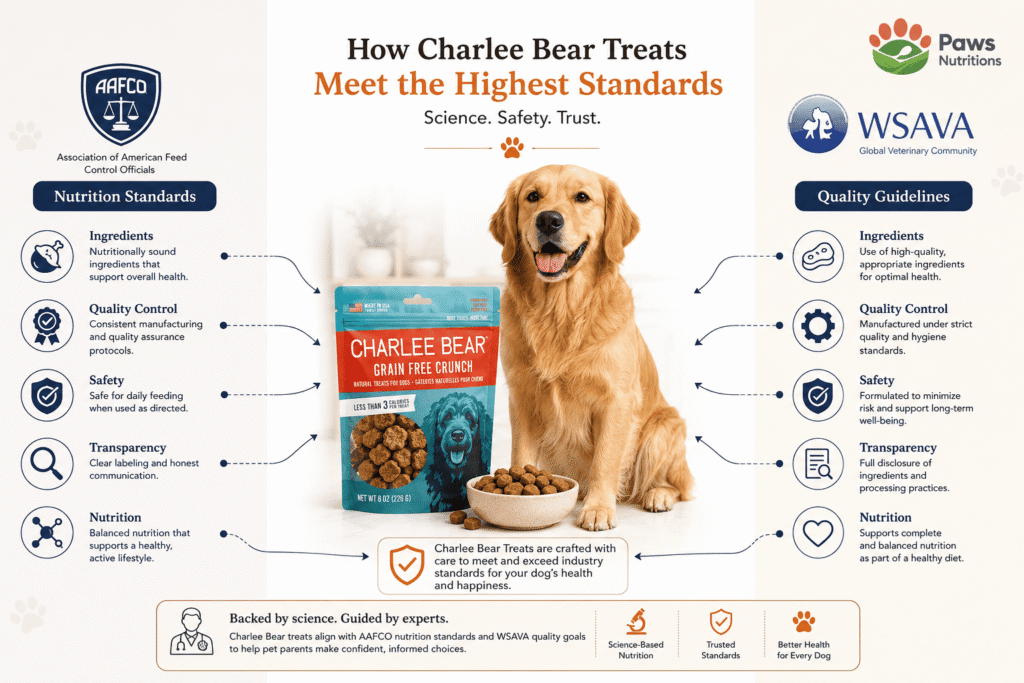
Is Charlee Bear AAFCO and WSAVA Compliant?
Many pet owners look for familiar quality indicators before buying any food or treat. Two names that often come up are AAFCO (Association of American Feed Control Officials) and WSAVA (World Small Animal Veterinary Association). While these organizations play different roles, understanding what they do—and just as importantly, what they don’t do—can help you make a more informed decision.
It’s also worth remembering that dog treats are regulated differently from complete and balanced dog foods. A treat isn’t expected to provide every nutrient your dog needs each day. Instead, its purpose is to complement a nutritionally complete diet. That distinction is important when evaluating Charlee Bear treats against industry guidelines.
Understanding AAFCO Requirements for Dog Treats
One of the biggest misconceptions in pet nutrition is that every pet product should carry an AAFCO nutritional adequacy statement. In reality, those statements are intended for foods designed to serve as a dog’s primary diet—not occasional treats.
Since Charlee Bear products are marketed as treats rather than complete meals, they aren’t required to meet AAFCO nutrient profiles for maintenance, growth, or all life stages. Instead, manufacturers must ensure their products are accurately labeled, safe for their intended use, and compliant with applicable feed regulations.
That means you shouldn’t judge these treats solely by the absence of an AAFCO feeding statement. Instead, focus on factors such as:
- The quality and transparency of the ingredient list
- The published Guaranteed Analysis
- Calorie content per treat
- Manufacturing practices
- Recall history
- Whether the treats fit appropriately within your dog’s daily calorie allowance
When used as intended, Charlee Bear treats can be a useful training reward without replacing the balanced nutrition provided by your dog’s regular food.
What WSAVA Guidelines Mean
Unlike AAFCO, WSAVA doesn’t certify pet food brands or approve individual products. Instead, it publishes nutritional guidelines that help veterinarians and pet owners evaluate manufacturers based on their commitment to quality, research, and safety.
Some of the questions encouraged by WSAVA nutritional guidelines include:
- Does the company employ qualified nutrition experts?
- Are recipes supported by nutritional science?
- Does the manufacturer maintain strong quality control procedures?
- Is nutritional information readily available?
- Does the company respond transparently to customer questions?
- Are safety standards clearly communicated?
These recommendations are designed to help consumers look beyond marketing claims and evaluate whether a company demonstrates a long-term commitment to producing safe, reliable pet foods and treats.
For treat manufacturers like Charlee Bear, these guidelines offer a useful framework rather than a pass-or-fail checklist.
Where Charlee Bear Meets (and Doesn’t Address) These Standards
Based on publicly available manufacturer information, Charlee Bear performs well in several areas that many pet owners value.
One positive is ingredient transparency. The company publishes complete ingredient panels and Guaranteed Analysis information for individual products, allowing owners to compare recipes instead of relying solely on package claims. This level of openness makes it easier to evaluate protein sources, calorie content, and ingredient composition before making a purchase.
Another strength is domestic manufacturing. The company states that its products are made in the USA, which may provide additional confidence for owners who prioritize U.S.-based production and quality oversight.
Charlee Bear also maintains a relatively strong long-term safety record. Aside from a limited recall in 2012 involving specific products manufactured by an outside contractor, the current product lines have remained free from additional recalls. While no manufacturer can guarantee that recalls will never occur, a lengthy period without new safety events is generally viewed as a positive sign.
At the same time, there are areas where publicly available information is more limited. For example, the company doesn’t provide extensive details about:
- Whether board-certified veterinary nutritionists participate in recipe formulation
- Published feeding trials for individual treat lines
- Ongoing nutritional research programs
- Detailed ingredient sourcing beyond general manufacturing information
This isn’t unusual for treat manufacturers, as these topics are discussed more frequently by companies producing complete diets. Nevertheless, owners seeking maximum transparency may wish to contact the manufacturer directly if these factors are especially important to them.
Overall, Charlee Bear demonstrates solid transparency in areas such as labeling, nutritional information, and manufacturing, while offering less public detail about research and formulation practices. For most pet owners, the more practical question is whether the treats fit appropriately into a balanced feeding plan—and on that front, they compare favorably with many other low-calorie dog training treats on the market.
Charlee Bear and the Grain-Free DCM Controversy
Few topics in pet nutrition have generated as much discussion as the possible connection between grain-free dog foods and dilated cardiomyopathy (DCM). Because several Charlee Bear products are grain-free and use ingredients such as peas and chickpeas, it’s natural for owners to wonder whether these treats raise similar concerns.
The good news is that the situation is more nuanced than many headlines suggest. Understanding what researchers have actually studied—and how treats differ from complete diets—can help you evaluate these products more confidently.
What the FDA’s DCM Investigation Found
In 2018, the U.S. Food and Drug Administration began investigating reports of canine dilated cardiomyopathy (DCM) in dogs that were eating certain grain-free diets. Many of the diets reported in these cases contained high levels of legumes, including peas, lentils, and chickpeas, or potatoes as major ingredients.
It’s important to note that the FDA did not conclude that grain-free foods directly cause DCM. Instead, the agency identified a potential association that required further scientific investigation. Since then, researchers have continued studying possible contributing factors, including genetics, nutrient interactions, ingredient formulation, and overall diet composition.
The investigation primarily focused on complete and balanced dog foods, not treats.
Why Treats Are Different from Complete Diets
This distinction often gets overlooked in online discussions. A complete diet supplies nearly all of a dog’s daily calories and nutrients, while treats usually contribute only a small percentage of daily intake.
For example, if your dog eats a nutritionally balanced kibble that meets recognized nutritional standards, a handful of low-calorie treats represents only a minor part of the overall diet. As a result, the nutritional impact of those treats is very different from feeding a grain-free food as the dog’s sole source of nutrition.
That’s why veterinarians generally evaluate the entire dietary pattern rather than judging a treat in isolation. A grain-free treat used occasionally isn’t viewed the same way as a grain-free diet consumed every day for months or years.
Should You Worry About Grain-Free Charlee Bear Treats?
For most healthy dogs, occasional use of Grain-Free Crunch treats is unlikely to be a major concern when they’re part of an otherwise complete and balanced diet. However, moderation and dietary variety remain sensible approaches.
The representative Grain-Free Crunch recipe does place peas and chickpeas among its leading ingredients, meaning legumes contribute significantly to the formulation. Owners who already feed a legume-heavy grain-free diet may prefer to choose the Original Crunch recipes instead, creating greater ingredient diversity across the dog’s overall nutrition.
On the other hand, dogs with grain sensitivities or owners who simply prefer grain-free treats may find these recipes suitable when used responsibly as training rewards.
If your dog has a history of heart disease, nutritional deficiencies, or a breed predisposed to DCM, it’s always wise to discuss treat choices with your veterinarian. Individual health conditions can influence dietary recommendations far more than general online advice.
The most balanced takeaway is this: grain-free treats are not automatically unsafe, but they should be viewed within the context of your dog’s complete diet. Paying attention to ingredient variety, maintaining a nutritionally balanced primary food, and using treats in moderation remain the best strategies for supporting long-term health.
Charlee Bear Recall History
When you’re choosing treats for your dog, safety often matters just as much as ingredients or nutrition. A brand may advertise premium recipes and natural ingredients, but a solid safety record gives you greater confidence in what you’re feeding your pet. Looking at a company’s recall history also shows how it has responded to quality issues over time.
Charlee Bear has one documented recall in its history, but it’s important to understand the details rather than judging the brand based on a headline alone. Knowing what happened, which products were involved, and what has changed since then provides a much clearer picture of the brand’s overall safety.
Complete Recall Timeline
Compared with many long-established pet food brands, Charlee Bear has maintained a relatively clean recall history.
| Date | Product | Reason | Scope | Current Status |
|---|---|---|---|---|
| November 2012 | Protein Crunch Bars (specific lots only) | Salmonella contamination | Limited recall affecting selected lots manufactured by an outside contractor | Product discontinued; no subsequent recalls reported |
One isolated recall over more than a decade doesn’t automatically make a brand unsafe. Instead, it’s more useful to examine how extensive the recall was and whether similar issues have occurred since.
The 2012 Salmonella Recall Explained
The only publicly documented recall involving Charlee Bear occurred in November 2012. The recall was initiated after routine testing detected possible Salmonella contamination in certain lots of Protein Crunch Bars.
Salmonella is a bacterium that can affect both animals and humans. In dogs, symptoms may include:
- Diarrhea
- Vomiting
- Fever
- Reduced appetite
- Lethargy
Even pets that don’t show visible symptoms can sometimes carry the bacteria and potentially expose people handling contaminated food or treats. That’s why manufacturers take Salmonella findings very seriously, even when no illnesses have been reported.
Importantly, the recall was described as a precautionary measure following routine quality testing rather than widespread reports of sick pets.
Products That Were Affected
One detail often overlooked in online discussions is that the recall did not involve every Charlee Bear product.
The affected products were limited to specific lots of:
- Protein Crunch Bars – Chicken Recipe with Carrots
- Protein Crunch Bars – Chicken Recipe with Sweet Potatoes
Only certain production lots carrying specific UPC numbers were included in the recall. The issue was linked to products manufactured by an outside contract facility rather than the brand’s broader treat lineup.
This distinction matters because owners sometimes assume an entire product catalog was recalled when only a small portion of one product line was affected.
Products That Were Not Affected
The recall did not include the products that most owners recognize today, including:
- Original Crunch treats
- Grain-Free Crunch treats
- Bearnola Bites
- Nuggets
- Meaty Bites
- Necessities Toppers
In addition, the recalled Protein Crunch Bars have since been discontinued, meaning current Charlee Bear products are different from those involved in the 2012 event.
Understanding this timeline helps prevent confusion between discontinued products and the treats currently available in pet stores and online retailers.
Current Safety Record
Since the 2012 recall, Charlee Bear has maintained a strong safety record with no additional publicly reported recalls involving its current product lines. While no manufacturer can guarantee that future recalls will never happen, a lengthy period without new incidents is generally viewed as a positive indicator.
The company’s transition to Gott Pet Products, LLC in 2018 also did not introduce any new documented recalls under the updated corporate name. This continuity suggests that the isolated 2012 event has not become part of a recurring pattern.
Of course, recall history should never be the only factor when evaluating a pet product. Ingredient quality, nutritional value, manufacturing practices, and proper storage all contribute to overall safety. Still, many owners appreciate seeing a brand with more than a decade of recall-free production following an isolated event.
How to Verify Future Recalls Yourself
Pet food information changes over time, so it’s a good habit to verify recalls periodically rather than relying on outdated articles. Fortunately, checking current safety information only takes a few minutes.
The most reliable sources include:
- FDA pet food recall announcements, which publish official recall notices and safety alerts.
- The manufacturer’s website, where companies typically post important product updates.
- Well-known pet food recall databases that compile official recall notices into searchable timelines.
Whenever you hear about a potential recall, verify the product name, package size, UPC code, lot number, and expiration date before taking action. Many recalls affect only specific production lots rather than every product sold under a brand name.
For most pet owners considering Charlee Bear Dog Treats, the available evidence points to a reassuring conclusion: the brand experienced one limited recall more than a decade ago, the affected products are no longer part of the current lineup, and there have been no additional publicly documented recalls involving today’s Charlee Bear treats. That long period without further safety incidents provides valuable context when evaluating the brand alongside other training treat options.
Charlee Bear Price Breakdown
Price is one of the biggest factors when choosing training treats, especially if you reward your dog frequently. A single obedience session can use dozens of treats, and active dogs may go through several bags each month. Looking only at the shelf price doesn’t tell the whole story, though. Comparing price per pound, package sizes, and product type gives a much better picture of long-term value.
Charlee Bear offers products across several price tiers, ranging from budget-friendly crunchy treats to premium freeze-dried options. Understanding where each line fits helps you decide whether you’re paying for convenience, specialized ingredients, or simply a different style of reward.
Original Crunch Pricing (16 oz)
The Original Crunch line delivers the best overall value in the Charlee Bear range. With large 16-ounce bags and relatively low cost per pound, these treats are well suited for everyday training, puppy classes, and households that reward frequently.
Typical retail pricing:
| Product | Size | Typical Price | Estimated Price per Pound |
|---|---|---|---|
| Cheese & Egg | 16 oz | Around $8.99 | About $9.00/lb |
| Chicken Liver | 16 oz | Around $9.28 | About $9.30/lb |
| Turkey Liver & Cranberries | 16 oz | Around $8.99 | About $9.00/lb |
| Chicken Soup & Garden Veggie | 16 oz | Around $9.99 | About $10.00/lb |
For owners who train daily, this product line provides the strongest balance between affordability and convenience. The larger bag size also means fewer repeat purchases over time.
Grain-Free Crunch Pricing
The Grain-Free Crunch recipes are positioned as a premium alternative to the Original Crunch line. Although the bags are smaller, they typically retail at similar prices, resulting in a noticeably higher cost per pound.
Typical pricing falls between $8.99 and $9.99 for an 8-ounce bag, translating to approximately $18–20 per pound.
That means you’re paying roughly twice as much per pound compared with the Original Crunch collection. The additional cost reflects the grain-free formulation rather than significantly larger package sizes or dramatically different calorie content.
Bearnola Bites Pricing
Bearnola Bites occupy a similar price category to Grain-Free Crunch.
Most 8-ounce bags typically sell for $9.99–10.99, placing them around $20–22 per pound depending on the retailer and flavor.
For owners seeking more variety in texture and ingredients, the higher price may be worthwhile. However, if your primary goal is inexpensive everyday training, Original Crunch remains the better value.
Nuggets and Meaty Bites Pricing (Premium Freeze-Dried Tier)
The premium collections represent the biggest jump in cost across the entire Charlee Bear lineup.
Approximate pricing:
| Product Line | Typical Size | Typical Retail Price | Estimated Price per Pound |
|---|---|---|---|
| Nuggets | 6 oz | $8–10 | About $22–28/lb |
| Meaty Bites | 2.25 oz | $13–14 | About $92–100/lb |
At first glance, these prices may seem surprisingly high. However, freeze-dried products contain far less moisture than traditional baked treats, making them much lighter by weight while concentrating flavor and nutrients.
These products are generally best reserved for difficult training situations, competitive sports, or dogs that need exceptionally motivating rewards rather than everyday use.
Product Sizes and Packaging Options
One advantage of the Charlee Bear lineup is the variety of package sizes available. Instead of offering every treat in a single bag size, the company tailors packaging to each product line and its intended use. Larger bags work well for owners who train every day, while smaller premium packages are easier to carry on walks or use as occasional high-value rewards.
Here’s a quick overview of the common packaging options you’ll find across retailers.
| Product Line | Common Package Sizes | Best For |
|---|---|---|
| Original Crunch | 16 oz | Everyday training and multi-dog households |
| Grain-Free Crunch | 8 oz | Grain-free reward treats |
| Bearnola Bites | 8 oz | Daily snacks and enrichment |
| Nuggets | 6 oz | Frequent reward training |
| Meaty Bites | 2.25 oz | High-value training and special rewards |
| Necessities Toppers | Small resealable bags | Meal enhancement |
You’ll also find variety packs and multi-pack bundles through some online retailers, especially Amazon. These packages can be a practical choice if your dog enjoys multiple flavors or you’re introducing the brand for the first time. Buying several bags together may also reduce the cost per bag during promotional sales.
Regardless of the size you choose, look for resealable packaging whenever possible. Properly sealing treats after each use helps maintain freshness and prevents crunchy products from becoming stale.
Where to Buy
Charlee Bear treats are widely available through both online and brick-and-mortar retailers, but prices and product selection can vary considerably. Some stores carry nearly the entire product lineup, while others stock only the most popular flavors.
Here’s how the major retailers compare.
| Retailer | Product Selection | Pricing | Best For |
|---|---|---|---|
| Charlee Bear (Official Store) | Full product lineup | Standard retail | Checking complete product information and new releases |
| Chewy | Extensive selection | Frequently competitive | Autoship discounts, customer reviews, broad availability |
| Amazon | Popular products and variety packs | Varies by seller | Fast shipping and bundle purchases |
| Max200 | Limited selection | Competitive on select products | Dog trainers and bulk buyers |
| Treats Unleashed | Selected products | Standard retail | Local shoppers and in-store pickup |
| Independent Pet Stores | Varies | Varies | Supporting local businesses and immediate availability |
Among these retailers, Chewy typically provides one of the widest selections of Charlee Bear products while also offering customer reviews that can help you compare flavors before purchasing. Meanwhile, Amazon often features convenient multipacks, although pricing may fluctuate depending on inventory and third-party sellers.
If you’re purchasing regularly, it’s worth comparing prices every few months. Promotional sales, subscription discounts, and seasonal offers can noticeably reduce your annual spending.
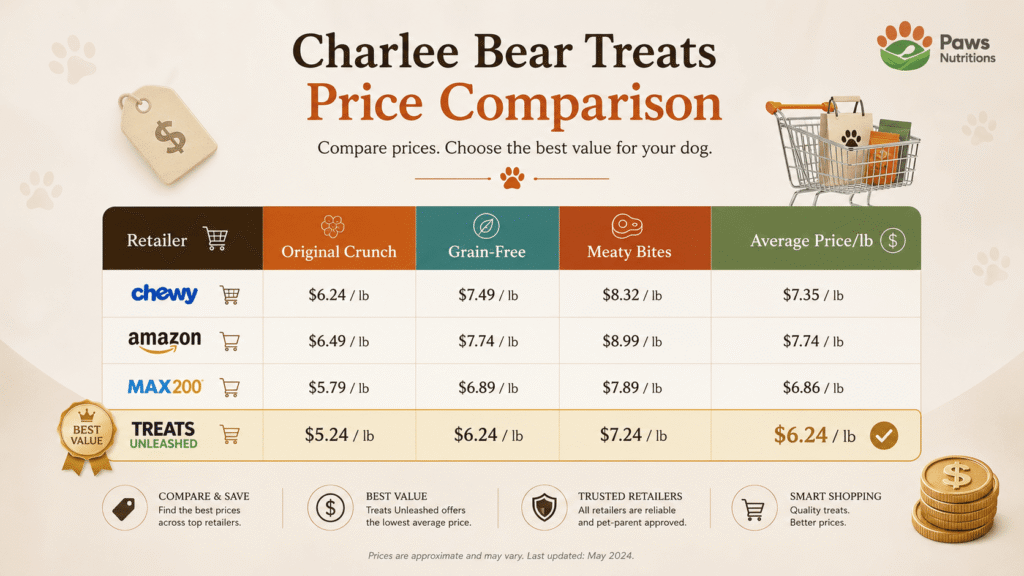
Full Price-Per-Pound Comparison Table
Looking at the price on the shelf tells only part of the story. A much better way to compare value is by calculating price per pound, since package sizes vary significantly across the Charlee Bear lineup.
The comparison below highlights just how wide the price range becomes as you move from standard baked treats to premium freeze-dried products.
| Product Line | Typical Bag Size | Approximate Price | Estimated Price Per Pound | Value Rating |
|---|---|---|---|---|
| Original Crunch | 16 oz | $8.99–9.99 | $9–10/lb | ★★★★★ Excellent |
| Grain-Free Crunch | 8 oz | $8.99–9.99 | $18–20/lb | ★★★★☆ Good |
| Bearnola Bites | 8 oz | $9.99–10.99 | $20–22/lb | ★★★★☆ Good |
| Nuggets | 6 oz | $8–10 | $22–28/lb | ★★★☆☆ Moderate |
| Meaty Bites | 2.25 oz | $13–14 | $92–100/lb | ★★☆☆☆ Premium Pricing |
| Necessities Toppers | Small bags | Varies | Highest cost per pound | Specialty Product |
One insight stands out immediately: Meaty Bites can cost roughly ten times more per pound than Original Crunch. That doesn’t necessarily mean they’re overpriced—it reflects the higher cost of freeze-dried manufacturing and meat-heavy formulations—but it’s an important distinction for shoppers comparing products across the same brand.
Which Charlee Bear Product Offers the Best Value?
The “best value” ultimately depends on how you define value. If your goal is maximizing the number of treats you receive for every dollar spent, Original Crunch is the clear winner. Large 16-ounce bags, low calorie content, and a price of roughly $9 per pound make these treats ideal for daily obedience training, puppy classes, and households with multiple dogs.
For owners feeding hundreds of treats each week, the savings quickly add up. A professional trainer working with several dogs each day, for example, could spend significantly less over the course of a year by choosing Original Crunch instead of premium freeze-dried options.
On the other hand, value isn’t always about paying the lowest price. Meaty Bites deliver concentrated meat flavor and a stronger reward for dogs that need extra motivation. If you’re working on difficult recall exercises, agility competitions, scent work, or behavior modification, a higher-value reward may actually improve training efficiency despite the higher purchase price.
The Grain-Free Crunch and Bearnola Bites lines sit comfortably in the middle. They cost more than the classic recipes but remain substantially less expensive than freeze-dried treats, making them a reasonable compromise for owners seeking different ingredient profiles without moving into the premium price category.
For most households, a practical strategy is to use Original Crunch as your everyday training reward and reserve premium products like Meaty Bites for situations where exceptional motivation is needed. This approach balances nutrition, effectiveness, and long-term cost while giving your dog a variety of rewarding experiences.
How to Choose the Right Charlee Bear Treat
Not every Charlee Bear product is designed for the same dog or the same training situation. A puppy learning basic commands has different needs than an adult agility dog, and a senior with dental concerns may prefer a different texture than a young, active Labrador. Choosing the right treat means considering more than flavor alone.
The best choice depends on your dog’s age, activity level, dietary preferences, and the purpose of the reward. Some treats are ideal for frequent reinforcement because they’re low in calories, while others are better reserved for high-value moments when you need your dog’s full attention. Understanding these differences helps you get the most benefit from every treat you offer.
Best for Sensitive Stomachs
Dogs with sensitive digestion often do best with treats that contain shorter ingredient lists and familiar protein sources. If your dog tolerates grains well, the Original Crunch recipes may be a suitable everyday option because of their straightforward formulations and modest calorie content.
For dogs that avoid grains under veterinary guidance, the Grain-Free Crunch line provides an alternative. However, because these recipes rely heavily on peas and chickpeas, owners should introduce them gradually and monitor for any digestive changes, just as they would with any new treat.
Best for Everyday Training
For most dogs, consistency matters more than fancy ingredients. During training sessions, you’ll often reward your dog dozens of times within a few minutes, so treats should be small, easy to carry, and low enough in calories that frequent rewards won’t significantly affect your dog’s daily energy intake.
This is where Original Crunch shines. The bite-sized pieces are easy to keep in a pocket or treat pouch, and their crunchy texture makes them quick to eat, allowing your dog to refocus on the next command instead of spending time chewing. Whether you’re teaching “sit,” “stay,” or loose-leash walking, these treats provide an efficient reward without interrupting the flow of training.
Another advantage is affordability. Since training requires repetition, going through several bags each month is common. Choosing a cost-effective option means you can reward generously without worrying about replacing expensive treats too often.
Best High-Value Rewards
Sometimes a standard training treat simply isn’t exciting enough. If you’re practicing advanced obedience, working on recall around distractions, or introducing a challenging new skill, a more enticing reward can make a noticeable difference.
For these situations, Meaty Bites are the standout choice. Their freeze-dried, meat-first recipes produce a richer aroma and flavor that many dogs find especially motivating. Trainers often refer to treats like these as high-value dog treats because they’re reserved for moments when exceptional focus and enthusiasm are needed.
Think of it this way: you probably wouldn’t celebrate a special occasion with an everyday snack. Dogs can respond similarly. Saving premium treats for your most important training moments helps maintain their excitement and makes those rewards feel even more valuable.
Best for Puppies
Puppies learn through repetition, and repetition requires lots of rewards. During the first few months, your puppy may receive treats while learning house training, crate training, socialization, leash manners, and basic obedience—all in the same day.
Because of their small size and low calorie content, Original Crunch treats are often well suited for these frequent sessions. They allow you to reward good behavior without adding excessive calories during a stage when balanced nutrition is especially important for healthy growth.
When introducing any new treat to a puppy, start with small amounts and watch for digestive changes. Every puppy is different, and gradual introduction helps identify any sensitivities before treats become a regular part of the routine.
Best for Adult Dogs
Adult dogs generally have the greatest flexibility when it comes to choosing treats. Your decision can focus more on lifestyle than life stage.
For example:
- Dogs attending weekly obedience classes often do well with Original Crunch.
- Active sporting dogs may appreciate Meaty Bites during demanding training.
- Grain-free households may prefer Grain-Free Crunch recipes.
- Dogs that enjoy variety can rotate between several product lines while maintaining a balanced overall diet.
Matching the reward to the activity helps keep training interesting while preventing your dog from becoming bored with the same treat every day.
Best for Senior Dogs
Older dogs deserve treats that fit both their nutritional needs and their changing physical abilities. Seniors are often less active than younger dogs, making calorie control increasingly important. At the same time, some older pets become more selective about flavor and texture.
For healthy seniors that still enjoy crunchy treats, Original Crunch remains an excellent option because each piece contributes only a small number of calories. This allows owners to continue rewarding positive behavior without significantly increasing daily calorie intake.
However, some senior dogs develop dental issues that make crunchy treats less comfortable to chew. In those cases, the softer Nuggets or flavorful Meaty Bites may be easier to eat while still providing an enjoyable reward. If your senior dog has significant dental disease or other health conditions, it’s always best to discuss treat choices with your veterinarian.
Charlee Bear Feeding Guide
Even healthy treats should be fed with moderation in mind. It’s easy to lose track of how many rewards your dog receives during a busy day, especially if multiple family members are involved in training. A handful here and another handful there can quickly add more calories than you realize.
The good news is that Charlee Bear Dog Treats are designed with frequent training in mind. Their relatively low calorie content makes them easier to incorporate into a balanced diet, provided you adjust portions appropriately and remember that treats should complement—not replace—a complete and balanced dog food.
Daily Treat Allowance by Dog Weight
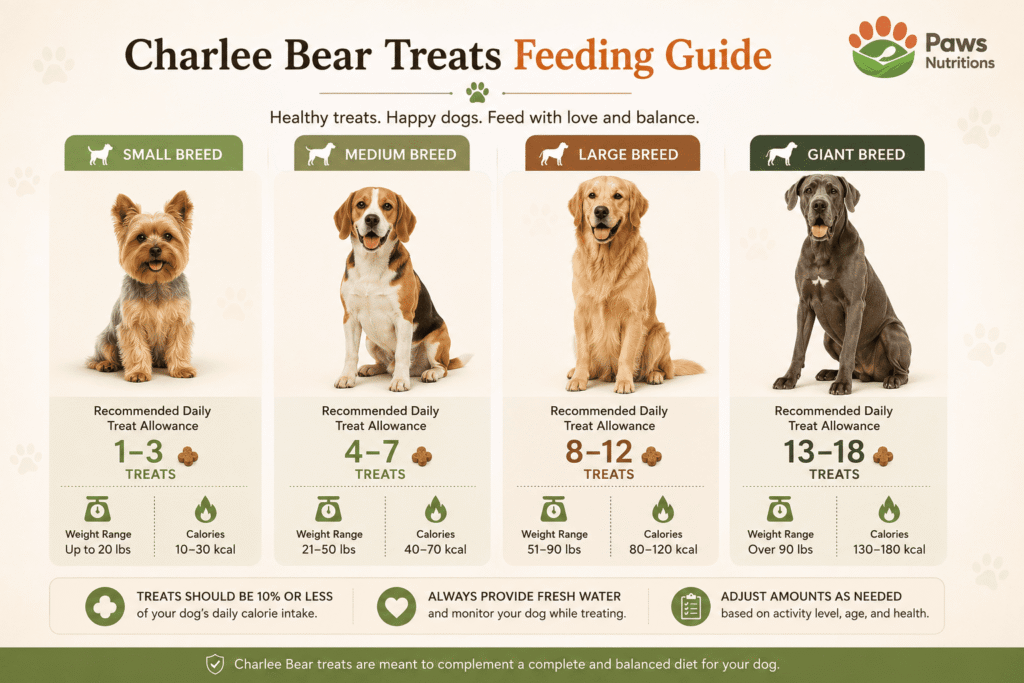
There isn’t a universal number of treats that’s right for every dog. Age, activity level, metabolism, and daily calorie needs all play a role. Still, a general guideline can help you estimate a reasonable daily treat allowance.
| Dog Weight | Estimated Daily Calorie Needs* | Calories from Treats (Max. 10%) | Approximate Number of 2–3 Calorie Charlee Bear Treats |
|---|---|---|---|
| Up to 10 lbs | 200–300 kcal | 20–30 kcal | 8–15 treats |
| 10–25 lbs | 350–550 kcal | 35–55 kcal | 14–27 treats |
| 25–50 lbs | 700–1,000 kcal | 70–100 kcal | 28–50 treats |
| 50–75 lbs | 1,000–1,400 kcal | 100–140 kcal | 40–70 treats |
| Over 75 lbs | 1,400+ kcal | 140+ kcal | Adjust according to activity level |
*These values are general estimates. Individual calorie requirements vary depending on age, breed, activity, reproductive status, and overall health.
Remember that these numbers represent the maximum calories that should generally come from treats—not a target you need to reach every day. Many dogs do perfectly well with fewer rewards.
The 10% Calorie Rule
Veterinarians commonly recommend following the 10% rule, which means treats should contribute no more than about 10% of your dog’s total daily calorie intake. The remaining 90% should come from a nutritionally complete and balanced diet.
Here’s a simple example. Suppose your dog requires approximately 800 calories per day. Following the 10% guideline means treats should provide no more than 80 calories. If each Charlee Bear treat contains roughly 2–3 calories, your dog could enjoy around 27 to 40 treats during training while still staying within the recommended limit.
This approach gives you flexibility. On days with longer training sessions, you can reduce meal portions slightly if recommended by your veterinarian, helping maintain your dog’s ideal body condition without sacrificing learning opportunities.
How Many Treats Are Too Many?
The answer depends less on the number of treats and more on the total calories they contribute throughout the day.
Imagine two different scenarios:
- A Border Collie spends 30 minutes practicing agility and earns 35 low-calorie Charlee Bear treats.
- A small indoor Chihuahua receives the same number of treats while lounging around the house.
Although both dogs ate the same number of rewards, their calorie needs and activity levels are very different. The active Border Collie is likely burning substantially more energy, making those treats a much smaller percentage of its daily intake.
A few simple habits can help prevent overfeeding:
- Count treats during longer training sessions.
- Divide daily rewards into several shorter sessions.
- Ask family members to communicate so treats aren’t accidentally doubled.
- Monitor your dog’s body condition regularly rather than relying on weight alone.
- Reduce treats temporarily if you notice unwanted weight gain.
Ultimately, treats should strengthen your relationship with your dog—not gradually increase waistlines. Used thoughtfully, Charlee Bear’s low-calorie design makes it much easier to reward generously while maintaining healthy nutrition over the long term.
Charlee Bear vs. Competitor Training Treats
No dog treat is perfect for every situation. Some are designed to be budget-friendly for daily obedience work, while others focus on premium meat ingredients, limited ingredient formulas, or freeze-dried nutrition. Comparing Charlee Bear with other well-known training treats helps you understand where it stands in terms of ingredients, calories, price, and overall value.
Rather than asking which brand is “best,” it’s more useful to ask which one best matches your dog’s needs. A puppy attending weekly training classes may benefit from a low-calorie crunchy treat, while a dog competing in agility or scent work may respond better to a richer, meat-based reward.
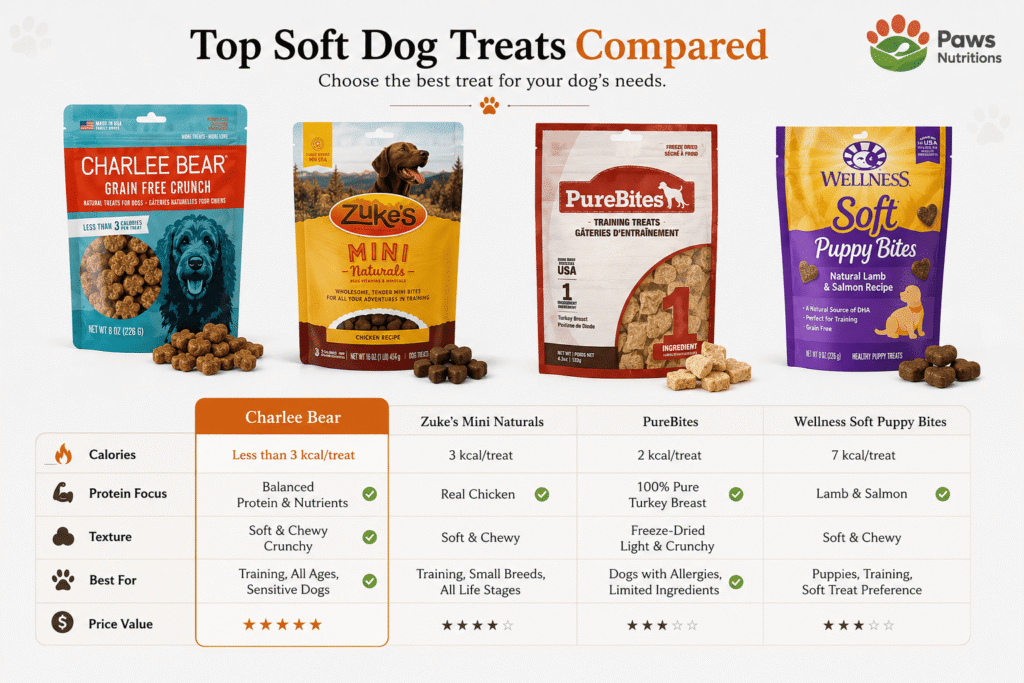
Charlee Bear vs. Zuke’s Mini Naturals
Both Charlee Bear and Zuke’s Mini Naturals are among the most popular dog training treats, but they appeal to slightly different audiences.
Charlee Bear focuses on crunchy, bite-sized rewards with very low calorie counts, making them ideal for frequent reinforcement during long training sessions. Most treats contain approximately 2–3 calories each, allowing owners to reward repeatedly without adding excessive calories.
Zuke’s Mini Naturals, on the other hand, are soft and chewy. They typically contain more meat ingredients and have a stronger aroma, making them especially attractive for dogs that need extra motivation. Their soft texture also makes them easier for puppies and senior dogs with dental concerns.
Here’s how they compare:
| Feature | Charlee Bear | Zuke’s Mini Naturals |
|---|---|---|
| Texture | Crunchy | Soft & chewy |
| Calories | 2–3 kcal/treat | Around 2 kcal/treat |
| Best For | Everyday obedience training | High-focus reward training |
| Bag Size | Larger economy bags | Medium-sized bags |
| Cost Per Pound | Generally lower | Typically higher |
| Variety | Multiple product families | Multiple protein recipes |
If your priority is affordability and frequent rewards, Charlee Bear usually offers better long-term value. If your dog responds better to soft, aromatic treats, Zuke’s may have a slight advantage.
Charlee Bear vs. PureBites Freeze-Dried
The comparison with PureBites is quite different because these products serve different purposes.
PureBites focuses almost entirely on single-ingredient freeze-dried treats, often using only one ingredient such as chicken, beef, turkey, or salmon. This simplicity makes them especially attractive for dogs with food sensitivities or owners looking for limited ingredient options.
Charlee Bear’s Meaty Bites move closer to this category than the Original Crunch products, but the brand still offers a much broader range of everyday training treats.
Here’s a side-by-side comparison:
| Feature | Charlee Bear | PureBites |
|---|---|---|
| Ingredient Complexity | Moderate | Very simple |
| Primary Focus | Training rewards | High-protein meat treats |
| Texture | Crunchy & freeze-dried options | Freeze-dried only |
| Cost | Budget to premium | Premium |
| Everyday Training | Excellent | Less economical |
| Dogs with Food Sensitivities | Good depending on recipe | Often excellent |
PureBites generally delivers higher meat concentration, but it also comes with a significantly higher price tag. For owners using dozens of treats every day, Charlee Bear remains the more practical choice.
Charlee Bear vs. Wellness Soft Puppy Bites
Although Wellness Soft Puppy Bites are designed primarily for puppies, many owners compare them with Charlee Bear because both are commonly used during early obedience training.
Wellness emphasizes soft texture and recipes formulated specifically for growing puppies. Their treats are easy to chew and contain ingredients chosen with young dogs in mind.
Charlee Bear, meanwhile, offers smaller crunchy treats that also work well during puppy training, especially once puppies are comfortable chewing dry treats.
Here’s how the two compare:
| Feature | Charlee Bear | Wellness Soft Puppy Bites |
|---|---|---|
| Target Age | All life stages | Primarily puppies |
| Texture | Crunchy | Soft |
| Calories | Low | Moderate |
| Training Sessions | Excellent | Excellent |
| Everyday Value | Higher | Moderate |
| Puppy-Specific Formulation | No | Yes |
If your puppy is very young or still developing chewing skills, Wellness may be slightly easier to eat. As puppies mature, Charlee Bear becomes an excellent everyday alternative thanks to its lower calorie content and economical pricing.
Full Comparison Table
The following table summarizes the major differences among these popular training treats.
| Feature | Charlee Bear | Zuke’s Mini Naturals | PureBites | Wellness Soft Puppy Bites |
|---|---|---|---|---|
| Best Use | Everyday training | High-value rewards | Premium protein treats | Puppy training |
| Texture | Crunchy / Freeze-dried | Soft | Freeze-dried | Soft |
| Typical Calories | 2–3 kcal | ~2 kcal | Varies | Slightly higher |
| Protein Focus | Moderate to High | Moderate | Very High | Moderate |
| Cost Per Pound | Excellent value | Moderate | Premium | Moderate |
| Everyday Affordability | ★★★★★ | ★★★★☆ | ★★☆☆☆ | ★★★★☆ |
| Variety of Product Lines | Excellent | Good | Limited | Limited |
Which Treat Should You Choose?
Each of these brands excels in different situations, so the right choice depends on your priorities rather than a single “winner.”
Choose Charlee Bear if you:
- Want low-calorie training treats for frequent rewards.
- Need an affordable option for daily obedience sessions.
- Prefer multiple product lines at different price points.
- Train several dogs or attend regular puppy classes.
Choose Zuke’s Mini Naturals if your dog strongly prefers soft, chewy treats or needs extra motivation during difficult training exercises.
Choose PureBites if ingredient simplicity is your highest priority or your veterinarian recommends a limited ingredient reward.
Choose Wellness Soft Puppy Bites if you’re working with a young puppy that benefits from softer treats designed specifically for early development.
For the average pet owner, Charlee Bear Dog Treats strike an impressive balance between affordability, calorie control, product variety, and ingredient transparency. They may not be the highest-protein treats on the market, but they deliver exactly what most owners need from an everyday training reward: consistent quality, convenient sizing, and excellent long-term value.
Pros and Cons of Charlee Bear Dog Treats
After examining the ingredients, nutrition, pricing, safety record, and competitor landscape, it’s easier to see where Charlee Bear performs well—and where there is still room for improvement. No treat will meet every dog’s needs, but understanding both the strengths and limitations helps you make a confident buying decision.
What Charlee Bear Does Well
One of the biggest strengths of Charlee Bear is its excellent value for everyday training. The Original Crunch line offers one of the lowest costs per pound among well-known training treats, making it practical for owners who reward frequently.
Other standout advantages include:
- Very low calorie content, making longer training sessions easier without excessive calorie intake.
- Wide product selection, including crunchy, grain-free, freeze-dried, and topper options.
- Made in the USA, which many owners consider an important quality factor.
- Good ingredient transparency, with detailed ingredient lists and Guaranteed Analysis available for individual products.
- Long recall-free period following the isolated 2012 recall.
- Convenient bite-sized treats that fit easily into treat pouches and pockets.
- Suitable for dogs of many breeds and sizes due to their small shape.
For owners focused on positive reinforcement training, these advantages make Charlee Bear one of the more practical options available.
Where Charlee Bear Falls Short
Despite its strengths, Charlee Bear isn’t the perfect choice for every household.
Some limitations include:
- Several Grain-Free Crunch recipes rely heavily on peas and chickpeas rather than placing meat first.
- Public information about veterinary nutrition expertise and feeding trials is relatively limited.
- Premium lines such as Meaty Bites become considerably more expensive than the classic recipes.
- Crunchy textures may not suit dogs with advanced dental disease or missing teeth.
- Dogs that strongly prefer soft, moist treats may respond better to chewy training rewards.
These drawbacks aren’t necessarily deal-breakers, but they’re worth considering alongside your dog’s individual needs and preferences.
Overall, Charlee Bear earns high marks as an affordable, low-calorie training treat with strong ingredient transparency and a reassuring long-term safety record. Owners looking for everyday rewards are likely to find much more to like than to criticize, while those seeking meat-first premium nutrition may prefer the brand’s freeze-dried offerings over its classic crunchy recipes.
Frequently Asked Questions
Is Charlee Bear a good dog treat?
Yes. Charlee Bear Dog Treats are a good choice for everyday training thanks to their low calorie count, small size, and wide flavor selection. They’re especially popular with owners who need frequent training rewards without adding too many extra calories.
Are Charlee Bear treats good for puppies?
Yes, they can be. Their bite-sized pieces and low-calorie formula make them suitable for puppy training, but you should introduce any new treat gradually and choose a recipe that fits your puppy’s dietary needs.
Has Charlee Bear ever had a recall?
Yes. Charlee Bear had one limited Salmonella recall in 2012 involving specific Protein Crunch Bars made by a contract manufacturer. No additional publicly reported recalls have affected the brand’s current product lines since then.
Are Charlee Bear treats made in the USA?
Yes. Charlee Bear states that its treats are manufactured in the USA, and the company notes that ingredients are sourced from the USA and Canada.
Are Charlee Bear treats grain-free?
Some are, and some aren’t. The Grain-Free Crunch, Meaty Bites, and several premium products are grain-free, while the classic Original Crunch recipes contain grains such as wheat and are not grain-free.
Where can I buy Charlee Bear Dog Treats?
You can buy Charlee Bear treats from the official website, major online retailers like Chewy and Amazon, as well as many independent pet stores and regional retailers, with prices varying by seller and package size.
Final Verdict: Are Charlee Bear Dog Treats Worth It?
After reviewing the ingredients, nutrition, pricing, safety history, and competitor landscape, Charlee Bear Dog Treats prove to be one of the strongest options for owners looking for affordable, low-calorie training rewards. Their biggest strengths are simple: they’re easy to carry, reasonably priced, widely available, and small enough to use repeatedly during training without dramatically increasing your dog’s daily calorie intake.
The brand also earns points for ingredient transparency. Unlike many treat manufacturers, Charlee Bear publishes complete ingredient lists and guaranteed analysis for its products, making it easier to compare recipes before buying. Combined with more than a decade without a new publicly reported recall, this helps build confidence in the brand’s overall safety profile.
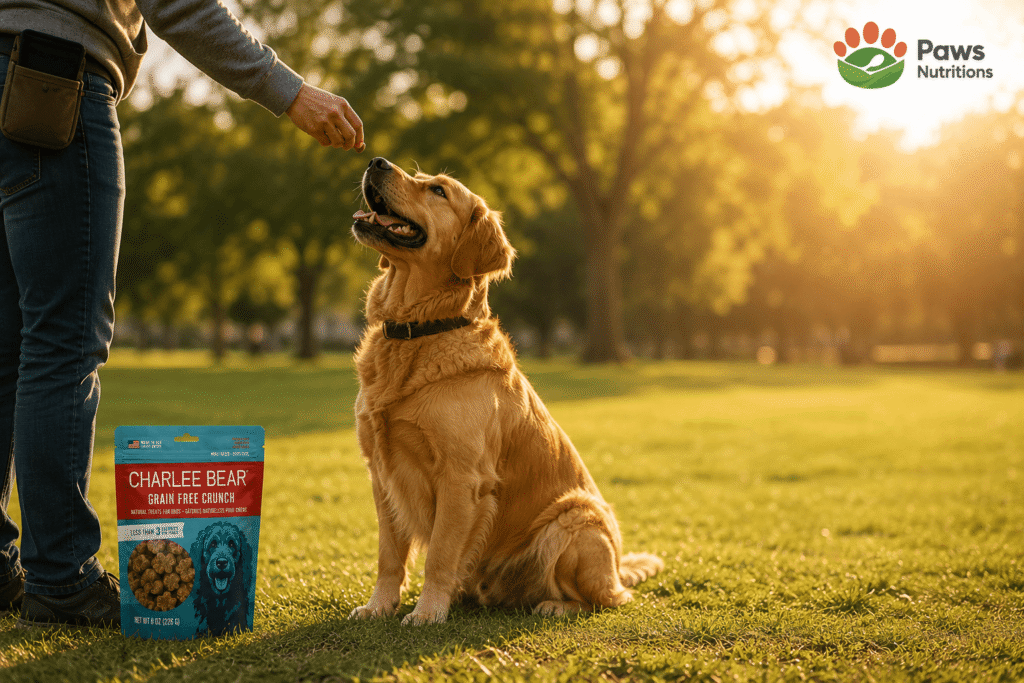
That said, no product is perfect. Owners looking for meat-first recipes may prefer the premium Meaty Bites line, while those who avoid legumes should pay closer attention to the ingredient lists in the Grain-Free Crunch collection. Fortunately, the brand offers enough variety that most dogs can find a suitable option.
If you’re searching for an everyday training treat that balances value, calorie control, and ingredient transparency, Charlee Bear is an easy recommendation. It may not be the most premium treat on the shelf, but it consistently delivers where it matters most for daily training and positive reinforcement.
Key Takeaways
- Excellent value, especially the Original Crunch line at roughly $9 per pound.
- Low-calorie treats (about 2–3 calories each) are ideal for frequent training.
- Multiple product lines offer options for different budgets and feeding preferences.
- One limited recall occurred in 2012, with no additional publicly reported recalls affecting current products.
- Premium freeze-dried treats provide stronger motivation but come at a significantly higher cost.
- Overall, the brand offers a strong balance of affordability, safety, and practicality for most dog owners.
Our Recommendation
Overall Rating: 8.8/10
Charlee Bear is an excellent choice for pet owners who want reliable, budget-friendly training treats with low calories and good ingredient transparency. For everyday obedience work, puppy classes, and routine positive reinforcement, the Original Crunch recipes offer the best overall value. If your dog needs a higher-value reward for advanced training, the Meaty Bites line is worth considering despite its premium price.

A dedicated writer and digital enthusiast committed to creating high-quality, informative, and reader-focused content. Through thoughtful research and clear communication, he aims to deliver valuable insights that help readers navigate the ever-changing digital landscape.